Kelim rugs: flatwoven pile-less craft of the Orient
The kilim is the pile-free woven rug of the Orient, reversible and lightweight. Overview of the main styles from Persia, Afghanistan, Anatolia and the Caucasus.
- Region
- Persia / Iran
- Category
- Kilim
- Manufacturing
- Hand-woven
- Knot density
- Flat weave (no knots)
Profile
- Manufacturing
- Hand-woven
- Origin
- Persia, Afghanistan, Turkey, Caucasus
- Pile material
- Flat weave (no pile)
- Knot density
- Flat weave (no knots)
- Features
- Reversible, lightweight, often geometric patterns, abstract symbolism
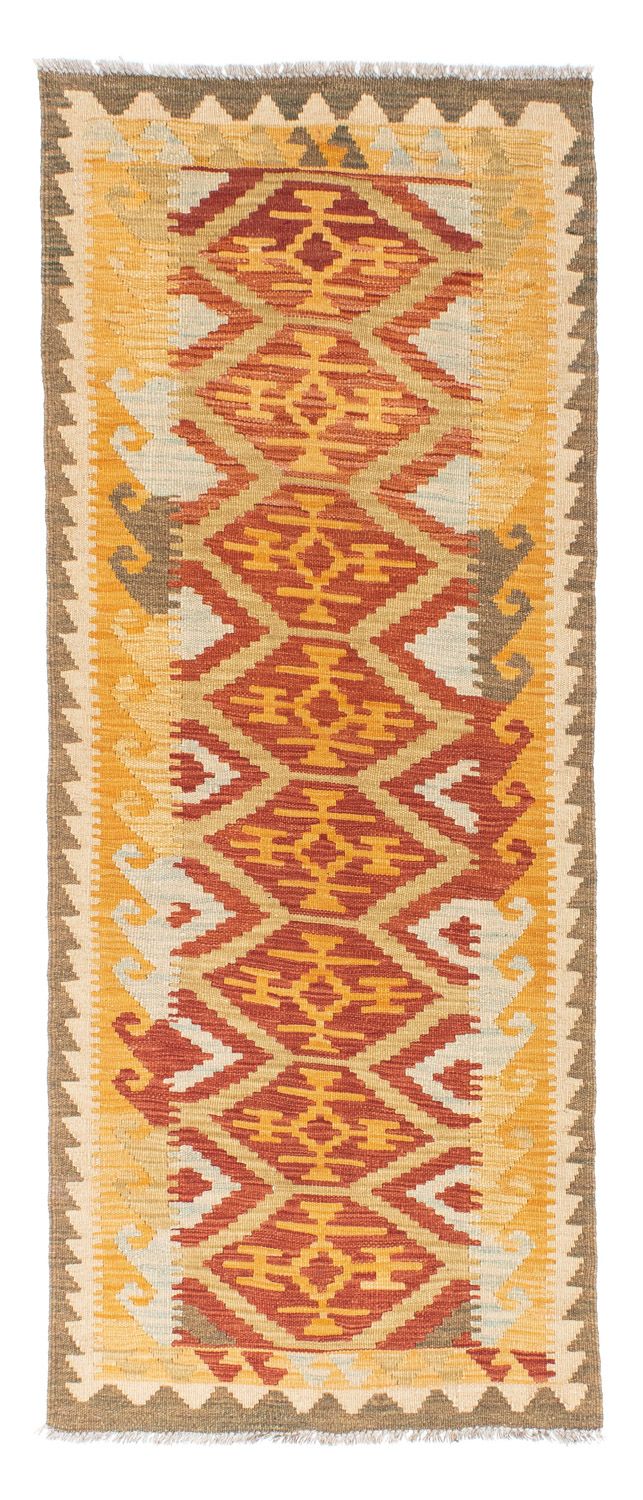
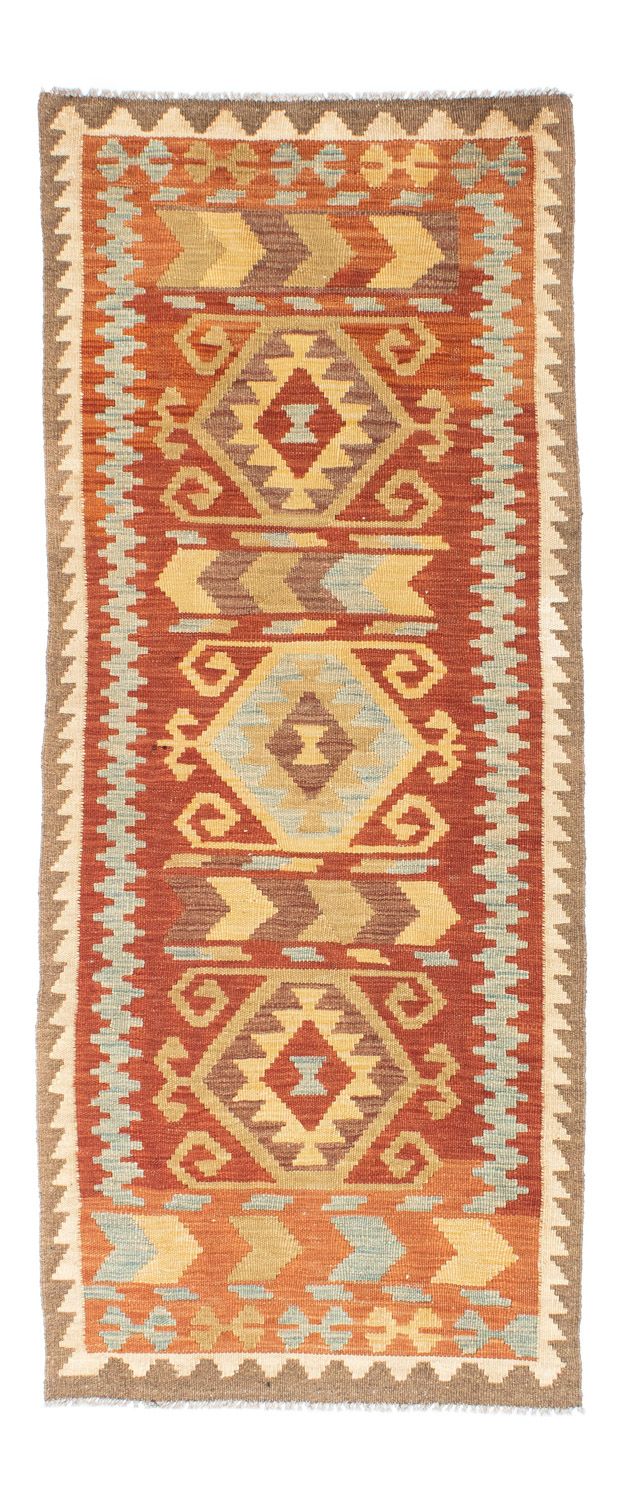
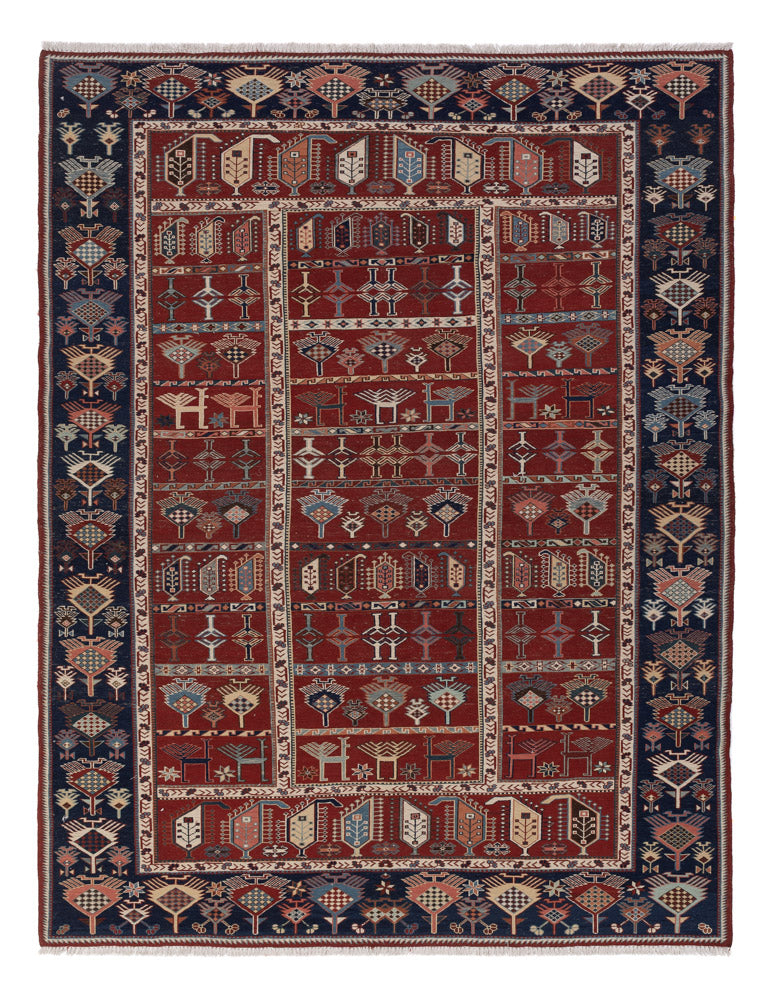
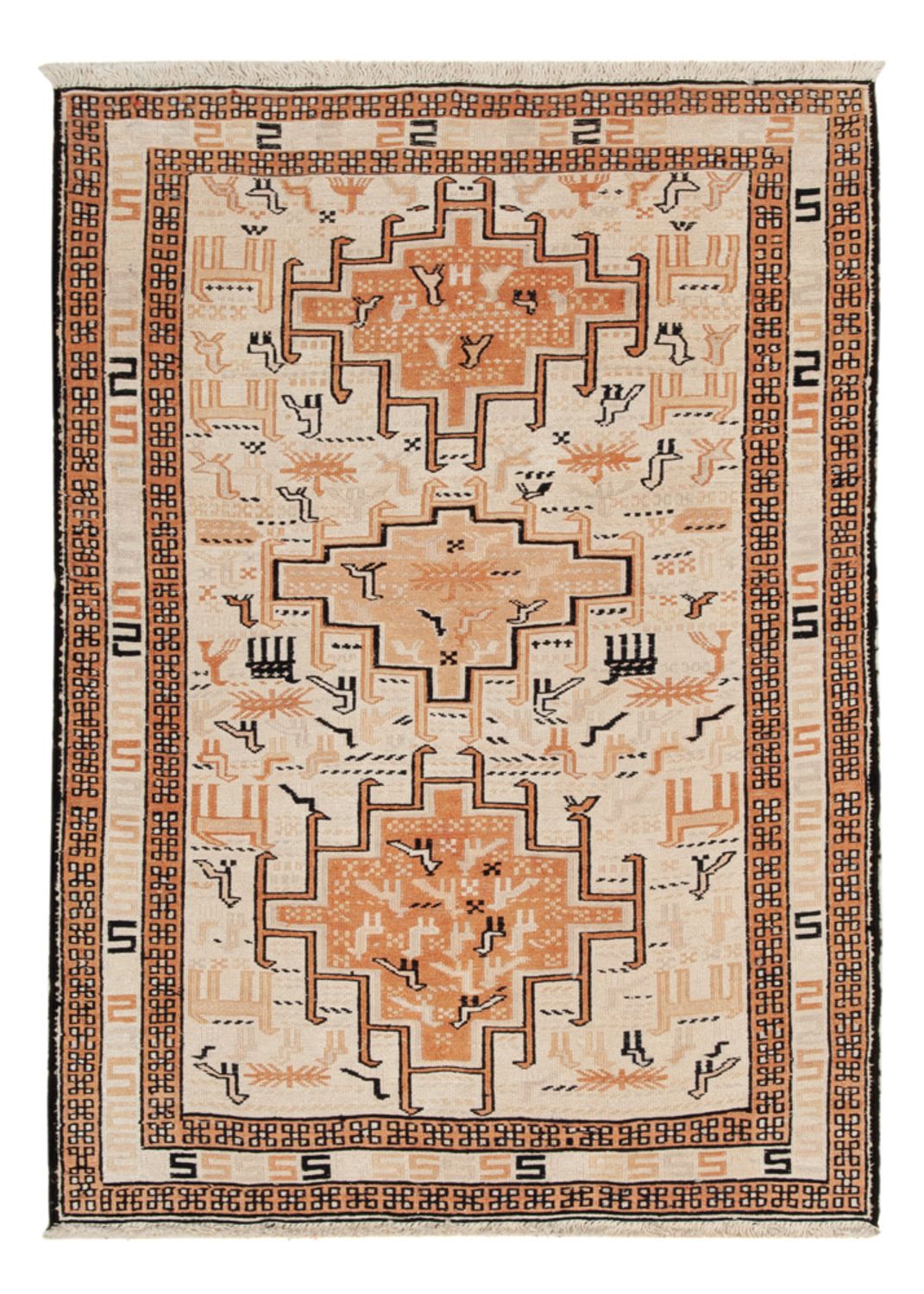
Photo: Morgenland Rugs
A kelim is a flatwoven, pile-less rug that is not knotted but woven from warp and weft threads. The term stands not for a single style but for a whole family of flatweaves that extends from the west of Anatolia through the Caucasus to Persia, Afghanistan and Central Asia. This style page places the most important kelim types and links to the individual provenances. A detailed introduction to technique and history is offered by the Kelim category overview.
What is a kelim?
A kelim is a woven rug without knots and without pile. Its pattern arises solely from coloured weft threads that are led in dense alternation over and under the stretched warp threads and cover the warp completely. Because no knotted pile is present, the surface remains flat, the weave thin and patterned almost identically on both sides. The kelim thus does not belong to the knotted but to the woven rugs, whose production is covered by the page on weaving in the section on manufacture.
The word kelim, Persian gelim, means as much as to weave flat or to spread out. Kelims count among the oldest textile products of humanity and were made by nomadic as well as settled peoples: as a sitting and sleeping pad, as a wall hanging, storage sack and saddle bag. The overview of all rug types is given by the rug types page.
Origin
Flatweaving is older than knotting. Before the pile knot was even invented, people made woven blankets and pads of wool. Finds from Anatolia, such as the wall paintings of Çatalhöyük from the seventh millennium BCE, show geometric weave patterns that strikingly resemble today's kelims. Through the Islamic world the technique spread in a continuous belt from North Africa to Central Asia.
In each region tribes and workshops shaped their own hand. From the southern Persian Fars come the powerful tribal kelims of the Qashqai and Lori nomads, from the Kurdish western Iran the fine weaves of Senneh, from northern Afghanistan the earthy Afghan kelims and the colourful market work from Maimene. Anatolian Türkiye contributes prayer kelims with mihrab niche, the Caucasus its dragon- and animal-filled diamond lattices. Many of these pieces arose in the environment of the nomad rugs.
Typical patterns and colours
Kelim patterns are almost always geometric. Because the weaving process is set on straight and slanting edges, diamonds, stars, hooks, combs, meanders and stylised animals dominate, while floral curves are rare and only suggested in fine workshops such as Senneh. Many motifs carry meaning: the hook wreath as protection, the ram's horn for fertility and strength, the scorpion for warding off. Unlike figurative city rugs, the kelim lives from an abstract, often archaic-feeling pictorial language.
The colour palette depends on the region. Southern Persian and Afghan kelims rely on warm earth tones, on rust red, terracotta, dark blue and undyed wool tones. Anatolian and Caucasian pieces work in higher contrast with clear reds, blues and ivory. Historically dyeing was done exclusively with natural dyes, with madder for red, indigo for blue and walnut husk for brown. The difference between plant and synthetic dyes is covered by the article recognising natural dyes.
Material and weaving technique
The warp of a kelim is stretched from strong virgin wool or cotton. The pattern-forming weft consists of dyed wool; on the most precious pieces of silk. There is no pile, because no wool knots are tied around the warp. Instead the weft thread runs in plain weave alternately over and under the warp threads and covers them completely. The weave is weft-faced, that is determined by the dense crosswise threads.
The pattern arises by leading each colour weft only within its own field back and forth. Where two fields meet vertically, a small slit remains, which gives slit tapestry its name. This slit is not a flaw but the most certain authenticity marker of a classical kelim. Slits that grow too long are avoided by interlocking the wefts, the so-called dovetailing, or by discreet stitching. Because the kelim lacks the heavy wool pile, it is lighter than a knotted rug, foldable and fully reversible. The fringes are the extended warp threads, not sewn on afterwards.
Weave density and quality
Instead of a knot count, the fineness of a kelim is described over the weft density, that is the number of weft threads per centimetre, as well as over the fineness of the yarns and the cleanliness of the edges. The denser and more evenly the weft is beaten in, the more precisely patterns can be drawn and the more stably the weave lies. Coarse nomadic market work shows a loose weft and larger fields; fine provenances such as Senneh reach a dense, almost rug-like structure with small-scale patterns.
Beyond weave density, wool quality, yarn processing and dyeing decide the rank of a piece. Hand-spun wool with natural lanolin content, saturated natural colours with lively abrash and straight, firmly set edges mark a good weave. Since the kelim has no pile to conceal wear, irregularities stand out here more clearly than on a knotted rug, which makes handcraft care all the more important.
Kelim types compared
| Type | Origin | Weave density | Typical features |
|---|---|---|---|
| Kelim Fars | southern Iran, Qashqai and Lori | medium-fine to coarse | bold tribal motifs, warm earth tones |
| Kelim Senneh | Sanandaj, western Iran (Kurdish) | very fine, extremely dense | boteh and Herati patterns, precise slit tapestry |
| Kelim Afghan | northern Afghanistan | medium to coarse | stripes and diamonds, deep reds |
| Kelim Maimene | Faryab, northern Afghanistan | medium to coarse | Turkmen güls, lively reds and blues |
| Kelim silk | Hereke, Kashan, Kashmir | finest structure | silk weft, high lustre, decorative pieces |
| Anatolian kelim | Türkiye | medium to fine | mihrab niche, star medallions, clear colours |
What is a kelim worth?
The value of a kelim is determined by fineness of weaving, purity of the natural colours, age, preservation and design quality. A fine Senneh kelim or an old Anatolian prayer kelim fetches considerably more than coarse market work, and pure silk kelims stand at the top. Young, commercially woven pieces of sheep's wool, by contrast, move in the affordable range and are bought above all as robust utility pieces. A placement of why handwork commands its price is given by why genuine rugs are expensive; the influence of the dyes is covered by natural dyes against chemical dyes. Before purchase a look at the buying guide is worthwhile.
How do you recognise a genuine kelim?
A genuine, hand-woven kelim shows several clear features:
- Slits at the colour borders: Small vertical openings where two colour fields meet are the most certain sign of true slit tapestry.
- Identical pattern on both sides: Front and back look almost identical; the kelim is fully reversible.
- No pile: The surface is flat and smooth; there is no velvety pile and no visible knot rows.
- Fringes as warp ends: The fringes are the extended warp threads, not sewn on afterwards.
- Handwork and abrash: Slightly wavy edges, hand-spun wool and the natural colour shift abrash speak for an authentic piece.
Machine-woven imitations, by contrast, read as perfectly even and often show adhesive layers or continuous threads on the back. The full guide is set out under is my rug genuine? in the section recognising an oriental rug.
Care
Kelims are thin and easier to handle than knotted rugs but react more sensitively to wetness, because the flat structure rapidly takes up liquid. In everyday use careful regular vacuuming with reduced suction and switched-off brush roll suffices; many pieces can also simply be shaken out. Small stains are treated with a slightly damp cloth and a mild agent; larger soilings belong in professional cleaning. Turn the kelim regularly; that distributes the wear across both sides. The full routines are set out in the care overview.
Frequently asked questions
Is a kelim a real rug?
Yes. A kelim is a full, traditionally hand-made rug, only woven rather than knotted. It has no pile, its pattern arises through coloured weft threads, and it is patterned almost identically on both sides. It is therefore thin, light and reversible. The technique is widespread from Morocco to Central Asia and older than knotting.
What is the difference between a kelim and a knotted rug?
A knotted rug has a pile of individual wool knots and is usable only on one side. A kelim has no pile and no knots but arises through interwoven weft threads. It is thin, flat and patterned identically on both sides. Therefore geometric patterns dominate on the kelim, while floral curves are rare.
Which kelim is the finest?
The Kelim Senneh from Sanandaj traditionally counts as the finest Persian kelim with extremely dense weaving. Among the silk weaves, the silk kelims from Hereke and Kashan exceed it in detail richness and lustre.
Where do kelims come from?
Kelims come from a large belt from Morocco through Türkiye and the Caucasus to Persia, Afghanistan and Central Asia. Well-known types are the southern Persian Kelim Fars, the fine Kurdish Kelim Senneh, the earthy Kelim Afghan and the Anatolian prayer kelims of Türkiye.
Can one turn a kelim?
Yes. Since the kelim has no pile and is patterned almost identically on both sides, it can be turned fully. Regular turning distributes wear evenly and extends the lifespan.
Are the slits in the kelim a flaw?
No. The vertical slits arise through traditional slit tapestry, in which each colour weft runs only in its field. They are the most certain authenticity marker, not a defect. Slits that grow too long are interlocked during weaving or discreetly stitched afterwards.
How do I care for a kelim properly?
Vacuum the kelim carefully with reduced suction and switched-off brush roll; smaller pieces can also be shaken out. Treat small stains with a slightly damp cloth and a mild agent; have larger soilings cleaned professionally, since the thin structure quickly becomes soaked through. A non-slip underlay protects on smooth floors.
Related styles
Fars Kilim
Fars kilims are flat-woven by Qashqai nomads in southern Iran and show vivid tribal motifs in a graphic style.
Afghan Kilim
Afghan kilims are flat-woven by Turkmen and Uzbek weavers in northern Afghanistan and stand out with their geometric stripes.
Senneh Kilim
Senneh kilims from Iranian Kurdistan are among the finest flat-woven rugs, exceptionally thin and finely worked.
Maimana Kilim
Maimana kilims are flat-woven in northern Afghanistan and are known for their bold red, blue, and ivory stripes.
Silk Kilim
Silk kilims are flat-woven from pure silk and are among the most refined flat weaves, luminous and finely detailed.


