Isfahan rugs: finest manufactory craft from the Safavid city
Isfahan rugs from the former Safavid capital are considered the pinnacle of Persian rug knotting, exceptionally fine and elegant.
- Region
- Persia / Iran
- Category
- Persian rugs
- Manufacturing
- Hand-knotted
- Knot density
- 400,000 – 1,000,000 knots/m²
Profile
- Manufacturing
- Hand-knotted
- Origin
- Iran — Isfahan Province
- Pile material
- Kurk wool on cotton, finest on silk
- Knot density
- 400,000 – 1,000,000 knots/m²
- Features
- Very fine knotting, silk warp, central medallion, floral motifs
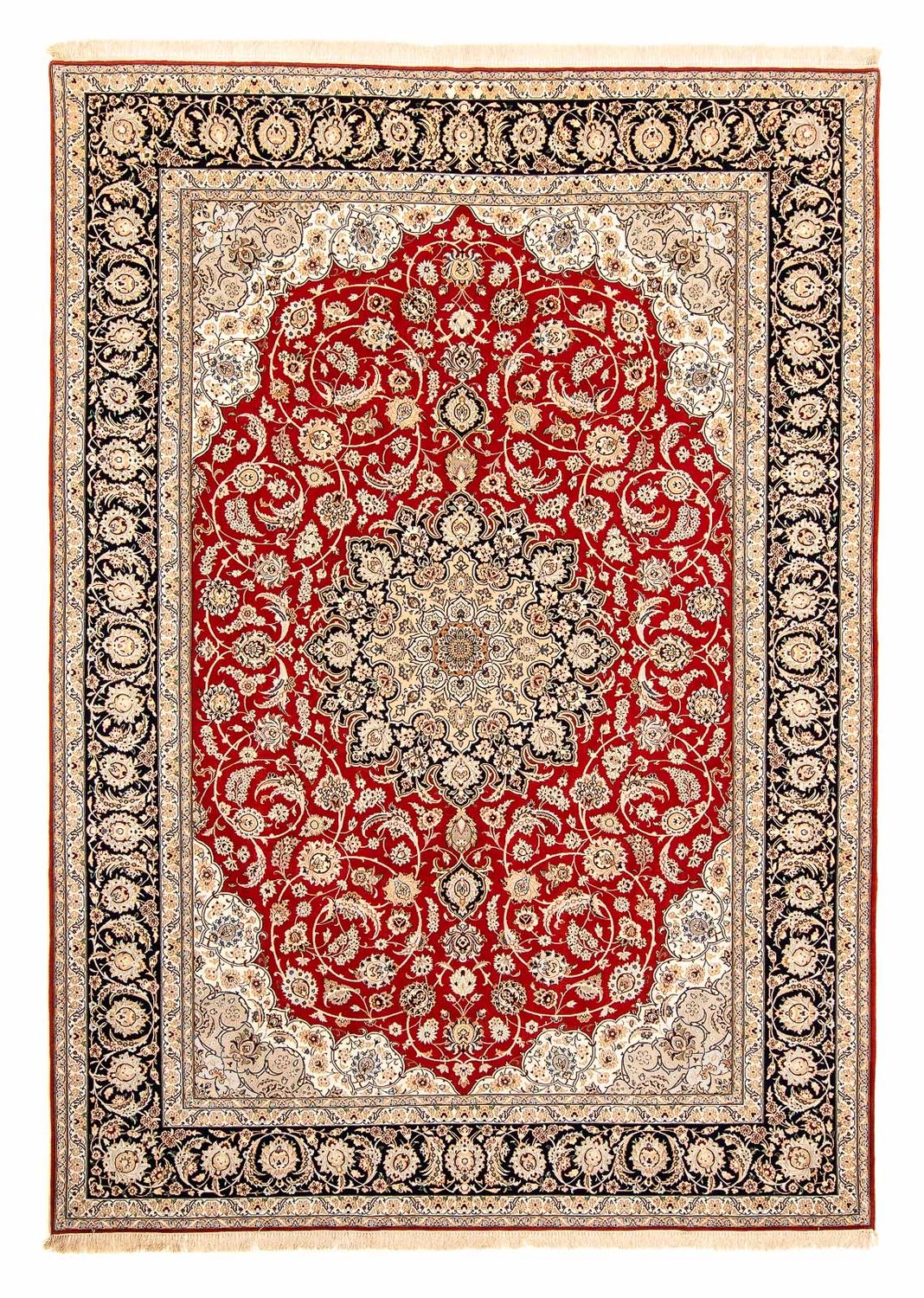
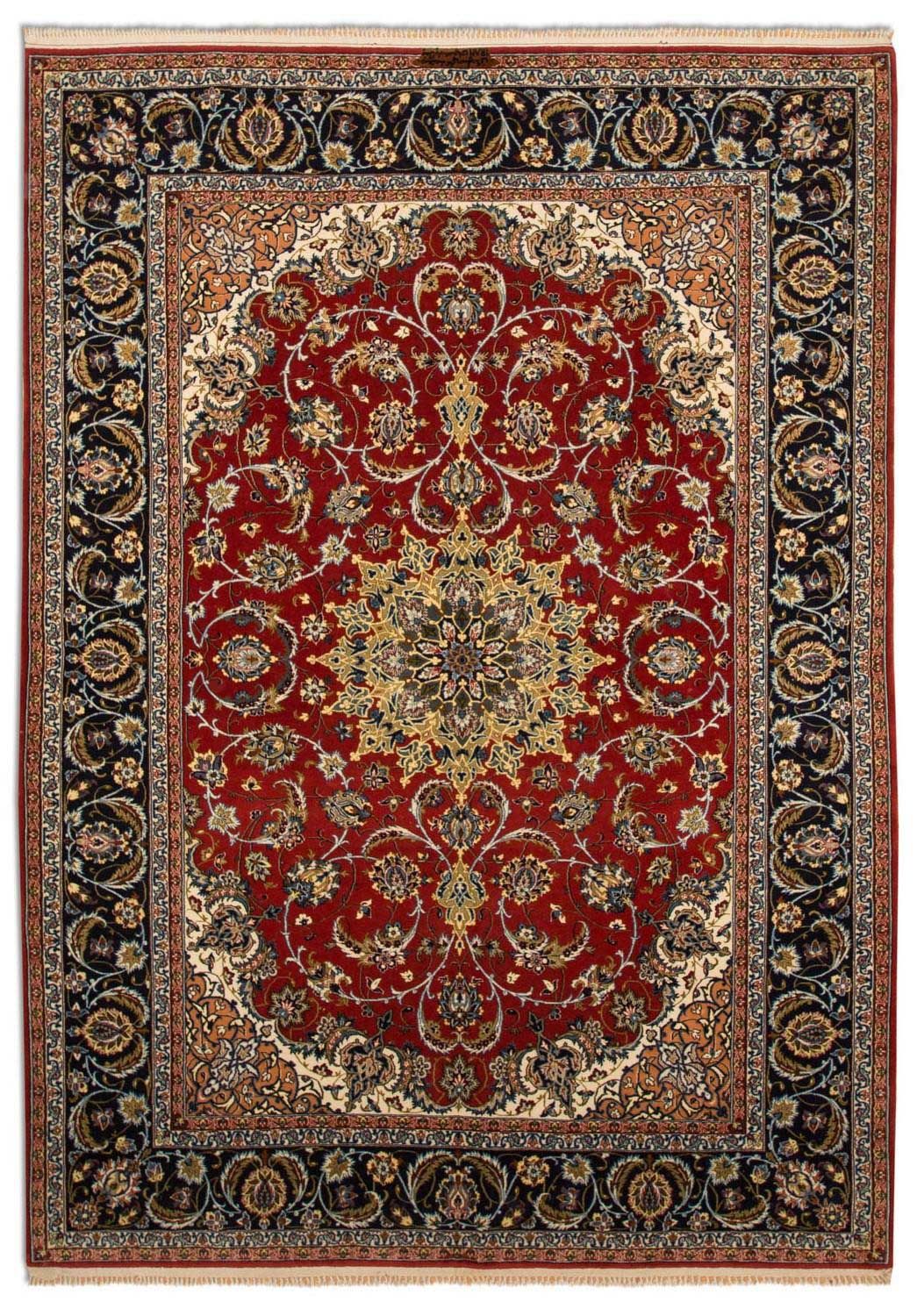
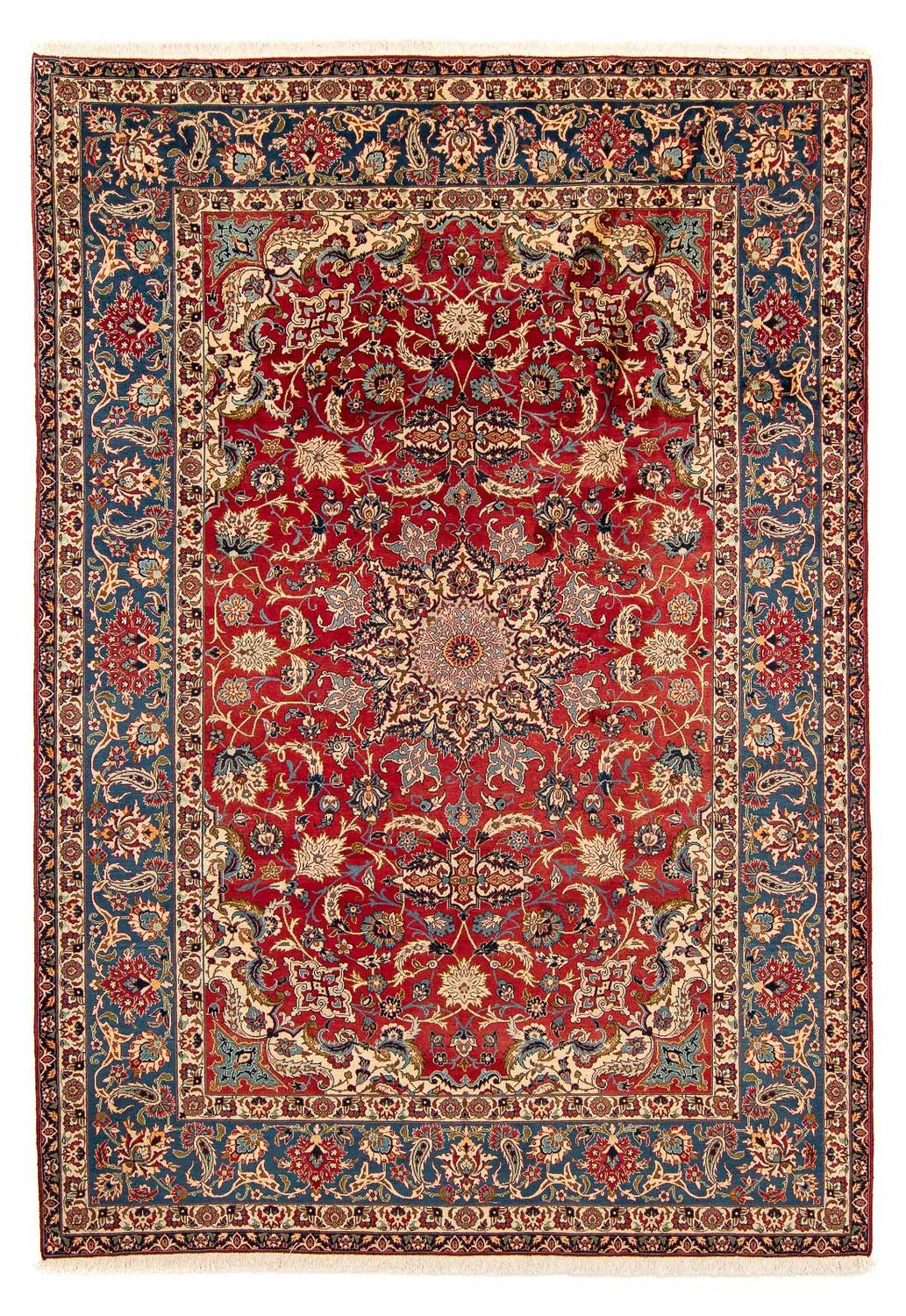
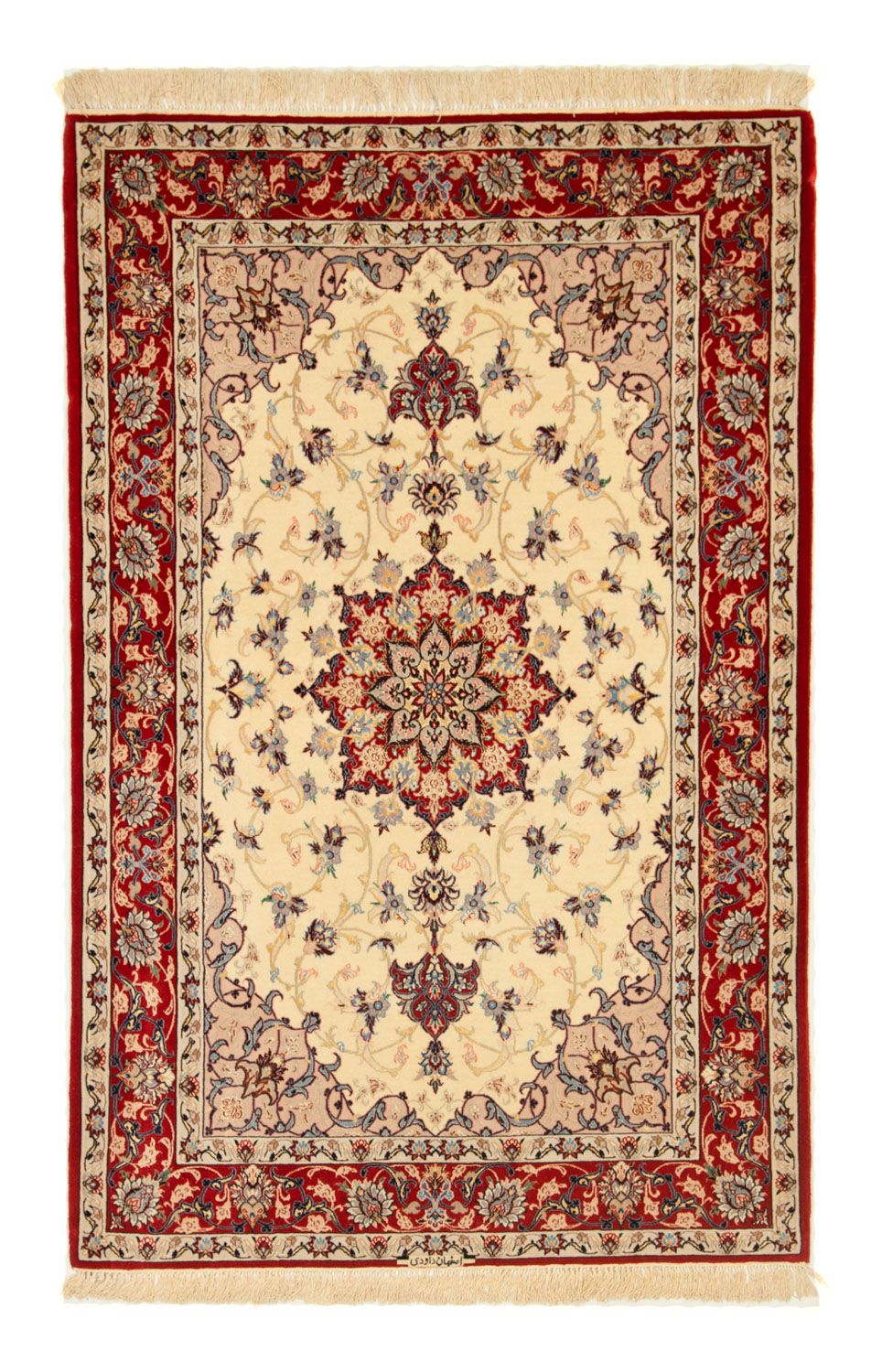
Photo: Morgenland Rugs
Isfahan rugs come from the central Iranian city of Isfahan, whose court manufactories wove for the shah under the Safavids. Fine pieces reach over a million knots per square meter, frequently carry the signature of the workshop that made them, and belong in the top class of Persian rugs. Anyone shopping for an Isfahan, though, will meet rugs from Najafabad and Indian-made Indo-Isfahan just as often as the real thing.
What is an Isfahan rug?
An Isfahan is a hand-knotted workshop rug from the city of Isfahan in central Persia. Workshop rug means the design is drawn out on paper first and the weavers follow that cartoon, rather than working a pattern from memory as village and nomad weavers do. Knotting is done with the asymmetric Persian knot on a warp of cotton, and on silk in the finest pieces. The pile is kork wool, the soft wool from the neck of young sheep, often supplemented by silk contours in individual pattern elements. Usual knot densities run from 400,000 to over a million knots per square meter.
Origin: the city of Isfahan and the Safavids
Isfahan lies roughly 340 kilometers south of Tehran in central Persia, where the old trade routes crossed. Under Shah Abbas the Great, around 1600, the city became the capital of the Safavid empire. The royal manufactories of that period produced court rugs in silk and metal thread, and their floral vocabulary still governs the Isfahan style today. The great central square, Naqsh-e Jahan, is a UNESCO World Heritage Site.
Production broke off with the fall of the Safavids in the 18th century. It came back in the 1920s and 1930s, when the first of the workshops still known today were set up in Isfahan, and reached its high point in the 1960s and 1970s. Those decades supplied most of the signed pieces now in circulation.
Pattern, color, and composition
The patterning is floral throughout: stylized palmettes, arabesques, and Shah Abbas vines, almost always laid around a central medallion and mirrored in the corner spandrels. The composition is strictly symmetric, and the borders run in several graduated tiers. Every square centimeter looks fully composed, and open ground is rare.
Ivory and the deep Isfahan blue serve as ground colors. The finest signed pieces in particular stand on an ivory ground, while red, beige, and gold tones carry the drawing, finely graduated and without hard contrasts. The pile is sheared low, which brings the drawing out more sharply and gives the surface a silky shimmer.
That curvilinear discipline is what separates the Isfahan from geometric village and nomad rugs such as Hamadan or Heriz. Within the floral city rugs, Keshan and Sarough stand closest to it.
Material and knotting technique
Warp and weft are usually cotton. In top qualities the warp is drawn from silk, which you can read straight off the fringes. The pile is kork wool, or mulberry silk in the silk versions. In wool rugs, silk mostly does accent work: contours and the centers of blossoms.
Knotting is done with the asymmetric Senneh knot. It encircles one warp thread fully and the second only partly, and that is what permits a finer pattern resolution than the symmetric Turkish knot allows. The sequence from warp preparation through to the final shearing is described in the section on production, the fiber science in the section on materials.
Knot density and quality
Knot density is the quality feature of an Isfahan that is easiest to check for yourself. Below 500,000 knots the fine gradations inside the blossoms look stepped, although the drawing itself stays clear; in finer qualities those transitions run smoothly into one another. The place to look first is the centers of the blossoms and the outlines of the medallion, where a designer has the least room to work.
Unlike Tabriz with its raj system, or Nain with its la grades, the fineness of an Isfahan is stated as a plain knot count per square meter. What that number tells you and what it does not is set out in Knot density explained.
| Quality | Knots/m² (approx.) | Material | Features |
|---|---|---|---|
| Standard | 400,000 to 500,000 | kork wool on cotton | clear floral drawing, good quality in use |
| Fine | 500,000 to 700,000 | kork wool with silk contours | detail-rich vines, silky shimmer |
| Very fine | 700,000 to 1,000,000 | kork wool and silk, some on silk warp | finest shadings, often signed |
| Masterpiece | over 1,000,000 | silk or kork-silk on a silk warp | collector quality, workshop signature |
What determines the value of an Isfahan rug?
Four things set the value of an Isfahan: the knot density, the material in pile and warp, provenance from the city itself rather than from Najafabad or India, and a genuine workshop signature. Size, age, and condition come on top of those.
The signature carries the most weight. A signed piece from a known workshop sits well above an unsigned rug of the same fineness. The names that move the market are almost all from the 20th century: Seirafian, Haghighi, Davari, and Akbar Mahdie.
How long a single rug takes cannot be stated seriously in months per square meter. On large formats several weavers work at the loom side by side, and the pace depends heavily on how experienced they are. The reverse statement is the reliable one: the finer the knotting, the more rows of knots per centimeter, and the longer the work.
Whether an Isfahan works as an investment depends on rarity, condition, and provenance. There is no guarantee of appreciation. For placing a piece, Recognizing valuable Persian rugs, the value overview, and the buying guide all help. Current pieces with dimensions are shown in the Isfahan selection at Morgenland Teppiche.
How do you recognize a genuine Isfahan rug?
You recognize a genuine Isfahan by the fine, even back, by fringes that run out of the weave as extended warp threads, by the low-sheared pile of kork wool, and frequently by a knotted-in signature in Persian script.
- Back: The floral pattern reads sharply from the reverse as well, and the individual knots sit very small and very evenly.
- Fringes: They are the extended warp threads and are not sewn on. On a silk warp they come out fine and lustrous, on a cotton warp matte. This is the quickest pointer to the quality class.
- Knot: The asymmetric Senneh knot encircles one warp thread fully and the second only partly, and it is the precondition for the fine drawing.
- Pile: Sheared low, silky shimmer, silk usually confined to contours and the centers of blossoms.
- Signature: Many high-grade Isfahans carry a knotted-in workshop signature in Persian script, usually in a cartouche at the upper border.
- Composition: Isfahan blue or ivory ground, central medallion, dense vine work, mirrored corner spandrels.
The commonest question in the showroom is not the one about fakes, but the one about mix-ups. Najafabad lies barely 30 kilometers west of Isfahan and works in the same style; Indo-Isfahan is knotted in India after Persian models. Both are respectable rugs, but neither comes from the city. A step-by-step guide is given in Is my rug authentic?, and the basics are under Recognizing an oriental rug.
Isfahan, Nain, Ghom, Najafabad, and Indo-Isfahan compared
Mix-ups happen with four provenances in particular. They differ clearly in origin, material, and fineness.
| Provenance | Origin | Pile and warp | Knot density | Telltale |
|---|---|---|---|---|
| Isfahan | city of Isfahan | kork wool on cotton, finest on silk | 400,000 to over 1,000,000 | Isfahan blue, Shah Abbas vines, often signed |
| Nain | Nain, Isfahan province | wool on cotton with silk inlays | 200,000 to over 1,000,000 | deliberately restrained palette, la grades |
| Ghom | city of Ghom (Qom) | often silk on silk | 300,000 to over 1,000,000 | frequently all silk, also figural patterns |
| Najafabad | Najafabad, Isfahan province | wool on cotton | 150,000 to 350,000 | modelled on Isfahan, more coarsely worked |
| Indo-Isfahan | India, after Persian models | wool on cotton | 200,000 to 500,000 | Isfahan pattern, knotted in India |
Caring for an Isfahan rug
An Isfahan takes regular vacuuming in the pile direction without complaint. What does harm it: steam cleaners, carpet foam from the hardware store, and years of direct sun on the same spot, which bleaches the natural dyes. Blot stains at once with clear water and do not rub. Where there is silk in the rug, washing belongs with a specialist firm. Detailed guidance is given in the care overview.
Frequently asked questions
Why are Isfahan rugs so expensive?
The same four factors that set the value: the fineness of the knotting, from 400,000 to over a million knots per square meter, the material in pile and warp, provenance from the city itself, and a genuine workshop signature. A signed piece sits well above an unsigned rug of the same fineness.
How do I recognize a genuine Isfahan?
By the extremely fine, even back, the asymmetric Senneh knot, and the low-sheared pile of kork wool with silk contours. The fringes give away the class: fine and lustrous on a silk warp, matte on a cotton warp. Beyond that, look for the ivory or Isfahan blue ground, the central medallion, and frequently a signature in Persian script at the upper border.
What is the difference between Isfahan and Nain?
Both come from Isfahan province and both are very finely knotted. Nain works with a deliberately restrained palette of beige, ivory, and a few blues, sets silk inlays as contours, and is classified in la grades. An Isfahan uses the full range, from deep Isfahan blue through red to gold, draws bolder floral patterns, and is described by plain knot count.
What is the difference between Isfahan and Ghom?
Ghom lies a good 230 kilometers north and is the address for all-silk rugs: there, pile and warp are frequently both silk. An Isfahan is at heart a wool rug in kork wool, with silk coming in as contour and, in top pieces, as warp. Ghom also shows figural motifs more often.
What is a Najafabad?
A rug from the town of Najafabad, barely 30 kilometers west of Isfahan, knotted in the Isfahan style with floral medallions. Knot density sits clearly lower at 150,000 to 350,000 knots, and the pile is wool on cotton. Solid rugs, but to be kept plainly apart from an Isfahan in the trade.
Are there also Indian Isfahan rugs?
Yes. Indo-Isfahan rugs are knotted in India after Persian models and reach 200,000 to 500,000 knots per square meter. They do not reach the fineness and material quality of the Iranian originals. Reputable dealers label them accordingly.
Are all Isfahan rugs made of silk?
No. Most consist of kork wool on a cotton warp, often with silk contours. Pure silk rugs and pieces with a silk warp are among the finest and rarest variants, but they are not the rule.
How do I properly care for an Isfahan rug?
Vacuum regularly in the pile direction and leave the cleaning to a specialist firm as a hand wash. Avoid direct sun, blot stains at once with clear water, and do not rub. With silk-blended pieces, always bring in a specialist.
Impressions of the origin
Places, landscapes and landmarks around the home of Isfahan rugs. Click any image for a larger view.
Master weavers
These masters and workshops have shaped the Isfahan tradition.
Related styles
Nain
Nain rugs from the desert town between Isfahan and Yazd are exceptionally fine and known for their cool ivory-and-blue palette.
Qom
Qom rugs from the holy city are among the finest Persian rugs and are particularly prized in pure-silk versions.
Tabriz
Tabriz rugs are among the most refined Persian carpets, known for their finely knotted designs and remarkable variety of patterns.


