Heriz rugs: geometric medallions from East Azerbaijan
Heriz rugs from northwestern Iran are known for their bold geometric medallions and exceptional durability.
- Region
- Persia / Iran
- Category
- Persian rugs
- Manufacturing
- Hand-knotted
- Knot density
- 60,000 – 160,000 knots/m²
Profile
- Manufacturing
- Hand-knotted
- Origin
- Iran — Heris region, East Azerbaijan Province
- Pile material
- Wool on cotton
- Knot density
- 60,000 – 160,000 knots/m²
- Features
- Geometric central medallion, very durable, bold reds
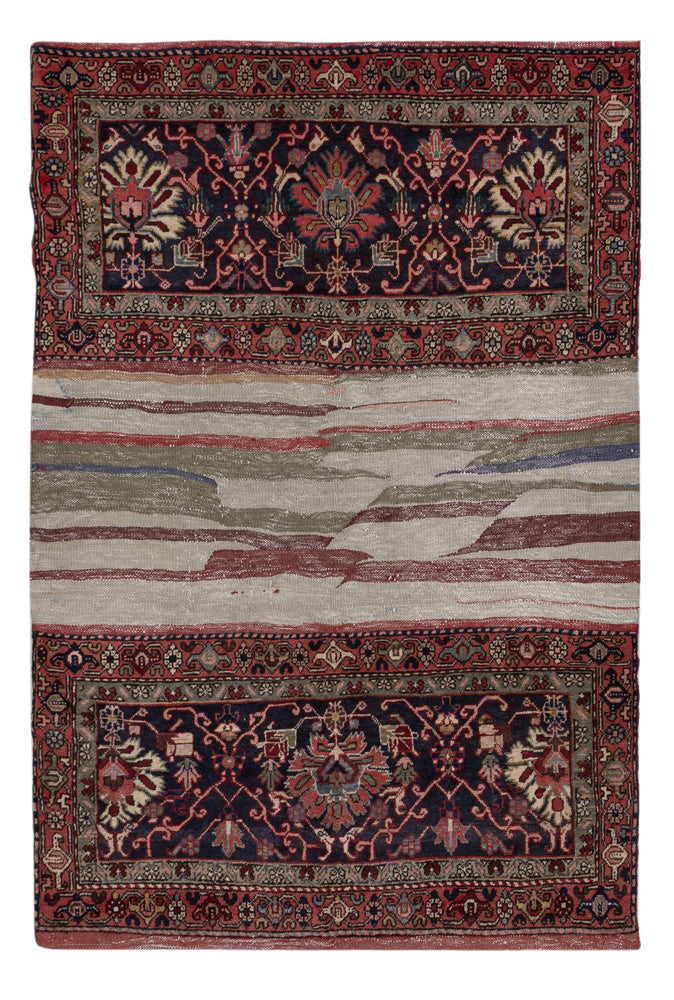
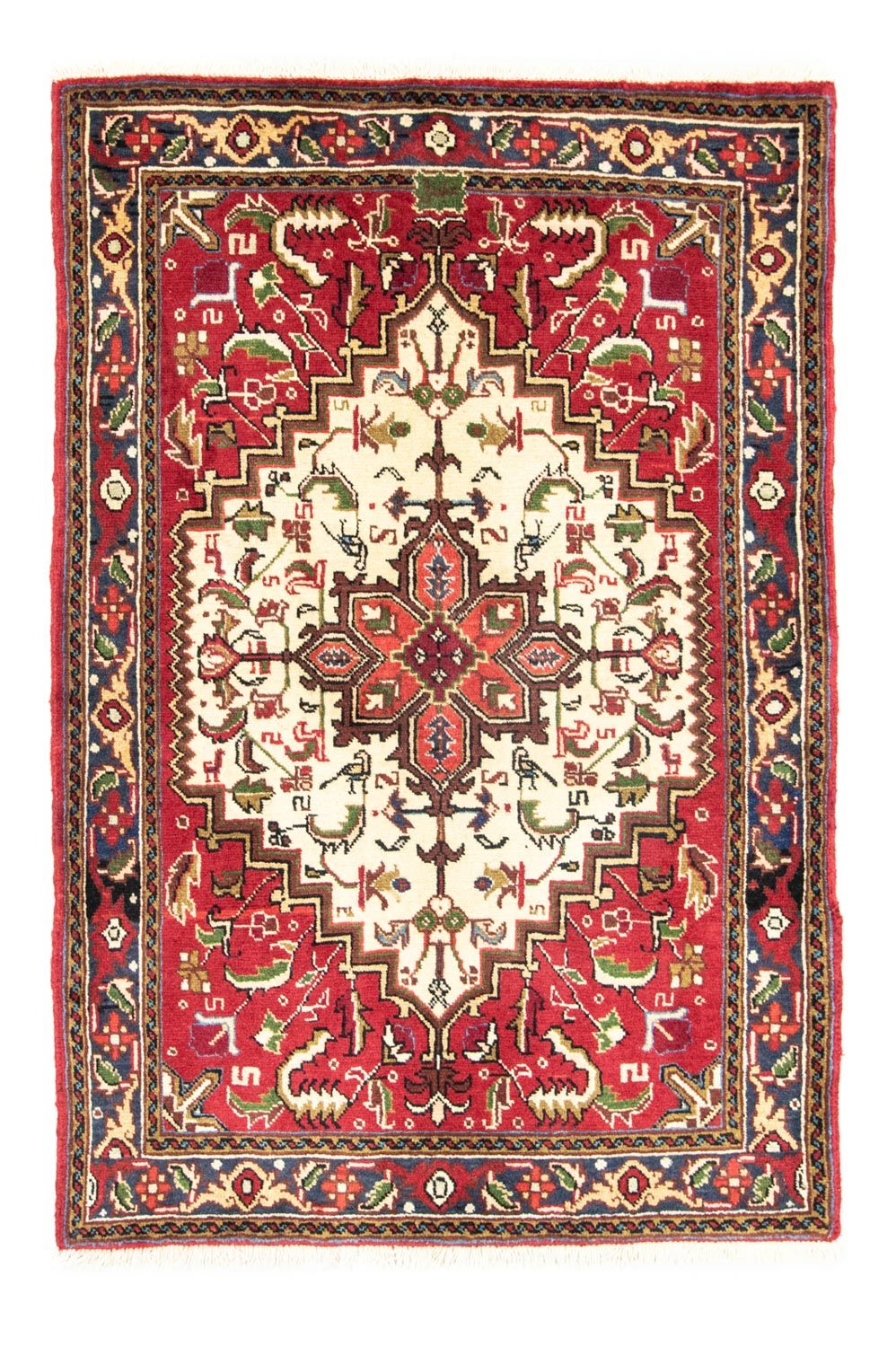
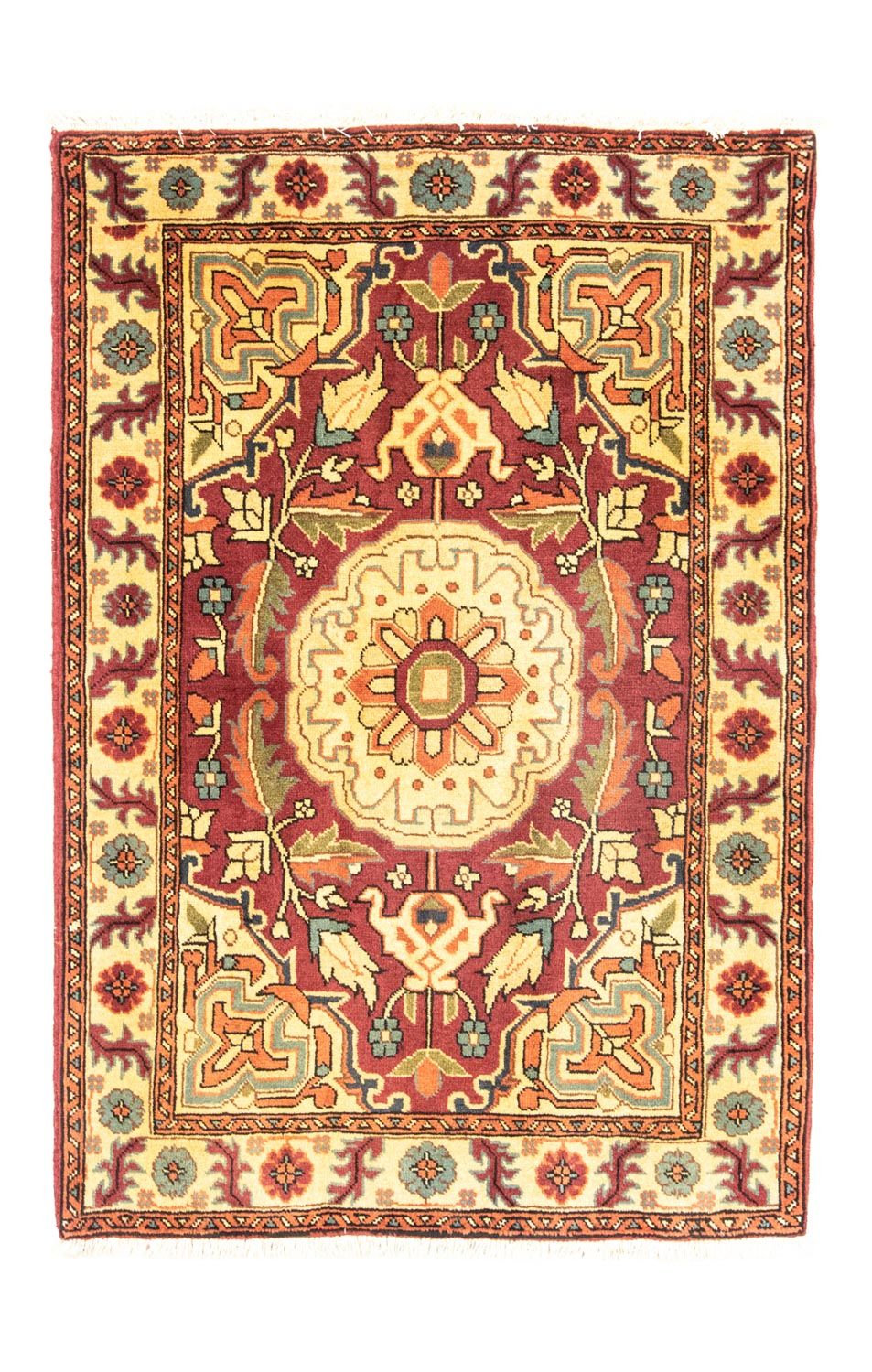
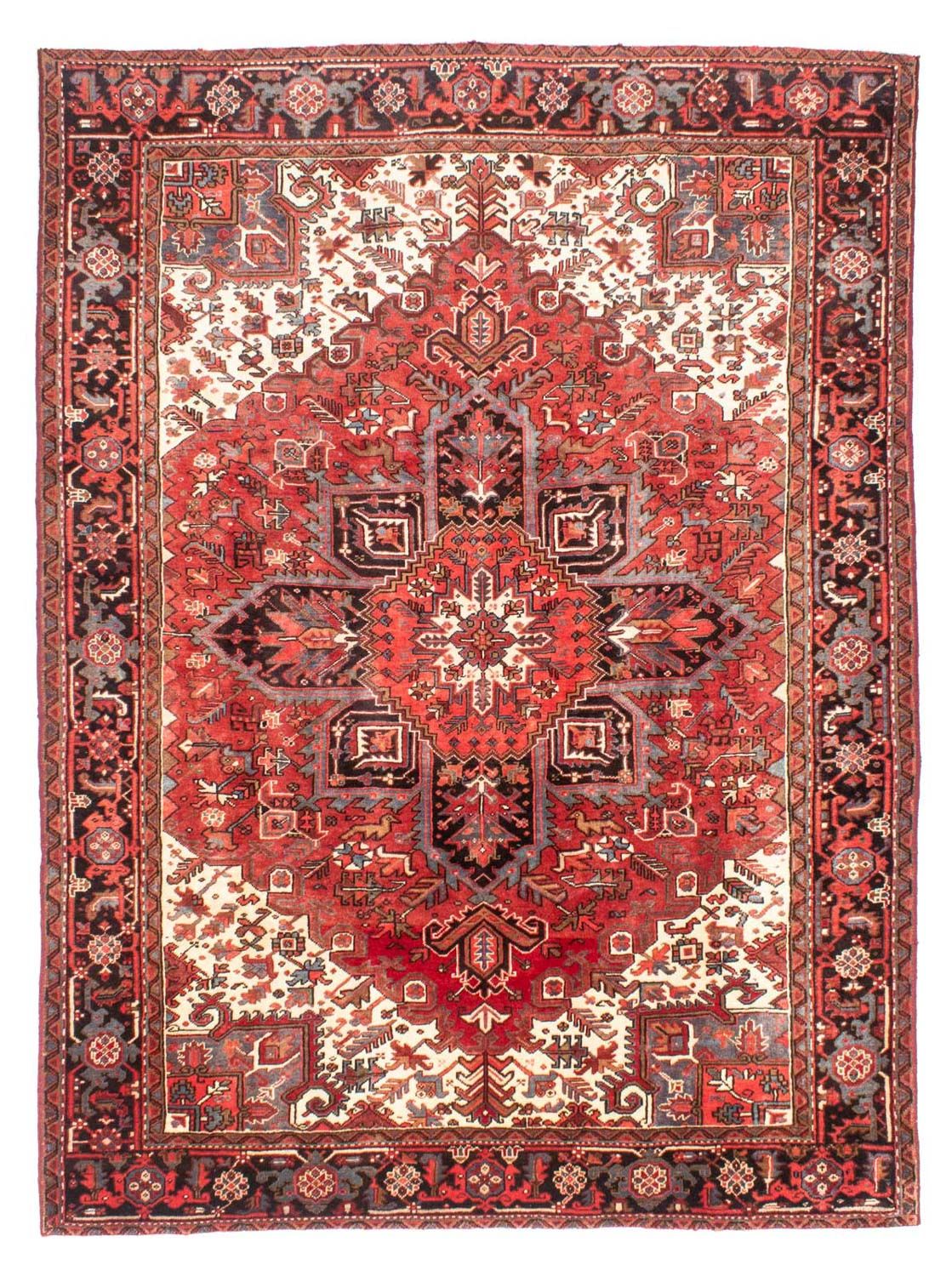
Photo: Morgenland Rugs
Heriz rugs are hand-knotted Persian rugs from the north-west of Iran, known for their large geometric medallion, their earth-bound colours and an exceptionally robust structure. They come from a mountainous region in the province of East Azerbaijan and belong among the best-known village-influenced Persian rugs of all. Anyone looking for a classical oriental rug for a heavily used living room almost inevitably arrives at the Heriz, because hardly any other Persian knotting style combines striking design and daily-suitability so convincingly.
What is a Heriz rug?
A Heriz is a hand-knotted rug from the town of Heriz and its surrounding villages in the east of the Iranian province of Azerbaijan. Characteristic are the large, angularly drawn central medallion, the geometric vocabulary, a wool pile on a cotton warp and the symmetric Turkish knot. Unlike the curvilinear manufactory patterns from Isfahan or Nain, the Heriz follows no detailed cartoon but a village knotting tradition, in which the patterns arise from memory and through handed-down corner templates. From this comes the typical, slightly angular character that makes the Heriz so unmistakable.
The name Heriz stands at once for the particular provenance and for a whole style family. In the trade, geometric medallion-emphasised rugs from the entire knotting area east of Tabriz are often referred to in general as Heriz, even when they strictly speaking come from one of the neighbouring villages.
Origin: the town of Heriz and the knotting area east of Tabriz
Heriz lies about 60 kilometres east of Tabriz at the foot of the Sabalan massif, in a rough, high-lying landscape of the province of East Azerbaijan. Rug knotting in this region can be traced back to the 18th century and developed over the course of the 19th century into one of the most important centres for geometric Persian rugs. Above all in the second half of the 19th century, the large-format, vigorously patterned salon rugs arose here that still shape the reputation of the style today and were strongly in demand on the international market.
The knotting area comprises, alongside Heriz itself, several well-known places with their own profile. Mehraban and Sarab stand for solid, often somewhat more coarsely knotted goods; Ahar and the closely related type Garawan for striking, generously drawn medallions; and the place Qaraja in the north of the area for smaller-format pieces with their own pattern vocabulary. The finest quality of this family carries the collective name Serapi, a historical trade label for particularly well-proportioned, clearly drawn Heriz rugs of the late 19th and early 20th century.
The region was struck several times by earthquakes, which temporarily interrupted production. The knotting tradition has nevertheless been preserved and continues to this day. Stylistically the Heriz stands close to neighbouring Tabriz, but remains markedly more geometric, while the famous Tabriz master Haji Jalili shows how fine the north-west Persian knotting art could become in the same period.
Patterns and colours
The defining feature of a Heriz is the large, often octagonal or diamond-shaped central medallion with extending pendants at the points. It sits on a densely filled field of stylised flowers, jagged vines and angular leaf forms, framed by four vigorously drawn corner spandrels. These corner spandrels often repeat the colour scheme of the medallion and give the Heriz its characteristic, almost architectural severity.
Typical alongside is the earth-bound palette: a warm brick to rust red as base tone, with deep indigo blue in the medallion, bright ivory in the corner spandrels and accents in green, yellow or muted pink. The border is usually built in three parts, with a wide main border full of palmettes, vine work or geometricised flower motifs and two accompanying narrow guard borders. Because the weavers work without an exact cartoon, the two halves of a Heriz often deviate minimally from one another. These small irregularities are not a defect but a mark of authentic village handwork.
Material and knotting technique
The warp of a Heriz is traditionally cotton, which gives the rug dimensional stability and a firm stance. The pile is knotted of virgin wool from the local highland flocks, which because of its high lanolin content is especially hard-wearing and dirt-repellent. This robust mountain wool is one of the reasons why Heriz rugs withstand decades of use.
The Heriz is knotted with the symmetric Turkish knot, also called the Ghiordes knot. The knot thread wraps both warp threads completely, which yields a particularly firm, dimensionally stable binding and fits well with the angular, geometric pattern language. This choice distinguishes the Heriz from most central and eastern Persian provenances such as Kashan or Mashhad, which use the asymmetric Senneh knot. The Turkish knot is widespread across the whole north-west of Iran and marks the Azerbaijani knotting tradition to which the Heriz belongs. How the two basic knots differ is explained in the article on knot types and on knotting in detail.
The wool is dyed with both natural and synthetic dyes. Older pieces show the typical liveliness of plant-based dyeings with fine colour shifts, the so-called abrash, while newer Heriz rugs often turn out more uniform.
Knot density and quality
The knot density of a Heriz typically lies between 80,000 and 200,000 knots per square metre. That is moderate compared with fine manufactory rugs such as Nain or Qom, but fits exactly with the character of the style: the Heriz lives not from filigree details but from clear, generously drawn areas that look precise even at medium density. A higher knot count is therefore not a necessary quality criterion here. Why knot density is only one of several value factors, and should never be considered in isolation, is treated in its own article.
More decisive for quality in this style are the wool, the dyeing and the proportions. The best Heriz rugs, traditionally traded as Serapi, are distinguished by a balanced drawing, a clearly set medallion and a harmonious palette, without the knot density lying dramatically above average. Anyone judging quality looks for an even knotting, a saturated colour image without garish tones, a clean, readable back and the state of the pile and edges.
Heriz and related provenances in comparison
| Provenance | Relation to Heriz | Typical features |
|---|---|---|
| Heriz | umbrella term and main town | large geometric medallion, vigorous rust red |
| Serapi | finest Heriz quality | clearly proportioned, well drawn, often antique |
| Mehraban | neighbouring village | somewhat coarser, robust everyday quality |
| Ahar / Garawan | neighbouring knotting area | striking, generously drawn medallions |
| Sarab | nearby provenance | often runner formats, camel-coloured grounds |
| Qaraja | place in the north of the area | small formats, own geometric pattern language |
| Tabriz | neighbouring centre | finer, more curvilinear, manufactory goods |
What is a Heriz rug worth?
The value of a Heriz depends above all on age, condition, size, wool quality, dyeing, proportion and precise provenance. Newer Heriz rugs from solid village production are more affordable than fine Persian rugs from the great manufactory centres. Antique pieces from the 19th and early 20th centuries, especially well-preserved Serapi qualities with natural colours, by contrast regularly achieve high prices at auction and belong among the sought-after collector's rugs.
Anyone wanting to estimate the value of a particular Heriz should not look at the knot count alone but consider age, natural dyeing and state of preservation together. A deeper dive is possible via the overview of rug value, the guide recognising valuable Persian rugs and the general buying guide. Why hand-knotted originals even have their price is explained in the article why real rugs are expensive.
How do you recognise a genuine Heriz rug?
Reliable indicators of a genuine Heriz are:
- Symmetric Turkish knot: the Heriz is knotted with the Ghiordes knot, which can be read off from the evenly firm binding of the back.
- Hand-knotted back: the geometric pattern is clearly readable in mirror, individual knots are visible, and the back is not glued on or latexed as in machine goods.
- Large angular central medallion with extending pendants and four vigorously drawn corner spandrels.
- Earth-bound palette of brick red, indigo blue and ivory rather than garish-colourful tones.
- Robust highland wool on cotton warp that feels firm and somewhat dry.
- Small asymmetries between the rug halves as proof of village handwork without an exact cartoon.
- Fringes as extended warp, not sewn on afterwards.
A step-by-step guide for inspection is given in the article Is my rug genuine?. How to recognise origin and whether the colours are natural or chemical is treated in the accompanying articles. Caution: geometric medallion rugs in the Heriz style are today also made in Pakistan and India. They take over the design but usually differ from the north-west Persian original in wool quality, knotting and binding.
Care
Thanks to the robust highland wool and the firm structure, the Heriz is comparatively easy to care for. Regular vacuuming in the pile direction and the occasional professional cleaning preserve sheen and colour depth. Stains should be dabbed immediately with clear water from the outside inwards, without rubbing. Long direct sunlight bleaches even saturated natural colours over time, which is why the location should be well chosen. An occasional turning of the rug distributes wear evenly. Detailed notes are given in the care overview and in the guide to cleaning a wool rug.
Frequently asked questions
What is the difference between Heriz and Tabriz?
Both styles come from the province of East Azerbaijan, but the Heriz is markedly more geometric and more coarsely drawn, while Tabriz, as manufactory goods, turns out finer, more curvilinear and more richly detailed. The Heriz follows a village knotting tradition without an exact cartoon; the Tabriz works to precise designs. Both use the Turkish knot.
What is a Serapi rug?
Serapi is a historical trade label for the finest quality within the Heriz family. It denotes especially well-proportioned, clearly drawn Heriz rugs, above all from the late 19th and early 20th centuries. Serapis come from the same region as ordinary Heriz rugs, but represent their top quality and are correspondingly sought after by collectors.
Why is the Heriz so robust?
The Heriz combines the firm symmetric Turkish knot with a stable cotton warp and the lanolin-rich, hard-wearing highland wool of the region. This combination makes it particularly dimensionally stable and resistant to abrasion. Many Heriz rugs are still in good condition after decades of daily use.
Is a Heriz suitable for heavily used rooms?
Yes. Through the robust construction and the hard-wearing wool, the Heriz is outstandingly suited to living rooms, hallways, dining rooms and other frequently used areas. It lies firmly, can be cleaned well and copes with daily use better than most fine manufactory rugs.
How do antique and new Heriz rugs differ?
Antique Heriz rugs usually show natural colours with lively abrash, a patinated surface and occasional abrasion marks that speak for authenticity. Newer pieces often have more uniform, partly synthetic colours and a more modern palette, but retain the traditional geometric medallion pattern.
How do I care for a Heriz rug properly?
Regular vacuuming in the pile direction and a professional cleaning every few years are usually enough. Dab stains immediately with clear water, without rubbing, and avoid long direct sunlight. Because of the robust wool, the Heriz is easier to care for than many finer Persian rugs.
How do I recognise a genuine Heriz from an Indian or Pakistani copy?
Geometric medallion rugs from India and Pakistan take over the Heriz design but usually differ in wool, knotting and binding. In the north-west Persian original, the Turkish knot, the lanolin-rich highland wool, the earth-bound palette and the small village asymmetries are good points of reference. In case of doubt, the guide Is my rug genuine? helps.
Impressions of the origin
Places, landscapes and landmarks around the home of Heriz rugs. Click any image for a larger view.