//
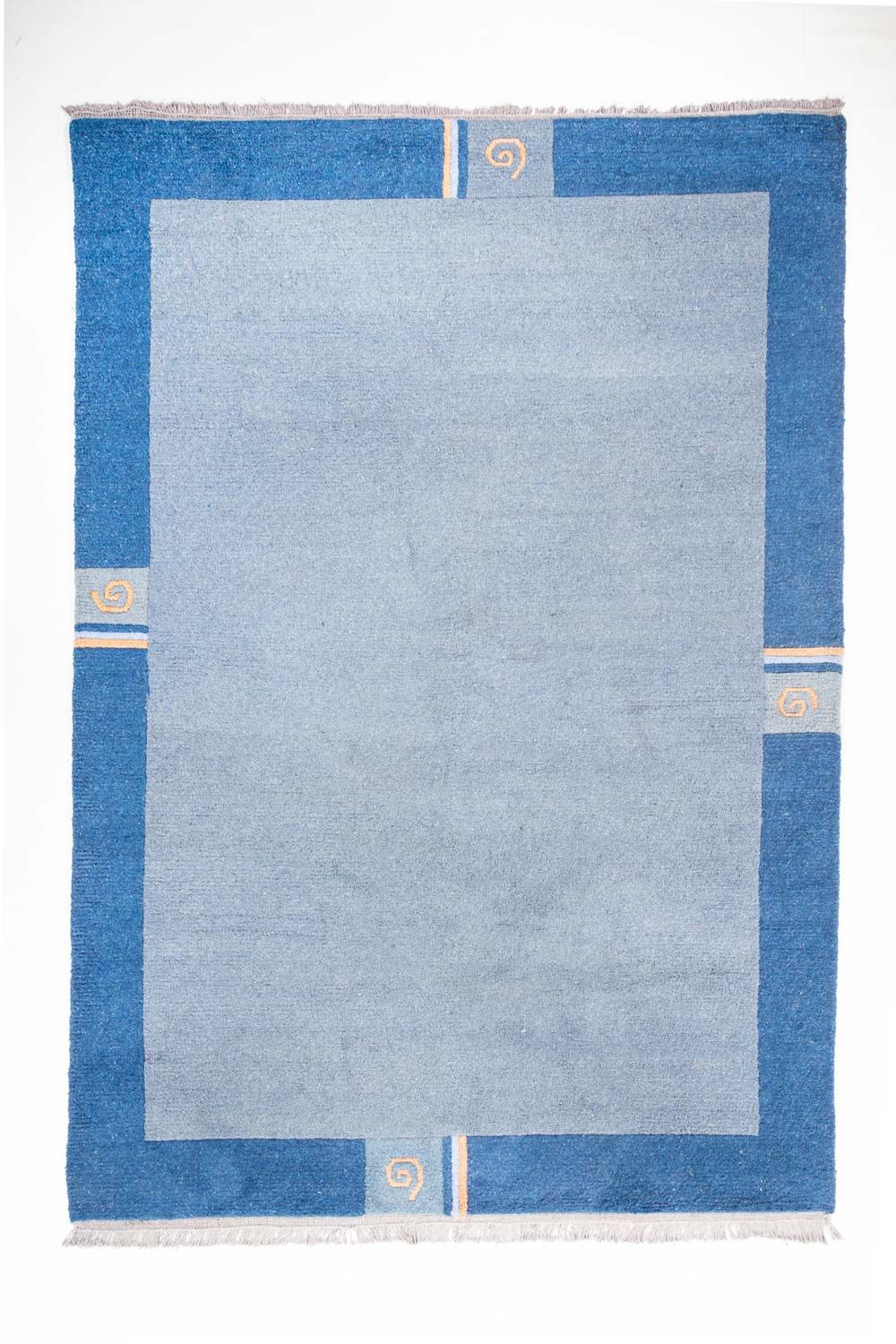
Nepalese rugs combine the Tibetan knotting tradition with modern design and exceptional craftsmanship.
Nepal is a comparatively young, but today internationally leading rug region. Unlike the millennia-old knotting traditions of Persia or China, Nepalese production only arose in the 1960s, when Tibetan refugees brought their knotting technique into the Kathmandu valley after China's annexation of Tibet. From this Tibetan root an independent industry grew within a few decades, an industry that today shapes the global market for high-quality designer rugs in a decisive way.
The technical heart of Nepalese rugs is the Tibetan knot, a loop technique that differs fundamentally from the knot types of the Persian and Turkish tradition. Combined with the dense, oil-rich virgin wool of Tibetan highland sheep, it produces a thick, soft, and exceptionally hardwearing pile. Nepal rugs therefore stand for modern, often reduced designs in earthy colors and explicitly do not belong to the family of Persian rugs but form a category of their own. How they set themselves off from a classical Persian is covered in the Comparison Nepal rug vs Persian rug.
Nepal lies at the heart of the Himalayas between Tibet to the north and India to the south, in the wider neighborhood of China. Rug production concentrates in the Kathmandu valley in central Nepal, which sits at around 1,350 meters elevation and has an old craft culture as well as a well-developed export infrastructure. The high country supplies the decisive raw material: the wool of Tibetan highland sheep, especially dense, oil-rich, and resilient because of the extreme weather. This high-altitude wool takes color well and gives the pile its characteristic soft hand and luster. More on the fibers sits under Materials.
The Nepalese knotting tradition is rooted in the Tibetan technique. Characteristic is the Tibetan knot, in which the pile yarn is looped around a metal rod laid across the warps. After a row of knots has been looped, the rod is pulled out and the pile is cut along the rod. The process allows brisk work and a particularly even, dense pile. Knot density typically lies between 80,000 and 350,000 knots per square meter, usually expressed in knots per inch from about 60 to over 150. More on the techniques sits under Knot types and Production.
The overview below sorts the most important features of Nepalese knotting.
| Center / feature | Known for | Typical traits |
|---|---|---|
| Kathmandu | main center | manufactories and exporters, broad stylistic spectrum |
| Tibetan knot | loop technique | yarn around metal rod, dense, even pile |
| High-altitude wool | Himalayan sheep | oil-rich, robust, soft hand, good luster |
| Designer lines | commission work | reduced modern patterns, muted palette |
| Patan / Bhaktapur | craft cities | old weaving tradition, skilled knotters |
| Tibetan motifs | tradition | dragons, phoenix, lotus, Buddhist symbols |
Kathmandu is the undisputed center of the Nepalese rug industry and seat of most manufactories and exporters. The historic cities of Patan and Bhaktapur in the same valley have their own old craft traditions. Production is carried mainly by Tibetan refugee communities and the native Newar population. The style runs from traditional Tibetan motifs to the modern designer lines that today found Nepal's reputation as a source of high-quality design rugs. The most important registered style is the Nepal rug, listed in the Style overview.
The Nepalese rug industry has a precise birth date. After the flight of the Dalai Lama in 1959, Swiss aid agencies and the Red Cross set up knotting workshops in the Kathmandu valley in the early 1960s to secure an income for the Tibetan refugees. From this humanitarian project an important economic branch grew rapidly. In the 1980s and early 1990s the sector saw a boom, carried above all by demand from Germany, where the Nepal rug became the embodiment of the modern hand-knotted rug.
With growth came accusations of child labor, to which the sector responded with certification systems. Today many manufactories are certified through seals such as GoodWeave (formerly Rugmark) or CARE&FAIR, which monitor fair working conditions and the absence of child labor. In parallel, the focus shifted from traditional patterns to commission work for international design houses, which use Nepal as a workshop for high-quality one-off pieces. The wider development of knotting is covered in the article History of knotting.
The Tibetan knot is a loop technique that differs fundamentally from the firm single knots of the Persian and Turkish tradition. The pile yarn is led continuously around a metal rod laid across the warp threads and looped around two warp threads at a time. Once a row is complete, the knotter cuts the pile along the rod and pulls the rod out. This technique combines a brisk working pace with a very even, dense, and elastic pile. It is the reason why Nepal rugs come out so thick and robust. The differences from other knotting types are covered in the Knot types section.
The foundation weave of Nepalese rugs is usually cotton; in fine pieces silk is used as an accent or throughout the pile. The pile is knotted predominantly from the oil-rich high-altitude wool of Tibetan highland sheep, often as pure virgin wool, increasingly also in blends with silk or plant fibers such as nettle and hemp. This wool gives the rug its durability and the characteristic silky luster. More on the fibers sits under Materials and Silk.
The pattern language runs from traditional Tibetan symbols such as dragons, phoenix, and lotus to the reduced, often minimalist designs of the modern lines. The palette is predominantly earth-bound with beige, brown, and gray tones, with accents in warm red, deep blue, and natural indigo. Many pieces are made as commission work after designs by international designers, which yields an exceptionally broad stylistic spectrum. How knot fineness affects value is explained in Knot density explained.
Nepal stands for the union of Tibetan technique with modern design. The most important variants are:
Anyone who wants to compare Nepal rugs with other modern knotting traditions will find a side-by-side in the Style comparison. The separation by origin is covered in Recognizing origin.
The value of a Nepal rug is set by knot density, wool quality, pile height, material blend, and the elaboration of the design. Pure high-altitude wool of high density and pieces with silk content sit at the upper end; simpler lines offer a good price-performance ratio. How knot fineness plays out in concrete terms is explained in Knot density explained. Certifications such as GoodWeave attest to fair production. Why hand-knotted rugs cost what they do is explained in Why genuine rugs are expensive. Before buying, the Buying guide and the notes under Value are worth a look. The authenticity check sits under Recognizing oriental rugs.
Nepal rugs made of high-altitude wool are robust and suited to everyday use. Regular vacuuming in the pile direction, occasional professional cleaning, and protection from direct sun preserve color and substance. The oil-rich wool initially repels stains well, yet spilled liquid should still be blotted immediately. Pieces with silk content need gentler handling. The complete routines sit in the Care overview.
Nepal rugs are knotted with the Tibetan knot from oil-rich Himalayan high-altitude wool and have a thick, soft, and very hardwearing pile. Characteristic are modern, often reduced designs in earthy colors. They form a category of their own and are not Persian rugs.
The Tibetan knot is a loop technique in which the pile yarn is looped around a metal rod laid across the warps and cut after each row. It differs fundamentally from the Persian and Turkish single knot and allows a particularly even, dense pile. This technique is the technical hallmark of Nepal rugs.
Nepal rugs come predominantly from the Kathmandu valley in central Nepal, the center of the Nepalese rug industry. The tradition was founded in the 1960s by Tibetan refugees and is carried today by Tibetan communities and the native Newar population. The virgin wool comes from Tibetan highland sheep of the Himalayas.
The price of a Nepal rug depends on knot density, wool quality, size, material blend, and design effort. Simple wool lines are affordable; finely knotted pieces with silk content or elaborate designer drafts sit considerably higher. A reliable orientation is given in the Buying guide.
Nepal rugs are considered high-quality and long-lived. The oil-rich high-altitude wool and the dense Tibetan knot yield a robust pile suited to everyday use. Combined with modern designs and fair-trade certification, they have established themselves as upper-tier designer rugs.
Nepal rugs use the Tibetan knotting technique but are made in the Kathmandu valley, often in larger formats and with contemporary designs. Authentic Tibetan rugs usually carry traditional motifs and are made in smaller quantities. Both share the Tibetan knot and the high-altitude wool.
Many Nepalese manufactories are certified through seals such as GoodWeave or CARE&FAIR, which monitor fair working conditions and the absence of child labor. Natural materials and environmentally friendly dyes are often used. When buying, it is worth looking at the specific certificate.