//
Moroccan rugs, most famously the Berber Beni Ourain and Azilal, fascinate with their minimalist designs and dense wool.
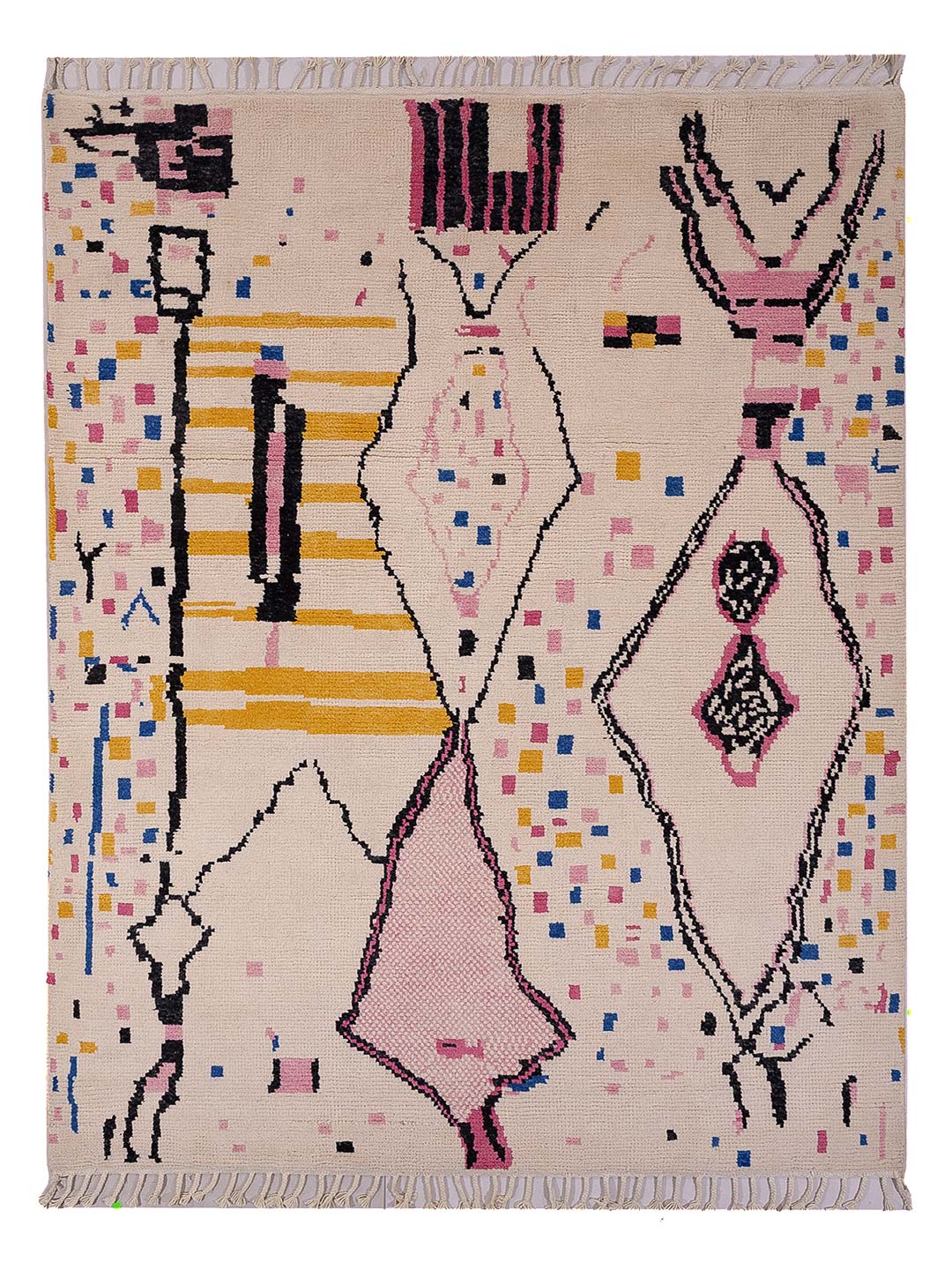
Morocco is the most important rug region of North Africa and stands for a knotting culture that differs clearly from the Persian court art. While Persian rugs cultivate the floral medallion, Moroccan rugs speak an archaic, geometric language: diamonds, zigzag lines, grids, and stylized signs, knotted by women of the Berber tribes in the Atlas mountains. These patterns are not mere decoration but often carry a protective or narrative meaning handed down from generation to generation.
Morocco became famous above all through the Berber rug, led by the cream-white Beni Ouarain with its black diamond grid, which has been a companion of contemporary architecture since the modernism of the 1950s. Alongside it the country stands for the colorful Boucherouite knotted from fabric scraps, for the lively Azilal of the High Atlas, and for the finer city productions of Rabat. Moroccan rugs are explicitly not Persian rugs but an independent Berber and nomadic tradition.
The Kingdom of Morocco stretches from the Atlantic coast to the foothills of the Sahara. The most important knotting areas lie in the Middle and High Atlas, where the Berber tribes live, and in the coastal cities of Rabat and Salé. This division shapes the tradition: in the mountain regions the nomadic and Berber knotting of the women dominates; in the cities, refined, often Andalusian-influenced techniques developed. The continental climate of hot summers and cold mountain winters favors sheep husbandry and yields strong wool.
The Moroccan knotting tradition is closely tied to Berber culture and reaches back over centuries. The work is done predominantly with the symmetric Berber knot, a regional variant of the Turkish knot, which produces robust, densely set pile structures. The knot density is deliberately coarser than Persian city goods and lies, depending on region and purpose, between roughly 40,000 and 160,000 knots per square meter. Highland rugs often have a long, shaggy pile that warmed in the cold mountain winters. Dyeing is traditionally done with natural dyestuffs: madder for red, indigo for blue, and plants of the region for yellow and orange tones. More on the techniques sits under Knot types and Production.
The overview below sorts the most important Moroccan knotting traditions. It runs from Berber nomadic goods to the city manufactory.
| Tribe / style | Known for | Typical traits |
|---|---|---|
| Beni Ouarain | modern classic | cream-white wool, black diamond grid, long pile |
| Boucherouite | recycling rug | colorful fabric and fiber scraps, lively patchwork look |
| Azilal | High Atlas | white ground, free colored signs, narrative patterns |
| Atlas Berber | highland tradition | geometric diamonds, earthy natural tones, dense wool pile |
| Zemmour / Zaian | Khénifra region | complex geometry, warm red and earth tones |
| Rabat | city manufactory | floral medallions, finer knotting, broad palette |
The Beni Ouarain from the Middle Atlas is the best-known Moroccan rug and shapes the international image of the Berber tradition. The Boucherouite stand for a younger variant improvised from fabric scraps; the Azilal for lively narrative patterns of the High Atlas. The Zemmour and Zaian tribes around Khénifra knot dense geometric patterns in warm earth tones; the nomadic rugs of the region are among the most expressive in North Africa. Rabat and Salé stand for the finer city production. The registered Berber tradition sits as the style Berber in the Style overview.
Berber knotting in Morocco is far older than any state industry and reaches back into pre-Islamic times. Over centuries the women of the Atlas tribes knotted rugs, blankets, and tent panels for their own use, as sleeping mats, as protection from the cold, and as dowry pieces. The patterns were regionally and family-coded and gave information about tribal affiliation, life events, and protective symbolism. Knotting was therefore through and through a female, domestic craft without manufactory character.
With the French protectorate period from 1912 a documented trade arose, and in the cities of Rabat and Salé a manufactory production formed itself after Ottoman and Andalusian models. The international breakthrough of the Moroccan rug came in the middle of the twentieth century: architects and designers of modernism, among them Le Corbusier and the circle around the Bauhaus, prized the plain Beni Ouarain as a counterpart to clean furniture lines. Since then the Moroccan Berber has been a fixed part of contemporary home culture. The wider development of knotting is covered in the article History of knotting.
The foundation weave of Moroccan rugs is cotton or, in traditional mountain goods, hand-spun wool. The pile is knotted predominantly from local virgin wool, supplemented by goat hair for especially robust pieces. The Boucherouite form an exception: they are made from recycled fabric and textile scraps and are an example of lived reuse, as the patchwork rugs also know. Unlike the knotting centers of Asia, silk plays only a minor role in Morocco. More on the fibers sits under Materials.
The work is done with the symmetric Berber knot, a variant of the Turkish knot, which produces a robust, geometrically structured weave. The pattern language is abstract and geometric: diamonds, zigzag lines, grids, crosses, and stylized signs that are often read as protective or fertility symbols. The palette runs from the natural cream tones of the Beni Ouarain through warm earth tones in brown, ochre, and terracotta to the strong red, blue, and green of the city and southern productions. How material and workmanship affect value is covered in the Value section.
Morocco stands for an archaic, geometric knotting language between mountain nomads and city manufactory. The most important representatives are:
Anyone who wants to compare Moroccan Berbers with other nomadic traditions will find a side-by-side in the Style comparison. The separation by origin is covered in Recognizing origin.
The value of a Moroccan rug is set less by the bare knot density than by wool quality, age, the authenticity of the pattern, and the radiance of the individual piece. Old, hand-spun mountain rugs and cleanly made Beni Ouarain sit at the upper end; newer market goods offer a good price-performance ratio. Why hand-knotted rugs cost what they do is explained in Why genuine rugs are expensive. Before buying, the Buying guide and the notes under Value are worth a look. The authenticity check sits under Recognizing oriental rugs.
Moroccan wool rugs are robust and made for daily use. Regular vacuuming in the pile direction, occasional shaking out, and protection from direct sun preserve color and substance. Long-pile Beni Ouarain are vacuumed gently and without a rotating brush, so as not to pull out the pile yarn. Spilled liquid is blotted immediately. The complete routines sit in the Care overview.
Moroccan rugs are hand-knotted Berber and nomadic rugs with an archaic, geometric pattern language of diamonds, zigzag lines, and stylized signs. They are traditionally knotted by women of the Atlas tribes from local wool. The best-known representative is the cream-white Beni Ouarain.
A Moroccan Berber is a hand-knotted wool rug of the Atlas Berber tribes with geometric patterns and natural dyeing. It is made with the symmetric Berber knot and often has a dense or long pile. Berber rugs stand for an independent North African tradition, not for Persian knotting.
A Beni Ouarain is a Berber rug of the eponymous tribal confederation from the Middle Atlas, recognized by the natural-white, undyed wool and the plain black or dark brown diamond grid. The high, soft pile and the reduced design made it a companion of modern architecture. It is among the best-known Moroccan rugs.
A Boucherouite is a Moroccan recycling rug knotted from fabric and textile scraps instead of pure wool. From this arises a lively, colorful patchwork look that makes every rug a one-off piece. The tradition grew from a careful approach to scarce materials in the Berber communities.
Moroccan rugs are Berber and nomadic goods with geometric, abstract patterns and the symmetric Berber knot, while Persian rugs cultivate floral medallions with the asymmetric knot. Morocco's dyeing is often natural or earthy, the knotting deliberately coarser. Both belong to the oriental rugs but are independent traditions. Recognizing origin helps with the classification.
High-quality Moroccan rugs are made of strong local wool and are very hardwearing. Their value lies less in extreme knot fineness than in the wool quality, the authenticity of the pattern, and the age. Old, hand-spun mountain rugs are considered especially sought after.
An authentic Moroccan rug is hand-knotted, shows slight irregularities in pattern and dyeing, and is made of real wool with subtle color variations from the natural dyeing. The back reflects the geometric pattern, and the fringes are part of the foundation. The detailed guide sits under Is my rug genuine?.