//
Chinese rugs stand out through their distinctive motifs, dragons, medallions, and Buddhist symbols on a silken pile.
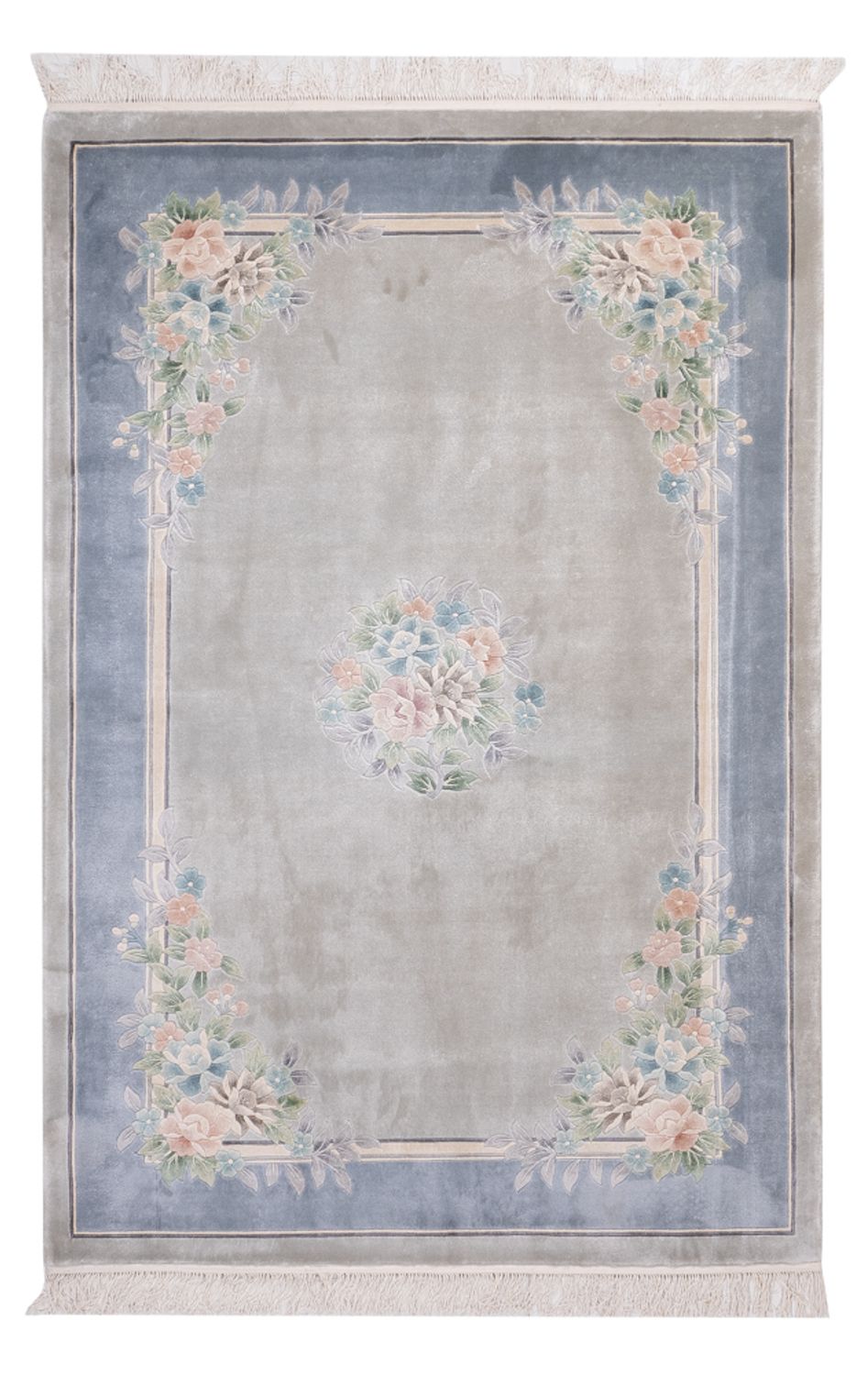
China possesses an independent rug culture that clearly differs from the Persian tradition. Where Persian knotting centers cultivate the floral medallion and the continuous vine, the Chinese rug rests on an open, planar composition with symbolically charged single motifs: dragons, phoenix, lotus, cloud bands, and the Buddhist auspicious signs. This unmistakable visual canon and a calm palette in blue, gold, ivory, and soft red make the Chinese rug recognizable at first glance.
Chinese silk rugs enjoy particular fame, their fine China silk reaching a fidelity that approaches painting. Alongside them stands China for the classical Beijing rugs with their open fields, for the dense wool rugs of Inner Mongolia, and for the Central Asian-influenced knotting of Xinjiang. Chinese rugs are explicitly not Persian rugs but a knotting tradition of their own with its own history and visual language.
Chinese rug production concentrates in the north and center of the country. Significant wool-rug centers lie in Henan, Shandong, Shanxi, and Inner Mongolia with the knotting town of Baotou. The cold winters of these regions historically favored sheep husbandry and the need for warm knotted work. The fine silk for the famous silk rugs comes from the southern silkworm provinces of Jiangsu and Zhejiang around Suzhou and Hangzhou.
The geographic location at the eastern end of the historic Silk Road enabled exchange with Persia, Central Asia, and Turkmenistan over centuries. In the western province of Xinjiang, Uyghur and Kazakh knotters combine Chinese traditions with Central Asian patterns. Traditional Chinese knotting uses the asymmetric knot, in the trade often listed as the Senneh knot. Knot density runs from robust wool rugs with moderate density to fine silk pieces with up to 1,000,000 knots per square meter and more. More on the techniques sits under Knot types and Production.
The overview below sorts the most important Chinese knotting traditions and motif groups.
| Center / style | Known for | Typical traits |
|---|---|---|
| Beijing | court tradition | open fields, single medallions, blue and ivory |
| Ningxia | oldest wool rugs | soft wool, muted tones, classical symbolism |
| China silk | finest silk work | highest density, intense luster, photographic detail |
| Dragon motifs | imperial symbolism | nine-dragon fields, cloud bands, power and protection |
| Baotou (Inner Mongolia) | robust wool rugs | strong pile, landscape and animal motifs |
| Xinjiang | Central Asian style | geometric guls, Uyghur patterns, strong colors |
Beijing stands for the classical court rugs with their open, calm compositions. Ningxia is regarded as the oldest wool rug center with particularly soft wool. The China silk marks the peak of Chinese knotting. The dragon rugs carry the imperial symbolism, Baotou supplies robust wool goods, Xinjiang combines Chinese and Central Asian formal language. All recorded styles sit in the Style overview.
Chinese rug knotting can be traced back to the Tang dynasty (618 to 907), although its surviving heyday falls in the Ming and Qing dynasties. The oldest well-documented wool rugs come from Ningxia and were made from the seventeenth century onwards for temples, monasteries, and the imperial court. Characteristic from the beginning were the symbolic visual language and a restrained, planar composition that deliberately set itself off from the dense Persian vine.
In the late nineteenth and early twentieth century an export-oriented industry grew up in Beijing and Tianjin, deliberately producing for the American and European markets. In this period the entrepreneur Helen Fette, together with Chinese workshops, shaped the so-called Fette rugs, whose open pastel fields still co-shape the Western idea of the China rug today. After 1949 production continued in state enterprises; since the economic reforms from 1978 onwards, fine silk rug production has expanded in particular. The wider development is covered in the article History of knotting.
The foundation weave of Chinese rugs is usually cotton, in fine pieces silk. The pile is knotted from virgin wool or pure silk. Chinese wool is regarded as soft and lustrous; the fine China silk of the silk rugs comes from native silkworm rearing. Pure silk rugs from China are among the best-selling fine silk rugs worldwide. More on the fibers sits under Materials and Silk.
The work uses the asymmetric knot, which allows the fine resolution of the detail-rich silk patterns. A peculiarity of Chinese rugs is relief cutting: the contours of the motifs are clipped lower, so that the pattern stands plastically out of the pile. The pattern language rests on a fixed canon: dragons for imperial power, phoenix for rebirth, five bats for the five blessings, lotus for purity, plus cloud bands, meanders, and the Buddhist auspicious signs. How knot fineness affects value is explained in Knot density explained.
China stands for a visual language of its own between court tradition and the finest silk work. The most important representatives are:
Anyone who wants to compare Chinese silk pieces with other silk traditions will find a side-by-side in the Style comparison. The separation by origin is covered in Recognizing origin.
The value of a Chinese rug is set by knot density, material quality, age, and the fineness of execution. Pure silk rugs and antique pieces sit at the upper end; robust wool rugs offer a good price-performance ratio. With silk rugs the authenticity of the fiber is a central criterion, since art silk made from viscose appears on the market. Why hand-knotted rugs cost what they do is explained in Why genuine rugs are expensive. Before buying, the Buying guide and the notes under Value are worth a look. The authenticity check sits under Recognizing oriental rugs.
Chinese wool rugs are long-lived with proper care. Regular vacuuming in the pile direction, occasional professional cleaning, and protection from direct sun preserve color and substance. Silk rugs need especially gentle handling: low suction, no DIY wet cleaning, immediate blotting of spilled liquids. The complete routines sit in the Care overview.
Chinese rugs follow a visual language of their own with dragons, phoenix, lotus, and cloud bands on open, planar fields in blue, gold, and ivory. A peculiarity is the relief cutting that lets the motifs stand out plastically. Above all the fine China silk rugs are famous.
A Beijing rug is a classical Chinese wool rug with an open, calm field and single medallions or symbols, usually in blue and ivory. The designs go back to the court tradition of the capital. Characteristic are the restrained composition and the clear, harmonious palette.
Genuine Chinese silk rugs are made of pure natural silk, recognizable by their warm, shimmering luster and their fine, light hand. The trade does, however, also offer pieces made of art silk on a viscose base, which gleam cooler and feel heavier. For valuable pieces a professional check is recommended, for instance via Materials Silk.
The dragon stands in Chinese symbolism for imperial power, protection, and luck; the five-clawed dragon was reserved for the emperor. Nine-dragon rugs show the creatures in complex interlacing as a sign of highest dignity. Such motifs belong to the fixed visual canon of classical Chinese knotting.
No. Chinese rugs are an independent knotting tradition with their own history, their own motifs, and their own composition. They differ clearly from the floral medallion rugs from Iran. Origin decides the classification; a Persian rug comes exclusively from Persia.
A genuine Chinese rug is hand-knotted, shows the pattern in mirror image on the back, and has fringes that are part of the foundation. Typical are the Chinese symbolism, the open composition, and often the plastic relief cutting of the contours. The detailed guide sits under Is my rug genuine?.
Silk rugs are vacuumed with low suction and without a rotating brush, protected from direct sun, and cleaned only professionally. Spilled liquid is blotted immediately with a clean, dry cloth, not rubbed. More on this sits in the Care overview.