Symbols and patterns
Patterns in an oriental rug are seldom accidental. Every motif has a story, often a religious or mythological meaning, sometimes a purely practical origin. This page sets out the most important symbols and where they come from.
#Why are patterns in an oriental rug never random?
A classic oriental rug tells several stories at once. The central medallion, the border, single motifs in the field, small symbols in the corner spandrels. Each layer has its own tradition, often centuries old.
Some motifs come from the pre-Islamic period, others from Sufism, others again from the folk religion of particular tribes. Anyone who knows a motif can often read off the region of a rug, sometimes the tribe or workshop.
There is no complete pattern symbolism. The traditions are too branched for that. But the most important motifs come up again and again, and their meaning is worth knowing.
#What does the boteh motif mean?
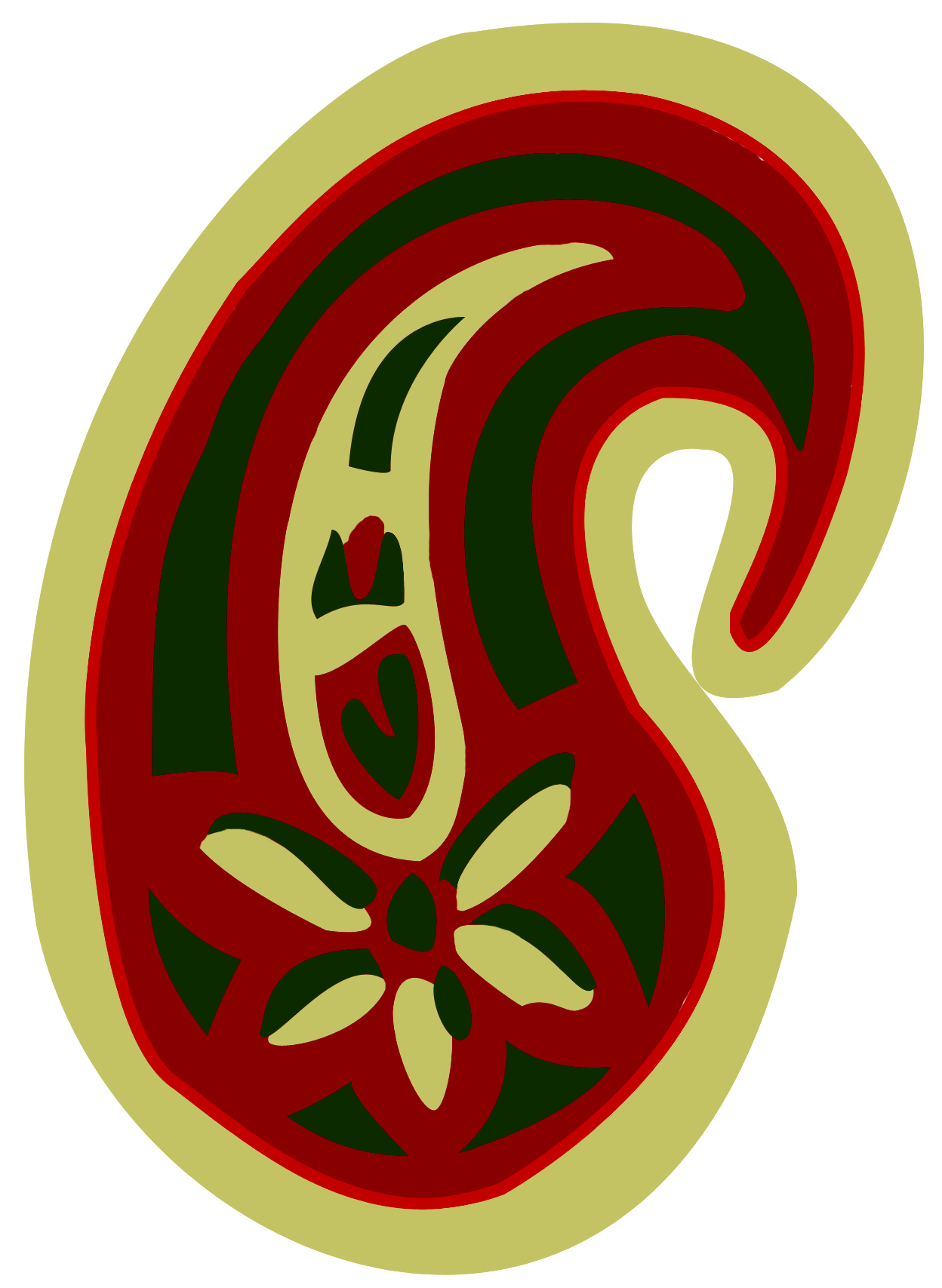
Photo: Wikimedia Commons
The boteh is perhaps the best-known motif in oriental rugs. A teardrop-shaped, often curved figure with a bent tip, often smaller than the palm of a hand, set in rows or pattern groups across the rug field.
In the West the motif is called paisley, after the Scottish town that imported huge quantities of Kashmir shawls bearing this pattern in the 19th century. Its Persian origin lies much earlier. Boteh in Farsi simply means "shrub" or "bud" and stands in many readings for the life force, sometimes also for the Zoroastrian Eternal Flame.
In Persian rugs from Sarough, Hamadan, and Sirjan it is the leitmotif. The North Indian variant of the boteh tilts more strongly to the side at its tip, which makes it look more flowing.
#What is a gül?
Photo: Wikimedia Commons
The Gül (also Göl, Gol, Khol) is an octagonal or diamond-shaped tribal symbol that fills the field above all in Turkmen rugs. Each Turkmen tribal community developed its own Gül across generations, so distinctive that a rug expert can identify the tribe by the Gül alone.
The most important variants: Tekke Gül (octagonal, divided into four quadrants), Yomut Gül (diamond-shaped, often lighter at the center), Salor Gül (octagonal with an inner double Z), and Ersari Gül (coarser, often with swastika-like symbols, used here as an old solar protective sign and not in the political sense of the 20th century).
The Gül is a dynastic emblem without a crown that recurs across rug, yurt, and saddle cover.
#What do the Herati and Mahi patterns show?
Photo: Wikimedia Commons
The Herati pattern, also called Mahi (Farsi: "fish"), is a continuous all-over pattern of a central rosette enclosed by a diamond-shaped frame with four curved leaves. The leaves recall fish in shape, hence the second name. The symbolism goes back to the image of a lake with water plants and fish.
The Herati is one of the oldest and most widespread Persian patterns and shapes above all the rugs of Bidjar, Senneh, Tabriz, and Hamadan. It suits large formats particularly well, because it continues evenly in any direction without needing a dominant center.
#What is a mihrab in a prayer rug?
Photo: Wikimedia Commons
The mihrab is an arched niche that marks the direction of prayer toward Mecca in a mosque. In Persian, Turkish, and Caucasian prayer rugs (namaz or sajada) the mihrab forms the main motif: an arch at the top of the rug, often with a hanging lamp or water jug, sometimes with a stylised tree of life inside it. In prayer, the believer aligns the mihrab with Mecca and kneels beneath it.
Classic prayer rugs come from Ladik, Ghiordes, Konya, Maslagan, Senneh, and many Kurdish workshops. The arch shape varies markedly: pointed, round, stepped, sometimes doubled. The size too is standardised to dimensions that allow one person to kneel.
#What do the tree of life and protective symbols mean?
Photo: Wikimedia Commons
The tree of life is one of humanity's oldest motifs and reaches back in Mesopotamia to the third millennium BCE. In an oriental rug it appears as a stylised tree with branching limbs, often with birds, sometimes with blossoms or fruits. It stands for fertility, the link between heaven and earth, and paradise.
Alongside it runs a whole series of smaller protective symbols that appear in borders, corner spandrels, or as filling elements. The "evil eye" as an eye or concentric circles. The scorpion as protection against accident. The stylised sheep as a promise of prosperity. The cock as the herald of daylight.
These symbols are as old as the rug itself and survive in the knotting traditions of nomadic tribes to this day.