Knot types
Four knot types dominate the classic oriental rug. The one a knotter uses shapes pattern resolution, lifespan, and price. This page sets the four side by side.
#What is a knot in a rug?
A knot is the smallest unit of a hand-knotted rug. Each pile thread is wound individually around two or four warps, the next knot follows in the next row, until at the end several hundred thousand to over a million knots per square meter have come together.
Which knot type a knotter uses shapes the rug's whole appearance: the fineness of the pattern, the sturdiness, even the lifespan.
Four knot types dominate the classic oriental rug. The Turkish Ghiordes knot, the Persian Senneh knot, the unloved Jufti, and the distinct Tibetan loop knot.
#What is the Ghiordes knot?
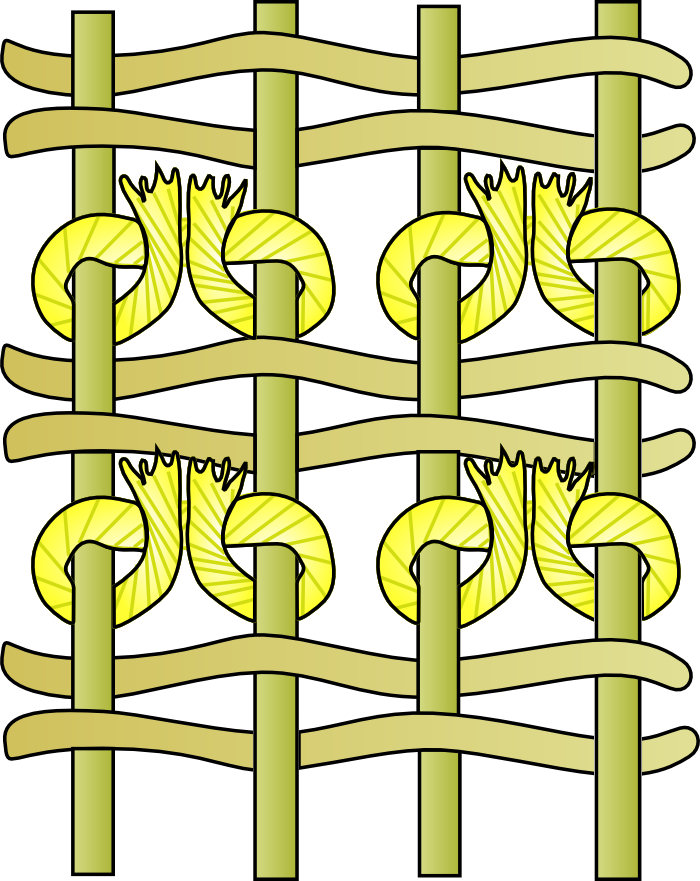
Photo: Wikimedia Commons
The Ghiordes knot, named after the western Anatolian town of Gördes, is symmetric. The pile thread is led around two warps and pulled to the front between them on both sides. Both ends of the knot are visible at equal length.
This symmetry makes the Ghiordes knot particularly rugged and clearly visible. The single knots are large, the pile looks strong. Turkish, Caucasian, Kurdish, and northwest Persian rugs use almost exclusively this knot. Examples are Bergama, Kazak, Heriz, and many Kurdish pieces.
Its weakness is limited pattern resolution. Filigree patterns with fine curves can hardly be cleanly knotted with the Ghiordes knot.
#What is the Senneh knot?
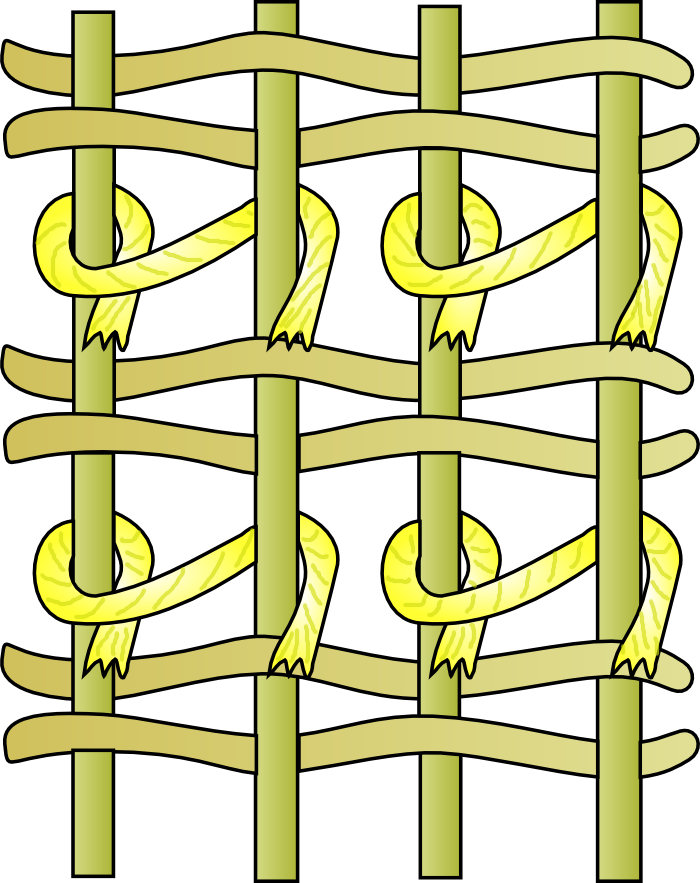
Photo: Wikimedia Commons
The Senneh knot, named after the western Iranian town of Sanandaj (formerly Senneh), is asymmetric. The pile thread is wound once around one warp and only passed under the second. So only one end of the knot lies on the surface; the other is hidden.
This asymmetry allows much higher knot densities and finer pattern detail. Persian city workshops like Isfahan, Nain, Ghom, Tabriz, or Kashan use only the Senneh knot. Indian knotters and most of modern Pakistani production also work asymmetrically.
Anyone who wants to see fine arabesques, medallions with precise curves, or figurative depictions sees Senneh knots.
#What is the Jufti knot?
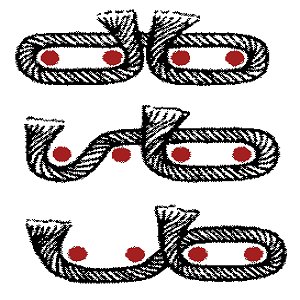
Photo: Wikimedia Commons
The Jufti knot is a variant that saves time and sacrifices quality. The knotter wraps the pile thread not around two but around four warps at once. That halves the knot count per square meter, and the knotter moves about twice as fast.
Visually, a Jufti rug looks at first glance like a normal Persian Senneh-knotted rug, but it is looser and less durable. The pile pulls out of the foundation more easily, and the rug loses shape faster. Jufti knots show up in some rugs from Persian Khorasan, in cheap Indian mass-market goods, and in many low-end imports.
A simple test: turn the rug over and count the knots in a centimeter strip. At a comparable fiber weight, the knot count of a Jufti rug sits noticeably below what is usual for the claimed provenance.
#What is the Tibetan loop knot?
Tibetan rugs are knotted with a method all their own. The pile thread is not wound around the warp but led in a continuous loop around a metal rod set parallel to the warp. Once the loop row is complete, the knotter cuts the loops with a knife, and the rod is moved up for the next row.
The result is an even pile with a characteristically dense, almost velvety surface. The Tibetan loop knot has become typical for modern, often minimalist designs because it suits unusual pile heights, relief structures, and large fields of color particularly well.
In Tibetan workshops in Nepal, India, and Tibet itself, many of today's contemporary designer rugs are made.
#What do the knot density numbers mean?
Photo: Wikimedia Commons
Knot density is the most important objective quality marker of a hand-knotted rug. It is given in knots per square meter (often abbreviated K/m²).
Three rough bands help with placing a rug. Up to 200,000 K/m²: simple tribal and nomadic rugs, robust mass-market goods from India and Pakistan. 200,000 to 500,000 K/m²: solid workshop rugs, fine Persian provenances like Heriz or Bidjar, upper-tier modern production. 500,000 K/m² and above: the finest workshop rugs, classic Isfahan, Nain with silk, Hereke. Top pieces from Hereke or Ghom reach 1.5 to 2 million K/m² and beyond.
A higher knot density means finer pattern detail and longer lifespan, but also a markedly higher price and longer knotting time. A single knotter manages 5,000 to 12,000 knots a day, depending on knot system and density. At one million knots per square meter, that is several years of work for a medium-sized rug.
Keep reading
How oriental rugs are made
How wool, silk, and natural dyes become a hand-knotted work of art, explained step by step.
ReadIdentifying oriental rugs
The key markers to distinguish a genuine hand-knotted oriental rug from imitations.
ReadMaterials for oriental rugs
Wool, silk, cotton, jute, and synthetic fibers. What sets each apart, what it suits, and how it feels.
Read