Kelim Fars rugs: Qashqai flatweave from Fars Province
Fars kilims are flat-woven by Qashqai nomads in southern Iran and show vivid tribal motifs in a graphic style.
- Region
- Persia / Iran
- Category
- Kilim
- Manufacturing
- Hand-woven
- Knot density
- Flat weave (no knots)
Profile
- Manufacturing
- Hand-woven
- Origin
- Iran — Fars Province, Qashqai tribes
- Pile material
- Wool
- Knot density
- Flat weave (no knots)
- Features
- Tribal motifs, vivid colors, graphic flat weave
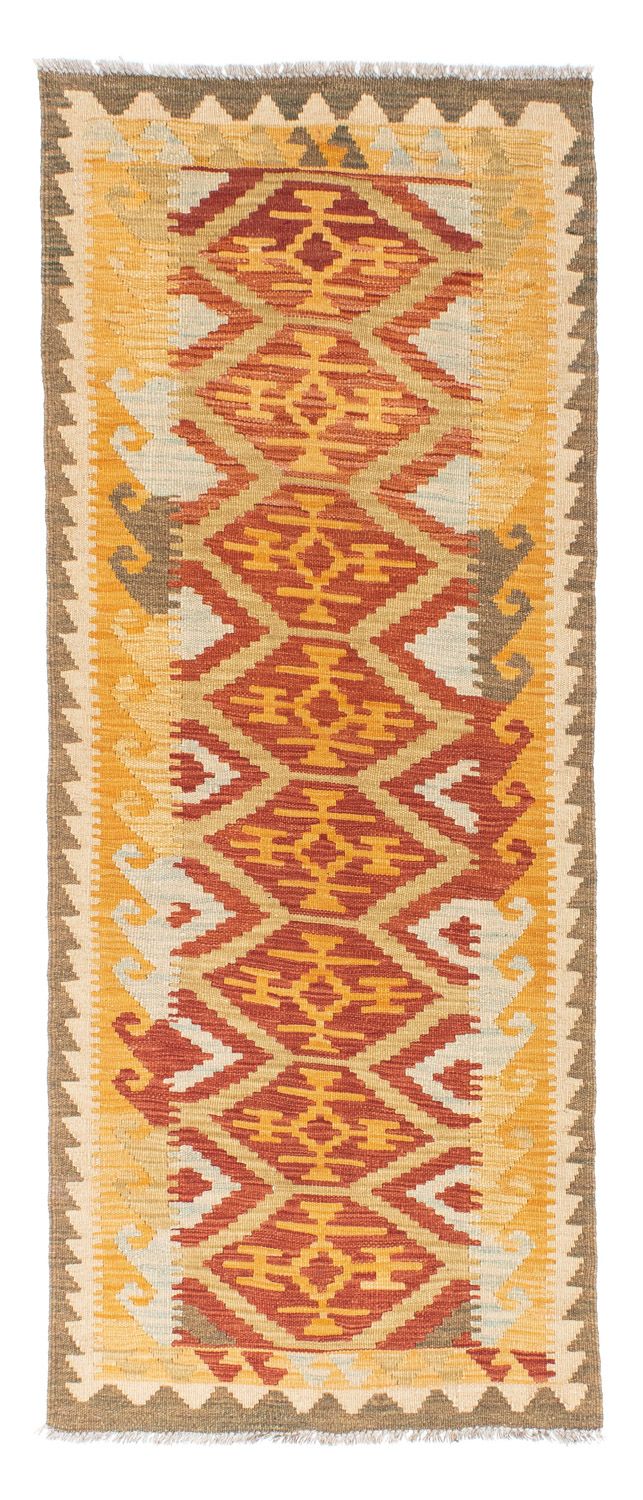
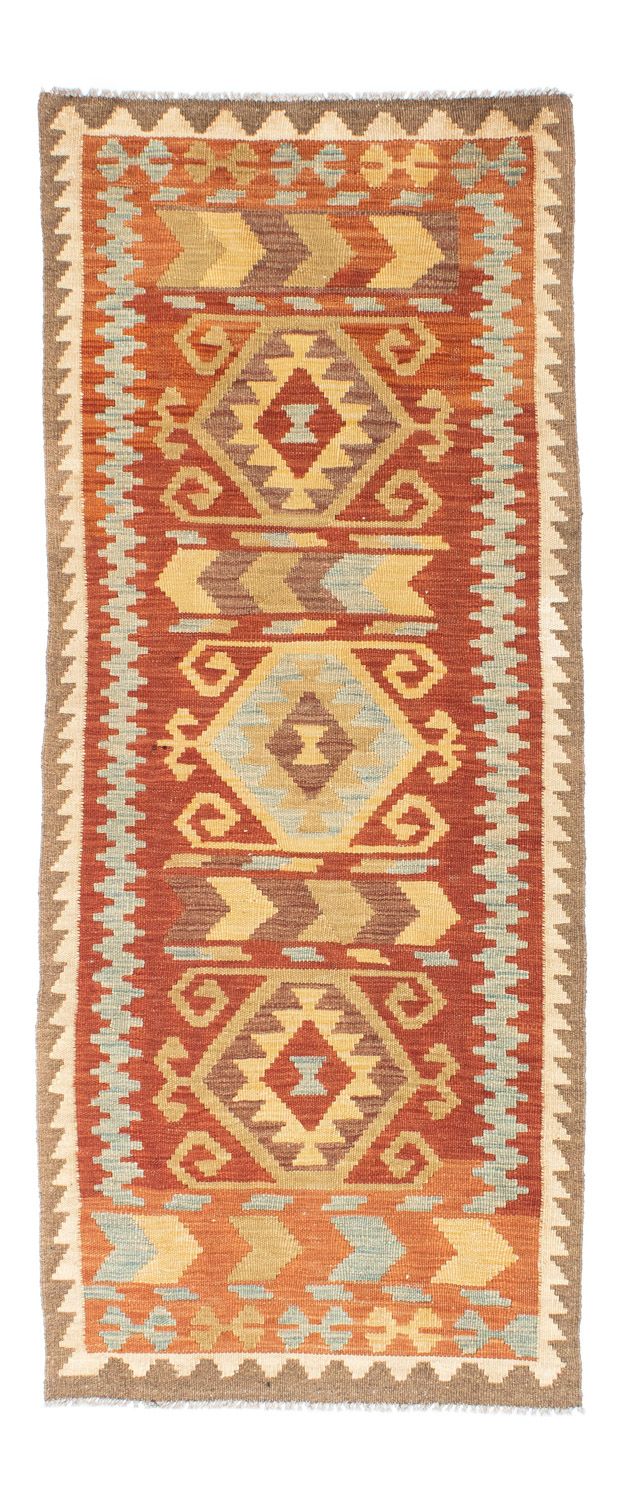
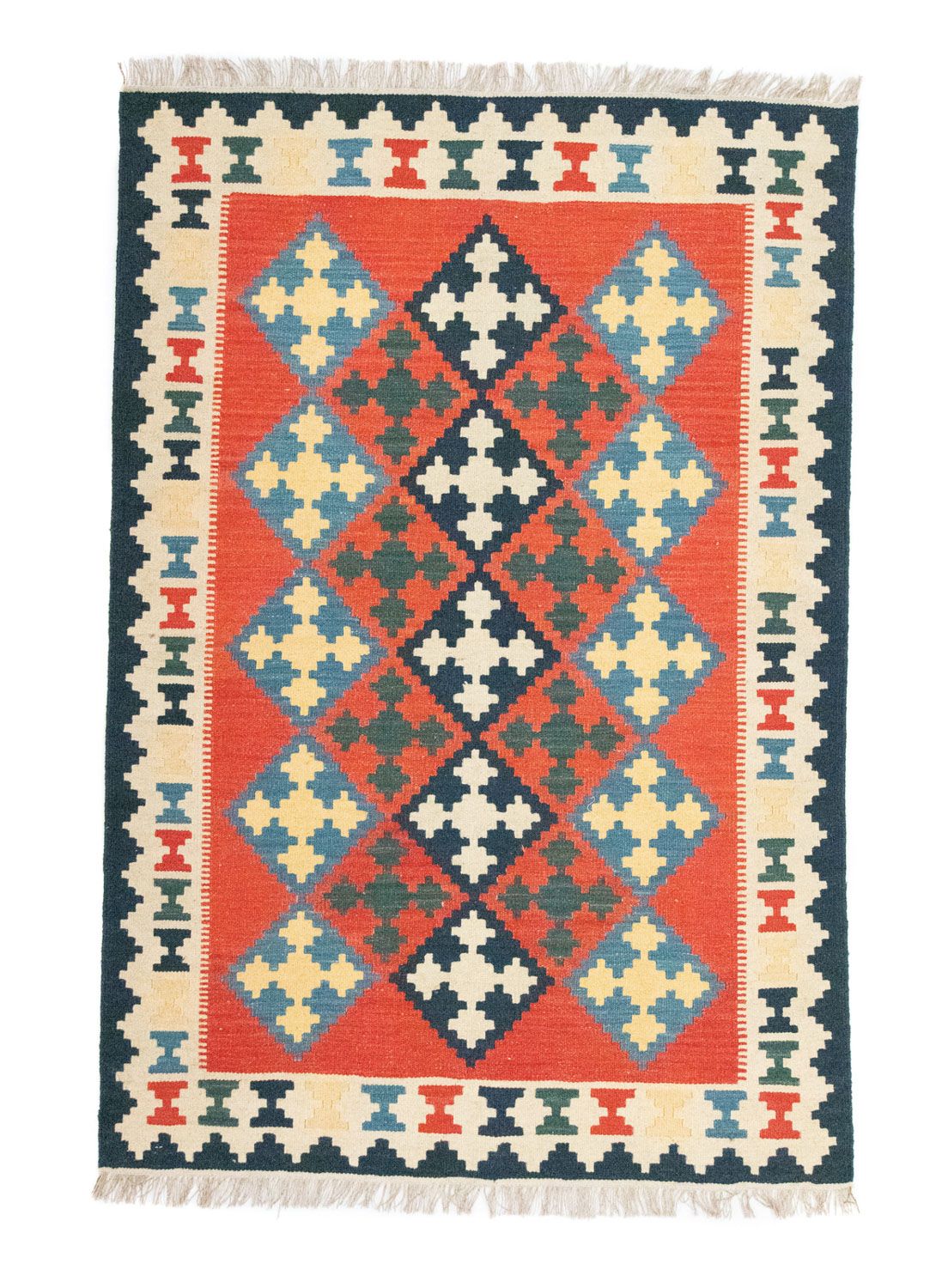
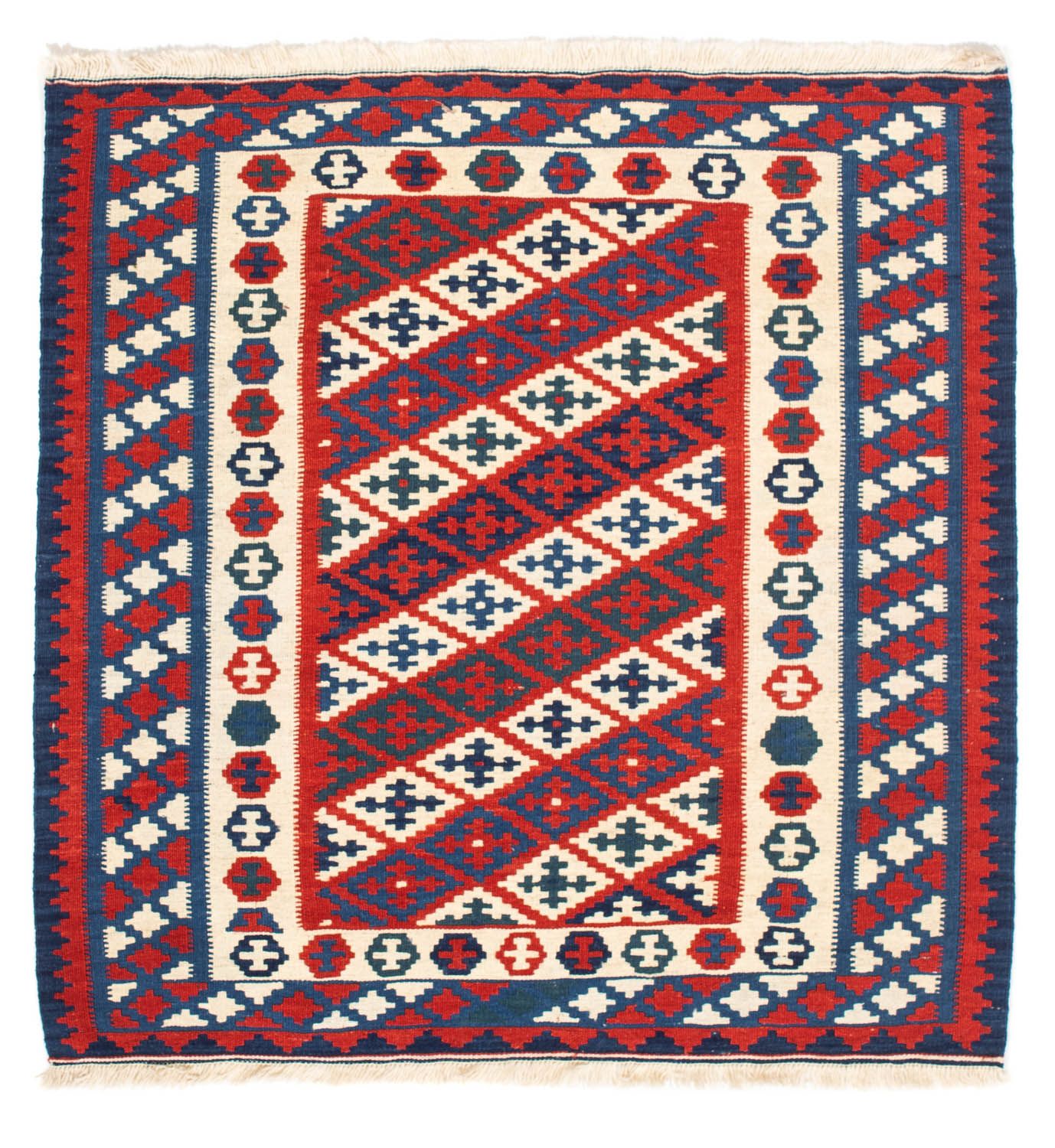
Photo: Morgenland Rugs
A Kelim Fars is a flat-woven, pile-free rug from the southern Persian province of Fars, woven by the Qashqai and Lori nomads around Shiraz. It is one of the most expressive tribal kelims of Persia: strong geometric fields, warm earth colors, and a visual language that comes straight from the daily life of the shepherding peoples. Unlike the knotted Shiraz rug from the same region, the Kelim Fars has no pile and is reversible.
What is a Kelim Fars?
A Kelim Fars is a woven rug without knots and without pile. Its pattern is formed by colored weft threads, which are passed densely over and under the warp threads and fully cover the warp. There is no knotted pole, so the surface stays flat and is patterned almost identically on both sides. The Kelim Fars thus belongs to the large family of kelim flatweaves and to the nomadic rugs, not to the knotted city rugs.
Characteristic are the small vertical slits at the color boundaries, which give traditional slit-weave its name. They are not a defect but a technical feature, because each colored weft runs only in its own field.
Origin
Kelim Fars comes from the province of Fars in the south of Iran, the historical heartland of Persia around the ancient residence Persepolis and today's provincial capital Shiraz. The region has been a center of nomadic textile art for centuries. It is carried by the tribes of the Qashqai confederation and the closely related Lori, who move with their herds between the summer pastures of the Zagros mountains and the wintry lowlands.
Kelims were originally woven here for practical reasons, as light, foldable underlays, tent floors, saddle bags, and storage sacks that were easy to transport on the backs of the animals. The nomadic way of life explains both the geometric severity of the patterns and the robust, weft-faced fabric. The related knotted pieces of the same tribes go by Qashqai and Shiraz rugs.
Typical patterns and colors
Kelim Fars shows a strongly tribal, geometric visual language. Common are continuous diamond grids, stepped hook borders, jagged stars, and strongly stylized animal and plant motifs, including the boteh native to Fars, which here comes out angular and not floral. Often a central medallion or a row of diamond medallions structures the field, complemented by diagonal stripes and small-scale fill motifs.
The palette is warm and earthy. Rust red and terracotta from madder, deep indigo blue, brown and beige tones from undyed wool form the basis, accented by yellow or orange from plant sources. The strong contrasts and the occasional abrash, the natural color shift through differently dyed yarn batches, are typical of handcrafted origin.
Material and weaving technique
For a classic Kelim Fars, warp and weft are made of virgin wool from local flocks, robustly spun and prized for its durability. There is no pile because no wool knots are placed around the warp. Instead, the weft thread runs in plain weave alternately over and under the warp threads, fully covering them, so that a weft-faced fabric emerges. The basic technique is explained on the page weaving.
The pattern forms because each colored weft is only passed back and forth in its color field. The typical slit remains at the vertical color boundaries. Because the heavy wool pole is missing, the Kelim Fars is markedly lighter than a knotted rug, foldable, and fully reversible. The short sides end in fringes, which are the extended warp threads, and the long sides are wrapped for reinforcement.
Weave density and quality
The fineness of a Kelim Fars is not described by a knot count but by weft density, that is, the number of weft threads driven in per centimeter, as well as by yarn fineness and evenness. Kelim Fars traditionally sits in the medium-fine to coarse range, which underscores its robust everyday character. The denser the weft is driven in, the more clearly edges and motifs are drawn and the more stable the fabric lies.
Beyond weave density, wool quality, spinning, and dyeing decide rank. Hand-spun wool with a natural lanolin content, rich natural colors, and an evenly firm weft mark a good piece. Slight irregularities in edge and format count as evidence of genuine handwork on the simple loom in a nomadic kelim, not as defects.
Persian and Afghan kelims at a glance
| Type | Origin | Weave density | Typical features |
|---|---|---|---|
| Kelim Fars | southern Iran, Qashqai and Lori | medium-fine to coarse | strong tribal motifs, warm earth tones |
| Senneh Kelim | Sanandaj, western Iran (Kurdish) | very fine, extremely dense | boteh and Herati patterns, precise slit-weave |
| Afghan Kelim | northern Afghanistan | medium to coarse | stripes and diamonds, deep reds |
| Maimene Kelim | Faryab, northern Afghanistan | medium to coarse | Turkmen guls, lively red and blue tones |
| Silk Kelim | Hereke, Kashan, Kashmir | finest structure | silk weft, high sheen, decorative pieces |
What is a Kelim Fars worth?
The value of a Kelim Fars depends on age, condition, size, weave density, pattern clarity, wool quality, and the purity of the natural dyes. Young, commercially woven sheep's wool kelims are affordable and are bought above all as robust everyday pieces. Older tribal kelims with hand-spun wool, rich plant-based colors, and lively abrash fetch markedly higher prices and are sought by collectors. Within the kelim family, the fine Senneh kelim sits above the coarse Fars in value; at the top stand pure silk kelims.
Why genuine handwork carries its price is explained in why genuine rugs are expensive, and the influence of dyestuffs is covered in the article natural dyes versus chemical dyes. Before buying, the buying guide is worth a look.
How do you recognize a genuine Kelim Fars?
Typical signs of a genuine Kelim Fars include:
- Slits at the color boundaries: small vertical openings where two color fields meet prove genuine slit-weave.
- Same pattern on both sides: front and back look almost identical, the piece is fully reversible.
- No pile: the surface is flat and smooth, there is no velvety pole and no rows of knots.
- Warm tribal colors: rust red, indigo, and undyed wool tones with geometric diamond and hook patterns.
- Hand-spun wool and abrash: slightly wavy edges and the natural abrash speak for an authentic nomadic piece.
Machine-woven imitations, by contrast, look perfectly even and often show adhesive layers or continuous threads on the back. A step-by-step guide is given in Is my rug genuine? in the recognize oriental rug area.
Care
Kelim Fars is, as a wool fabric, robust and easier to handle than a knotted rug, but it absorbs moisture more quickly because the structure is flat. In daily life, careful vacuuming with reduced suction and the brush roll switched off suffices; smaller pieces can simply be shaken out. Blot stains immediately with clear water and a mild agent, without rubbing. Heavier soiling belongs in professional cleaning. Turn the kelim regularly to spread wear across both sides. On smooth floors, a non-slip underlay is recommended. Full routines are in the care overview.
Frequently asked questions
What is the difference between a Kelim Fars and a knotted rug?
A knotted rug, such as a Shiraz from the same region, has a pile of individual wool knots and is usable on one side only. A Kelim Fars has no pile and no knots; it is produced by woven weft threads. It is thinner, lighter, and patterned identically on both sides.
How does a Kelim Fars differ from other Persian kelims?
Kelim Fars shows the warm earth colors and angular tribal motifs of the Qashqai and Lori from southern Iran. It is usually more coarsely woven than the fine Senneh kelim from the Kurdish west of Iran, whose pattern is more small-scale and whose weft density is markedly higher.
Who weaves the Kelim Fars?
Is a Kelim Fars suitable for daily use?
Yes. The dense wool weave and the robust sheep's wool make Kelim Fars very hard-wearing. It was originally woven for hard nomadic daily life and suits hallways, kitchens, and other heavily used areas well.
Are the slits in the Kelim Fars a defect?
No. The vertical slits arise from slit-weave, in which each colored weft runs only in its field. They are a constructive feature and a sign of authenticity, not a defect.
How do I care for a Kelim Fars properly?
Vacuum carefully with reduced suction and the brush roll switched off, or shake it out. Blot stains immediately with clear water and a mild agent, do not rub. Have heavier soiling cleaned professionally and turn the piece regularly to spread wear evenly.
Impressions of the origin
Places, landscapes and landmarks around the home of Fars Kilim rugs. Click any image for a larger view.
Related styles
Senneh Kilim
Senneh kilims from Iranian Kurdistan are among the finest flat-woven rugs, exceptionally thin and finely worked.
Afghan Kilim
Afghan kilims are flat-woven by Turkmen and Uzbek weavers in northern Afghanistan and stand out with their geometric stripes.
Qashqai
Qashqai rugs are knotted by the eponymous nomadic tribe in Fars Province and stand out with their distinctive medallion style.