Hosseinabad rugs: Herati village weave from Hamadan Province
Hosseinabad rugs come from a village in Hamadan Province and show classic Herati patterns in the typical Hamadan single-weft weave.
- Region
- Persia / Iran
- Category
- Persian rugs
- Manufacturing
- Hand-knotted
- Knot density
- 60,000 – 130,000 knots/m²
Profile
- Manufacturing
- Hand-knotted
- Origin
- Iran — Hosseinabad village, Hamadan Province
- Pile material
- Wool on cotton
- Knot density
- 60,000 – 130,000 knots/m²
- Features
- Herati pattern, single-weft, ivory ground
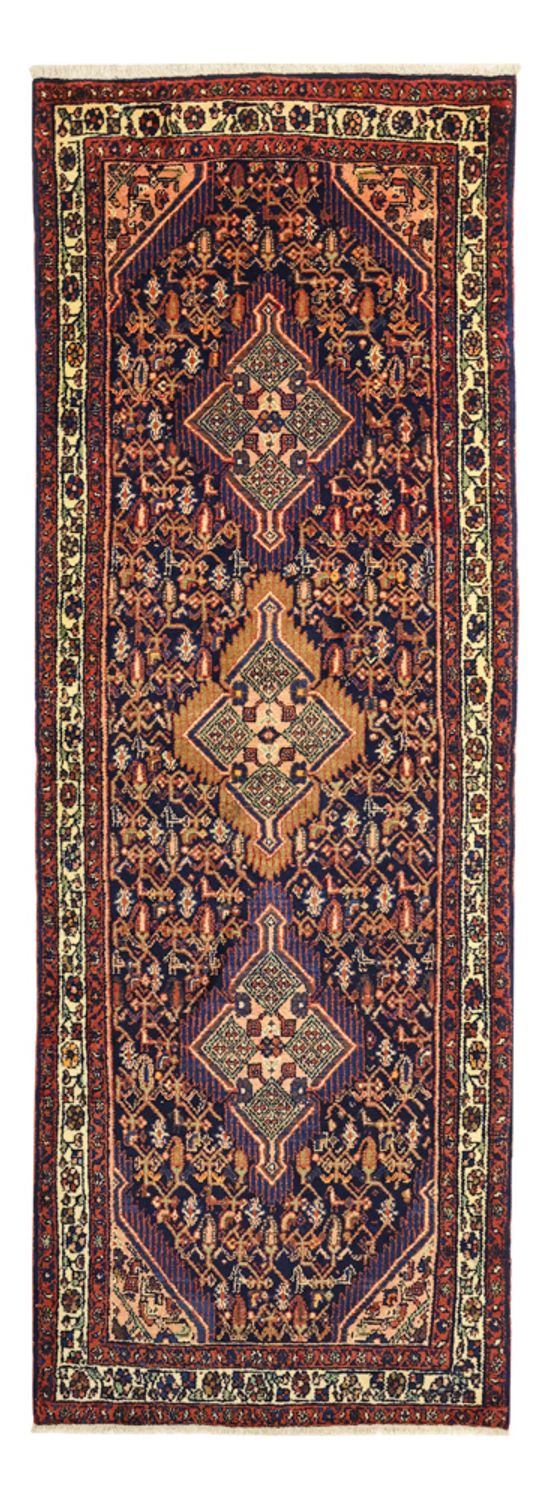
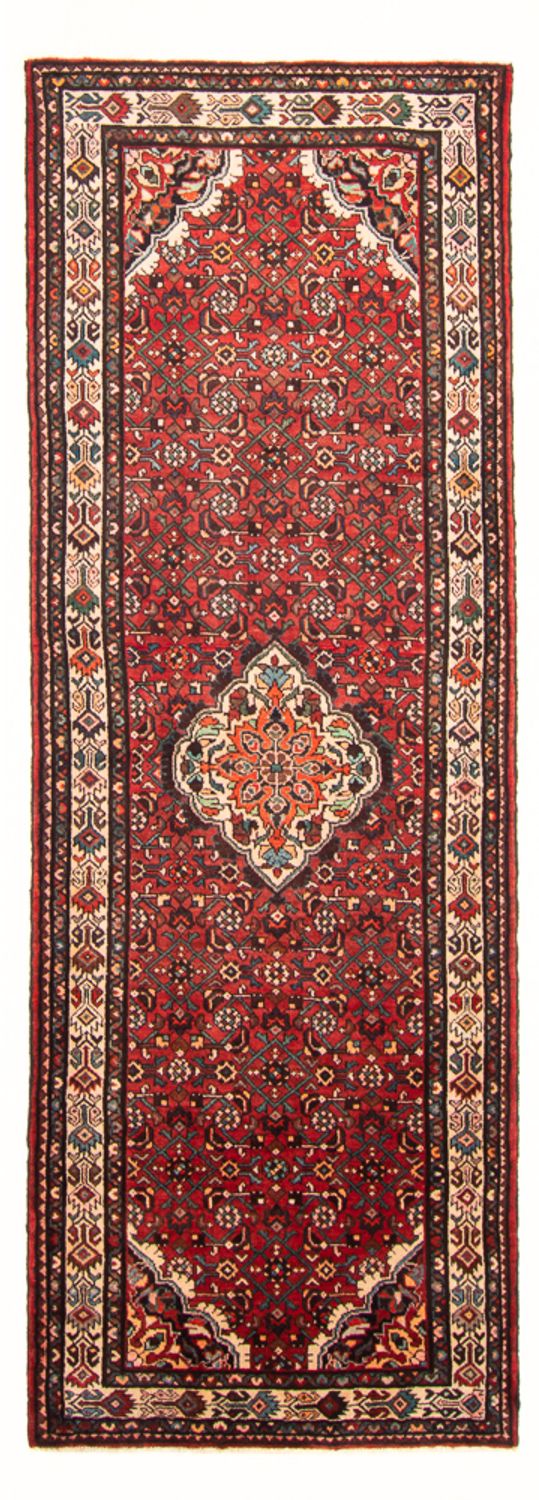
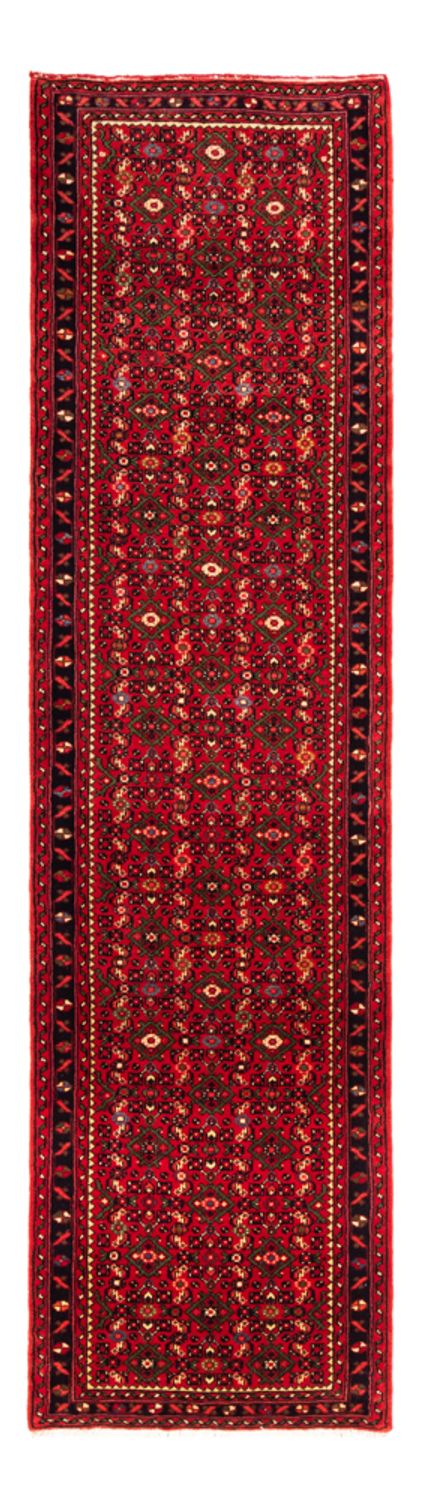
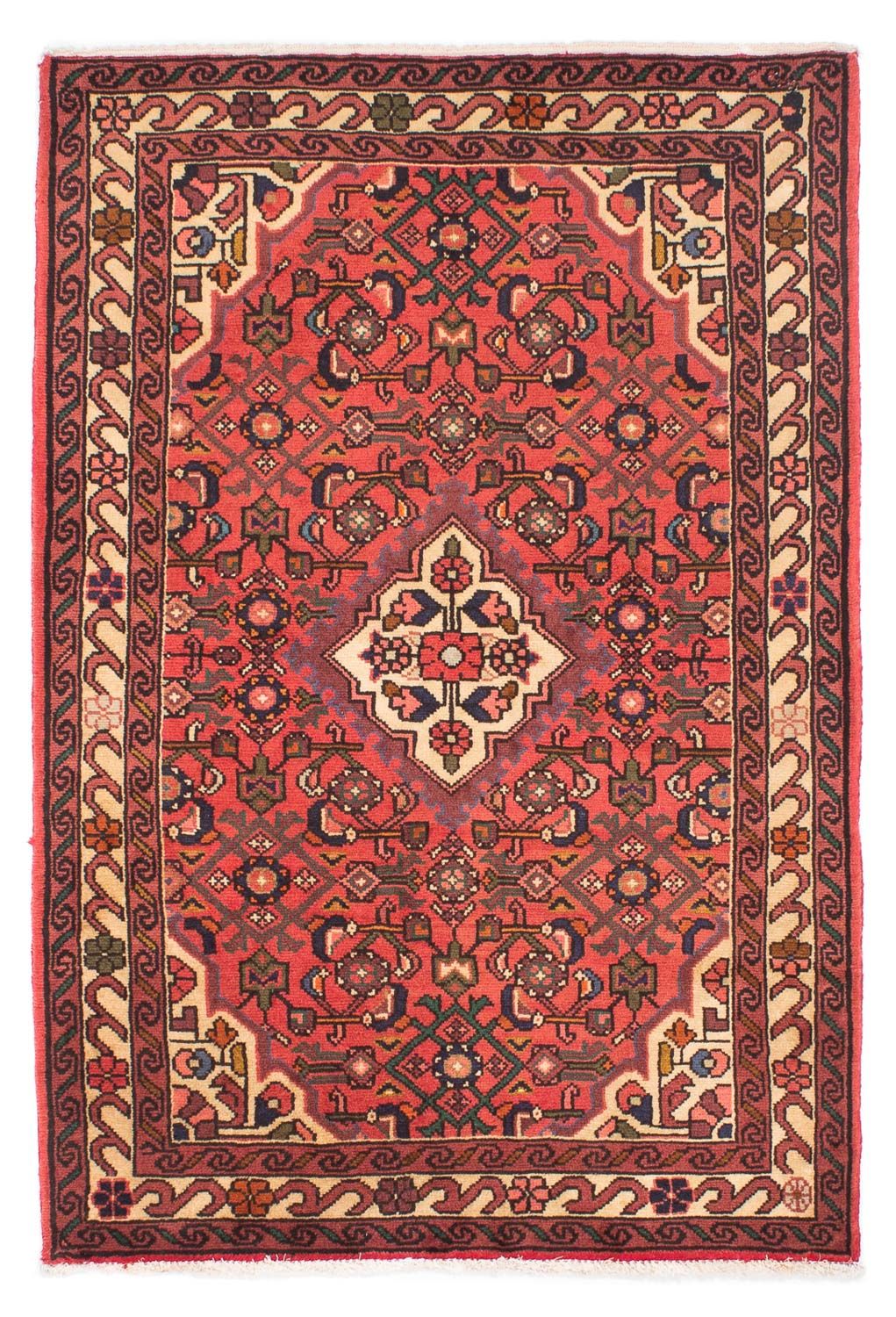
Photo: Morgenland Rugs
Hosseinabad rugs are sturdy hand-knotted Persian rugs from a village in Hamadan Province in western Iran. They belong to the broad family of Hamadan rugs and show the typical single-weft structure of the region, often combined with an all-over Herati pattern or a clear central medallion. As durable village rugs with good value for money, they count among the well-regarded everyday rugs of western Persia. This article explains origin, pattern, material and knotting technique, value, and the authenticity markers of a Hosseinabad rug.
What is a Hosseinabad rug?
A Hosseinabad is a hand-knotted village rug from the eponymous town in the western part of Hamadan Province. Its hallmarks are an all-over Herati pattern or a central geometric medallion, a cotton warp, a wool pile, and the single-weft construction typical of the region, in which only a single weft thread runs between two rows of knots. Knotting uses the symmetric Turkish knot that defines the entire Hamadan group.
Hosseinabad is one of the towns in the Hamadan belt that has established itself in the market under its own name. As with many western Persian village provenances, the term is not narrowly defined: pieces of varying quality run under this name, from simple, boldly patterned everyday goods to more carefully drawn work.
Origin
Hosseinabad lies in the western part of Hamadan Province, a few hours' travel from the provincial capital. The region is one of the oldest continuously settled knotting areas in Persia and is closely tied to rural life at the foot of the Alvand range. The province as a whole comprises several hundred knotting villages whose output converged for centuries on the market of Hamadan city and entered the trade under that name.
The knotting tradition in Hosseinabad reaches back several generations and is maintained in cottage work and small workshops. Production is strongly shaped by agriculture, since many knotters work seasonally in the fields. This leads to limited but continuous availability. In the second half of the 20th century, Hosseinabad rugs gained recognition beyond Persia, mainly because of their balanced combination of traditional drawing and practical suitability for everyday use. Related provenances from the same region include Malayer, Nahavand, Borchalou, Touiserkan, and the Kurdish-influenced Koliai.
Pattern and color
Hosseinabad rugs mostly show robust, geometric patterns typical of the Hamadan region. Common is the all-over Herati pattern with its herringbone-like leaf scrolls around a small rosette, repeating across the entire field. Large central medallions also occur, surrounded by stylized floral motifs and geometric ornaments. The boteh motif, the teardrop-shaped paisley, also appears in all-over arrangement.
The color palette is earthy and bold. Warm reds and deep navy dominate, complemented by beige, ivory, and brown. Historically, madder served as the red dye, indigo as the blue. Borders are usually multi-tiered and pick up geometric or stylized floral motifs. Overall, Hosseinabad rugs look village-made and geometric, less rigorously composed than the fine manufactory patterns of the major city centers.
Material and knotting technique
The warp of Hosseinabad rugs is cotton, the weft is cotton or wool. The pile is virgin wool from local flocks, valued for its sturdiness and natural lanolin content, often handspun. An overview of the fibers used is given in the section on materials.
Knotting uses the symmetric Turkish knot, also called the Ghiordes knot. This is characteristic of the entire Hamadan region and sets Hosseinabad apart from many other Persian provenances that use the asymmetric Senneh knot. The defining technical feature is the single weft: only one weft thread runs between two rows of knots, producing the flat, firm character that can be read off the back. The pile is sheared to a medium length. The entire sequence from warping to shearing is described in the article on rug making.
Knot density and quality
The knot density of Hosseinabad rugs typically lies between roughly 60,000 and 130,000 knots per square meter, placing them in the medium quality category. What knot density actually says about fineness and price, and why a medium density suits a village rug well, is covered in a dedicated article.
Beyond density, wool quality, clarity of drawing, depth of color, and condition determine quality. Older or finer pieces often show handspun wool and natural color nuances, while simpler commercial qualities can be coarser in workmanship. Hosseinabad traditionally enjoys a solid reputation as a durable, everyday rug suitable for daily use.
| Provenance | Relation to Hosseinabad | Typical features |
|---|---|---|
| Hosseinabad | own provenance within the Hamadan belt | Herati all-over or medallion, Turkish knot, single weft |
| Hamadan | umbrella term and region | sturdy village rugs, single weft, geometric |
| Malayer | neighboring provenance | often finer, floral and geometric motifs |
| Nahavand | nearby region, related style | geometric medallion or Herati, bold colors |
| Touiserkan | surrounding region | village knotting, traditional patterns |
| Koliai | western Iran, Kurdish-related | very sturdy, strongly geometric |
What is a Hosseinabad rug worth?
The value of a Hosseinabad rug depends on age, condition, size, knot density, pattern clarity, wool quality, and dyeing. As sturdy village rugs of the medium category, Hosseinabads are generally more affordable than fine Persian manufactory work such as Nain, Isfahan, or Ghom. Well-preserved older pieces with handspun wool and natural dyes, however, can be worth considerably more than simple new commercial qualities.
Their reputation as durable, everyday rugs with good value for money is well-founded. For a sound assessment, see the overview What is my rug worth? and the article Recognizing valuable Persian rugs. Practical pointers on selection and buying are given in the buying guide.
How to recognize an authentic Hosseinabad rug
Typical pointers to an authentic, hand-knotted Hosseinabad are:
- Symmetric Turkish knot: Hosseinabad uses the Ghiordes knot like the entire Hamadan region, unlike many other Persian rugs.
- Single-weft structure: Only one weft thread runs between rows of knots, readable on the back.
- Hand-knotted back: The pattern appears clearly in mirror image; individual knots are visible.
- Genuine fringes: The fringes are the extended cotton warp threads, not sewn on afterward.
- All-over Herati pattern or geometric medallion in bold red and navy.
- Wool pile on a cotton foundation with a sturdy, village character.
Since Hosseinabad belongs to the broad Hamadan environment, individual pieces vary. Classification should therefore consider pattern, back, material, and condition together. A general step-by-step inspection is offered in Is my rug authentic?, and an overview of hand-knotted rug features is collected in Recognizing hand-knotted rugs.
Care
Hosseinabad rugs made of sturdy wool are low-maintenance and well-suited to daily life. Regular vacuuming in the pile direction and occasional professional cleaning preserve color and pile. Stains should be blotted up immediately with clear water, without rubbing. Long direct sun exposure fades the colors and should be avoided. Occasional rotation distributes wear evenly. Detailed guidance is given in the care overview.
Frequently asked questions
Where does a Hosseinabad rug come from?
From the village of Hosseinabad in the western part of Hamadan Province in western Iran. The region belongs to the large Hamadan rug belt with a long village knotting tradition at the foot of the Alvand range.
What sets a Hosseinabad apart from other Hamadan rugs?
Hosseinabad shares the basic features of the region: the Turkish knot, the cotton warp, and the single-weft structure. Characteristic are the frequently used all-over Herati pattern or a clear central medallion and an earthy color scheme with bold red and navy.
Which knot is used in a Hosseinabad rug?
The symmetric Turkish knot, also called the Ghiordes knot. This is characteristic of the entire Hamadan region and unusual for Persian rugs, many of which use the asymmetric Senneh knot. The differences are explained in the overview of knot types.
What does a Hosseinabad rug cost?
The price depends on age, condition, size, knot density, wool quality, and dyeing. Simple new village qualities are affordable; well-preserved older pieces with handspun wool and clear drawing can cost considerably more.
Are Hosseinabad rugs suitable for high-traffic areas?
Yes. The flat single-weft structure and the sturdy, naturally lanolin-rich wool make Hosseinabad rugs very resilient and well-suited to living rooms with normal to high use.
What sizes are common for Hosseinabad rugs?
Hosseinabad rugs are frequently knotted as runners or in medium formats up to about 200 x 300 cm. Very large formats are rarer, since the traditional looms of the region are sized accordingly.
How do I properly care for a Hosseinabad rug?
Vacuum regularly in the pile direction, blot stains immediately with clear water without rubbing, and have the rug professionally cleaned every few years. Avoid long direct sun exposure and rotate the rug occasionally so that wear is distributed evenly.
Impressions of the origin
Places, landscapes and landmarks around the home of Hosseinabad rugs. Click any image for a larger view.
