//
Flat-woven, pile-free rugs, kilims captivate with bold graphic patterns and versatile use anywhere in the home.
Photo: Morgenland Rugs
A kilim is a flat-woven, pile-less rug that is not knotted but woven in plain weave from warp and weft threads. The technique is spread across a vast area, from Morocco across Turkey and the Caucasus to Persia, Afghanistan and Central Asia. Characteristic are the clear geometric patterns that look the same on both sides, and the fine vertical slits that arise where two color fields meet.
The word kilim (Persian gelim) means roughly to spread out or to flat-weave. Kilims belong to the oldest textile products of humankind and were made equally by nomadic and settled peoples: as seating and sleeping mat, wall hanging, storage bag and saddlebag. This page explains the difference between a kilim and a knotted rug, the most important regions of origin, the weaving technique and what to look for when buying an authentic kilim.
The decisive difference lies in the technique. A knotted rug has a pile: individual wool knots are tied around the warp threads, and their ends form the soft, velvety pile you feel under your fingers. A kilim has no pile. It is created solely by densely interweaving colored weft threads, is therefore thin, flat and almost identical in pattern on both sides. The knotting technique is covered on the page Knotting, the flatweave on the page Weaving.
From this follow practical differences. The kilim is lighter, foldable and reversible, the knotted rug thicker, heavier and only usable on one side. In pattern, the kilim is bound to straight and oblique edges, which is why floral curves are rare and geometric forms dominate. The general overview of rug categories is on the page Rug types, the comparison of production methods in hand-knotted vs. machine-made.
A kilim is a woven rug without knots and without pile, whose pattern arises from colored weft threads that are only carried back and forth within their own color area. Since no continuous cross thread connects the fields, a small slit remains at every vertical color boundary. This gives slit-tapestry weaving its name. The slit is not a flaw but the most reliable mark of authenticity of a classic kilim.
Kilims usually carry the name of their region of origin or of the weaving tribe. Each region has developed its own patterns, colors and weave densities. The overview below places the best-known types.
| Region / type | Known for | Typical features |
|---|---|---|
| Kilim Fars | southern Persian tribal goods | strong fields, geometric tribal motifs |
| Kilim Senneh | finest weave | dense fabric, complex boteh and Herati patterns |
| Kilim Afghan | earthy large patterns | brown and red tones, broad stripes and diamonds |
| Kilim Maimana | northern Afghan market goods | lively colors, floral accents |
| Silk kilim | top fineness | silk weft, high sheen, finest patterns |
| Anatolian kilim (Turkey) | prayer niches | mihrab motif, star medallions, clear colors |
| Caucasian kilim (Caucasus) | strong contrasts | stylized animals, dragon and diamond lattices |
The finest weave traditionally comes from Senneh in the Kurdish region, the most colorful from southern Persian Fars and the northern Afghan Maimana market. Anatolian and Caucasian kilims stand out with strong, contrasting fields. All recorded styles can be found in the styles overview.
Flatweaving is older than knotting. Even before the pile knot was invented, people made woven blankets and mats from wool. Finds from Anatolia, such as the wall paintings of Çatalhöyük, point to geometric weave patterns that are strikingly similar to today's kilims. The tradition therefore reaches back several millennia.
Through the Islamic world the technique spread in a continuous belt from North Africa to Central Asia. In every region, tribes and workshops shaped their own signature: the mihrab motif of the Anatolian prayer kilims, the fine patterns of the Kurdish weavers of Senneh, the dragon and animal motifs of the Caucasus. More on the development of textile art is in Origin of the knotting art.
The warp of a kilim is set up from strong virgin wool or cotton. The pattern-forming weft is made from dyed wool, on fine pieces from silk. Historically, dyeing was done exclusively with natural colors from plants, minerals and insects, whose identification is covered in Recognize natural dyes.
Weaving is done in plain weave: the weft thread runs alternately over and under the warps and covers the warp completely. The pattern is created by carrying each colored weft back and forth only within its own field. Where two fields meet, the typical slit remains. Weaving techniques such as the interlocking of wefts, called dovetailing, or subsequent stitching avoid overly long slits. The whole process is explained on the page Weaving in the Production area.
An authentic, hand-woven kilim shows several clear features:
Machine-woven imitations, by contrast, look perfectly even and often show adhesive layers or continuous threads on the back. The complete guide is in Recognize an oriental rug and Is my rug authentic?.
The value of a kilim is determined by the fineness of the weave, the purity of the natural dyes, age, condition and graphic quality. A fine Senneh kilim or an old Anatolian prayer kilim fetches significantly more than coarse market goods. Pure silk kilims sit at the top. Why authentic handwork has its price is explained in Why authentic rugs are expensive, the difference between dyes in the article Natural dyes vs. chemical dyes.
Before buying, the buying guide and the style comparison are worth a look. Look for clean, fully stitched larger slits and straight edges. Since kilims are thin and slippery, a non-slip underlay is recommended on smooth floors.
Kilims are thin and react more sensitively to moisture than knotted rugs. Regular, careful vacuuming with reduced suction and the brush roll switched off is enough in everyday use. Small stains are treated with a slightly damp cloth and mild cleaner, larger soiling belongs in professional cleaning because the flat structure quickly becomes saturated. Turn the kilim regularly to distribute wear evenly. The complete routines are in the care overview.
A kilim is a flat-woven, pile-less rug whose pattern arises from colored weft threads and which looks nearly the same on both sides. It is not knotted but woven in plain weave, is therefore thin, light and reversible. The technique is spread from Morocco to Central Asia.
A knotted rug has a pile of individual wool knots and is only usable on one side. A kilim has no pile but arises from interwoven weft threads, is thin, flat and patterned identically on both sides. That is why geometric patterns dominate in a kilim while floral curves are rare.
Authentic kilims show the typical vertical slits at color boundaries, an almost identical pattern on both sides, no pile and slightly irregular edges. Handspun wool and the natural color shift Abrash also speak for an authentic piece.
No. The vertical slits arise from the traditional slit-tapestry weaving, in which each colored weft runs only within its own field. They are the most reliable mark of authenticity, not a defect. Overly long slits are interlocked during weaving or discreetly stitched afterwards.
Kilims come from a large belt stretching from Morocco across Turkey and the Caucasus to Persia, Afghanistan and Central Asia. Well-known types are the southern Persian Kilim Fars, the fine Kurdish Kilim Senneh, the earthy Kilim Afghan and the Anatolian prayer kilims of Turkey.
Yes. Since the kilim has no pile and is patterned nearly identically on both sides, it can be fully turned over. Regularly reversing it distributes wear evenly and extends its lifespan.
Vacuum the kilim carefully with reduced suction and the brush roll switched off. Treat small stains with a slightly damp cloth and mild cleaner, have larger soiling cleaned professionally since the thin structure quickly becomes saturated. A non-slip underlay protects it on smooth floors.
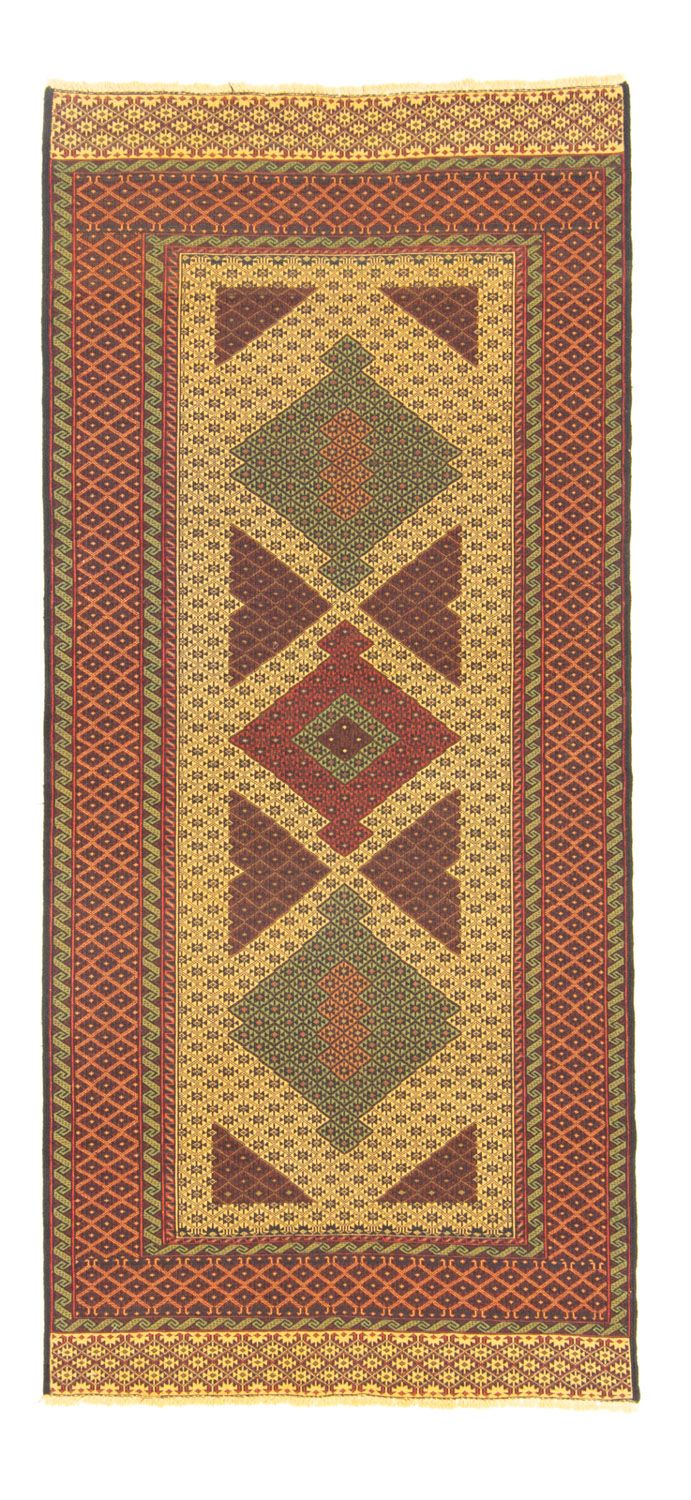
Afghan kilims are flat-woven by Turkmen and Uzbek weavers in northern Afghanistan and stand out with their geometric stripes.
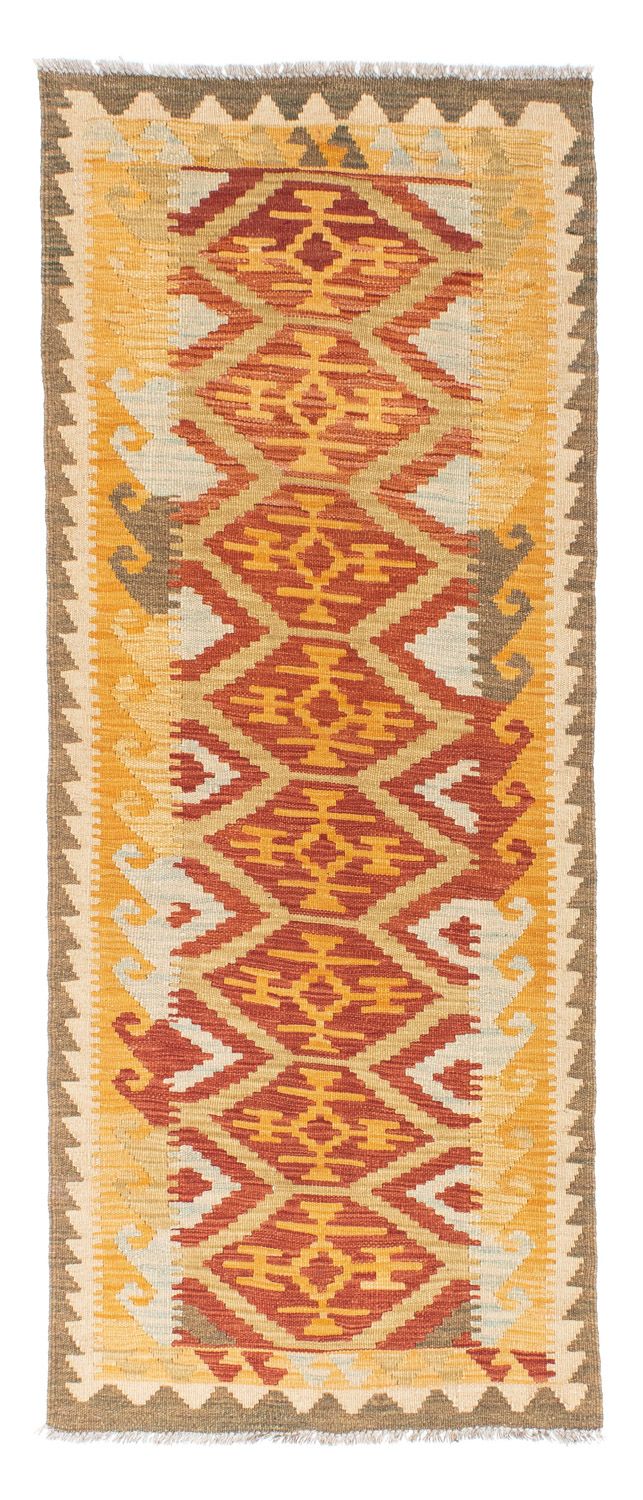
Fars kilims are flat-woven by Qashqai nomads in southern Iran and show vivid tribal motifs in a graphic style.
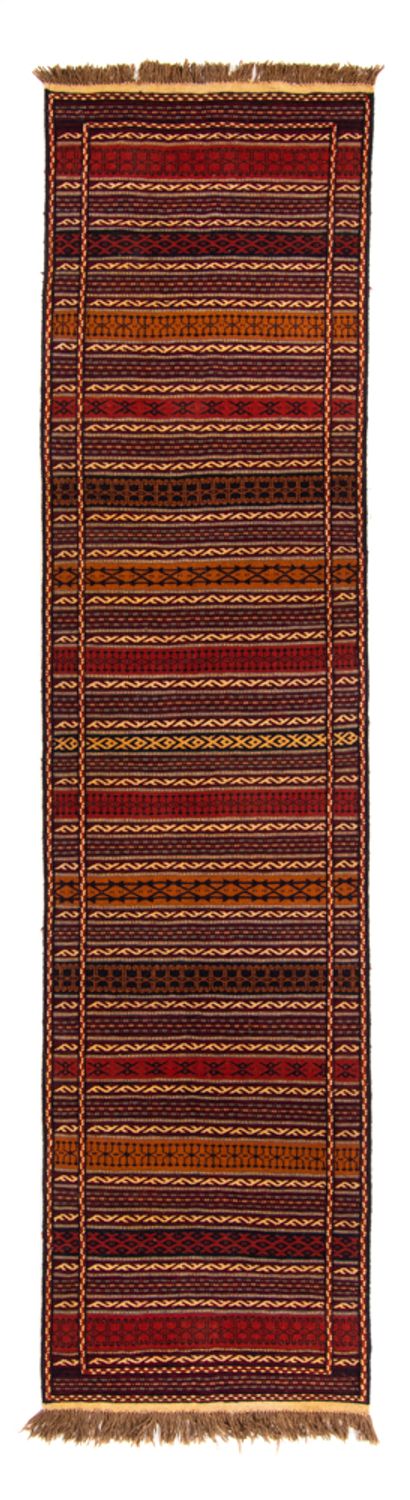
Senneh kilims from Iranian Kurdistan are among the finest flat-woven rugs, exceptionally thin and finely worked.
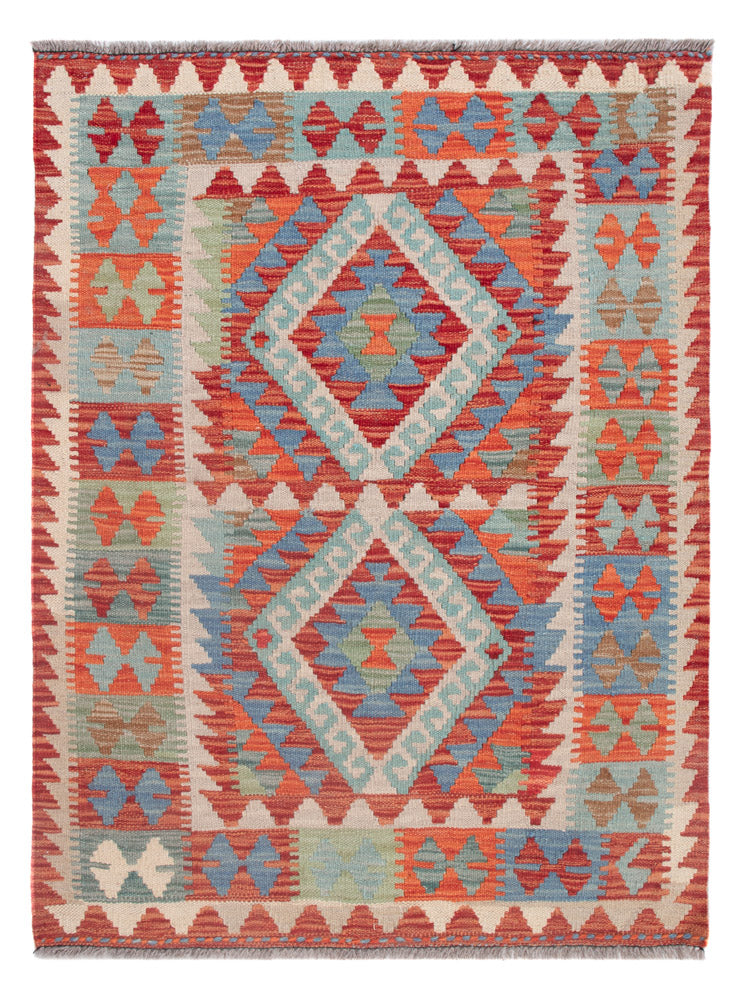
Maimana kilims are flat-woven in northern Afghanistan and are known for their bold red, blue, and ivory stripes.
The kilim is the pile-free woven rug of the Orient, reversible and lightweight. Overview of the main styles from Persia, Afghanistan, Anatolia and the Caucasus.