Hand-knotted vs. machine-made
The biggest decision when buying a rug is not style or color, but how it was made. A hand-knotted oriental rug and a machine-made rug often look similar at first glance, and differ fundamentally in everything that comes after: lifespan, value retention, care, and reparability. This page compares both worlds head-on.
Eight criteria compared directly
The table sums up what the sections below explain in detail. Anyone needing a quick overview should start here.
| Criterion | Hand-knotted | Machine-made |
|---|---|---|
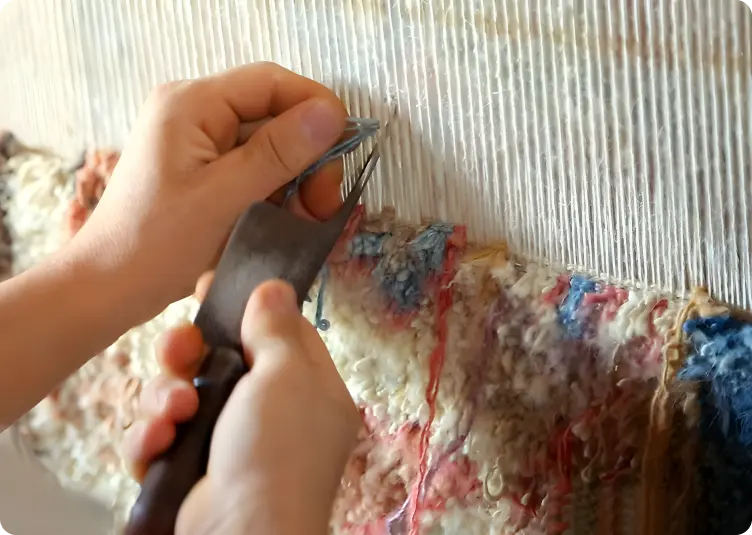
| Production time | 6–24 months for a 200×300 cm piece | minutes to hours |
| Lifespan | 60–150 years, often outlasting generationsSource: Sotheby's and Christie's auction records, antique pieces are regularly auctioned at 100+ years | 8–20 years |
| Material | wool, silk, occasionally cotton | mostly synthetic (PP, polyester, viscose) |
| Dyeing | natural or genuine acid dyes, abrash possible | mass dyeing, uniform throughout |
| Knot density | 60,000–2,000,000 knots per m² | no real knot, inserted pile |
| Value retention | can rise, antique pieces routinely four-figure | loses value immediately, consumable |
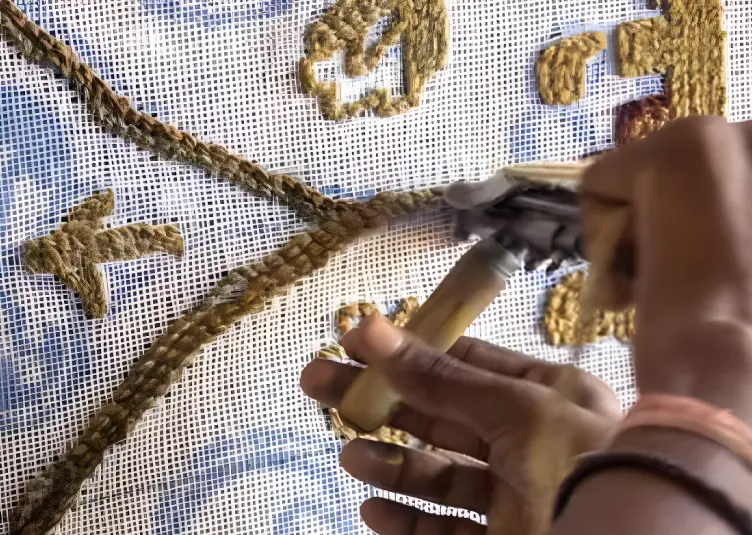
| Reparability | fully repairable, fringes, edges, holes | barely repairable, usually full replacement |
| Price per m² | 200–4,000 euros depending on quality | 20–150 euros |
#How do you tell hand-knotted from machine-made?
The fastest test is the back. Turn the rug over. On a hand-knotted rug you see the pattern in mirror image, but as sharply as on the front. Each knot is visible on the back as a small dot, slightly irregular in size and position.
On a machine-made rug, you see a uniform fabric or fleece on the back. The pattern stays pale, because the colors do not push through. Often you can recognize a backing of polyester or latex, sometimes with a sewn-in mark or label.
Second test: the fringes. Real fringes are the extension of the rug's warp threads, so part of the construction. Machine-made fringes are often sewn on separately and can be plucked off without the rug fabric coming apart.
#How do lifespan and value compare?
This is where the biggest practical difference lies. A hand-knotted wool rug lasts at least 60 years under normal residential use, often considerably longer. Antique pieces from the 19th century appear regularly in auctions, and not infrequently fetch more than they did at first sale a hundred years ago.
A machine-made rug has an average useful life of 8 to 20 years. After that, the pile is worn out, the colors have faded, the backing has gone brittle. There is no collector, auction, or resale market for these pieces. The loss in value is immediate and total.
This does not mean a machine-made rug is automatically a bad choice. For a three-year tenancy, a children's room, or an entrance area, it can be the right answer. But if you understand a rug as a piece of furniture meant to accompany several phases of life, you end up with the hand-knotted piece.
#Which materials, and which care?
Hand-knotted rugs consist almost entirely of natural fibers. Wool is the standard, silk the premium, cotton the load-bearing warp. These materials are durable, dirt-repellent, hard to ignite, and fully washable when needed. Wool absorbs up to 30 percent moisture without feeling wet, and releases it again in dry indoor air.
Machine-made rugs are mostly polypropylene, polyester, or viscose. These synthetics are cheap, color-fast, and machine-washable in smaller sizes, but they melt at heat, build up static, and age poorly because they pill as soon as the fiber tires.
In practical terms: a wool rug needs regular vacuuming and a professional wash every 5 to 10 years. A synthetic rug tolerates frequent vacuuming and the occasional household remedy, but it does not stand up to that treatment as long as wool stands up to load.
#When does a machine-made rug make sense?
No one has to buy a hand-knotted rug on principle. There are clear situations in which a machine-made piece is the more rational choice. First: rented flats with short tenancies. If you know the rug will be discarded in two or three years at the next move, a 100-euro solution makes more sense than a 1,500-euro investment.
Second: very high-traffic zones, where wear is guaranteed. Entrance areas with outdoor shoes, pet zones, play areas with toddlers. The rug will be worn out in foreseeable time, and a machine-made replacement is cheaper than any professional repair.
Third: looks over substance. Some designs are simply not available as hand-knotted pieces, for example modern vintage patchworks with industrial styling. Here the machine-made piece is a deliberate stylistic choice, not a fallback.
For everything else, especially living rooms, bedrooms, and representative spaces, the hand-knotted rug almost always pays off.
#What does the difference really cost?
At first glance the gap is dramatic. A machine-made rug of 200 × 300 cm costs between 80 and 300 euros, a hand-knotted rug of the same size between 1,200 and 6,000 euros depending on quality.
Spread over the lifespan, the picture shifts. At 12 years of machine-made use, the rug costs around 25 euros per year. At 80 years of hand-knotted use, the same square meter comes out at 30 to 75 euros per year, depending on the purchase price. If the antique rug is then resold with a gain in value at the end, the effective annual cost falls below the machine-made comparison.
This calculation only holds if the hand-knotted rug actually reaches its 60 to 150 years. That requires correct care and occasional repair, both possible, neither rocket science.
Keep reading
How oriental rugs are made
How wool, silk, and natural dyes become a hand-knotted work of art, explained step by step.
ReadIdentifying oriental rugs
The key markers to distinguish a genuine hand-knotted oriental rug from imitations.
ReadBuying guide
Quality, size, price: what to look for when buying an oriental rug.
Read