Yalameh rugs: rows of diamond medallions from Fars Province
Yalameh rugs are knotted by a Qashqai sub-tribe in Fars and show diamond lattice fields full of nomadic symbols.
- Region
- Persia / Iran
- Category
- Nomad rugs
- Manufacturing
- Hand-knotted
- Knot density
- 60,000 – 140,000 knots/m²
Profile
- Manufacturing
- Hand-knotted
- Origin
- Iran — Fars Province, Yalameh tribe
- Pile material
- Wool on wool
- Knot density
- 60,000 – 140,000 knots/m²
- Features
- Diamond lattice, nomadic symbols, vivid red-and-blue palette
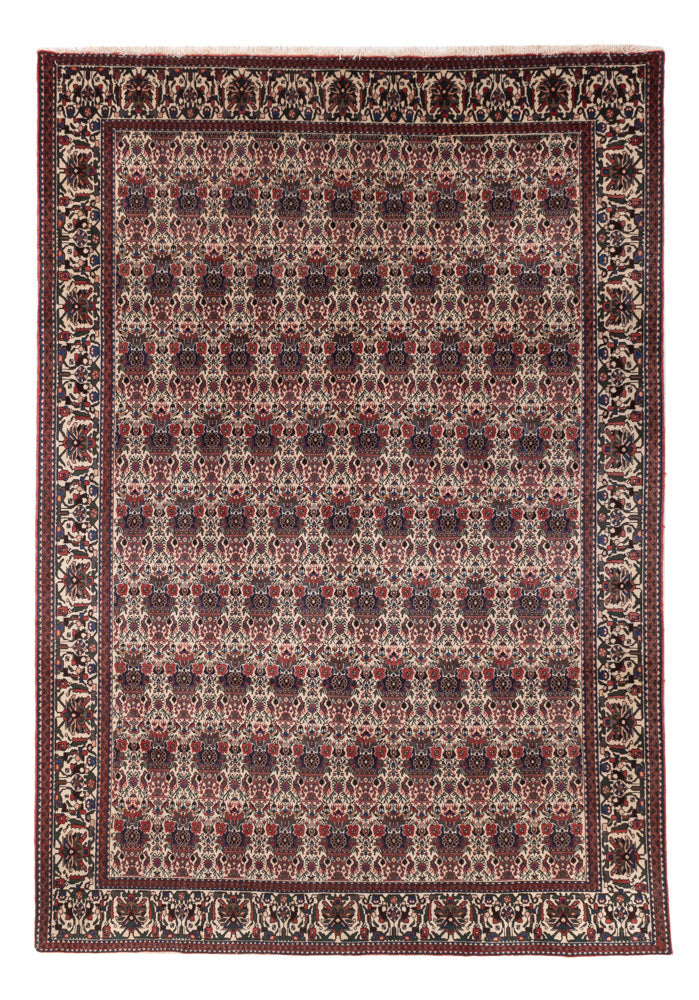
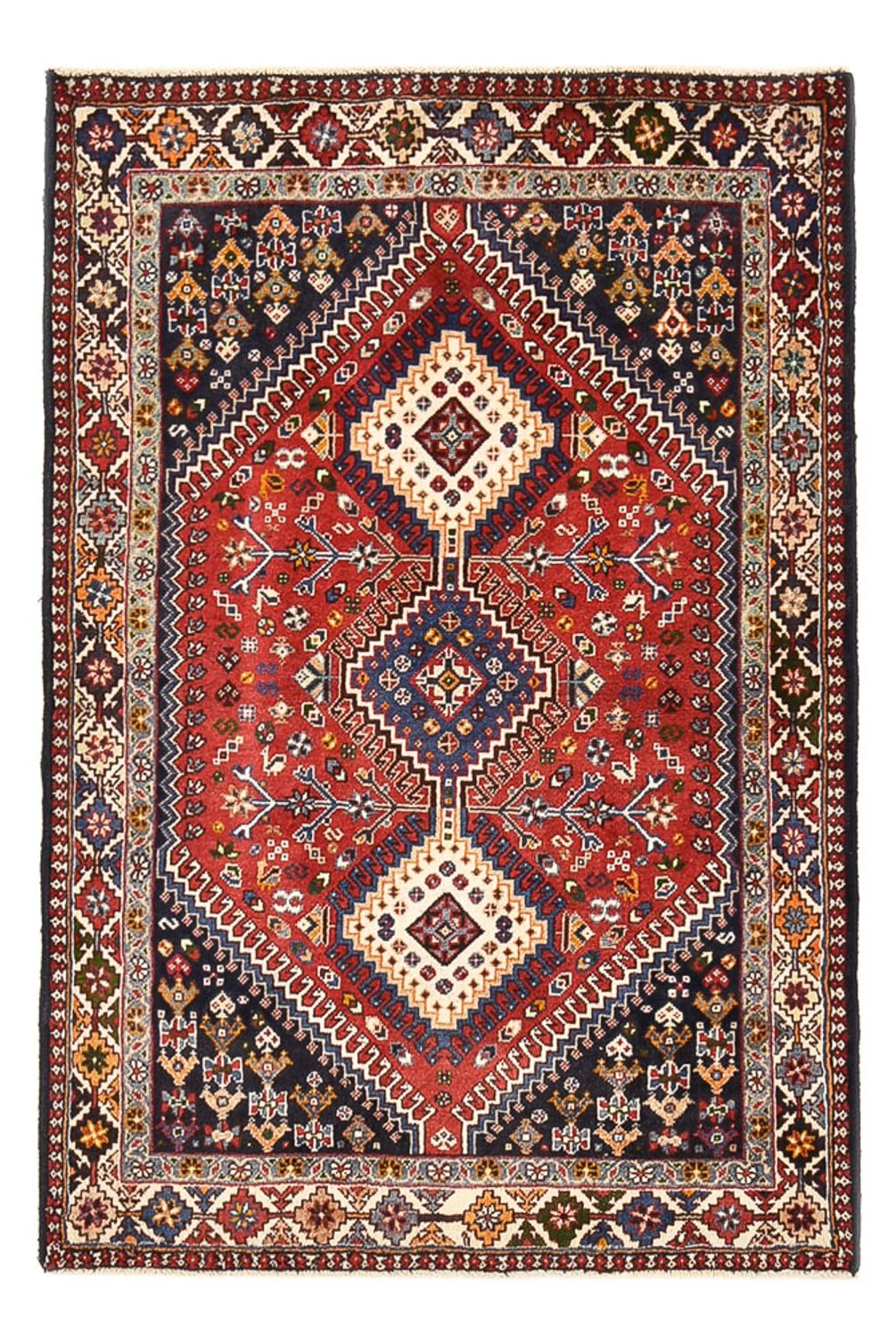
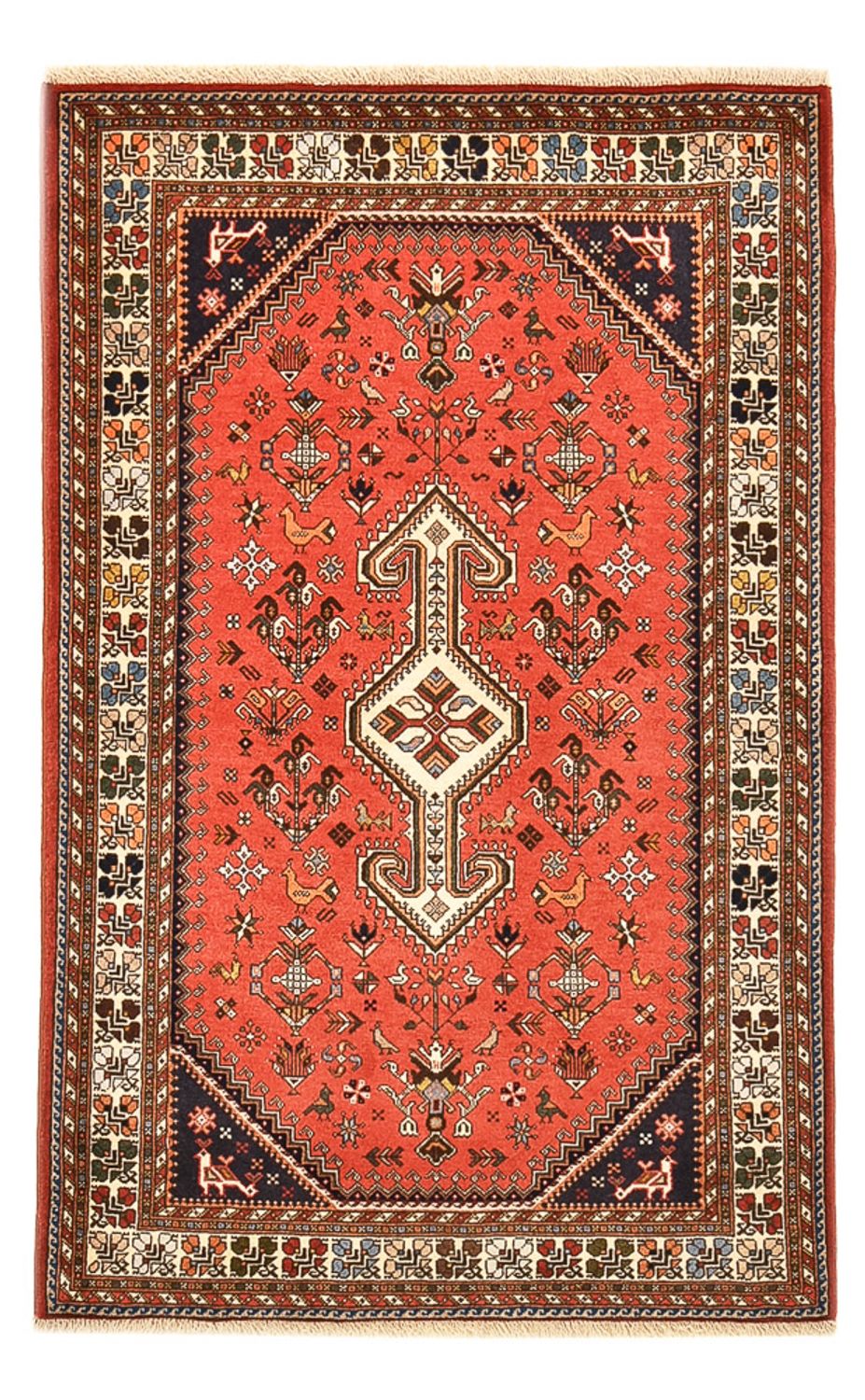
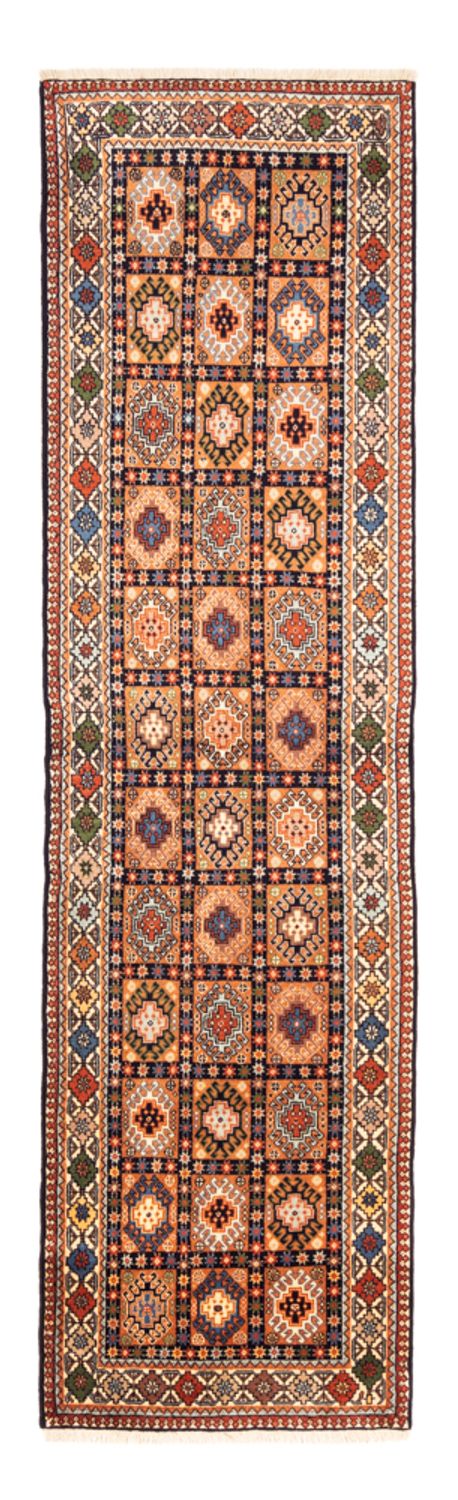
Photo: Morgenland Rugs
Yalameh rugs are bold, geometrically patterned nomad rugs from the Fars province in south-western Persia. They are knotted by the Yalameh, a tribe close to the Qashqai and sharing their tribal knotting tradition. Characteristic are rows of diamond medallions, luminous colours, and a robust, all-wool construction.
What is a Yalameh rug?
A Yalameh is a hand-knotted wool rug of the eponymous tribal group from southern Iran. The most important identifying mark are several diamond-shaped medallions stacked above one another along a central axis, filling the field. The Yalameh therefore belongs to the south-Persian Persian rugs of tribal character.
Within Fars knotting, the Yalameh stands between the high-piled Gabbeh and the finely drawn Kashkuli. It is clearly patterned, bold in colour, and solidly worked, without aiming at the extreme fineness of Kashkuli ware. The stacked diamonds make it recognisable at a glance.
Origin
The Yalameh live in the Fars province and belong to the wider orbit of the Qashqai tribes, the great Turkic-speaking tribal confederation of southern Persia. Like their neighbours, they traditionally led a semi-nomadic life with seasonal migrations. Their weaving traditions reach back through generations and have largely survived despite increasing settlement.
Older trade literature partly assigned the Yalameh to the tribes of the Chahar Mahal va Bakhtiari region and so to the orbit of the Lurs. Today it is mostly listed as a Fars rug from the Qashqai area. This proximity explains the stylistic overlaps with other tribes of the region. Knotting takes place in both nomadic camps and small villages, and trade often runs through the markets of Fars.
Patterns and colours
The Yalameh pattern lives from vertical stacking: several stepped diamond medallions stand above one another along the central axis, surrounded by small geometric scatter motifs. Worked into the field are stylised animals, especially birds and deer, that mirror the knotters' bond with nature. The borders often carry floral vines or stylised blossoms and form an appealing contrast with the strictly geometric inner field.
The colour world is earthy and at the same time luminous: brick red and rust, navy blue and deep indigo, with natural white and beige as bright dividers. This combination of warm reds and cool blue gives the Yalameh its characteristic, high-contrast effect. Traditionally the colours come from plant dyeing, which can produce a lively abrash.
Material and knotting technique
Yalameh rugs are knotted entirely from high-quality sheep's wool, both the pile and the warp and weft. The wool comes from local sheep flocks and is known for its longevity and natural sheen. The pure wool construction gives the rug flexibility and a warm feel underfoot.
Knotting is done, as with the related Qashqai tribes, predominantly with the asymmetric Persian knot, the Senneh knot. On some pieces the symmetric Turkish knot also appears, a variant not unusual with the tribal groups of Fars. The pile is sheared medium-high, which joins clear contours with a pleasant hand. How a rug arises on the loom is described in the overview of production, where the materials used are also explained.
Knot density and quality
The knot density of a Yalameh usually lies between 60,000 and 140,000 knots per square metre, in the solid middle range of nomadic ware. This density ensures good durability without over-refining the bold, geometric pattern language. The Yalameh is conceived as a robust working rug, not as a salon piece.
How knot density influences quality and price is covered in its own article. With the Yalameh, what matters alongside density is wool quality, the luminosity of colours, and the clear stacking of the diamond medallions. Pieces with natural colours and a cleanly drawn pattern count as the best of their kind.
Yalameh and related Fars nomad rugs compared
| Style | Tribe / origin | Knot density | Character |
|---|---|---|---|
| Yalameh | Qashqai-related tribe, Fars | approx. 60,000 – 140,000 / m² | stacked diamond medallions, luminous colours |
| Qashqai | Qashqai confederation, Fars | approx. 80,000 – 180,000 / m² | medallions, animal motifs, lively colours |
| Kashkuli | Qashqai subgroup, Fars | approx. 100,000 – 250,000 / m² | finest nomadic knotting |
| Gabbeh | Qashqai and Lori, Fars and Zagros | approx. 40,000 – 200,000 / m² | coarse, high-piled, abstract |
| Afshar | Afshar tribes, Kerman | approx. 80,000 – 180,000 / m² | boteh and diamond motifs |
| Bakhtiar | Bakhtiari, Zagros | approx. 80,000 – 200,000 / m² | garden patterns, robust village quality |
What is a Yalameh rug worth?
The value of a Yalameh depends on age, condition, size, knot density, rarity of pattern, and wool quality. As a robust tribal rug it sits in the affordable to middle range of Persian nomadic ware. Older pieces with traditional patterns and pure natural colours are more value-stable and sought after by connoisseurs.
Hand-spun wool, luminous plant colours, and a clear, balanced stacking of the medallions all build value. A market-value placement is in the rug value overview and the general buying guide.
How can you tell a genuine Yalameh rug?
Typical features of an authentic Yalameh include:
- Stacked diamond medallions: several stepped diamonds stand above one another along the central axis.
- Pure wool structure: pile, warp, and weft are wool; the yarn feels hand-spun.
- Contrast of red and blue: brick red and navy blue meet natural white and beige.
- Stylised animal motifs: scattered birds and deer are characteristic.
- Floral border: vines or blossoms frame the geometric inner field.
- Hand-knotted back: the pattern stands out clearly; the fringes are part of the warp.
How material, knotting, and origin can be tested is described in the identifying rugs guide, supplemented by identifying provenance.
Care
Thanks to the robust wool quality, a Yalameh is easy to care for. Regular vacuuming in the direction of the pile is enough day to day. Blot spills at once with clear water, do not rub. Professional cleaning every few years preserves the wool. Because natural dyes can be light-sensitive, long, direct sunlight should be avoided. Detailed guidance is in the care overview.
Frequently asked questions
What is the difference between Yalameh and Qashqai?
Both come from the Fars province and share the tribal Qashqai tradition. The Yalameh is particularly memorable through its vertically stacked diamond medallions, while a Qashqai more often shows a single central medallion with dense animal motifs. In fineness both lie in the medium range; the Kashkuli is finer.
Which knot is used for a Yalameh?
Predominantly the asymmetric Persian knot, as with the related Qashqai tribes. On individual pieces the symmetric Turkish knot also appears, which occurs with the tribal groups of Fars and is not a sign of lesser quality.
What sizes are common for Yalameh rugs?
Traditionally smaller to medium formats, roughly between 100 x 150 cm and 150 x 250 cm, fitting the nomadic way of life. Runners and large formats are rarer and mostly of more recent date.
What does a Yalameh rug cost?
As a robust tribal rug, the Yalameh sits in the affordable to middle range. The price is set by age, size, knot density, wool quality, and the rarity of the pattern. Older, naturally dyed pieces are more value-stable.
How do I recognise a genuine Yalameh?
By the vertically stacked diamond medallions, the pure wool structure, the contrast of red and blue, and the scattered animal motifs. The hand-knotted back shows the pattern clearly; the fringes are part of the warp.
Are Yalameh rugs a good store of value?
High-quality, authentic pieces with traditional patterns and natural colours can hold their value. Value depends on age, condition, rarity, and craftsmanship. More on this in the rug value overview.
How do I care for a Yalameh rug correctly?
Vacuum regularly in the direction of the pile, blot spills at once with clear water and do not rub. Professional cleaning every few years and protection from long, direct sunlight preserve wool and colours.
Impressions of the origin
Places, landscapes and landmarks around the home of Yalameh rugs. Click any image for a larger view.
Related styles
Qashqai
Qashqai rugs are knotted by the eponymous nomadic tribe in Fars Province and stand out with their distinctive medallion style.
Gabbeh
Gabbeh rugs are coarsely knotted by Qashqai nomads in the Zagros and feature long pile and abstract symbolism.
Kashkuli
Kashkuli rugs are knotted by a refined Qashqai sub-tribe in Fars and show fine Qashqai medallions in cleaner workshop quality.


