Khal Mohammadi rugs: deep red gül rows from northern Afghanistan
Khal Mohammadi rugs are produced in northern Afghanistan and stand out with their deep red tones and characteristic gül medallions.
- Region
- Afghanistan
- Category
- Nomad rugs
- Manufacturing
- Hand-knotted
- Knot density
- 80,000 – 160,000 knots/m²
Profile
- Manufacturing
- Hand-knotted
- Origin
- Afghanistan — northern provinces
- Pile material
- Wool on wool
- Knot density
- 80,000 – 160,000 knots/m²
- Features
- Deep red ground, gül medallions, dense weave
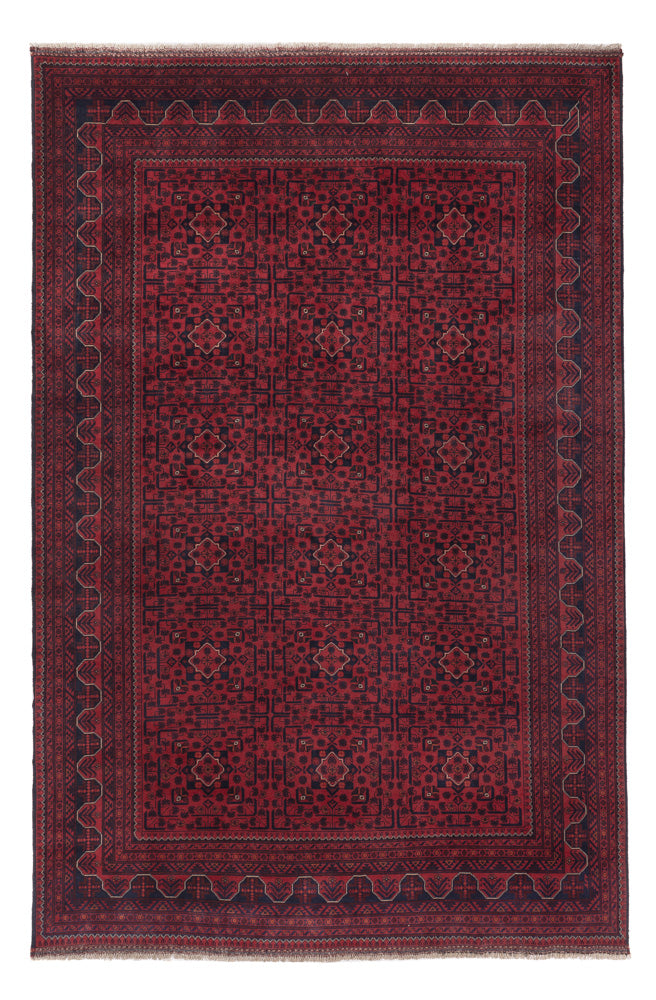
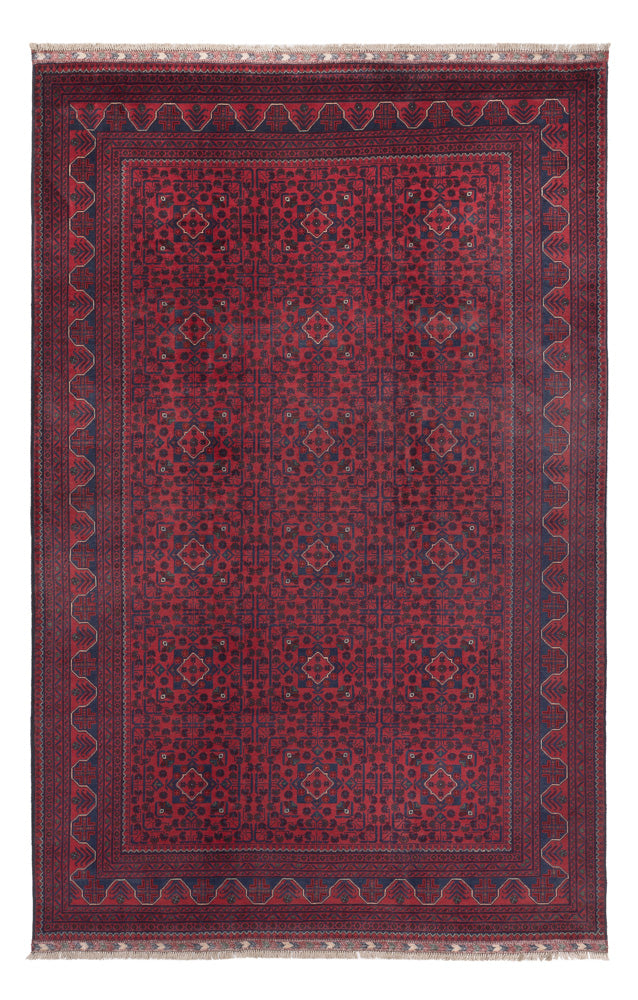
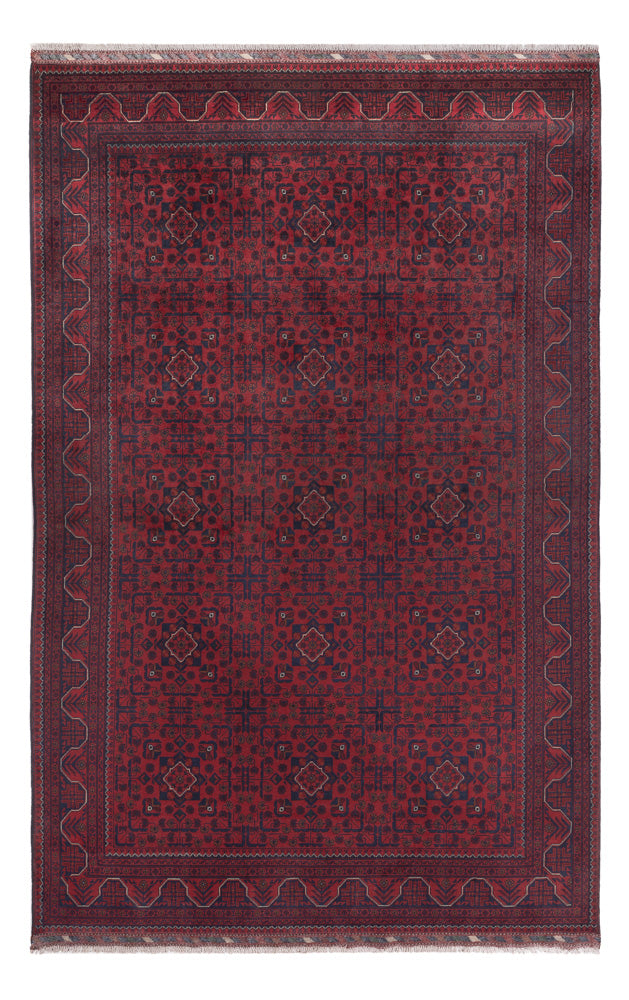
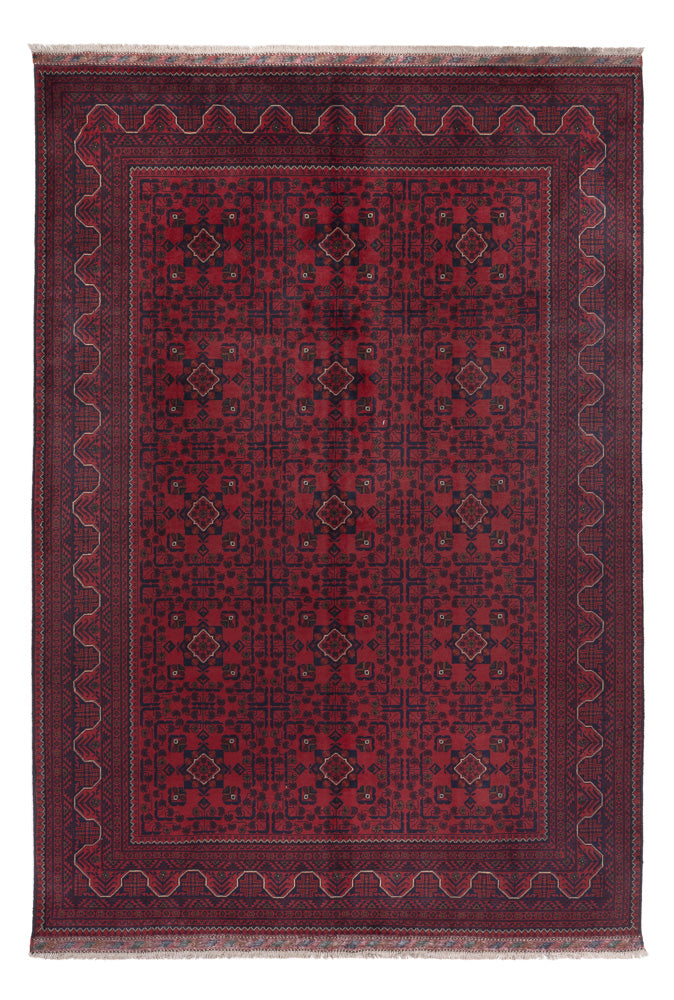
Photo: Morgenland Rugs
The Khal Mohammadi is the best-known Afghan rug of all. Its identifying mark is a particularly deep, dark red-brown crossed by even rows of octagonal gul medallions. It is knotted by Turkmen tribes in the north of Afghanistan, above all in the provinces of Kunduz and Baghlan. Within the nomadic rugs, the Khal Mohammadi stands for the robust, richly colored variant of the Afghan Turkmen rugs and is closely related to the Akhche and the Turkaman.
What is a Khal Mohammadi rug?
A Khal Mohammadi is a hand-knotted Afghan rug of Turkmen tradition, whose field is structured by dense rows of octagonal gul medallions. The name is a trade term that goes back to a tribal and dealer name and has only become established as a brand label in recent decades. Characteristic are the deep wine red to burgundy, the medium-long wool pile, and a solid, everyday-capable knotting. The Khal Mohammadi thus belongs to the same family as the Bukhara, named after the trading place.
Within the Afghan rugs, the Khal Mohammadi forms the dark-red, vigorous line. Where the Ariana serves the Western market with washed, muted colors, the Khal Mohammadi remains the richly colored classic that carries on the Turkmen preference for a dominating red.
Origin
The Khal Mohammadi comes from the northern provinces of Afghanistan, especially from the region around Kunduz and Baghlan. There live Turkmen ethnic groups that have passed down their knotting tradition for generations. The region borders Turkmenistan, from whose tribal areas the visual language of the gul originally comes. After the Russian conquest of Central Asia in the 19th century, many Turkmen families, especially Ersari, settled south of the Amu Darya in northern Afghanistan and brought their tradition with them.
The designation Khal Mohammadi was established as a trade name relatively late. Historically, these rugs were listed under regional names, for example after the market towns of the northern provinces. After the political upheavals of the 20th century, production sites also emerged in Pakistan, where Afghan knotters continued their techniques. Related provenances from the same environment include the Akhche from Jowzjan and the Turkmen door hanging Hatchlu.
Patterns and colors
The defining element of the Khal Mohammadi is the gul, an octagonal medallion arranged in dense, regular rows across the entire field. The guls are connected by a fine line grid and mostly kept in darker reds or black, with fine accents in beige or ivory. The borders follow Turkmen patterns with geometric elements and stylized floral elements. More on the meaning of the gul is in the symbol overview.
The dominant color scheme is a deep wine red to burgundy that gives the Khal Mohammadi its unmistakable, warm effect. Typical is the abrash, a slight shifting of the ground color caused by different dye baths, which lends naturally dyed pieces a lively surface. Modern trade qualities are partly dyed with synthetic dyes, which yield a more even coloring. Background on the dyes is in rug colors and recognize natural dyes.
Material and knotting technique
Khal Mohammadi rugs consist entirely of sheep's wool, both in the pile and in warp and weft. The wool comes from local sheep breeds and is distinguished by robustness and a warm sheen. More on the fibers is in materials and virgin wool. Many modern pieces are washed after knotting, which strengthens the sheen and evens out the surface.
The Khal Mohammadi is knotted predominantly with the asymmetric knot, also called the Persian or open knot, which carries on the Turkmen construction of this region. How the knot types differ is explained in the article on knot types; the entire process from spinning to shearing is in production. The pile is sheared medium-long, the fringes are the extended warp threads at the short sides.
Knot density and quality
Khal Mohammadi rugs belong to the solid, robust nomadic rugs. Knot density usually lies between about 80,000 and 160,000 knots per square meter, which allows good quality with economical production. How knot density affects quality and price is covered in a dedicated guide.
Quality markers are an even knot density, clearly bounded guls, an even pile height, and a natural wool sheen. The following overview places the Khal Mohammadi among the related Afghan types.
| Type | Region / character | Typical features |
|---|---|---|
| Khal Mohammadi | Kunduz, Baghlan, northern Afghanistan | deep wine red, dense gul rows, robust |
| Akhche | Aqcha, Jowzjan | Turkmen gul rows, often somewhat lighter |
| Turkaman | Turkmen (umbrella term) | umbrella term for the Turkmen knottings |
| Bukhara | Turkmen, trade name | finer gul rows, short pile |
| Ariana | northern Afghanistan, modern production | washed, muted colors, floral all-over |
| Baluch | border region Iran/Afghanistan | dark earth tones, small-format prayer rugs |
What is a Khal Mohammadi rug worth?
The value of a Khal Mohammadi depends on age, condition, size, knot density, wool quality, and dyeing. Naturally dyed older pieces with dense knotting and a rich, shifting red are more sought after than evenly synthetically dyed trade ware. Overall, the Khal Mohammadi counts as one of the more affordable hand-knotted oriental rugs and is a popular, robust everyday rug. Why genuine knottings carry their price is explained in the article why genuine rugs are expensive.
For a sound placement, identify valuable Persian rugs offers methodological orientation, alongside the value overview and the buying guide.
How do you recognize a genuine Khal Mohammadi rug?
Typical signs of a genuine Khal Mohammadi include:
- Deep wine red to burgundy as dominant ground color, often with slight abrash.
- Dense rows of octagonal guls, connected by a fine line grid.
- Wool on wool: warp, weft, and pile consist of sheep's wool with a warm sheen.
- Asymmetric knot: the Khal Mohammadi uses predominantly the Persian, open knot of the Turkmen tradition.
- Medium-long pile with an even height and cleanly worked fringes from the warp.
- Hand-knotted back: the pattern is clearly recognizable in mirror image, individual knots are visible.
Since the style is widely reproduced, color, gul shape, material, and back should be assessed together. A step-by-step guide is given in Is my rug genuine?; for regional placement, recognize origin helps.
Care
Thanks to the robust wool, the Khal Mohammadi is easy to care for and durable. Regular vacuuming in the pile direction and occasional professional cleaning preserve color and sheen. Stains should be blotted immediately with clear water, without rubbing, since otherwise naturally dyed pieces can bleed. Long direct sunlight fades the deep red and should be avoided. Detailed notes are in the care overview and under cleaning wool rugs.
Frequently asked questions
Where does the name Khal Mohammadi come from?
Khal Mohammadi is a trade name that goes back to a tribal and dealer name and has only become established as a brand label in recent decades. Historically, these rugs were listed under regional designations of the northern provinces of Afghanistan.
Why are Khal Mohammadi rugs predominantly red?
The deep red is a traditional feature of the Turkmen rug culture from which the visual language of the Khal Mohammadi comes. The characteristic wine red to burgundy has become the most important identifying mark of the style and arises historically from madder.
Which knot does a Khal Mohammadi rug use?
The Khal Mohammadi is knotted predominantly with the asymmetric knot, also called the Persian or open knot, which carries on the Turkmen construction of the region. More on this under knot types.
How does a Khal Mohammadi differ from an Akhche?
Both are Turkmen-shaped rugs from northern Afghanistan with gul rows. The Khal Mohammadi from Kunduz and Baghlan shows a particularly deep wine red with dense gul arrangement; the Akhche from Jowzjan often comes out somewhat lighter and coarser.
Are Khal Mohammadi rugs suitable for allergy sufferers?
Khal Mohammadi rugs in pure sheep's wool are generally well tolerated, since wool regulates moisture and offers little nourishment to dust mites. With a specific wool allergy, it should be checked before purchase whether the material is tolerated.
How do I care for a Khal Mohammadi rug properly?
Regular vacuuming in the pile direction and professional cleaning every few years suffice. Blot stains immediately with clear water, without rubbing. Long direct sunlight should be avoided so the deep red does not fade.
Impressions of the origin
Places, landscapes and landmarks around the home of Khal Mohammadi rugs. Click any image for a larger view.


