Sarouk rugs: dense floral knotting from the Arak region
Sarouk rugs come from the Arak area and are classic floral Persian rugs with dense knotting and a deep red ground.
- Region
- Persia / Iran
- Category
- Persian rugs
- Manufacturing
- Hand-knotted
- Knot density
- 150,000 – 400,000 knots/m²
Profile
- Manufacturing
- Hand-knotted
- Origin
- Iran — Arak region, Markazi Province
- Pile material
- Wool on cotton
- Knot density
- 150,000 – 400,000 knots/m²
- Features
- Floral medallions, deep red ground, dense knotting
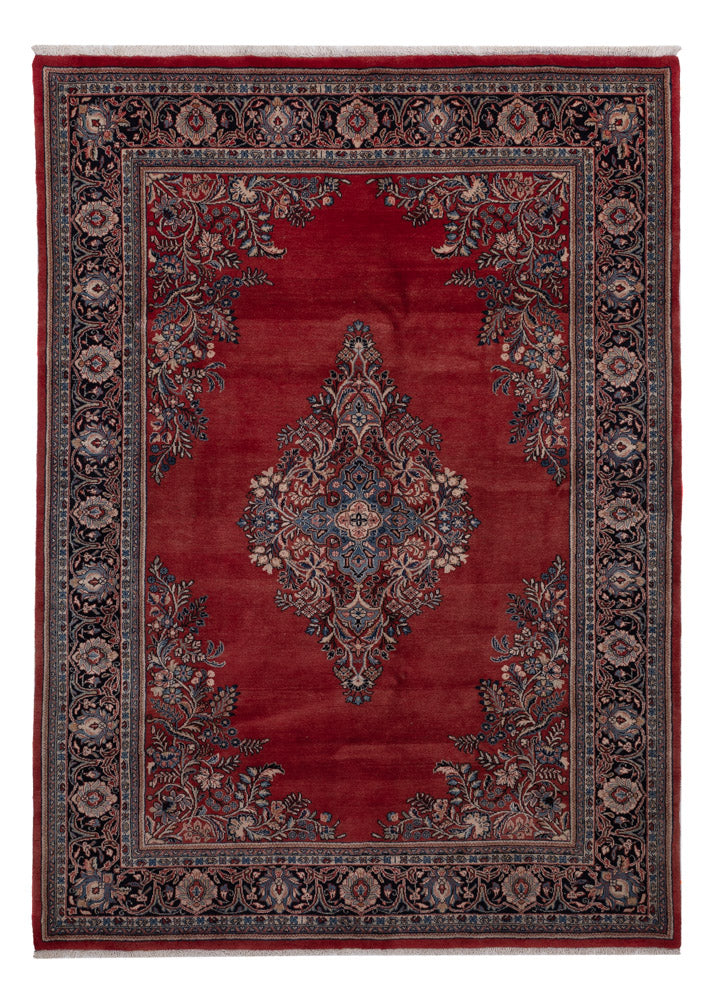
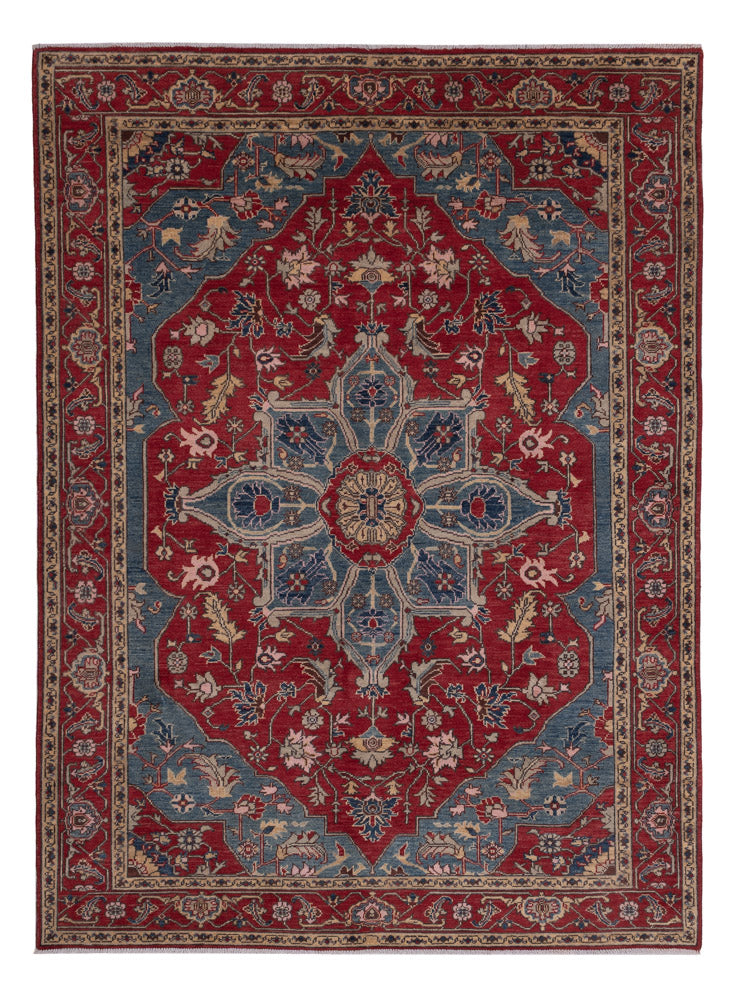
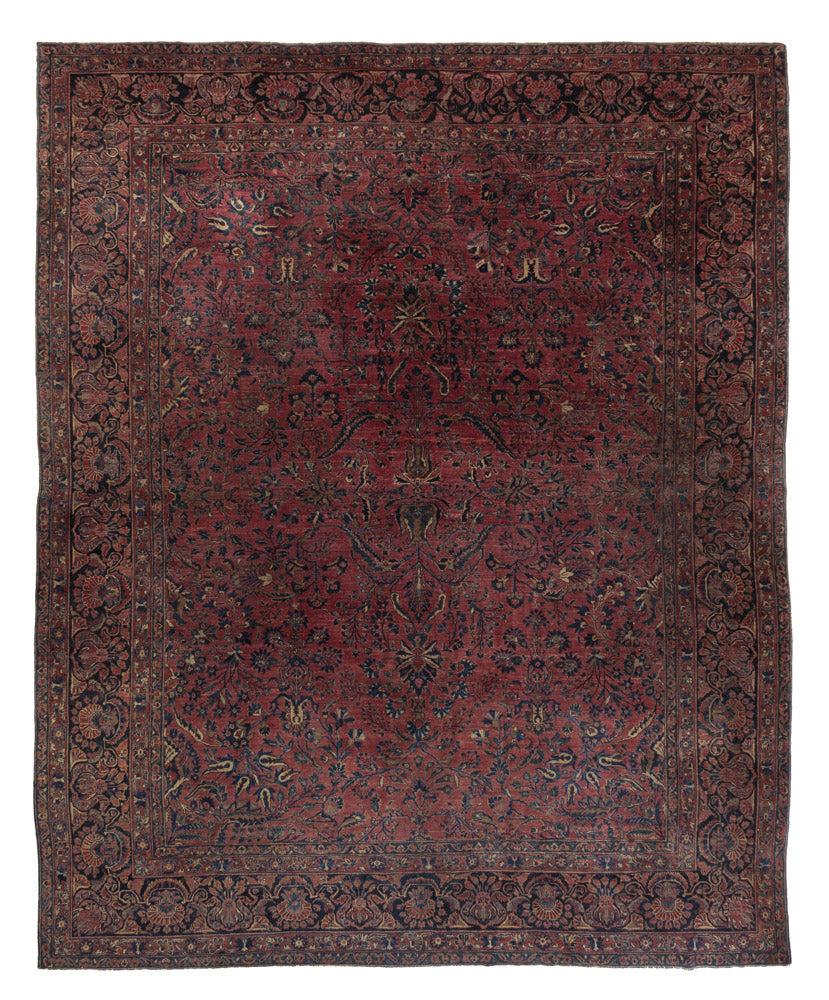
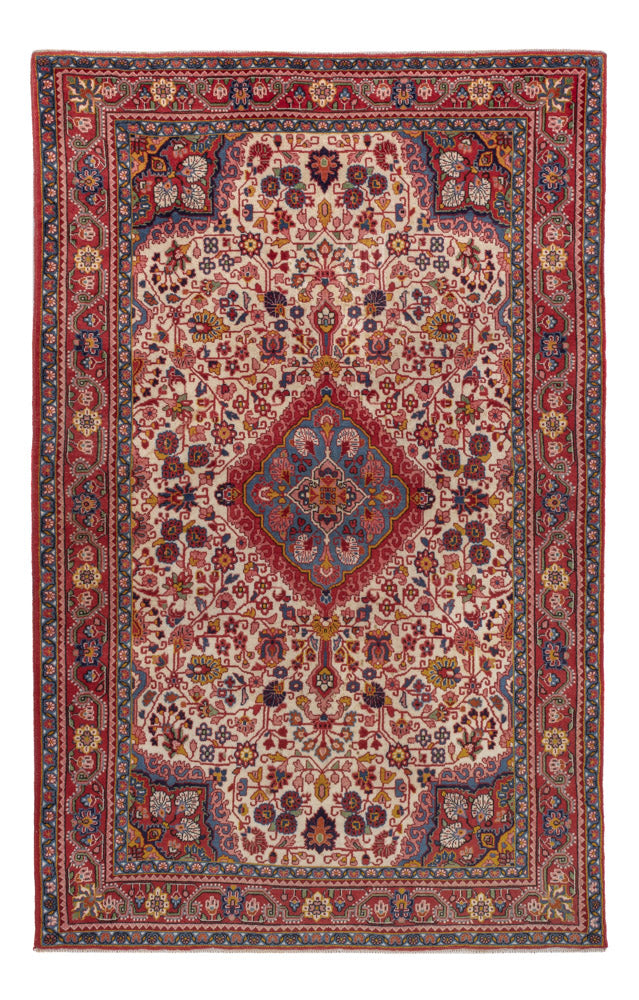
Photo: Morgenland Rugs
Sarouk rugs are hand-knotted Persian rugs from the region around Arak in central Iran, known for dense floral patterns, a full, medium-depth pile, and a muted, elegant palette. They are among the most robust of the fine Persian rugs and enjoyed an unparalleled demand on the American market in the first half of the 20th century. The Sarouk combines the floral elegance of workshop ware with a firmness that makes it more suitable for daily use than many of its central-Persian relatives.
What is a Sarouk rug?
A Sarouk is a hand-knotted rug from the village of Sarouk and the surrounding knotting area in the province of Markazi, south of the town of Arak. Characteristic features include a floral pattern, a dense, medium-depth wool pile, a cotton warp, and the fine asymmetric Persian knot. Unlike the geometric village rugs from Heriz or Bidjar, the Sarouk follows a curvilinear, floral visual language, but through its fuller pile and dense patterning feels stronger and more usable than the filigree pieces from Keschan or Nain.
The name Sarouk stands for a whole group of related provenances from the Arak area. This family includes Lilian, Jozan, and Mahal, each with its own patterns and quality grades, but often named alongside the Sarouk in trade.
Origin: Sarouk and the knotting area around Arak
Sarouk lies about 40 kilometres south of Arak in the province of Markazi and counts among the most important rug regions of central Iran. The area looks back on a long knotting tradition, but the commercial significance of the Sarouk only grew in the late 19th century. Production peaked in the first half of the 20th century, when Sarouk rugs became a fixed part of upmarket American home interiors and were exported in large numbers.
From this export history comes the best-known term around the style: the American Sarouk. This is the name for rugs originally knotted in rather dark, saturated colours and then chemically treated afterwards to lighten them for the western taste of the time and give them a characteristic rose or salmon tone. This Sarouk wash shaped the picture of the style in the West for decades. Geographically and stylistically the Sarouk stands close to the neighbouring Mahal and the finer Lilian, which also come from the Arak area.
Patterns and colours
The classical Sarouk design consists of a central floral medallion surrounded by densely set vines, rosettes, and palmette-like motifs. The all-over pattern is also widespread, in which a floral repeat without a medallion covers the entire field. A particularly well-known variant of the early 20th century shows individual bouquets loosely distributed across the field on a rose or red ground, the typical signature of the American Sarouk.
The palette is muted and elegant, dominated by saturated reds, blues, and beiges as well as the characteristic dusty rose of the washed export ware. The border is usually built up in several tiers, with the main border often featuring the Herati pattern or stylised blossom motifs. The drawing feels organic and lively because the floral patterning is not held strictly symmetrical but keeps a natural flow.
Material and knotting technique
Sarouk rugs are knotted from high-quality sheep's wool from local flocks, valued for its toughness and full hand. The warp is traditionally cotton; older pieces also use wool warps, the weft is usually cotton. The characteristic dense, medium-depth pile gives the Sarouk its heavy, saturated hand and makes it comparatively robust.
The Sarouk is knotted with the asymmetric Persian knot, also called the Senneh knot. This binding loops around only one of the two warp threads and allows the fine, curvilinear drawing of floral patterns with soft contours. The Sarouk thus belongs to the great majority of central-Persian provenances that use the Persian knot, in contrast with the Turkish knot of the north-west Iranian village rugs such as Heriz. The differences between the two basic knots are covered in the article on knot types and on production.
The wool is traditionally dyed with natural colours; since the early 20th century chemical dyes have also been in use. The pile is sheared at medium length, which gives the Sarouk its characteristic, slightly full feel. The careful workmanship and high-quality materials make the Sarouk a long-lived and hard-wearing rug.
Knot density and quality
The knot density of a Sarouk typically lies between 200,000 and 400,000 knots per square metre; particularly fine examples can sit higher. That is a solid to high density that fits the detailed floral drawing without reaching the filigree fineness of a Ghom or Isfahan. With the Sarouk, what matters is not the maximum knot count but the combination of dense knotting, full pile, and harmonious patterning. How knot density influences quality and price, and why it must always be read together with material and craftsmanship, is explained in its own article.
Decisive for the quality of a Sarouk are the wool, the density of the pile, the cleanness of the drawing, and the dye. To assess quality, look for a full, firm hand, an even back, clearly drawn blossom motifs, and a harmonious colour picture. With washed export ware, it is worth checking whether the lightening came out evenly and whether the pile has not suffered from the treatment.
Sarouk and related provenances compared
| Provenance | Relation to Sarouk | Typical features |
|---|---|---|
| Sarouk | parent term and main town | dense floral patterns, full pile, muted colours |
| American Sarouk | 20th-century export variant | lightened, dusty rose, often bouquets in the field |
| Lilian | neighbouring provenance | floral, often finer, own colour nuances |
| Jozan | provenance in the Sarouk area | very firm, bold medallion, high quality |
| Mahal | neighbouring provenance (Arak) | coarser, decorative all-over patterns |
| Keschan | classical workshop rug | finer, short pile, dark ground |
| Indo-Sarouk | Indian reproduction | same design, different wool, usually less expensive |
What is a Sarouk rug worth?
The value of a Sarouk depends above all on age, condition, size, wool quality, dye, density, and provenance. High-quality old Sarouks, especially examples from the classical production period of the first half of the 20th century, can certainly hold their value and are sought after by collectors. Well-preserved American Sarouks with a harmonious wash and fine blossom patterns regularly fetch good prices on the market. New Sarouk rugs, by contrast, are primarily high-quality working pieces in the middle of the price range.
Indian reproductions such as the Indo-Sarouk take over the design but usually differ in wool and knotting and sit lower in price. For a grounded assessment, see the rug value overview, the guide Identifying valuable Persian rugs, and the general buying guide. How age affects value is covered in the article that explains why old rugs become more valuable.
How can you tell a genuine Sarouk rug?
Typical signs of a genuine Sarouk include:
- Fine asymmetric Persian knot: the back shows an even, fine knot pattern with the Senneh knot and a visible cotton warp.
- Dense, medium-depth pile with a full, heavy hand that makes the Sarouk feel more robust than many other floral Persian rugs.
- Floral patterns of medallion, all-over vines, or individual bouquets, in an organically flowing rather than strictly symmetrical drawing.
- Muted, harmonious colours; on export ware often the characteristic dusty rose or salmon tone of the Sarouk wash.
- Soft, supple wool of good hand and sheen.
- Fringes as extended warp, not sewn on afterwards.
A step-by-step check is set out in Is my rug genuine?. Whether the colours are natural or synthetic can be judged with the corresponding article, which is particularly informative for the Sarouk because of the historical wash. Note: floral rugs in the Sarouk style are today also made in India as Indo-Sarouk and differ in wool and knotting from the Persian original.
Care
Thanks to the dense, firm pile, the Sarouk is comparatively easy to care for. Regular vacuuming in the direction of the pile, occasional turning for even wear, and professional cleaning every few years preserve sheen and substance. Spills should be blotted at once with clear water from the outside inward, without rubbing. Long, direct sunlight will fade the colours, so the location should be chosen with care. Detailed guidance is in the care overview and the guide on cleaning a wool rug.
Frequently asked questions
What is an American Sarouk?
American Sarouk is the term for rugs of the first half of the 20th century that were originally knotted in dark, saturated colours and then chemically washed to lighten them for the western market. This produced the characteristic dusty rose or salmon tone. Many of these pieces show individual bouquets loosely distributed across the field and have developed a fine patina over time.
What does a Sarouk rug cost?
Prices depend on age, size, condition, and quality. New Sarouk rugs are high-quality working pieces in the middle of the price range, while well-preserved old examples from the classical production era trade considerably higher. Particularly fine antique Sarouks and rare pictorial variants fetch collector prices.
What is the difference between Sarouk and Keschan?
Both are floral central-Persian rugs with the Persian knot, but the Sarouk has a denser, medium-depth pile and a fuller hand, while the Keschan is more finely knotted and shows a short-sheared pile with sharper contours. The Sarouk therefore feels stronger and more usable; the Keschan more filigree and more formal.
What is the difference between a Sarouk and an Indo-Sarouk?
An Indo-Sarouk is a reproduction made in India in the Sarouk style. These pieces are usually less expensive, take over the floral patterns, but often have a different wool quality and slightly modified drawing. Genuine Sarouk rugs come exclusively from the knotting area around Arak in central Iran.
Are Sarouk rugs a good store of value?
High-quality old Sarouks can be value-stable, especially examples from the classical production period with good wool and harmonious dyeing. Value development depends on condition, age, size, and quality. New Sarouk rugs by contrast are primarily working objects, not an investment.
How do I care for a Sarouk rug correctly?
Regular vacuuming in the direction of the pile, occasional turning, and professional cleaning every few years preserve its beauty. Blot spills at once with clear water, without rubbing, and avoid long, direct sunlight. Thanks to the dense pile, the Sarouk is more robust in daily use than many finer Persian rugs.
Impressions of the origin
Places, landscapes and landmarks around the home of Sarouk rugs. Click any image for a larger view.
Related styles
Lilian
Lilian rugs come from a village in the Markazi province and show classic Sarouk-style floral medallions in compact sizes.
Mahal
Mahal rugs come from the Arak region (historic Sultanabad) and combine open all-over floral fields with antique appeal.
Jozan
Jozan rugs come from the Malayer district of Hamadan Province and combine classic Sarouk-style medallions with sturdy village quality.
Farahan
Farahan rugs come from the Arak area of Markazi Province and are sought-after for their classic Herati patterns and harmonious colors.


