Kayseri rugs: floral court patterns from central Anatolia
Kayseri rugs come from Cappadocia and offer classical Anatolian patterns in a wide range of qualities and sizes.
- Region
- Turkey
- Category
- Turkish rugs
- Manufacturing
- Hand-knotted
- Knot density
- 100,000 – 400,000 knots/m²
Profile
- Manufacturing
- Hand-knotted
- Origin
- Turkey — Kayseri, Cappadocia
- Pile material
- Wool, cotton or art-silk on cotton
- Knot density
- 100,000 – 400,000 knots/m²
- Features
- Anatolian patterns, wide quality range, classical formats
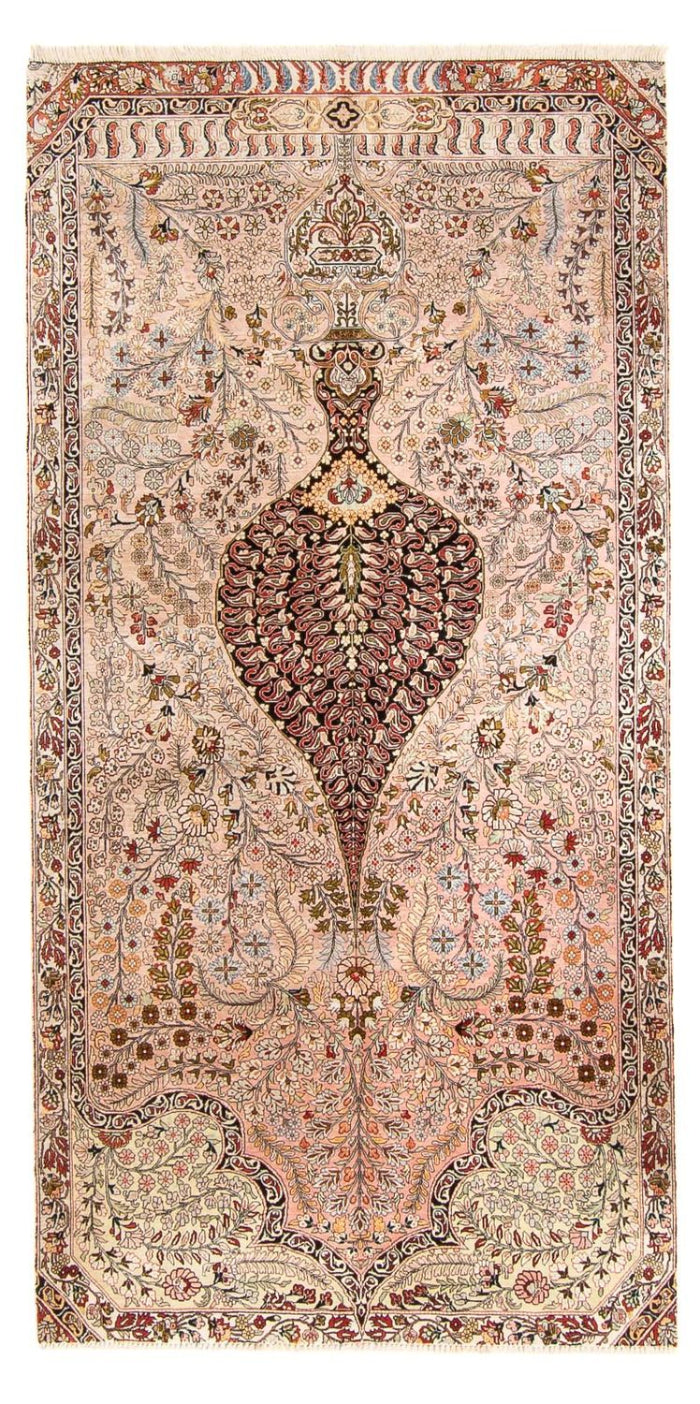
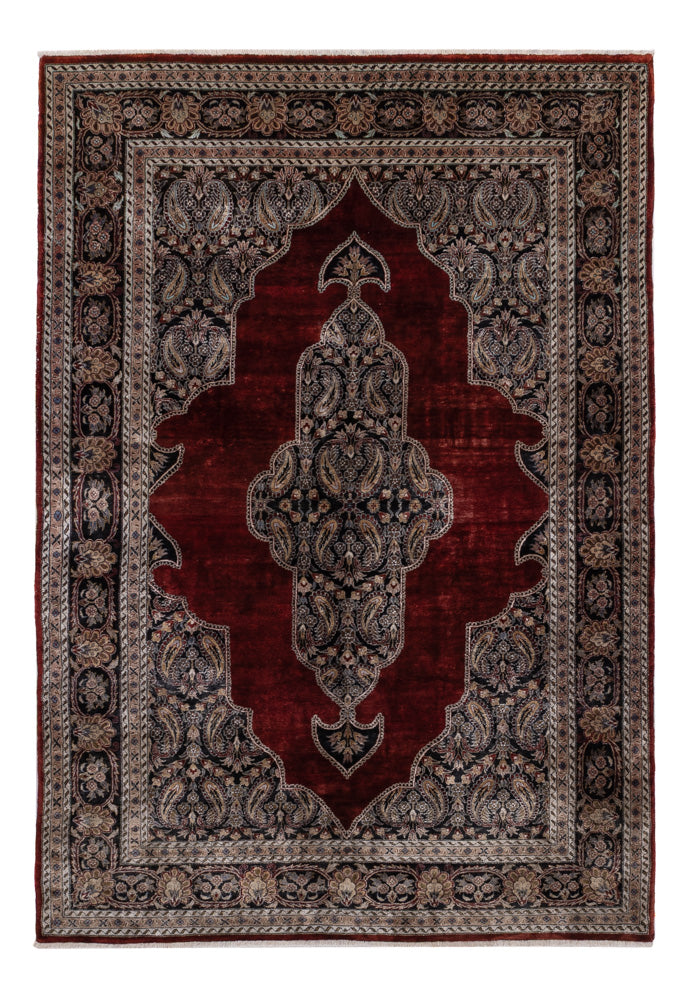
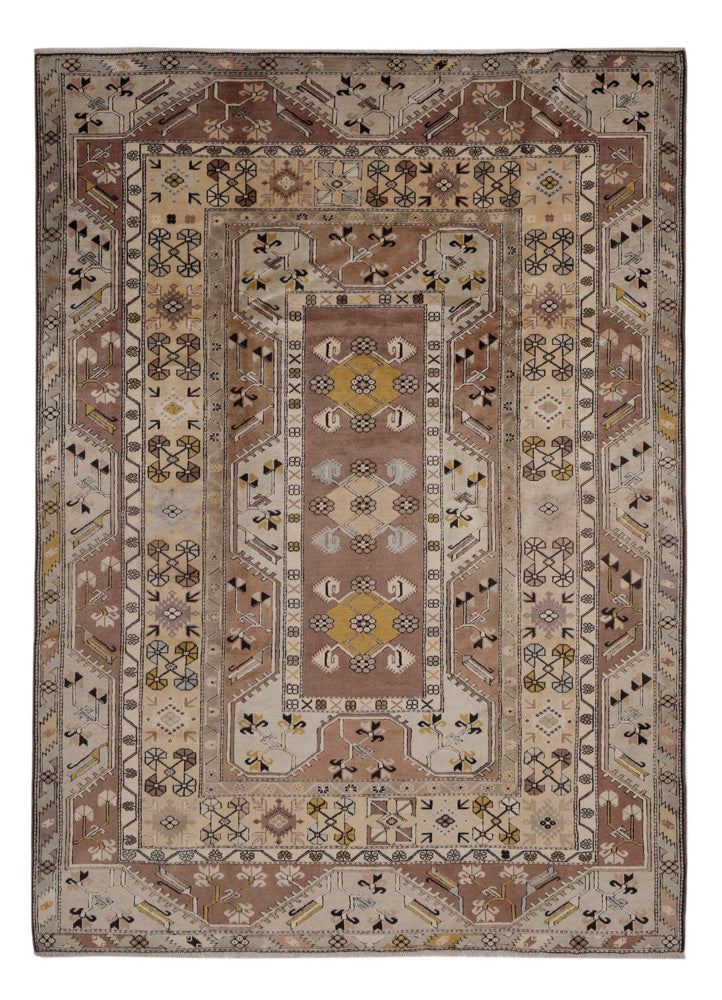
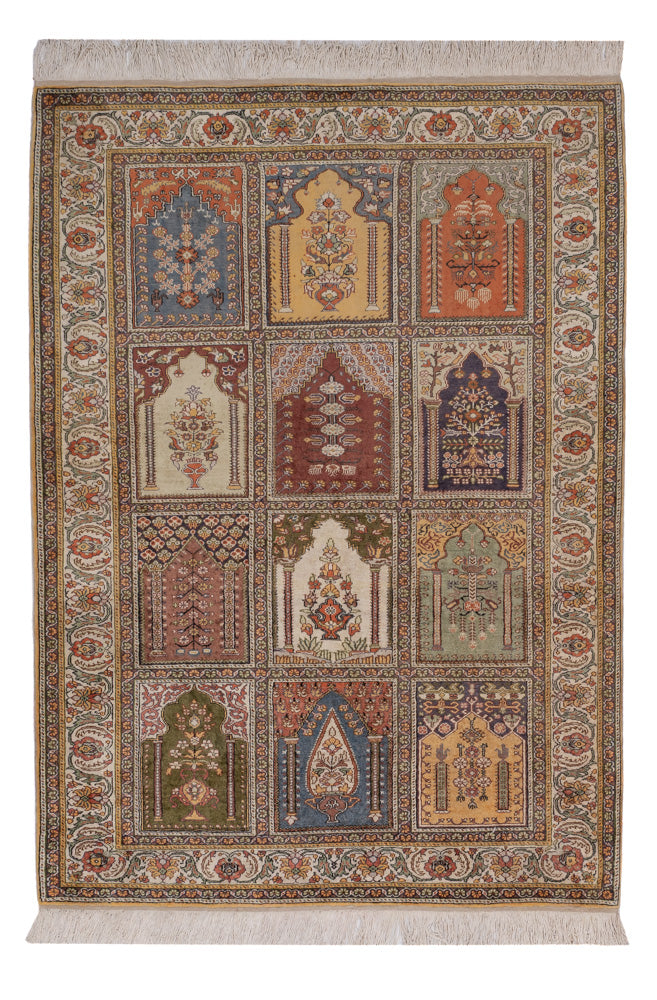
Photo: Morgenland Rugs
Kayseri rugs come from the central Anatolian city of Kayseri at the foot of Mount Erciyes in Turkey and belong to the most versatile Turkish knotted ware. The city has been a trading hub on the historical Silk Road for centuries, and that shapes its rugs to this day: Kayseri is knotted in fine wool, in lustrous floss silk, and in genuine silk. Characteristic are elegant floral court patterns, finely drawn prayer niches, and a restrained, harmonious palette. Knotting is always done with the symmetric Turkish knot.
What is a Kayseri rug?
A Kayseri is a hand-knotted Turkish rug from the city of Kayseri and its surroundings in central Anatolia. The name stands less for a single pattern than for a broad workshop program: Kayseri workshops draw on classical Persian and Ottoman court motifs and translate them into different materials and grades of fineness. Knotting uses the symmetric Turkish knot, the Ghiordes knot, on a warp that is usually cotton.
Kayseri is thus the Anatolian counterpart to the fine court workshops of Hereke, on which it often models itself stylistically. By comparison, the Kayseri is usually somewhat more coarsely knotted and therefore more affordable, without giving up its elegant, floral character. It differs from the geometric large-format rugs from Usak through its finer drawing and more curving patterns.
Origin
Kayseri, the ancient Caesarea in Cappadocia, lies about 300 kilometers southeast of Ankara at the foot of the extinct volcano Mount Erciyes. Important trade routes have run through the city since antiquity, and in the Middle Ages Kayseri was a major transshipment point on the Silk Road. This trade in silk and textiles laid the groundwork for later rug production.
Kayseri developed into a self-contained rug center especially in the 19th and early 20th centuries. From the start, the workshops modeled themselves on the fine court patterns of the Ottoman workshops, particularly Hereke, and at the same time adapted Persian models from Tabriz and Isfahan. This produced a style that combines Anatolian knotting tradition with the elegance of courtly models. In the second half of the 20th century, Kayseri grew into one of Turkey's most important production and trading centers, producing specifically for export. Much is still made today in small family workshops where knotting know-how is passed down across generations.
Patterns and colors
Kayseri rugs show predominantly floral and floral-geometric patterns. Common are central medallion designs, continuous palmette and arabesque vines, and stylized blossom fields. Particularly characteristic is the prayer rug with a finely drawn mihrab niche, often complemented by a hanging mosque lamp and column motifs. Many pieces also draw on the famous Four Seasons and garden designs, which divide the field into compartments with blossoms, trees, and birds.
The palette is usually restrained and elegantly balanced. Deep reds and blues dominate, complemented by beige, cream, and ivory, often with subtle pastel nuances. Pieces in floss silk or genuine silk add a marked sheen that makes the colors shift with the angle of light. The borders are carefully and usually multi-tiered and pick up the floral motifs of the field.
Material and knotting technique
Kayseri rugs are made in three material variants, which accounts for their versatility. The classic variant is the wool rug in firm Anatolian virgin wool on a cotton warp. Alongside it stands the characteristic Kayseri in floss silk, a heavily lustrous, mercerized cotton often called art silk or mercer silk in the trade, which offers a silk-like shimmer at a lower price. The highest-quality variant is the rug in genuine silk, which achieves the finest drawing and the strongest sheen. Which fibers are used in oriental rugs is covered in the overview of materials.
The Kayseri is knotted exclusively with the symmetric Turkish knot, also called the Ghiordes knot, typical for all of Anatolia. The pile is sheared short so that the floral patterns come through sharply and precisely. How the individual work steps from spinning through knotting to shearing proceed is described in the article on production. After knotting, the rugs are washed and sheared to bring out the characteristic sheen.
Knot density and quality
The knot density of a Kayseri depends on the material. Wool qualities often lie between 100,000 and 250,000 knots per square meter, while fine floss silk and genuine silk pieces reach 250,000 to over 400,000 knots. This higher density is the prerequisite for the filigree floral patterns and the sharp outlines of the fine variants. How knot density affects quality and price is covered in detail in a dedicated article.
Quality markers of a Kayseri are even knotting, cleanly drawn contours, a balanced color picture, and, in silk pieces, a deep, shifting sheen. Important is the honest material statement: floss silk is a high-quality but cheaper material than genuine silk, and the two should be clearly distinguished. Which material is actually present can be checked using the notes in recognize silk.
| Feature | Expression in Kayseri |
|---|---|
| Knot type | symmetric Turkish knot (Ghiordes) |
| Knot density | approx. 100,000 to 400,000 knots/m² |
| Pile material | virgin wool, floss silk, or genuine silk |
| Warp | mostly cotton, in silk pieces also silk |
| Pile height | sheared short |
| Typical patterns | floral medallions, mihrab prayer niches, garden and Four Seasons designs |
| Models | Hereke, Persian court patterns from Tabriz and Isfahan |
What is a Kayseri rug worth?
The value of a Kayseri rug depends primarily on the material. Wool qualities sit in the mid price segment and are a good entry into finer Turkish knotted ware. Pieces in floss silk sit above that, offering a very attractive sheen-to-price ratio. Rugs in genuine silk with high knot density reach the highest values and approach the level of fine silk rugs. Size, age, condition, and the cleanness of the drawing add to that.
Because the material question is so decisive here, careful inspection before buying is worthwhile. Orientation is provided by the value overview, the article why genuine rugs are expensive, and the general buying guide.
How do you recognize a genuine Kayseri rug?
Typical signs of a genuine, hand-knotted Kayseri include:
- Hand-knotted back: the floral pattern is clearly recognizable in mirror image, individual knots are visible.
- Symmetric Turkish knot: the Kayseri is worked with the Ghiordes knot, typical of Anatolia.
- Fine floral court patterns: medallions, arabesques, and prayer niches instead of coarse geometry.
- Honest material statement: wool, floss silk, and genuine silk are clearly distinguished; a burn test on a loose fiber exposes pretended silk.
- Shifting sheen in silk and floss silk pieces, which changes with the angle of light.
- Fringes as part of the warp, not added afterwards.
Since floss silk is occasionally passed off as genuine silk in the trade, material, knot type, back, and pattern should be checked together. A step-by-step guide is given in Is my rug genuine?; material testing is explained in recognize silk.
Care
Wool Kayseri rugs are easy to care for: regular vacuuming in the pile direction and occasional professional cleaning suffice. Pieces in floss silk and genuine silk are more delicate and should be handled gently, best vacuumed without a rotating brush and, when in doubt, cleaned by an expert. Long direct sunlight fades the colors and should be avoided. Stains are blotted immediately with clear water, without rubbing; with silk, treatment belongs in expert hands. Detailed notes are in the care overview.
Frequently asked questions
Are Kayseri rugs made of silk or wool?
Both are possible. Kayseri is knotted in firm virgin wool, in lustrous floss silk, and in genuine silk. The choice of material significantly determines sheen, fineness, and price, which is why it should always be clearly named at the point of sale.
What is floss silk in a Kayseri rug?
Floss silk is a heavily lustrous, mercerized cotton often called art silk or mercer silk in the trade. It gives the Kayseri a silk-like shimmer at a markedly lower price than genuine silk but should not be equated with it.
How does a Kayseri differ from a Hereke rug?
Both are fine Turkish workshop rugs with floral court patterns. The Hereke is regarded as the finest and most prestigious provenance with the highest knot density and often a knotted-in signature. The Kayseri draws on similar patterns, is usually somewhat more coarsely knotted, and therefore more affordable.
Are Kayseri rugs Turkish or Persian?
Are Kayseri rugs long-lasting?
Wool Kayseri rugs are very long-lasting and suitable for everyday use thanks to firm virgin wool and solid knotting. Fine silk pieces, by contrast, are more delicate and are more representative living and collector rugs than everyday rugs for heavily walked rooms.
How do I care for a Kayseri silk rug properly?
Silk and floss silk Kayseri rugs are vacuumed gently and without a rotating brush, protected from direct sunlight, and not placed in damp or heavily walked rooms. Stains and deep cleaning belong in the hands of a specialized cleaner.
Impressions of the origin
Places, landscapes and landmarks around the home of Kayseri rugs. Click any image for a larger view.


