Qaraja rugs: angular medallion chain with camel-hair accent
Karaja rugs come from the Arasbaran forests of East Azerbaijan and show simple geometric medallions in long runner formats.
- Region
- Persia / Iran
- Category
- Persian rugs
- Manufacturing
- Hand-knotted
- Knot density
- 70,000 – 160,000 knots/m²
Profile
- Manufacturing
- Hand-knotted
- Origin
- Iran — Arasbaran, East Azerbaijan Province
- Pile material
- Wool on cotton
- Knot density
- 70,000 – 160,000 knots/m²
- Features
- Geometric medallions, often runner formats, robust pile
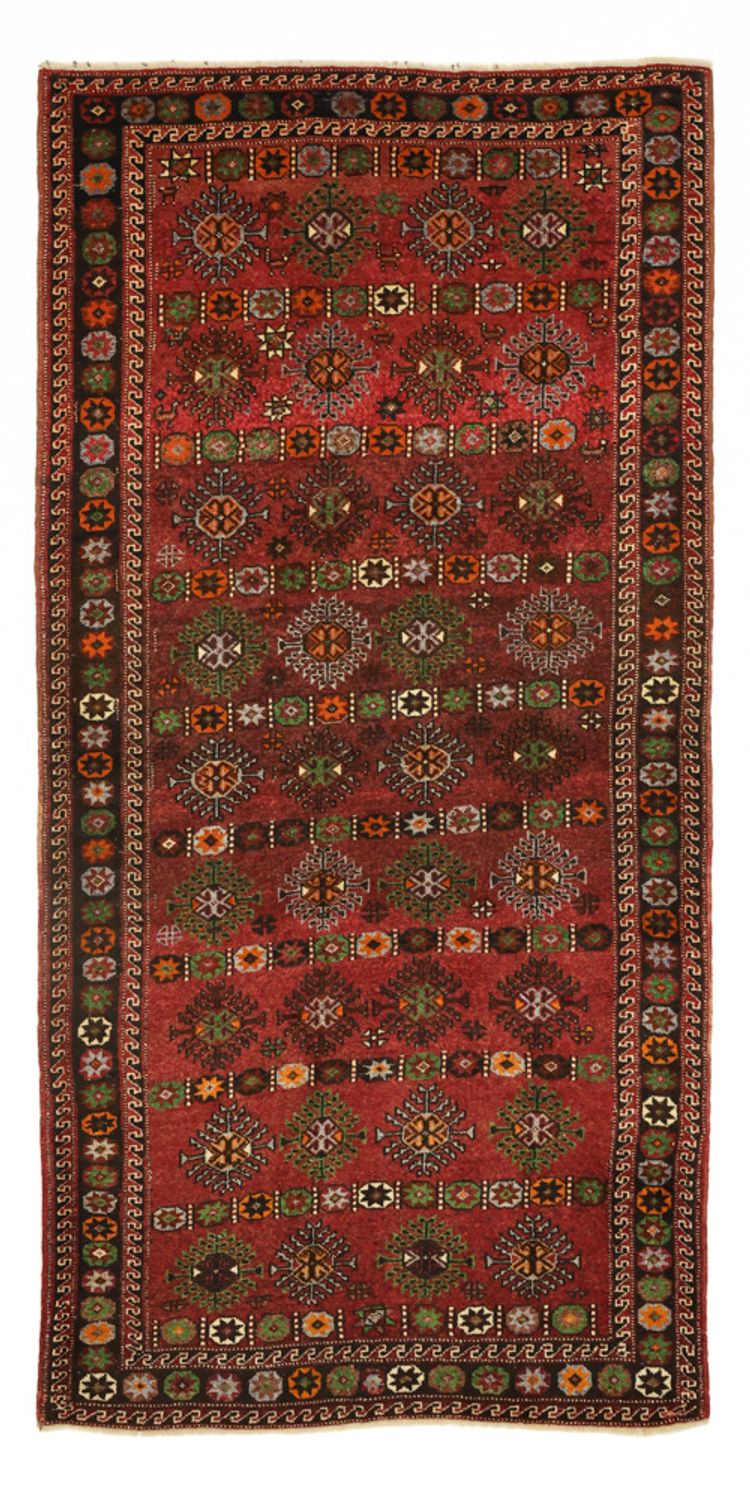
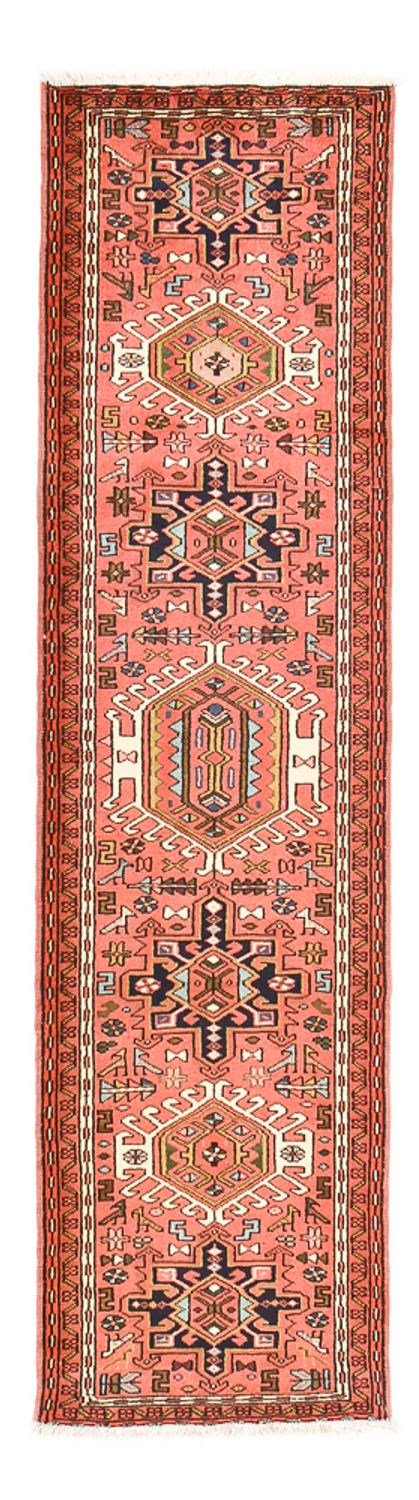
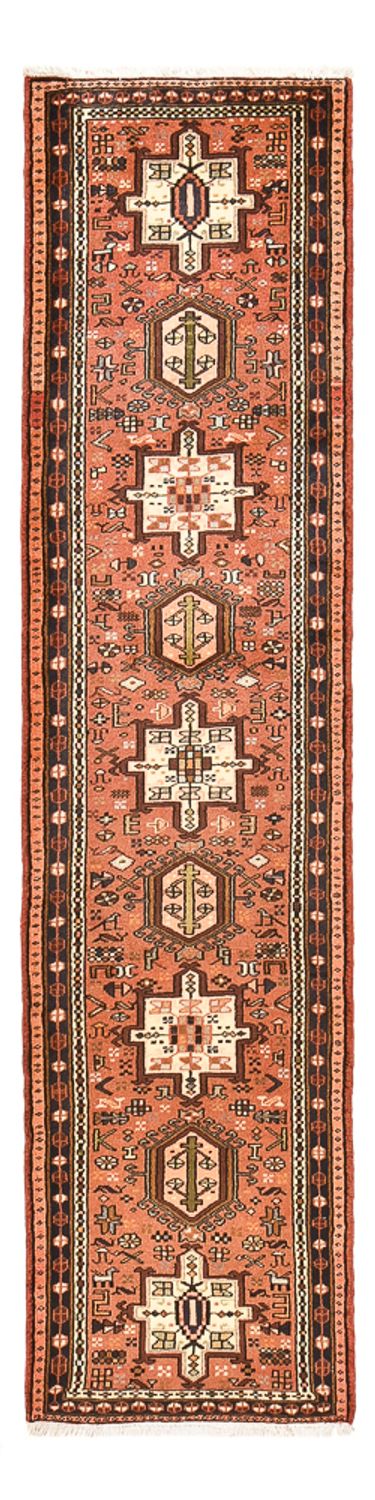
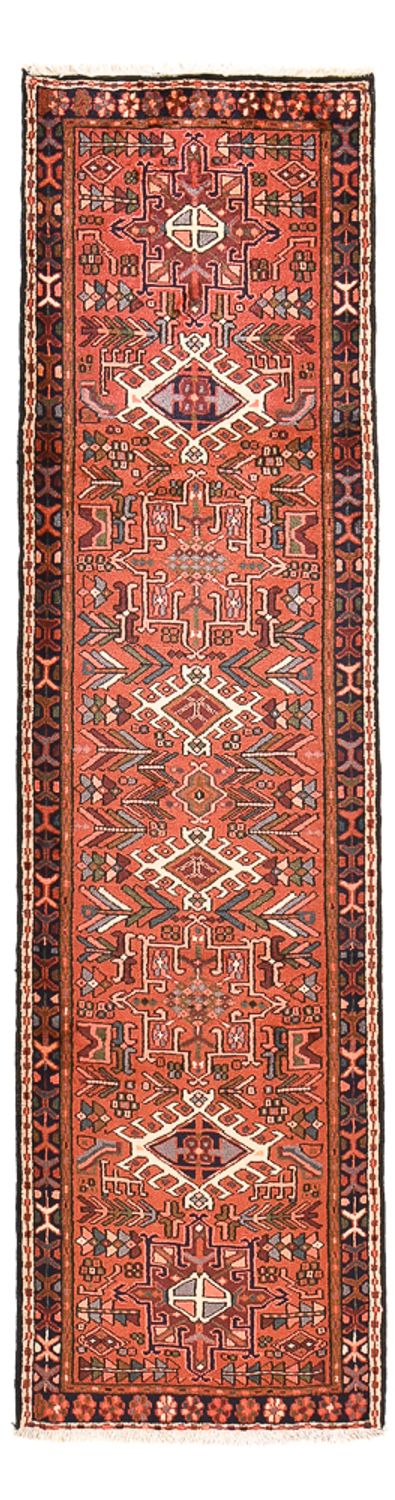
Photo: Morgenland Rugs
Qaraja rugs are sturdy hand-knotted Persian rugs from north-western Iran, from the knotting area between the great centres of Tabriz and Ardebil. Characteristic are their stacked, angular medallions arranged in a vertical row, the bold earth colours, and the frequent use of natural-coloured camel hair. Also spelled Qaradja or Karaja in trade, the Qaraja counts as a distinctive, down-to-earth village rug with an unmistakable geometric character.
What is a Qaraja rug?
A Qaraja is a hand-knotted village rug from the eponymous region in the province of East Azerbaijan. Characteristic features include the symmetric Turkish knot, a construction predominantly of wool, bold geometric patterns, and the typical row of medallions. The knotters belong predominantly to the Azerbaijani-Turkic population of the region, which has passed its patterns and techniques down through generations. Qaraja rugs belong to the wider family of north-west Persian village rugs around Heriz.
Origin
The knotting area lies in the province of East Azerbaijan, in the highlands between Tabriz to the west and Ardebil to the east. The region belongs to the wider family of Persian rugs but carries its own craft signature through its Turkic-speaking population and the proximity to the Caucasus. Knotting in Qaraja has been tied to village and semi-nomadic life for generations and reaches back far in its inherited patterns.
Through the trade routes around Tabriz, Qaraja's goods already found their way into export in the late 19th and 20th centuries. The setting between the workshop centre of Tabriz and the geometrically shaped knotting area of Ardebil explains the mix of clearly articulated medallions and Caucasian-feeling detail motifs that mark the Qaraja.
Patterns and colours
The most striking feature of a Qaraja is the arrangement of several angular, often octagonal medallions in a vertical row, usually alternating between a larger and a smaller form. This stacked composition sets the Qaraja clearly apart from the single-medallion Heriz and Garawan rugs. The inner field is filled with stylised blossoms, hooks, stars, and small geometric scatter motifs.
The palette is earthy and warm: a deep red or terracotta dominates, complemented by dark blue, ivory, and bold browns. Particularly characteristic is the use of natural-coloured camel hair or camel-coloured wool in beige and sand tones, giving certain areas their unmistakable warm presence. The border is usually multi-tiered and shows zigzag bands, diamonds, or stylised blossom motifs. Overall a Qaraja feels rustic, clearly articulated, and distinctly more geometric than the curvilinear workshop patterns from Isfahan.
Material and knotting technique
Qaraja rugs are traditionally made predominantly of wool, often with warp and weft both in wool. The pile uses bold local sheep's wool, often combined with natural-coloured camel hair. The natural tones of these wool types lend the rugs their warm, muted appearance. Some pieces also use a cotton warp.
Knotting uses the symmetric Turkish knot, also called the Ghiordes knot. This knot is the rule across the entire north-west Persian belt. The looms are often simple horizontal or vertical constructions in the knotters' homes. After knotting, the rugs are sheared; through use they develop a fine patina over the years. The individual steps are described in the overview of rug production; the materials used are covered in their own article.
Knot density and quality
The knot density of a Qaraja usually lies between 80,000 and 150,000 knots per square metre. This comparatively coarse knotting underscores the rustic character and makes the rug not a workshop piece but a sturdy working rug. How knot density affects fineness, durability, and price is explained in its own article.
For assessing quality, wool quality, naturalness of dyes, and clarity of the medallion drawing matter alongside knot count. Older Qaraja rugs with hand-spun wool, real camel hair, and natural dyes are especially valued.
| Provenance | Relation to Qaraja | Typical features |
|---|---|---|
| Qaraja | own village provenance, Heriz area | octagonal stacked medallions, camel-hair tones |
| Heriz | neighbouring main provenance | large angular single medallion |
| Garawan | coarser Heriz tier | robust medallion, double weft |
| Sarab | neighbouring region | elongated formats, runners |
| Ardebil | nearby provincial capital | geometric and floral medallions |
| Tabriz | nearby urban centre | fine workshop ware, curvilinear patterns |
What is a Qaraja rug worth?
The value of a Qaraja depends above all on age, condition, size, knot density, wool quality, and the authenticity of the camel hair. Owing to the comparatively coarse knotting, Qaraja rugs are often less expensive than finer Persian provenances such as Tabriz, without losing craft substance. They are primarily conceived as working rugs, though well-preserved older pieces with real camel hair and natural dyes can certainly gain in value.
For a grounded assessment, see the article Identifying valuable Persian rugs, the general guidance on rug value, and the buying guide.
How can you tell a genuine Qaraja rug?
Typical signs of a genuine Qaraja include:
- A row of several angular medallions, often octagonal and alternating in size, rather than a single central medallion.
- Natural-coloured camel hair or camel-coloured wool in beige and sand tones as the ground of individual sections.
- Symmetric Turkish knot with an even, somewhat coarse back structure.
- Predominant wool construction, with many pieces also showing wool warp and weft.
- Fringes as extended warp threads, not sewn on afterwards.
- Warm earth colours with red, dark blue, and brown tones.
Since Qaraja and the neighbouring provenances of the Heriz family are related, the classification should weigh pattern, material, back, and fineness together. Identifying provenance and the step-by-step Is my rug genuine? provide help.
Care
The robust wool quality makes Qaraja rugs easy to care for. Regular vacuuming in the direction of the pile and occasional professional cleaning preserve quality. Spills should be treated at once with clear water, without rubbing. The rug should be protected from long, direct sunlight to keep the colours, and the more sensitive camel hair, from fading. Detailed guidance is in the care overview and in the article on cleaning a wool rug.
Frequently asked questions
What distinguishes a Qaraja from a Heriz?
The Qaraja typically shows several angular medallions in a row and often uses natural-coloured camel hair, while the Heriz bears a single large central medallion. Both come from the same north-west Persian knotting area and use the Turkish knot.
Which knot is used for a Qaraja rug?
Qaraja rugs are knotted with the symmetric Turkish knot, the Ghiordes knot. This is the rule across the north-west Persian belt between Tabriz and Ardebil.
How can you recognise real camel hair in a Qaraja?
Real camel hair shows a warm, slightly uneven natural tone and a matte sheen. It is usually limited to individual fields or the ground. Wool dyed in a camel tone, by contrast, looks more uniform and flatter.
Are Qaraja rugs suitable for heavily used rooms?
Yes. The predominantly wool construction and the robust, somewhat coarse knotting make Qaraja rugs very hard-wearing and long-lived. They suit living rooms with heavy use.
What does a Qaraja rug cost?
The price depends on age, condition, size, knot density, and wool quality. Through the coarser knotting, Qaraja rugs are often less expensive than fine north-west Persian pieces; well-preserved older examples with camel hair and natural dyes, however, fetch higher prices.
How do I care for a Qaraja rug correctly?
Vacuum regularly in the direction of the pile and have the rug professionally cleaned every few years. Blot spills at once with clear water without rubbing, and avoid long, direct sunlight so the colours and the camel hair do not fade.
Impressions of the origin
Places, landscapes and landmarks around the home of Karaja rugs. Click any image for a larger view.
Related styles
Heriz
Heriz rugs from northwestern Iran are known for their bold geometric medallions and exceptional durability.
Ardabil
Ardebil rugs come from northwestern Iran and often show geometric patterns with Caucasian influence.
Sarab
Sarab rugs come from East Azerbaijan and are typical for their long runner formats with camel-colored grounds.


