Nain rugs: beige and blue manufactory from central Iran
Nain rugs from the desert town between Isfahan and Yazd are exceptionally fine and known for their cool ivory-and-blue palette.
- Region
- Persia / Iran
- Category
- Persian rugs
- Manufacturing
- Hand-knotted
- Knot density
- 200,000 – 1,000,000+ knots/m²
Profile
- Manufacturing
- Hand-knotted
- Origin
- Iran — town of Nain, Isfahan Province
- Pile material
- Wool on cotton with silk inlays
- Knot density
- 200,000 – 1,000,000+ knots/m²
- Features
- Very fine knotting, ivory ground, blue-and-rose tones, silk highlights
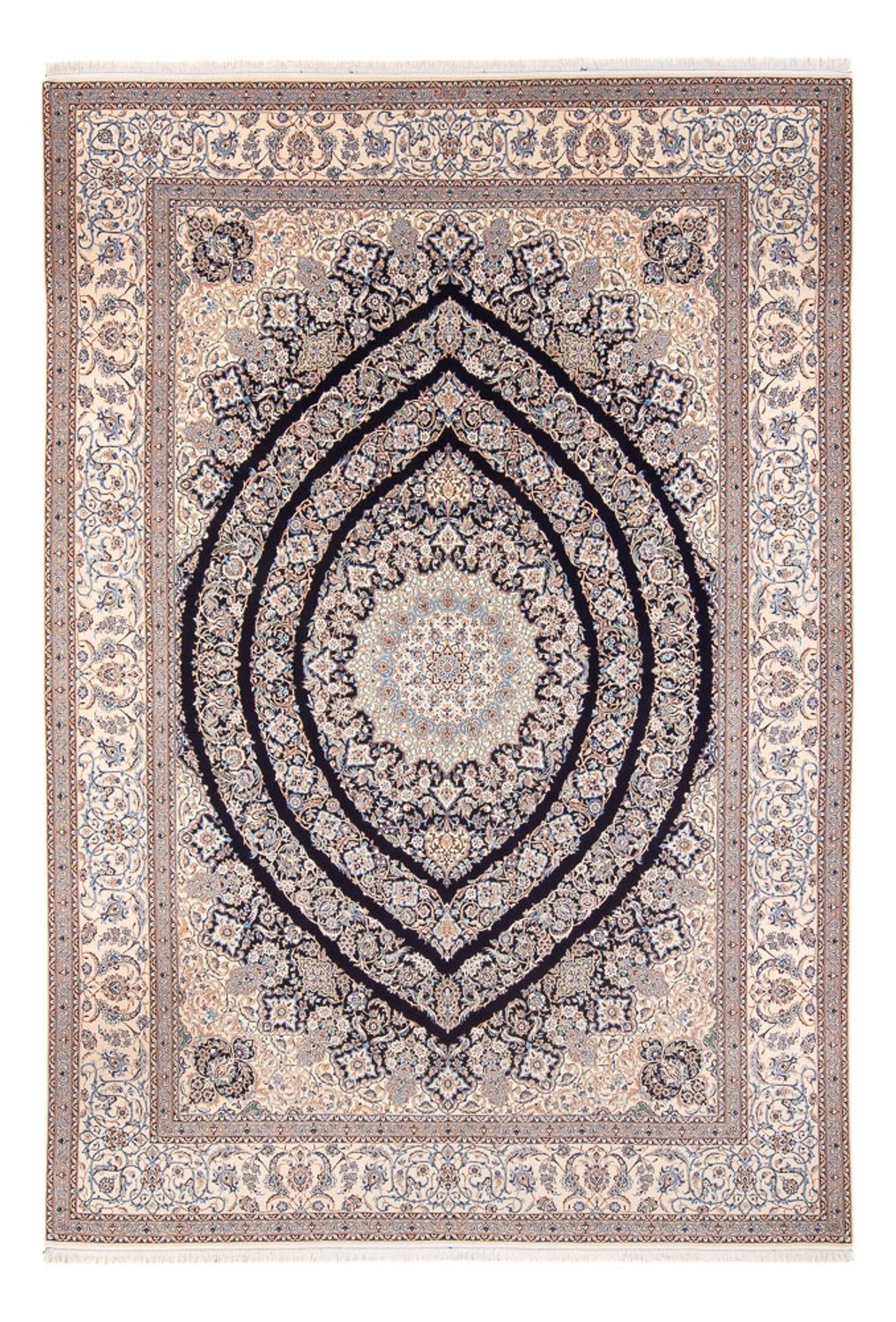
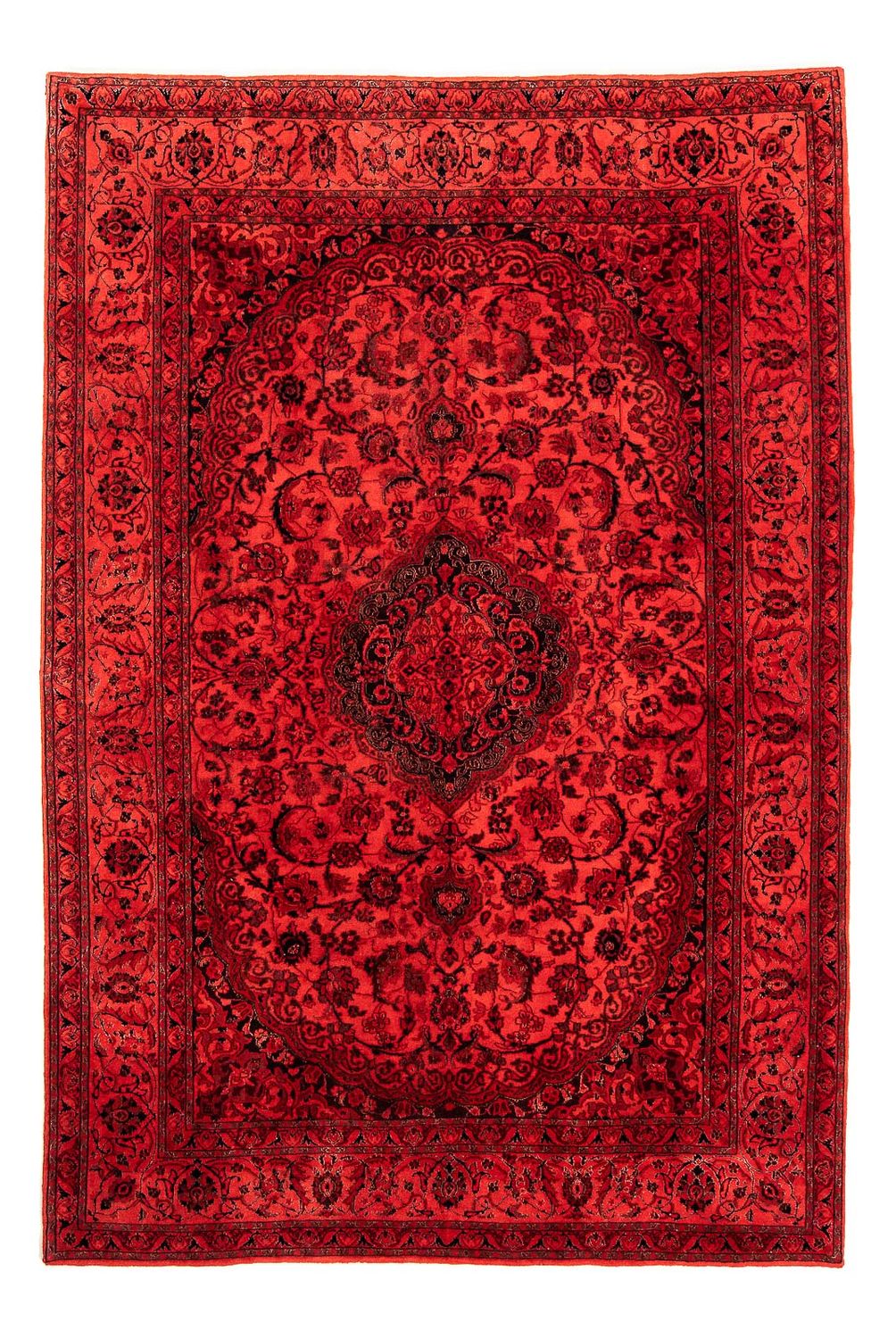
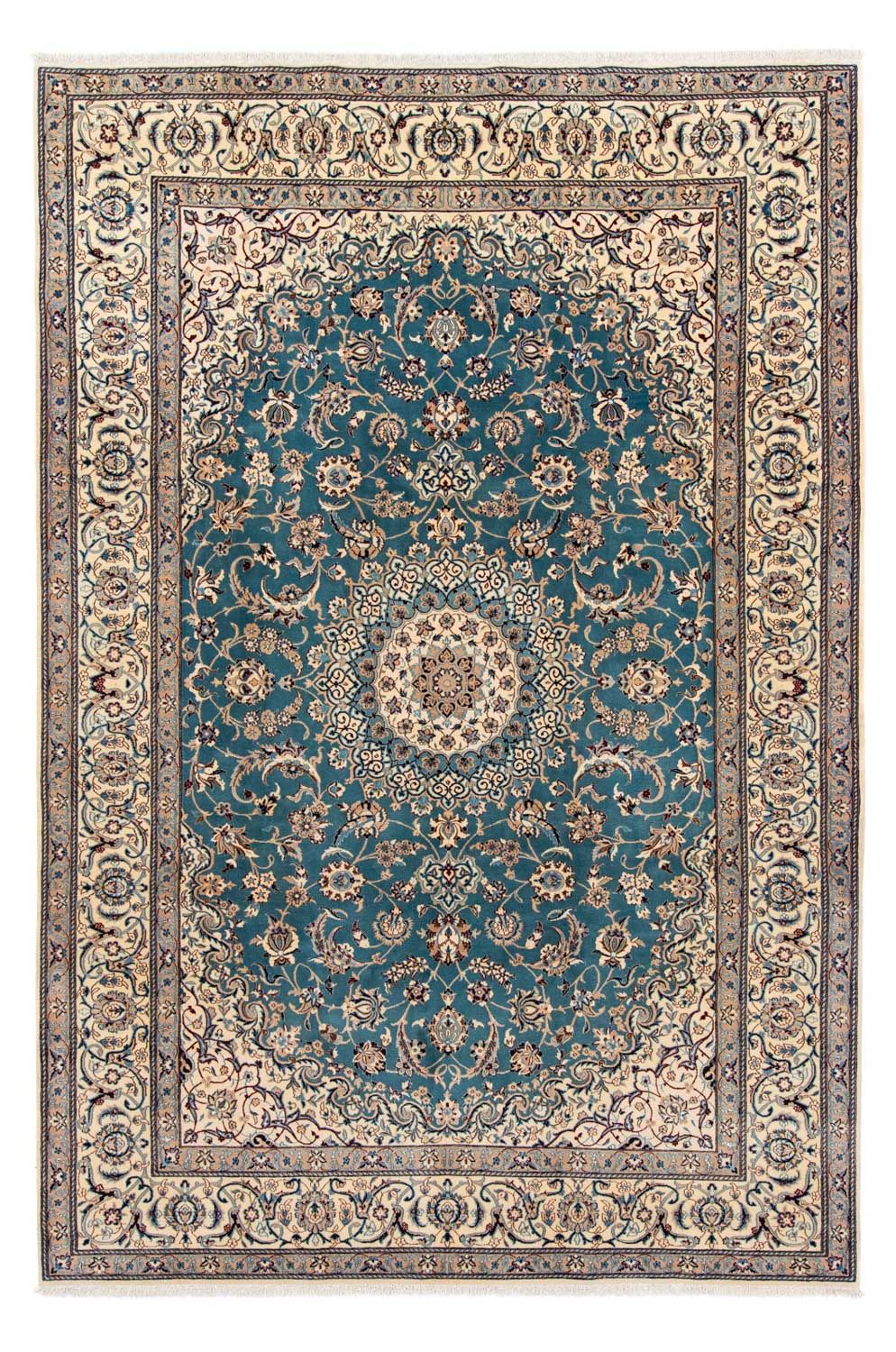
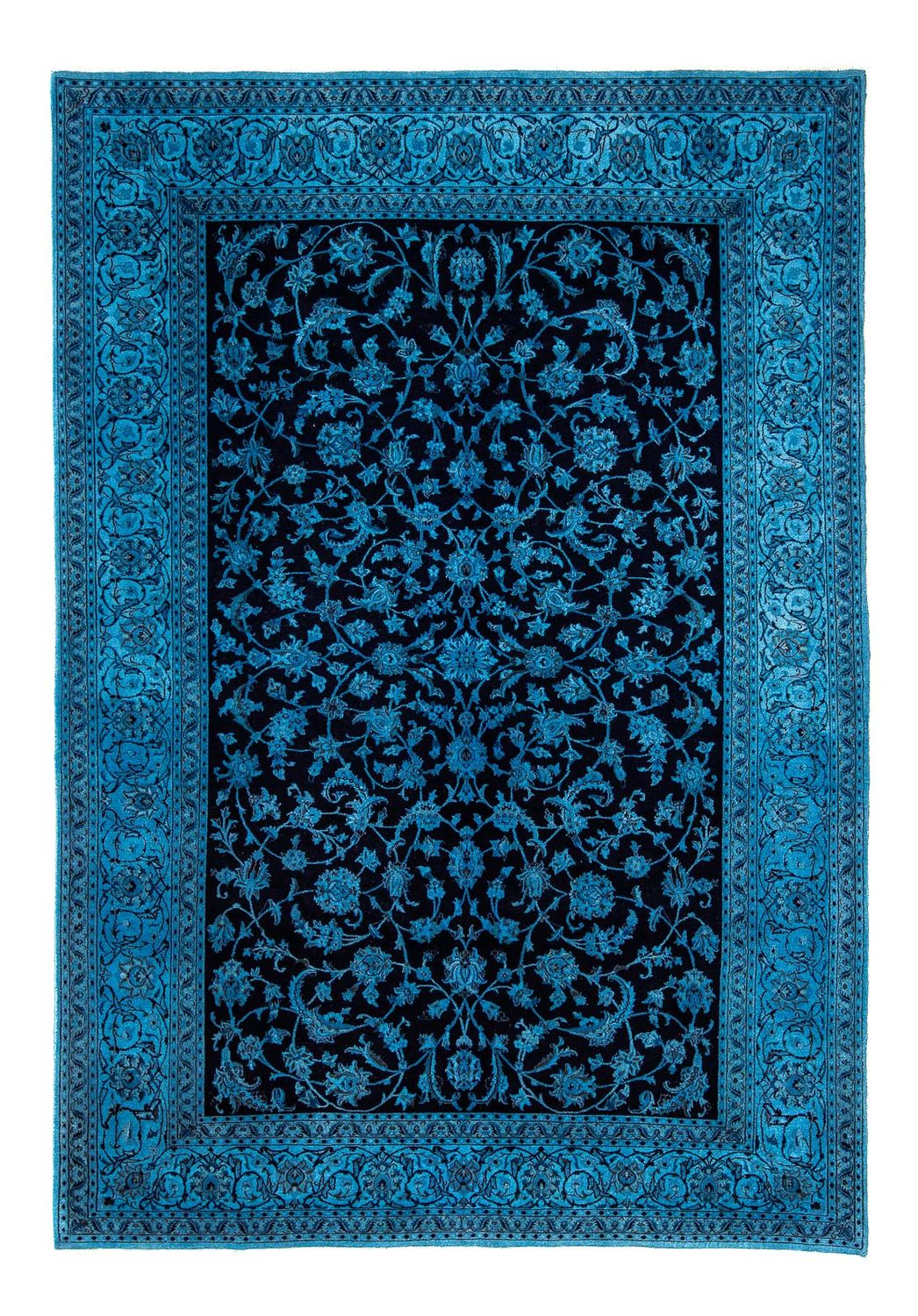
Photo: Morgenland Rugs
Nain rugs are fine hand-knotted Persian rugs from the central Iranian city of Nain, known for their light, refined palette and the characteristic La classification. Although production only began in the 1930s, Nain rugs today are regarded as the epitome of modern Persian rug art. Typical features include the deep beige-blue colour play, the fine Shah Abbas vines, and the silk worked into many pieces for contours and accents.
What is a Nain rug?
A Nain is a hand-knotted workshop rug from the city of Nain in the Isfahan province of Iran. It is knotted with the asymmetric Persian knot on a cotton warp; the pile is fine kork wool, often combined with silk for the contours. With knot counts of about 400,000 to over 1,000,000 knots per square metre, the Nain is among the finest Persian rugs. Its fineness is given in La grades, where a lower number means a higher density.
Origin: the city of Nain in Isfahan province
Nain lies about 150 kilometres east of the city of Isfahan in the eponymous province, on the edge of the central Iranian desert. The town was originally known for its fine wool weaving and for cloaks of high-quality wool. When this traditional textile industry declined in the first half of the 20th century, local craftspeople turned to rug knotting. Production only began in the 1930s, which makes it very young compared with the centuries-old tradition of Tabriz or Isfahan.
Despite this short history, Nain quickly developed an unmistakable style and international recognition. Production is strongly family-based. Many weaver families have developed their own quality standards and are continued through generations of master weavers, which contributes to the consistently high quality. Closely tied to Nain's rise is the name Habibian, whose workshop shaped the fine, light Nain style decisively and whose signed pieces are especially sought after today. The entire region belongs to the wider family of Persian rugs.
Typical features
Nain rugs stand out through their light, elegant colour tones. Beige, cream, and ivory dominate, combined with soft blues and restrained red accents. The patterns are classically Persian in character and often show the Shah Abbas palmette motif, fine vines, and floral ornaments. In larger formats a central medallion with surrounding corner spandrels is typical. The pile is cut relatively short, which lets the precise contours of the ornaments come into their own particularly well. Characteristic are the outlines retraced in silk, which lend the patterns sharpness and a subtle sheen.
Patterns and colours
The beige-blue colour play is probably the surest mark of recognition for a Nain. On a light, often ivory ground, blue vines and palmettes unfold, their contours often worked in light silk. This bright, almost luminous feel sets the Nain clearly apart from the bolder, deep-blue Isfahan and from the warm reds of south-Persian provenances such as Kerman. The restrained palette makes Nain rugs calm, refined pieces that fit well into bright interiors.
Material and knotting technique
Nain rugs are knotted on a cotton warp. The pile is high-quality kork wool, the soft wool from the neck of young sheep, often combined with silk threads. In the finest qualities the silk share can be considerable, used above all for contours and accents. This silk content gives the rugs their characteristic silken sheen. Pure wool qualities from Nain also exist but are rarer than the combinations of sheep's wool and silk.
Knotting uses the asymmetric Senneh knot, the Persian knot. It enables the fine pattern resolution Nain is known for and sets the city apart from the few Persian provenances with the Turkish knot, such as Hamadan. The exact production sequence is described in the production section.
Knot density and quality: the La grades
Nain rugs are traditionally classified by La grades. La refers to the number of warp threads from which a single knot is formed. The fewer the threads, the finer the knotting. Paradoxically, a lower La number therefore means a higher knot density and so a finer quality. The grades 9 La, 6 La, and 4 La are the common labels in trade. How this measure is read is explained in the article La grades explained; the basics on density in knot density explained.
| La grade | Warp threads per knot | Knot density | Quality | Material |
|---|---|---|---|---|
| 12 La | 12 | coarse to medium | entry | wool |
| 9 La | 9 | fine | standard | kork wool |
| 6 La | 6 | very fine | upmarket | kork wool with silk |
| 4 La | 4 | finest | collector | much silk, silk contours |
| Nain Tudeshk | as 9 or 6 La | fine to very fine | known origin | kork wool with silk |
A 9 La Nain counts as a fine standard quality, 6 La as very fine, and 4 La as collector quality whose making can take an experienced weaver several years. The La grades are the counterpart to the Raj system used to describe the fineness of a Tabriz.
What is a Nain rug worth?
The value of a Nain depends above all on the La grade, the silk content, size, age, condition, and precise origin. Fine 9 La qualities fall within the range of good Persian rugs; 6 La and 4 La pieces with a high silk content are considerably more expensive. Signed pieces from renowned workshops such as Habibian fetch the highest prices and rank as sought-after collector and value objects.
High-quality, well-preserved Nain rugs can hold their value over long periods. A guarantee of appreciation, however, does not exist. For the assessment, Identifying valuable Persian rugs and the general buying guide help. Anyone weighing Nain against Isfahan will find a direct comparison in Nain versus Isfahan.
How can you tell a genuine Nain rug?
Typical signs of a genuine Nain include:
- Light beige-blue colour play: the bright palette with an ivory ground and blue vines is the surest mark of recognition.
- Asymmetric Senneh knot: Nain is knotted with the Persian knot, visible in the fine, clear back.
- Silk contours in the pile: the outlines retraced in silk shimmer and stand out against the matte wool ground.
- La grade matched by knot density: the actual density should match the stated La grade.
- Kork wool on a cotton warp with a low-sheared, precisely drawn pattern.
- Fringes as part of the weave: the fringes are the extended warp threads, not sewn on afterwards.
The Nain is to be distinguished from Indo-Nain, rugs knotted in India after the Persian model, which are less expensive and do not reach the fineness of the originals. A step-by-step guide is in Is my rug genuine?; the basics are in identifying an oriental rug.
Care
Nain rugs should be vacuumed regularly in the direction of the pile and cleaned professionally from time to time. Because of the silk content, expert hand washing is advisable for fine qualities rather than do-it-yourself cleaning. Long, direct sunlight bleaches the bright natural dyes over the years and should be avoided. Blot spills carefully at once with clear water, without rubbing. Detailed guidance is in the care overview.
Frequently asked questions
What do the La grades on a Nain mean?
The La grade indicates how many warp threads a single knot is formed from. A lower La number means a higher knot density and so a finer quality. 9 La counts as fine, 6 La as very fine, 4 La as collector quality.
What does a Nain rug cost?
The price depends on La grade, silk content, size, age, and condition. Fine 9 La qualities are more affordable; 6 La and 4 La pieces with a high silk content are considerably more expensive. Signed pieces from well-known workshops reach the highest prices.
How do I recognise a genuine Nain?
By the light beige-blue colour play, the contours retraced in silk, and the asymmetric Senneh knot on a cotton warp. The actual knot density should match the stated La grade, and the pattern should appear clearly on the back.
What is the difference between Nain and Isfahan?
Both come from the same province and are very fine. Nain is lighter, with dominant beige and blue tones, and is classified in La grades. Isfahan shows the deep Isfahan blue, bolder floral patterns, and is described over the plain knot density. The direct comparison is in Nain versus Isfahan.
Are all Nain rugs knotted with silk?
Not all, but most high-quality Nain rugs contain silk, above all for contours and details. Pure wool Nain rugs also exist but are rarer than the combinations of wool and silk.
Why are Nain rugs relatively expensive?
The prices follow from the high knot density, the silk content, the elaborate handwork, and the excellent material quality. A 4 La Nain can take an experienced weaver several years of work.
How do I care for a Nain rug correctly?
Vacuum regularly in the direction of the pile and have the rug professionally cleaned every few years. Avoid direct sunlight, blot spills at once carefully with clear water, do not rub. Fine qualities with a silk content belong in the hands of a specialist.
Quality grades
Nain rugs are made in various quality grades. Each grade differs in knot density, material, and price.
Nain 4la
Shop →The finest Nain quality with 4 warp threads per knot, extremely densely knotted and with a high share of silk.
- Pile material
- Kurk wool and silk on cotton
- Knot density
- 700,000 – 1,000,000+ knots/m²
- Features
- 4 warp threads per knot, finest Nain quality, high silk share
Nain 6la
Shop →The most popular Nain quality, finely knotted with a clear share of silk.
- Pile material
- Kurk wool with silk on cotton
- Knot density
- 500,000 – 700,000 knots/m²
- Features
- 6 warp threads per knot, popular fine standard quality
Nain 9la
Shop →A sturdier quality grade with 9 warp threads per knot and a slightly coarser drawing.
- Pile material
- Kurk wool on cotton
- Knot density
- 350,000 – 500,000 knots/m²
- Features
- 9 warp threads per knot, sturdier quality with silk inlays
Nain 12la
Shop →The coarsest Nain quality with 12 warp threads per knot. Robust and accessible.
- Pile material
- Wool on cotton
- Knot density
- 200,000 – 350,000 knots/m²
- Features
- 12 warp threads per knot, sturdier Nain quality
Impressions of the origin
Places, landscapes and landmarks around the home of Nain rugs. Click any image for a larger view.
Master weavers
These masters and workshops have shaped the Nain tradition.
Related styles
Isfahan
Isfahan rugs from the former Safavid capital are considered the pinnacle of Persian rug knotting, exceptionally fine and elegant.
Qom
Qom rugs from the holy city are among the finest Persian rugs and are particularly prized in pure-silk versions.
Tabriz
Tabriz rugs are among the most refined Persian carpets, known for their finely knotted designs and remarkable variety of patterns.