Moud rugs: fine Herati pattern from South Khorasan
Moud rugs come from southern Khorasan and combine fine knotting with the classic Herati all-over pattern.
- Region
- Persia / Iran
- Category
- Persian rugs
- Manufacturing
- Hand-knotted
- Knot density
- 150,000 – 350,000 knots/m²
Profile
- Manufacturing
- Hand-knotted
- Origin
- Iran — Birjand region, South Khorasan Province
- Pile material
- Wool on cotton
- Knot density
- 150,000 – 350,000 knots/m²
- Features
- Fine knotting, Herati pattern, restrained colors
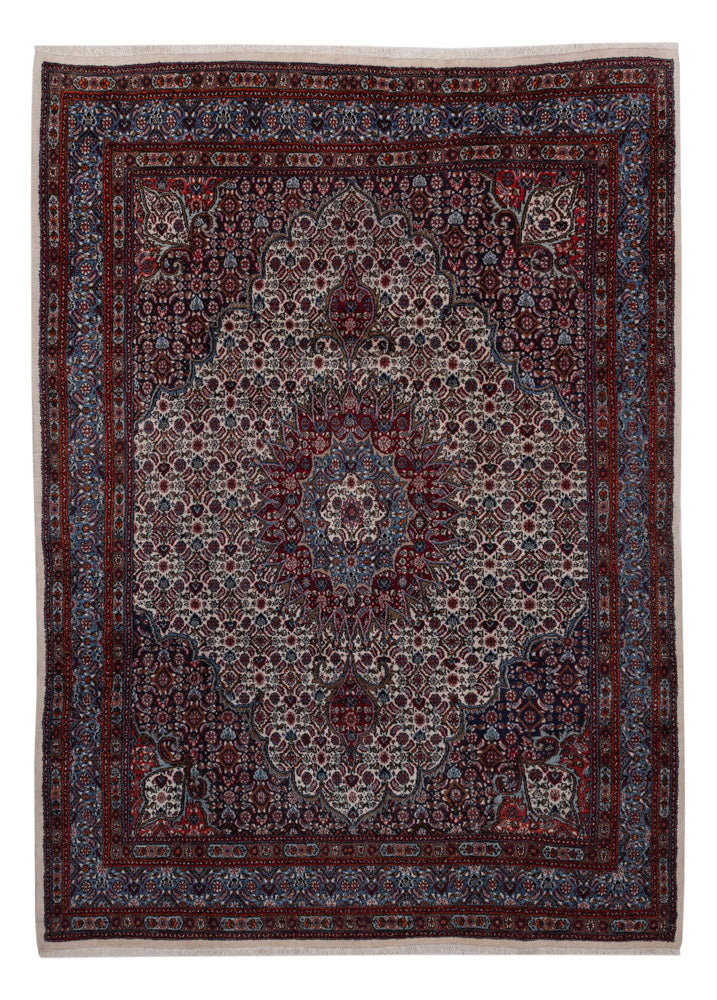
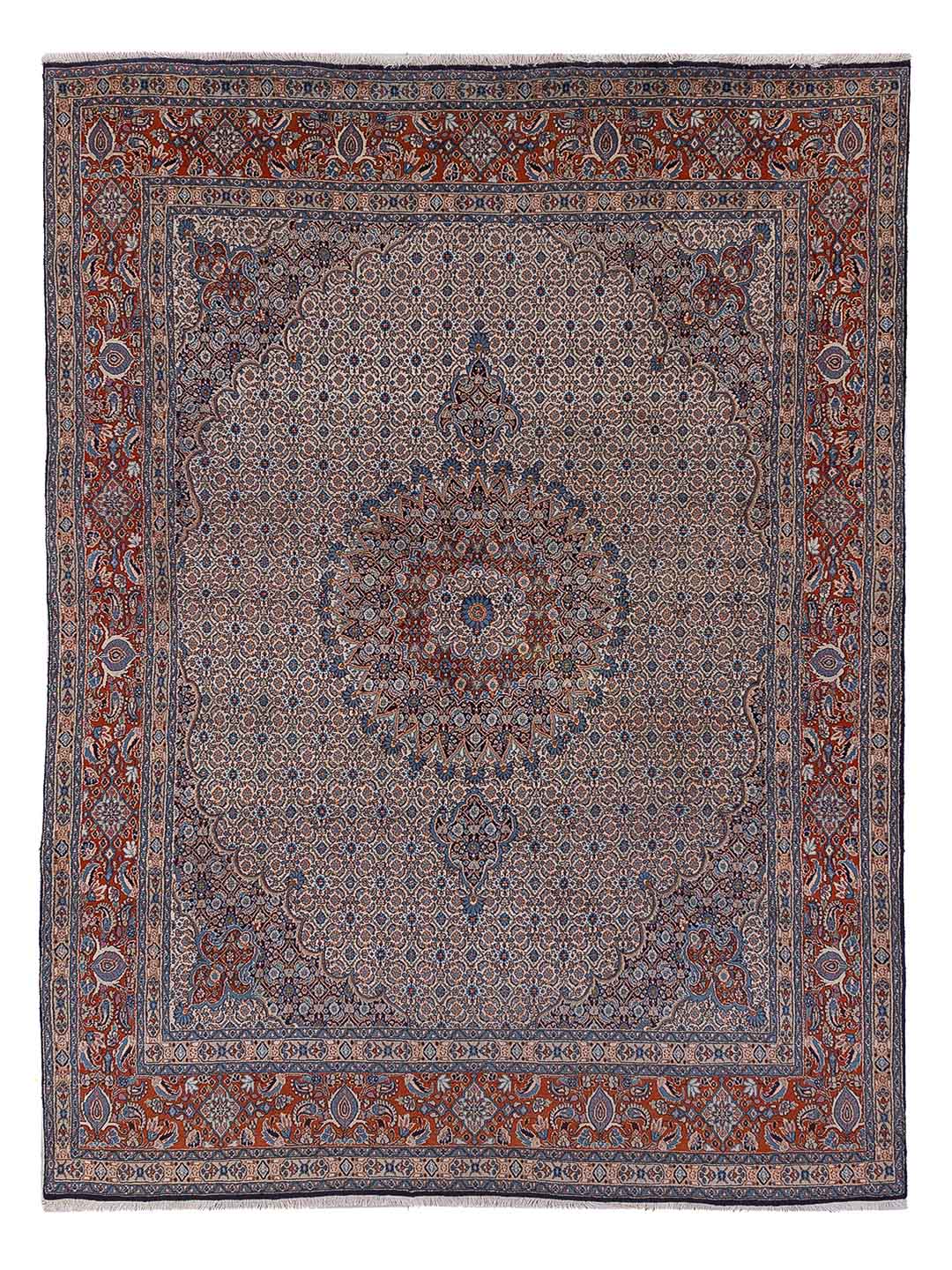
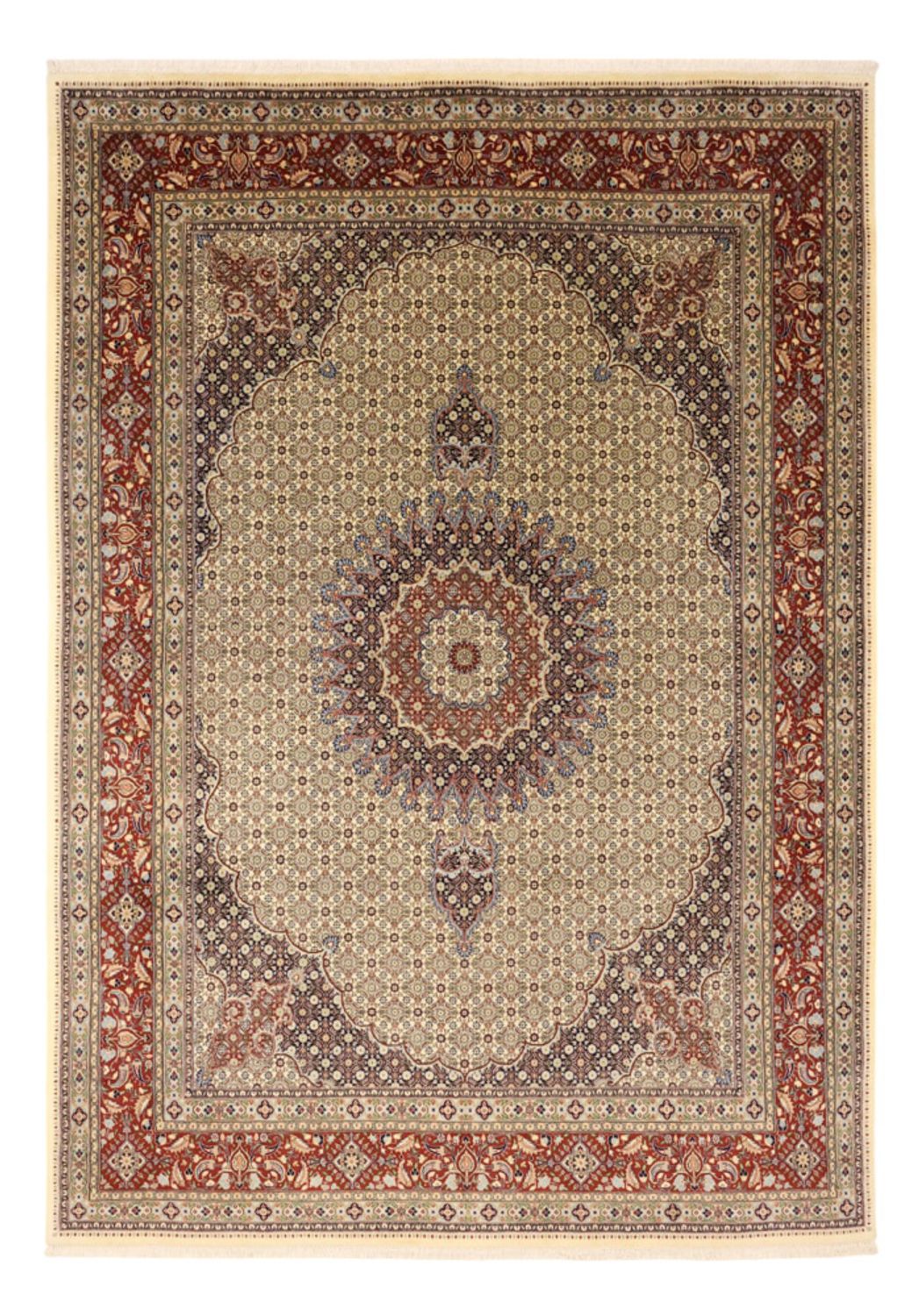
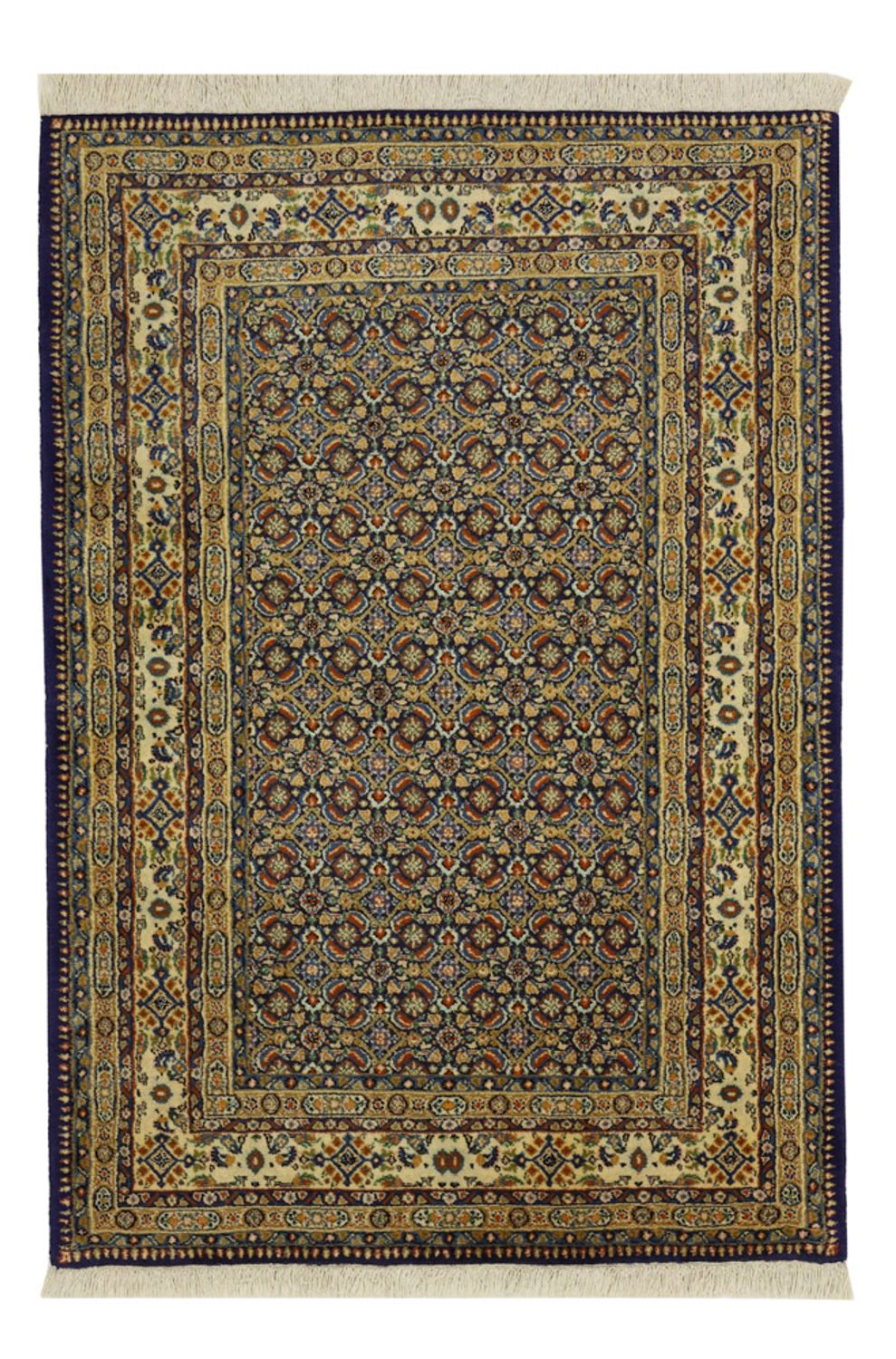
Photo: Morgenland Rugs
Moud rugs are particularly finely knotted Persian rugs from eastern Iran, from the Moud area in the province of South Khorasan near the town of Birjand. They are known for high knot counts, the all-over Herati pattern, and a restrained, elegant palette. Among connoisseurs Moud rugs count as an insider tip: fine knotting quality at comparatively moderate prices, carried by small family workshops that pass their patterns down through generations. They belong to the family of east-Persian Khorasan rugs.
What is a Moud rug?
A Moud is a hand-knotted rug from the village of Moud and the surrounding settlements in the Birjand district. Knotting uses the asymmetric Persian knot, the Senneh knot, on a cotton warp with a fine wool pile. Characteristic features are the finely articulated all-over Herati pattern or a floral medallion, a high knot density, and a calm palette of reds, blues, and creams. The low pile lets the fine details stand out clearly.
Origin
Moud lies in eastern Iran, in the province of South Khorasan, a few kilometres from the district town of Birjand, near the border with Afghanistan. For centuries the region was a centre of east-Persian knotting craft; Birjand and its surroundings count among the traditional knotting areas of Khorasan. The arid, semi-desert landscape shaped a rural weaving culture in which knotting was a settled part of household life.
Production still focuses on smaller family workshops and ateliers in which inherited patterns and knotting techniques are passed down. The all-over Herati pattern, also called Mahi (fish) in Iran, shapes the style so strongly that it counts as the trademark of the provenance. Moud shares its roots with the neighbouring east-Persian provenances Mashhad, Kaschmar, Sabsewar, and Ghoutshan, but stands apart through the consistent fineness of its knotting.
Patterns and colours
The defining Moud design is the all-over Herati pattern: a fine, repeating motif of a rosette in a diamond, flanked by four curved leaves that resemble small fish. Alongside it stand floral medallion compositions with a central medallion in the middle of the field, surrounded by fine vines and blossom ornaments and matching corner fillings. Both variants live from the finely articulated, precise line work that the high knot density makes possible.
The palette is restrained and elegant: warm reds and deep blues dominate, complemented by beige, ivory, and subtle accents. This calm colour world gives Moud rugs a formal, classical character. The borders are usually multi-tiered and show palmettes, geometric bands, or stylised flowering chains framing the dense field in harmony.
Material and knotting technique
The pile uses high-quality sheep's wool from the region, valued for softness and sheen. The warp is traditionally cotton, while the weft is wool or a combination of wool and cotton. This construction gives the rug stability and a straight set without compromising the fineness of the surface.
Knotting uses the asymmetric Senneh knot, the typical knot of Persian rugs, which alone makes the characteristically high knot density and thus the fine pattern drawing possible. After knotting the pile is sheared low and the rug is washed; special washing processes give it its characteristic sheen and softness. How knotting works in detail is described in the overview of rug production and especially under knotting.
Knot density and quality
The knot density of a Moud typically lies between 400,000 and 1,000,000 knots per square metre, considerably higher than at most east-Persian provenances. This fine knotting is the reason for the precise pattern drawing and the silken hand. Top pieces reach the upper range, while everyday qualities sit in the lower range without feeling coarse.
High-quality Moud rugs show an even, very dense knotting, a low, clear pile, and a balanced palette. How knot density affects quality and price, and why it must always be judged together with wool quality and pattern clarity, is covered in its own article.
| Feature | Expression on the Moud |
|---|---|
| Knotting | asymmetric Senneh knot (Persian knot) |
| Warp | cotton |
| Weft | wool or wool-cotton combination |
| Pile | fine sheep's wool, low-sheared, lustrous |
| Knot density | approx. 400,000 – 1,000,000 knots/m² |
| Pattern | all-over Herati pattern or floral medallion |
| Colours | red, blue, beige, ivory; restrained and elegant |
What is a Moud rug worth?
The value of a Moud depends on age, condition, size, knot density, wool quality, and dye. Moud rugs count as attractively priced in relation to their high knotting quality: they offer fineness at a level that is often considerably more expensive at other provenances. Larger formats are rarer than runners and small sizes, and accordingly more sought after. They do not, as a rule, reach the top prices of the finest workshop production from Isfahan, Nain, or Ghom.
A grounded assessment is possible with reference to the basics under What is my rug worth? and the notes on valuable Persian rugs. Before buying, the general buying guide helps to weigh quality and price realistically.
How can you tell a genuine Moud rug?
Typical signs of a genuine, hand-knotted Moud include:
- Very fine, hand-knotted back: the pattern is mirrored razor-sharp, and the knots form an exceptionally dense grid.
- All-over Herati pattern: the finely articulated repeat of diamond, rosette, and fish leaves is the strongest mark of recognition.
- Fringes as part of the warp: the fringes are the extended warp threads, not sewn on afterwards.
- Asymmetric Senneh knot as is standard at Persian provenances.
- Low, lustrous wool pile on a cotton foundation with a calm, elegant palette.
Since fine provenances are easily confused, pattern fineness, back, material, and colour direction should be judged together. A step-by-step authenticity check is set out in Is my rug genuine?; general guidance on identifying handwork and provenance is in identifying rugs.
Care
Thanks to the high knot density and the low, firm pile, Moud rugs are relatively easy to care for and dirt-resistant. Regular vacuuming and occasional professional cleaning are usually enough. Spills should be blotted at once with clear water, without rubbing. Long, direct sunlight will fade the colours. Detailed guidance is in the care overview and especially under cleaning a wool rug.
Frequently asked questions
How do I recognise a genuine Moud rug?
A genuine Moud is very finely hand-knotted, uses the asymmetric Persian knot, and usually shows the all-over Herati pattern. The back shows an exceptionally dense, clear knot grid, the fringes are part of the warp, and the palette is restrained in red, blue, and beige.
What is the Herati pattern on a Moud rug?
The Herati pattern, also called Mahi (fish) in Iran, is a finely articulated, repeating motif of a rosette in a diamond with four curved leaves that recall fish. It is the defining and most common motif of Moud rugs.
What sets a Moud apart from other Persian rugs?
Are Moud rugs long-lived?
Yes. Through the high knot density and the high-quality sheep's wool, Moud rugs are very hard-wearing and long-lived. With appropriate care they last for decades. The low, dense pile also makes them dirt-resistant.
In which sizes are Moud rugs offered?
Moud rugs are mainly knotted in smaller formats. Particularly common are runners and rugs up to about 200 x 300 cm. Larger examples are less readily available and accordingly sought after by collectors.
How do I care for a Moud rug correctly?
Vacuum regularly and have the rug professionally cleaned every few years. Blot spills at once with clear water, do not rub. Avoid long, direct sunlight. Thanks to the high knot density, care needs are low.
Impressions of the origin
Places, landscapes and landmarks around the home of Moud rugs. Click any image for a larger view.

