Mahal rugs: generous Sultanabad weave from the Arak region
Mahal rugs come from the Arak region (historic Sultanabad) and combine open all-over floral fields with antique appeal.
- Region
- Persia / Iran
- Category
- Persian rugs
- Manufacturing
- Hand-knotted
- Knot density
- 80,000 – 180,000 knots/m²
Profile
- Manufacturing
- Hand-knotted
- Origin
- Iran — Arak region (Sultanabad), Markazi Province
- Pile material
- Wool on cotton
- Knot density
- 80,000 – 180,000 knots/m²
- Features
- Open all-over floral fields, antique-style palette, large formats
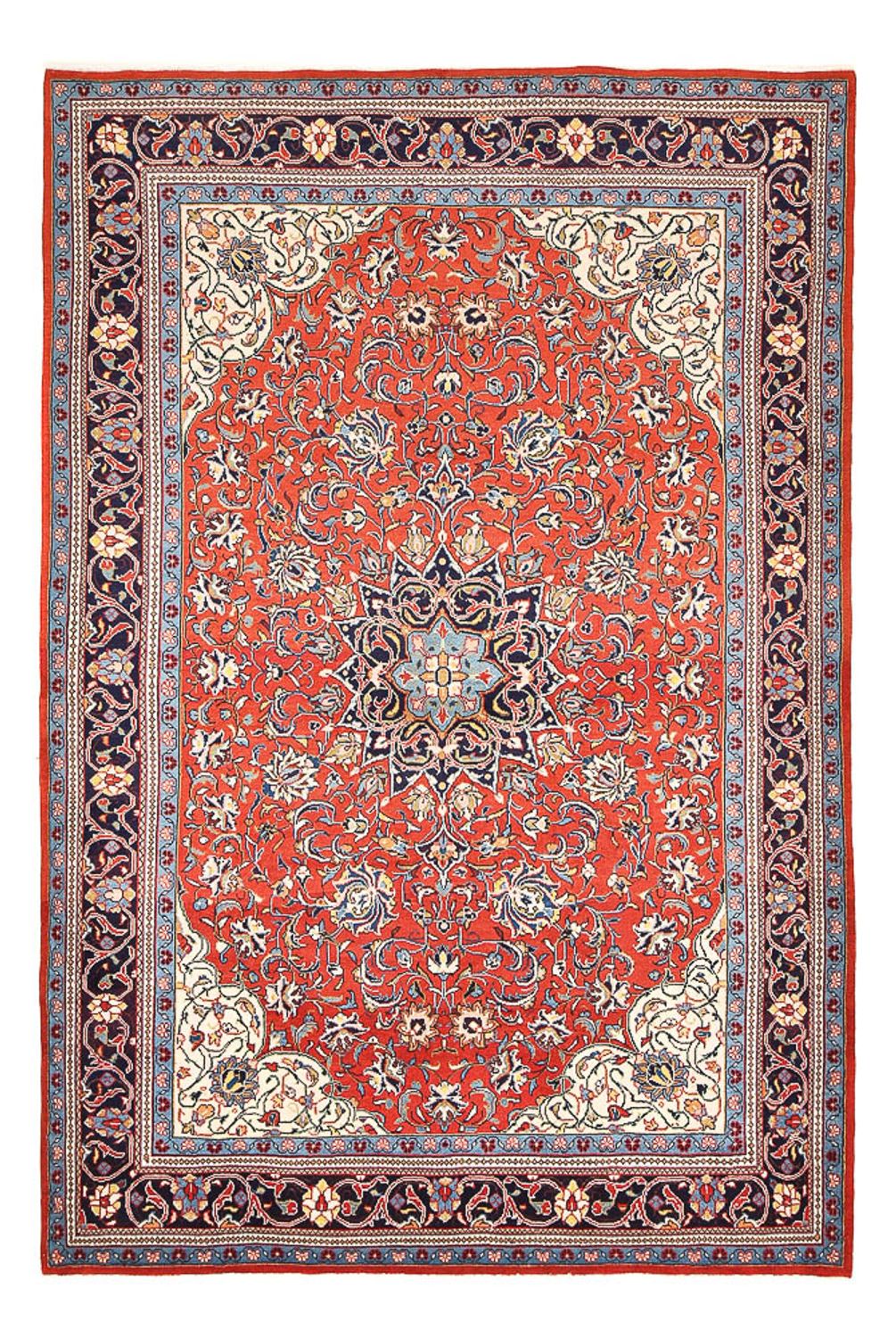
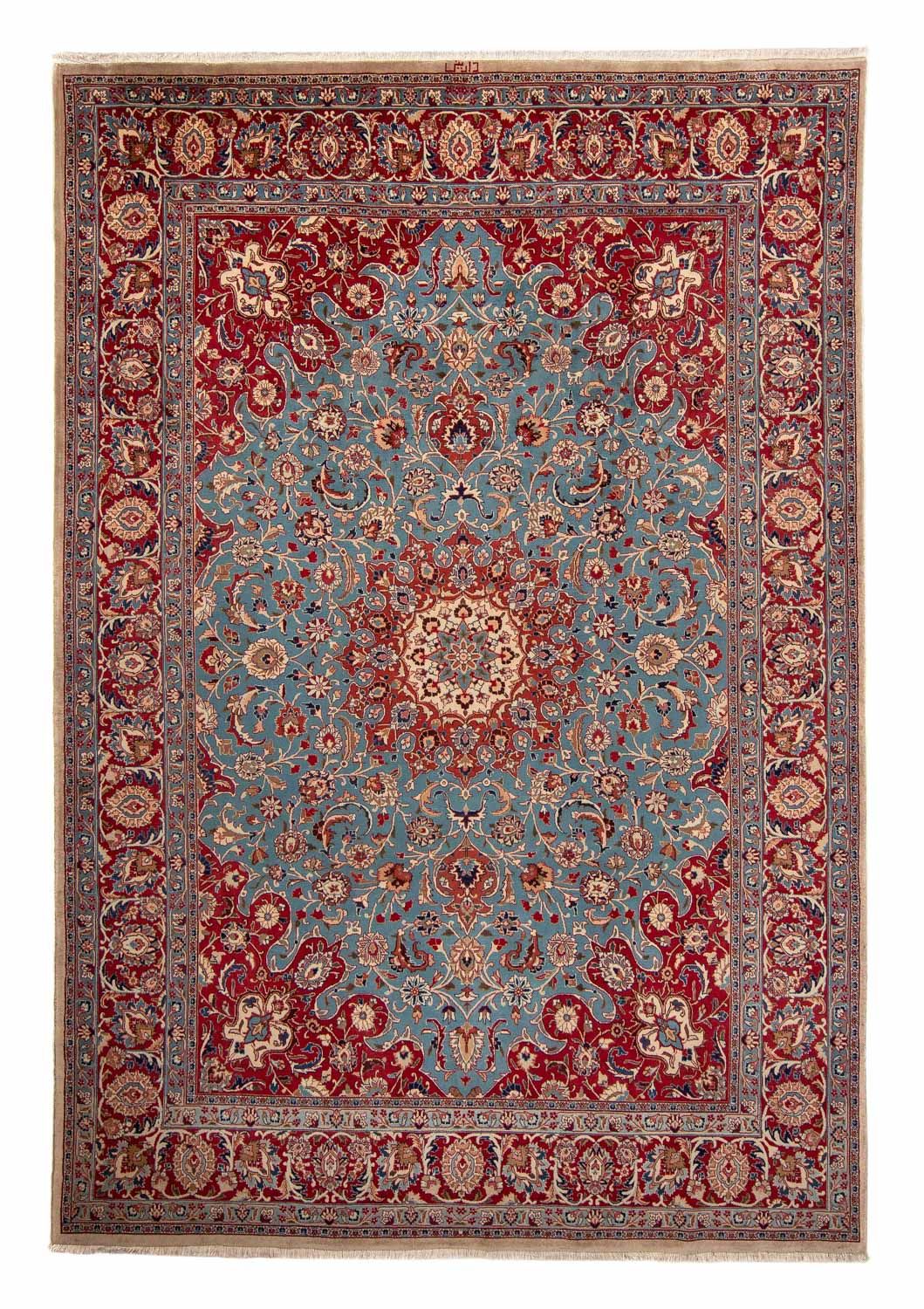
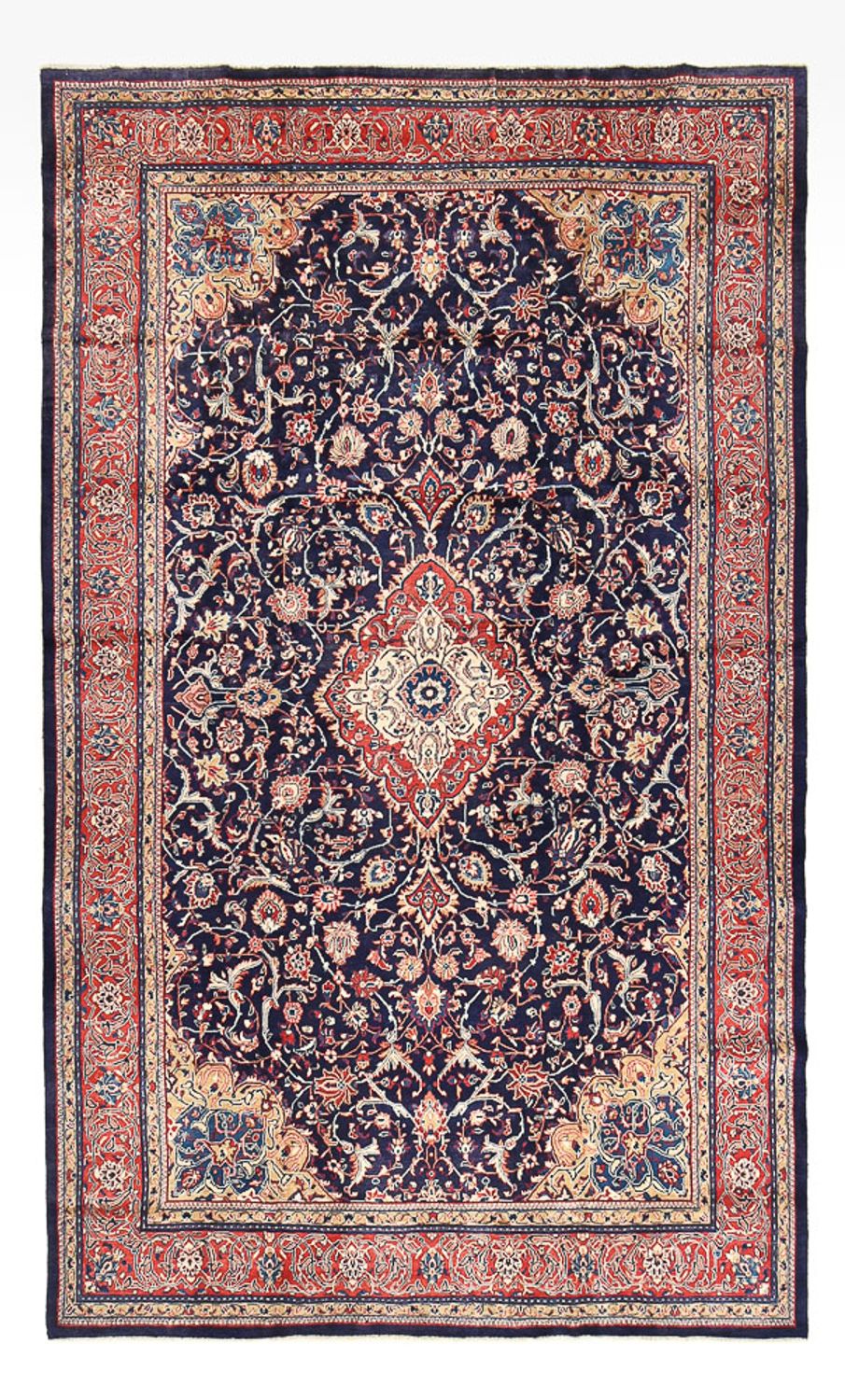
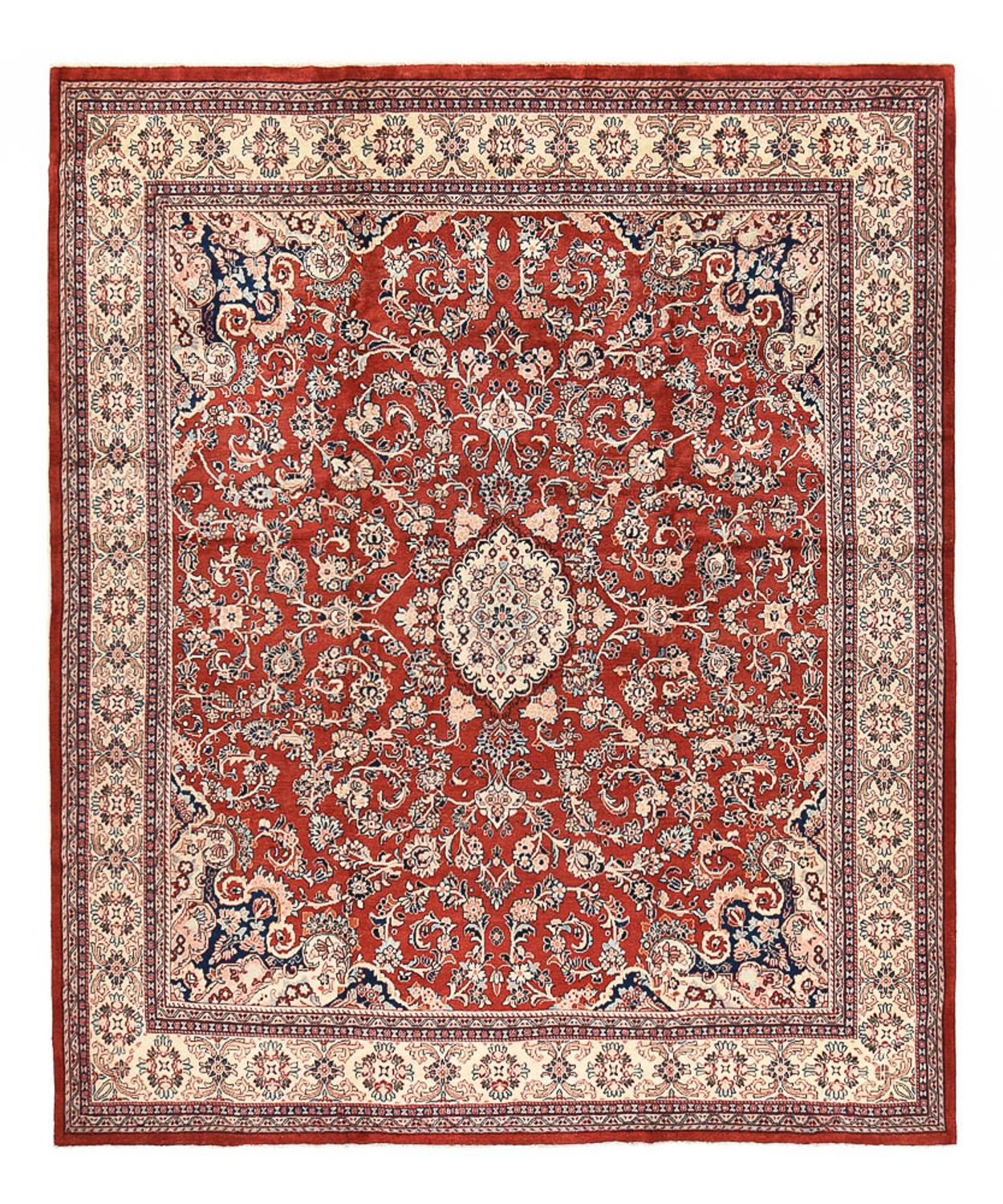
Photo: Morgenland Rugs
Mahal rugs are large-format hand-knotted Persian rugs from the Sultanabad region around the city of Arak in central Persia. They link classical Persian floral patterns with a loose, generous drawing and muted colours that were chosen specifically for the Western market from the late 19th century. The Mahal counts as the direct forerunner of the Ziegler style and stands for robust, everyday-capable quality in decorative formats.
What is a Mahal rug?
A Mahal is a hand-knotted rug from the hinterland of Arak, formerly Sultanabad, in today's province of Markazi. Characteristic are the asymmetrical Persian knot, a wool pile on cotton ground and a loose floral allover with a muted, Western-oriented colour palette. The name Mahal does not stand for a single place but serves as a collective designation for rugs of medium knot density from the villages of the Sultanabad plain. Within the region it forms a quality grade between the coarser Mahal group rug and the finer Sarough and Ziegler qualities.
Origin
The homeland of Mahal rugs is the Sultanabad plain around the city of Arak, about 200 kilometres southwest of Tehran. Sultanabad was founded in the early 19th century as a trading and administrative city and developed rapidly into one of the most important knotting centres of Persia. The actual heyday began in the 1880s, when European and American trading houses organised the production of the surrounding villages for export.
A key role was played by the Swiss trading house Ziegler & Co., which settled in Sultanabad from 1883, tuned patterns and colours to Western taste and supplied thousands of looms in the region. From this link of local village knotting and Western marketing emerged both the standard Mahal rugs and the later, specifically composed Ziegler style. The heyday lay between about 1880 and 1930. After the First World War export declined; in the second half of the century production was taken up again in adapted form.
Pattern and colour
Mahal rugs mostly show a loose, broad-surfaced floral allover of palmettes, scrolls and stylised flowering branches, often grouped around a discreet central medallion. The drawing reads as generous and slightly abstracted, with significantly more space between the motifs than on the densely filled city rugs. Widespread are also allover variants entirely without medallion.
The colour palette is the actual trademark of the Mahal: muted, soft tones in rust, terracotta, brick red, muted indigo, sage green, beige and ivory. This restrained, slightly lightened colour effect was deliberately chosen for European and American interiors and distinguishes the Mahal from the more boldly dyed eastern Persian provenances. The borders take up classical motifs such as palmettes and the Herati pattern but remain in the scale of the generous main surface.
Material and knotting technique
The pile consists of virgin wool from the herds around Arak; warp and weft mostly of cotton. The wool of the region is soft and well dyeable, which favours the typical, somewhat velvety surface. The pile is sheared medium-high to high.
The Mahal is knotted with the asymmetrical Persian knot, also called the Senneh knot. This knot type allows flowing, curvilinear floral lines and is characteristic of the provenances of the Sultanabad region. Traditionally it was dyed with plant dyes; later and modern productions also use synthetic dyes. How a rug arises from warping to shearing is explained in the overview of manufacture; the yarns used are covered by material studies.
Knot density and quality
The knot density of a Mahal usually lies between 80,000 and 200,000 knots per square metre. The Mahal thus places itself in the middle range, coarser than fine city rugs but firm and long-lived. The medium density suits the generous scale of the pattern: the loose floral drawing needs no extremely high resolution but lives from the calm surface effect. A factual placement of what knot density says about quality and price is offered by its own article.
For the assessment of a Mahal, besides density, what counts above all are wool quality, natural dyeing, condition and age. Antique pieces often show hand-spun wool and natural colour transitions, while plainer trade qualities can be worked with machine-spun yarn.
Mahal, Ziegler and Sultanabad compared
| Provenance | Relation to the Sultanabad region | Typical features |
|---|---|---|
| Sultanabad (Arak) | region of origin and umbrella term | collective name for the village knotting around Arak, Persian knot |
| Mahal | quality grade of the region | loose floral allover, muted colours, medium density |
| Ziegler | style composed by Ziegler & Co. | particularly soft pastel palette, broad-surfaced, Western-oriented |
| Sarough | finer provenance of the same region | more densely knotted, bolder red, often medallion |
| Bakhtiar | neighbouring Zagros highlands | kheshti garden pattern, symmetrical Turkish knot |
| Heriz (comparison) | northwestern Persia | geometricised medallion, robust village knotting |
What is a Mahal rug worth?
The value of a Mahal depends above all on age, condition, size, knot density, wool quality and dyeing. Antique Mahal rugs from before 1930 count as collector items and can be value-stable or value-rising, especially large formats with natural colours and even patina. Modern productions are rather to be placed as decorative utility rugs and lie in the more affordable range.
Since Mahal and Ziegler rugs come from the same region, the direct comparison of both provenances is worthwhile in the value assessment. Orientation is given by the overview of rug value, the article recognising valuable Persian rugs and the buying guide.
How do you recognise a genuine Mahal rug?
Typical indicators of a genuine Mahal include:
- Loose floral allover in generous scale, often with discreet medallion.
- Muted, Western-oriented colours in rust, terracotta, sage and ivory.
- Asymmetrical Persian knot: the back shows the finely graded, curvilinear pattern clearly.
- Wool pile on cotton ground with medium density and medium-high to high pile.
- Large-format layout: the Mahal was knotted predominantly in decorative room and salon sizes.
- Fringes as part of the warp, not sewn on afterwards.
A machine imitation gives itself away through a glued-on back, uniform knots and a flat, lustreless yarn. The detailed check is described in is my rug genuine?; a general introduction in the guide to recognising.
Care
Owing to the robust wool quality, the Mahal is relatively easy to maintain. Regular vacuuming in the direction of the pile and a professional cleaning every few years preserve colour and structure. Blot stains immediately with clear water, without rubbing. For large formats an occasional turning is recommended so that wear is distributed evenly. Long direct sunlight will further fade the muted colours. Detailed guidance is set out in the care overview.
Frequently asked questions
What is the difference between Mahal and Ziegler?
Both come from the Sultanabad region around Arak and share the Persian knot as well as the broad-surfaced floral pattern. The Ziegler is the style specifically composed by the trading house Ziegler & Co. with a particularly soft pastel palette, while the Mahal designates the standard village quality of the same region with somewhat bolder, muted colours. The Mahal counts as forerunner of the Ziegler.
Where are Mahal rugs made?
Mahal rugs come from the villages of the Sultanabad plain around the city of Arak in the Iranian province of Markazi, about 200 kilometres southwest of Tehran.
How do I recognise a genuine Mahal rug?
Look for the loose floral allover in a large scale, muted colours in rust and sage, the asymmetrical Persian knot and a wool pile on cotton ground. The back shows the pattern clearly; the fringes are part of the warp.
Are Mahal rugs value-stable?
Antique Mahal rugs from before 1930 count as collector items and can be value-stable or value-rising. Modern productions are rather decorative utility rugs in the more affordable range.
Which knot do Mahal rugs use?
Mahal rugs are knotted with the asymmetrical Persian knot, also called the Senneh knot. This knot type is characteristic of the provenances of the Sultanabad region and allows the flowing floral drawing.
Do Mahal rugs suit modern interiors?
Yes. The muted colours and the slightly abstracted, generous patterns fit well into contemporary interior concepts and were originally chosen exactly for Western rooms.
How do I care for a Mahal rug properly?
Vacuum regularly in the direction of the pile and have it professionally cleaned every few years. Blot stains immediately with clear water, without rubbing. Rotate large formats occasionally and avoid long direct sunlight.
Impressions of the origin
Places, landscapes and landmarks around the home of Mahal rugs. Click any image for a larger view.


