Qom silk rugs: finest Persian silk from Qom
Qom silk rugs are knotted from pure silk in the holy city of Qom and rank among the world’s finest hand-knotted carpets.
- Region
- Persia / Iran
- Category
- Silk rugs
- Manufacturing
- Hand-knotted
- Knot density
- 600,000 – 1,200.000+ knots/m²
Profile
- Manufacturing
- Hand-knotted
- Origin
- Iran — Qom (Ghom)
- Pile material
- Silk on silk
- Knot density
- 600,000 – 1,200.000+ knots/m²
- Features
- Pure silk, very fine knotting, elegant medallion designs
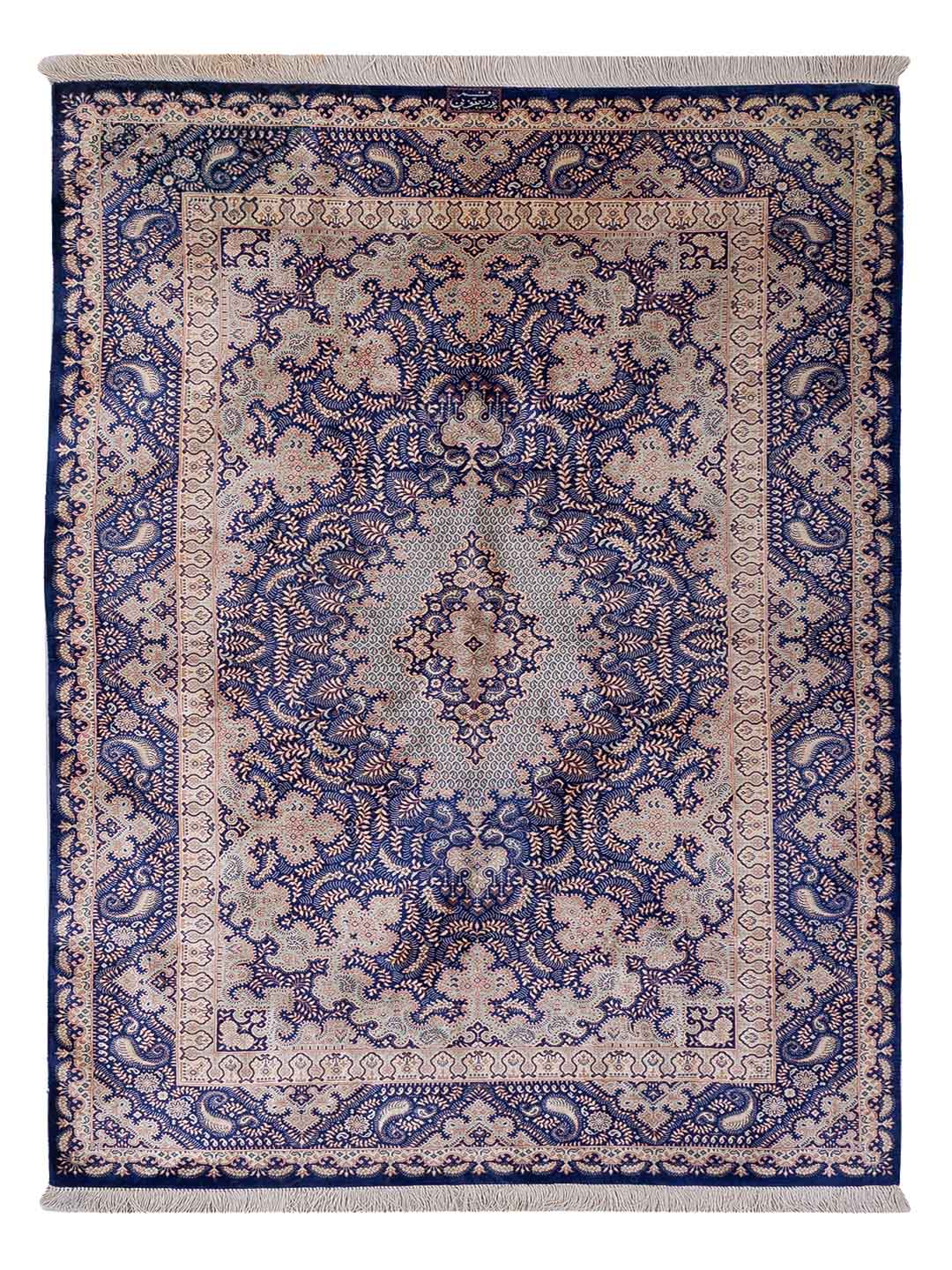
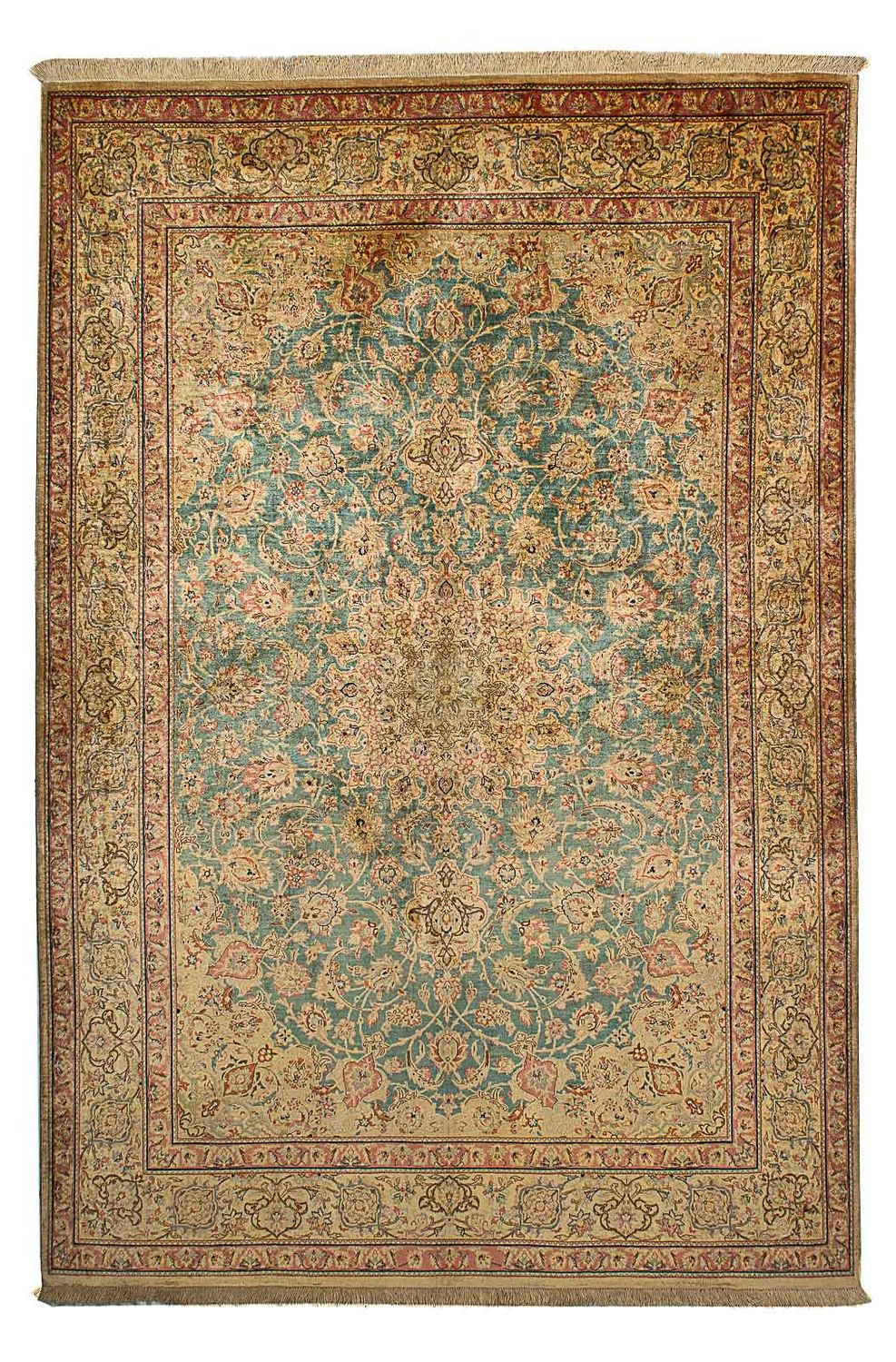
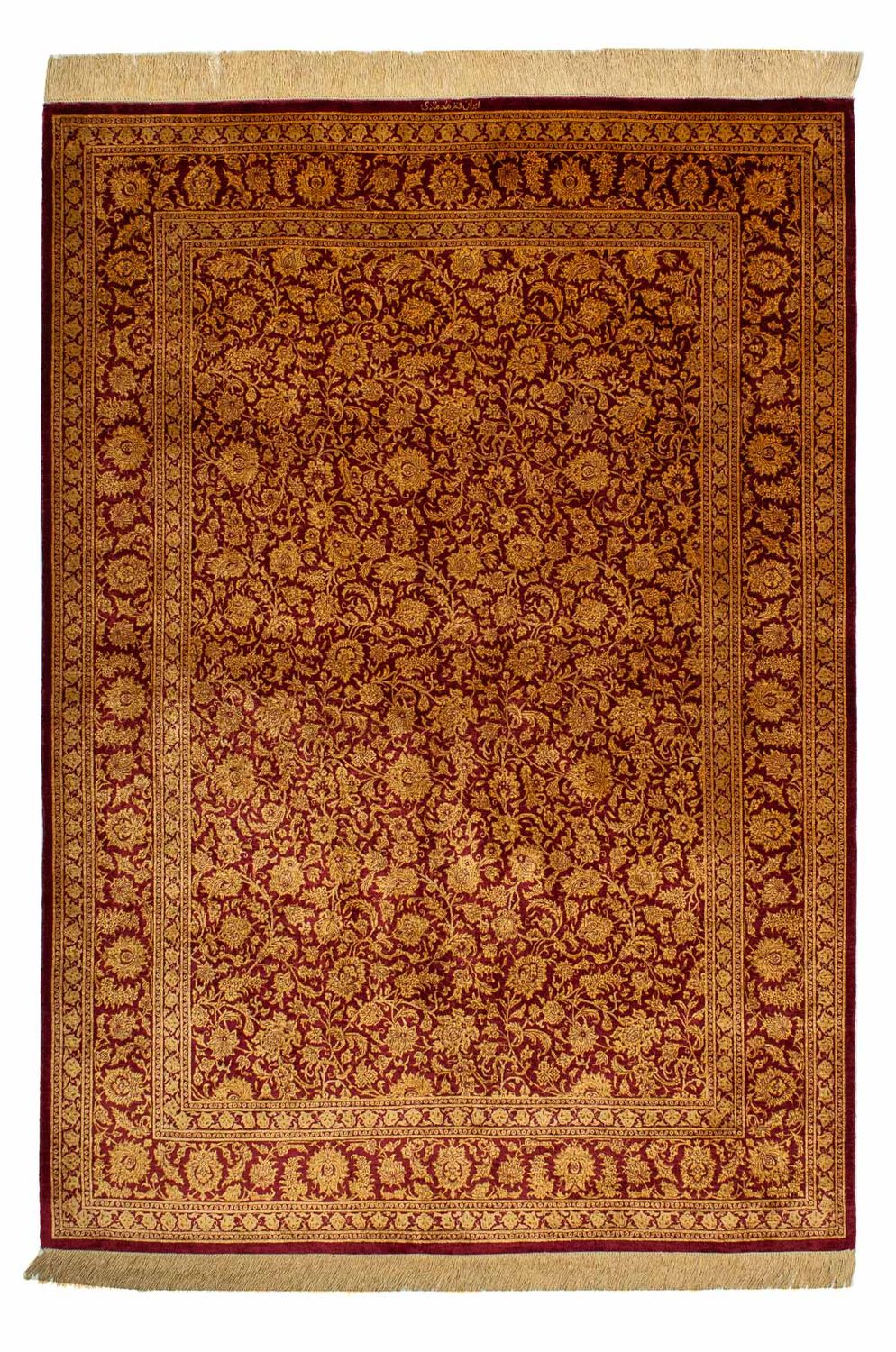
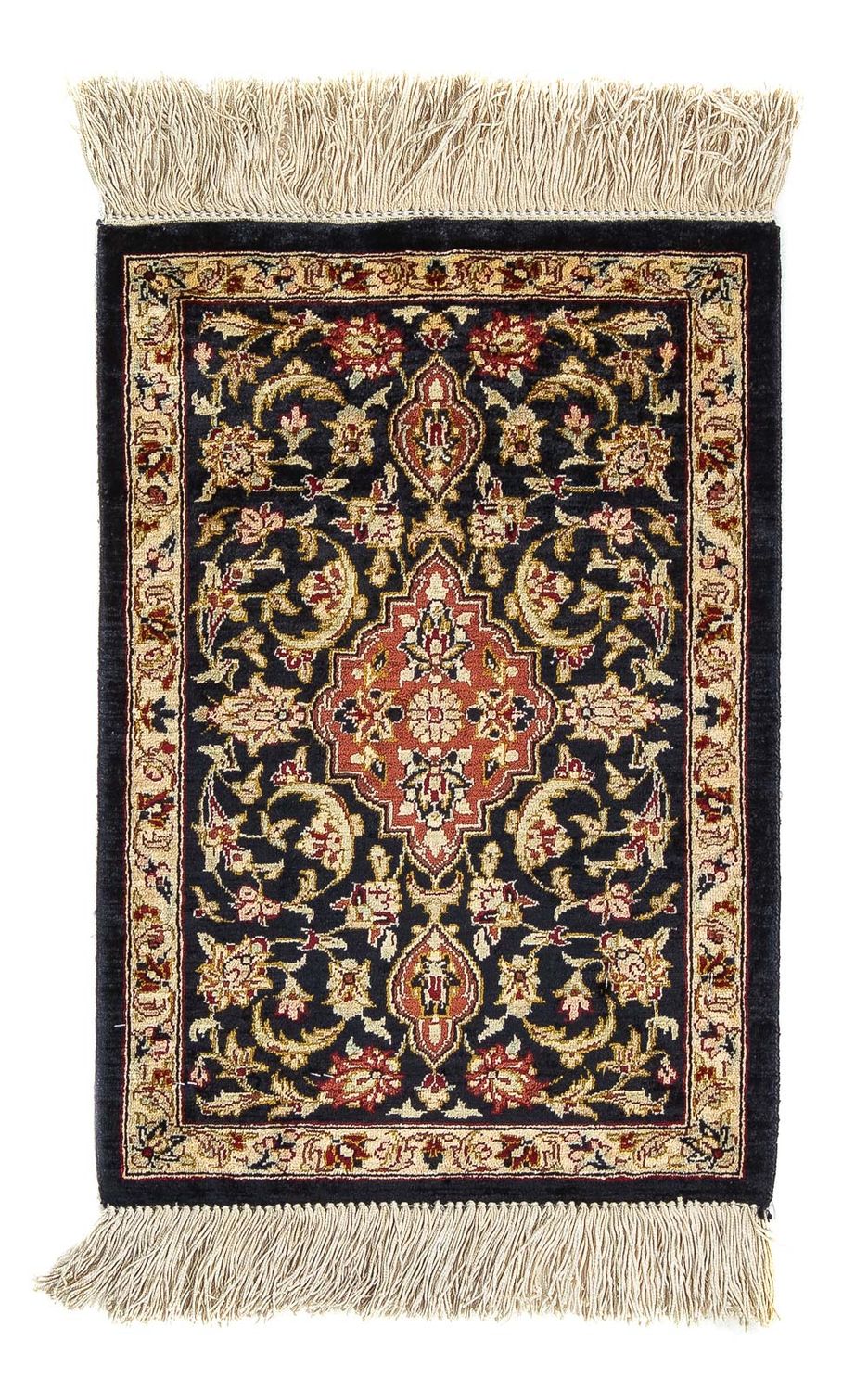
Photo: Morgenland Rugs
Qom silk rugs are the finest pure silk rugs that Iran produces. They come from the city of Qom, are knotted entirely of mulberry silk, and reach knot densities that only a handful of knotting regions worldwide achieve. With their fine floral and figurative patterns, their shifting sheen and their high market prices, they stand at the summit of Persian rug art. This article explains the origin, material, knotting technique, value and authentication features of a Qom silk rug.
What is a Qom silk rug?
A Qom silk rug is a hand-knotted Persian rug from the Iranian city of Qom (also written Ghom), whose pile, warp and weft consist entirely of silk. Knotting is done with the asymmetric Persian knot, the so-called Senneh knot, which makes possible the fine, curving line work of the patterns. Characteristic are a very short pile, an extremely high knot density and a sheen that lets the colours shift depending on the angle of light. With this, the Qom silk rug clearly differs from the woollen Qom, which has the same origin but is more coarsely worked and significantly cheaper.
The term denotes no single workshop, but the whole silk production of the city, from solid commercial quality to signed masterpieces. Within this span, fineness, yarn quality, pattern clarity and the hand of the master weaver decide the rank of a piece.
Origin
Qom lies about 150 kilometres south of Tehran and has been one of the most important pilgrimage cities of Shia Islam for centuries. As a centre of rug knotting, however, the city is young. A systematic production began only in the 1930s, that is, centuries after the classical centres such as Tabriz, Isfahan or Kashan. Qom had no centuries-old village tradition of its own to tie into, and developed from the outset as a manufactory location that oriented itself on the high level of the established centres.
This late start shaped the character of the city. Qom adopted patterns and techniques from across Persia and refined them, rather than cultivating a single regional style. In the second half of the 20th century a part of the workshops consistently specialised in pure silk and so occupied the highest market segment. Today, several thousand looms are in operation in the city, of which only a smaller part produces pure silk rugs. The majority knot wool rugs or pieces with silk contours on a wool ground.
Patterns and colours
Qom silk rugs belong to the curvilinear, that is, drawn, patterns and follow a cartoon. Most widespread is the classical medallion composition with a central medallion, four corner spandrels and a floral inner field of vines, palmettes and fine flowers. Alongside are figurative patterns, for example hunting scenes, animal and bird representations, as well as garden patterns (chahar bagh) and vase motifs. Particularly fine all-over patterns without a central medallion also occur.
The palette is broader and often lighter than in many other Persian rugs. Besides the classical red and blue tones, elegant cream, ivory and pastel tones are typical, supported by green, turquoise, delicate pink and gold nuances. The silk sheen lets every colour appear lighter or darker depending on the angle of view, which is why the same rug viewed from two directions has a different effect. This liveliness is a hallmark of fine silk work. Many pieces carry a woven-in signature of the master weaver or workshop, occasionally with a year according to the Persian calendar.
Material and knotting technique
Qom silk rugs are made entirely of pure silk. Both the pile and the warp and weft consist of high-quality mulberry silk, valued for its sheen, its tensile strength and its fineness. The fibre can be spun so thinly that very many knots find room in the smallest space, which is what makes the high resolution of the patterns possible in the first place. More on the production and properties of the fibre is given in the article on silk.
Knotting is done with the asymmetric Persian knot, in the trade called the Senneh knot. Unlike the symmetric Turkish knot, it wraps only one of the two warp threads completely, which allows a denser distribution and softer, curving lines. This technique is the precondition for the fine curves of the floral Qom patterns. The basics of both knot types are explained in the overview of knot types; the whole sequence from setting the warp to shearing is described in the article on rug production. How silk differs from wool is treated in the overview of materials.
The pile is sheared very short so that the patterning stands out sharply. The labour involved is enormous: a fine Qom silk rug of medium size can occupy an experienced weaver for one to several years. This combination of precious material and extreme time is the main reason for the high prices.
Knot density and quality
Qom silk rugs are among the most densely knotted rugs at all. Common qualities lie at around 400,000 knots per square metre; fine pieces reach 700,000 to over 1,000,000 knots per square metre. Such values are only realisable with pure silk and the asymmetric knot, because the fibre is thin enough and the knot sits closely enough. What knot density means in detail, and why it is not a sole mark of quality, is explained in its own article.
Density alone, however, does not decide quality. Just as important are the purity and sheen of the silk, the cleanness of the drawing, the harmony of the colours and the evenness of the knotting across the entire surface. A technically very dense but dully dyed or unsharply drawn piece stands behind a somewhat less dense but brilliantly worked rug.
| Variant | Material | Typical knot density | Classification |
|---|---|---|---|
| Qom silk | pure silk | approx. 400,000 to over 1,000,000 / m² | finest segment, highest prices |
| Qom (wool) | wool, partly with silk contours | approx. 250,000 to 500,000 / m² | fine wool rug, significantly cheaper |
| Isfahan | wool on silk warp | approx. 500,000 to 1,000,000 / m² | classical manufactory centre |
| Nain | wool with silk contours | approx. 250,000 to 700,000 / m² | fine wool quality, silk sheen only in contours |
| Hereke silk | pure silk (Turkey) | up to over 1,000,000 / m² | Turkish counterpart in the silk segment |
| Indo Qom | silk or art silk (India) | strongly variable | reproduction of the Qom design outside Iran |
What is a Qom silk rug worth?
Qom silk rugs belong among the most expensive hand-knotted rugs in the world. The value of a piece depends on size, knot density, silk quality, pattern clarity, state of preservation, age and the signature of the master weaver. Small formats begin in the mid to high four-figure range; large or signed masterpieces reach five- to six-figure sums. Pieces from the workshops of well-known master weavers are particularly traded on the international market and count as collector's items and stores of value.
Because of the high sums and the many reproductions, a careful classification before buying pays off. Orientation is given by the overview what is my rug worth? and by the article recognising valuable Persian rugs. Practical notes on selection and reputable sources are given in the buying guide.
How do you recognise a genuine Qom silk rug?
The most important question with a Qom silk rug is whether it is actually genuine, hand-knotted natural silk. Confusion is possible above all with art silk (viscose, often offered as mercerised cotton or bamboo silk) and with machine-made imitations. Reliable indicators of a genuine piece are:
- Hand-knotted back: the pattern is sharply mirrored on the reverse; individual knots are visible as a fine, even grid.
- Real fringes: the fringes are the extended silk warp threads, not sewn on afterwards. In pure silk the fringes are also of silk.
- Shifting sheen: natural silk changes brightness with the angle of light. Art silk often shines more uniformly and more coldly.
- Very high, even knot density with a short pile and fine drawing down to the smallest details.
- Warm handle: natural silk feels warm and dry, art silk often cooler and smoother.
- Signature: many genuine pieces carry a woven-in signature of the workshop or master weaver, occasionally with a year.
A reliable method for distinguishing natural from art silk is described in the article identifying silk. A general step-by-step inspection is given in Is my rug genuine?; an overview of the authentication features is found in recognising hand-knotted rugs. For high sums, a professional appraisal in addition is advisable.
Care
Silk rugs are more delicate than wool rugs and need correspondingly more care. Qom silk rugs are often not walked on at all, or only very gently; many serve as wall hangings or representative single pieces in order to spare the fine pile. Vacuum only carefully in the pile direction, without a rotating brush and without strong suction. Direct, permanent sunlight bleaches the colours and should be avoided.
Stains or moisture on silk belong in expert hands. Self-experiments with water or cleaning agents can permanently reduce the sheen and leave rings. In case of damage, a specialised silk cleaning is the safe route. Detailed notes are given in the care overview.
Frequently asked questions
Why is a Qom silk rug so expensive?
A Qom silk rug combines three cost-driving factors: precious pure mulberry silk as material, an extremely high knot density of often several hundred thousand to more than a million knots per square metre, and a labour input that for fine pieces amounts to one to several years. Added to this for signed masterpieces is the reputation of the workshop. From this combination the high prices arise.
What is the difference between Qom silk and Qom in wool?
Both come from the same city but differ in material. The Qom in wool is coarser, more robust and significantly cheaper, while the Qom silk rug consists entirely of silk, is more finely knotted, shines more strongly and occupies the highest price segment. Some wool qualities use silk only for individual contours, which does not make them pure silk rugs.
How do I recognise genuine natural silk in a Qom rug?
Natural silk shifts in light, feels warm and dry, and burns with the smell of singed hair to crumbly ash, while art silk feels cooler, shines more uniformly and on burning smells like paper. In pure silk the fringes are also made of silk. The safe procedure including the burn test is described in the article identifying silk.
How do I care for a Qom silk rug properly?
Carefully and without experiments. Only vacuum gently in the pile direction, do not use a rotating brush, protect from permanent sun and do not apply moisture or cleaning agents yourself. Stains and thorough cleaning belong with a specialised silk cleaner. Many collectors use fine pieces as wall hangings in order to spare the pile.
Can you lay a Qom silk rug on the floor?
Technically yes, but because of the high value and the delicate fibre, many pieces are only used in little-walked areas or as wall hangings. With floor use, a protected position away from heavily trafficked paths and without heavy, pressing furniture on the fine pile is advisable.
How do I tell a hand-knotted Qom from a machine-made imitation?
In the hand-knotted Qom the pattern is sharply and mirror-imaged on the back; the knots form a fine, slightly irregular grid; and the fringes are part of the warp. Machine-made imitations show a uniform back image, often glued-on or sewn-in fringes, and a colder, more uniform shine. The features of hand-knotted pieces are gathered in recognising hand-knotted rugs.
Which city does a Qom silk rug come from?
From Qom (Ghom), a city about 150 kilometres south of Tehran in Iran. It is known as a Shia pilgrimage city and only developed from the 1930s onwards into a centre of rug knotting that has specialised in fine pure silk rugs.
Impressions of the origin
Places, landscapes and landmarks around the home of Qom Silk rugs. Click any image for a larger view.
Related styles
Qom
Qom rugs from the holy city are among the finest Persian rugs and are particularly prized in pure-silk versions.
Hereke Silk
Hereke silk rugs come from the Ottoman court manufactory and are among the world’s most prized silk carpets.
Kashmir Silk
Kashmir silk rugs are knotted in northern India and combine classic Persian designs with the lustrous quality of Kashmir silk.


