Kashmir silk rugs: silk knotting from northern India
Kashmir silk rugs are knotted in northern India and combine classic Persian designs with the lustrous quality of Kashmir silk.
Profile
- Manufacturing
- Hand-knotted
- Origin
- India — Srinagar, Kashmir
- Pile material
- Silk on cotton or silk
- Knot density
- 300,000 – 1,000,000 knots/m²
- Features
- Pure or mixed silk, classic Persian designs, fine knotting
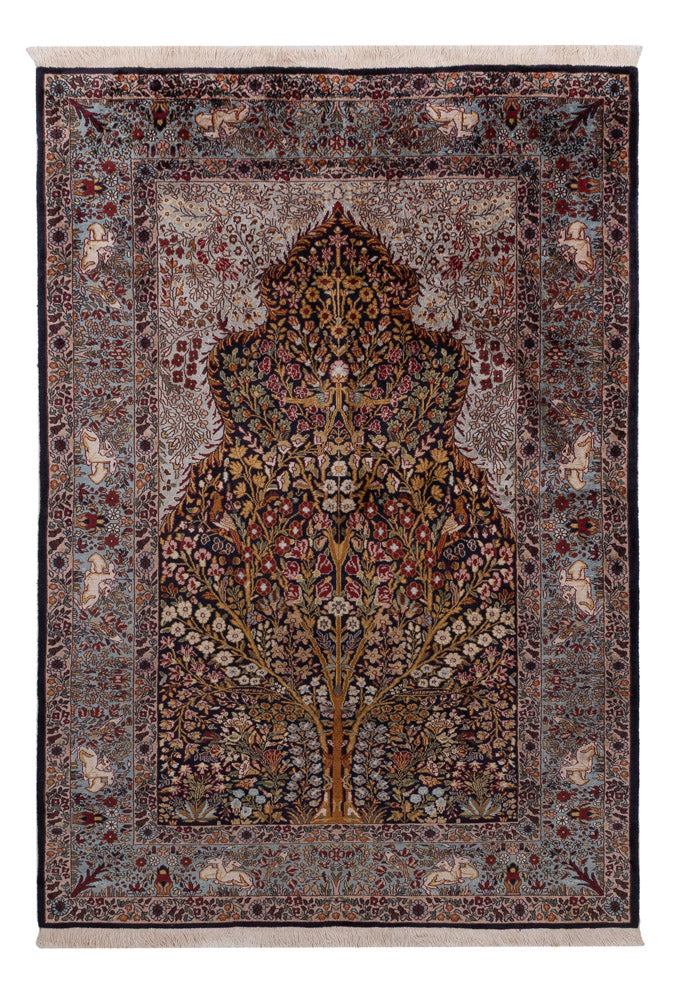
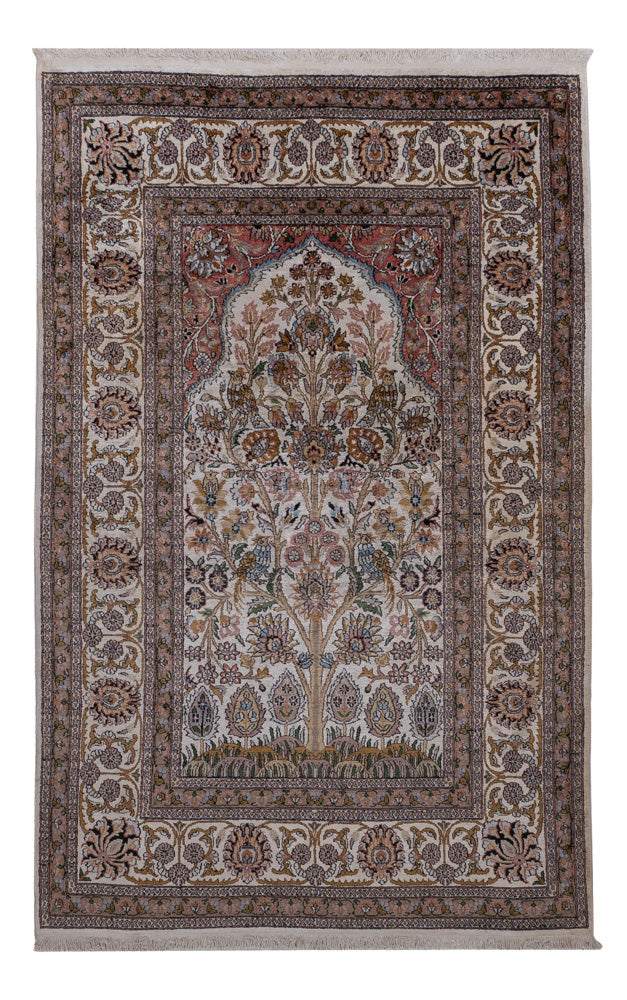
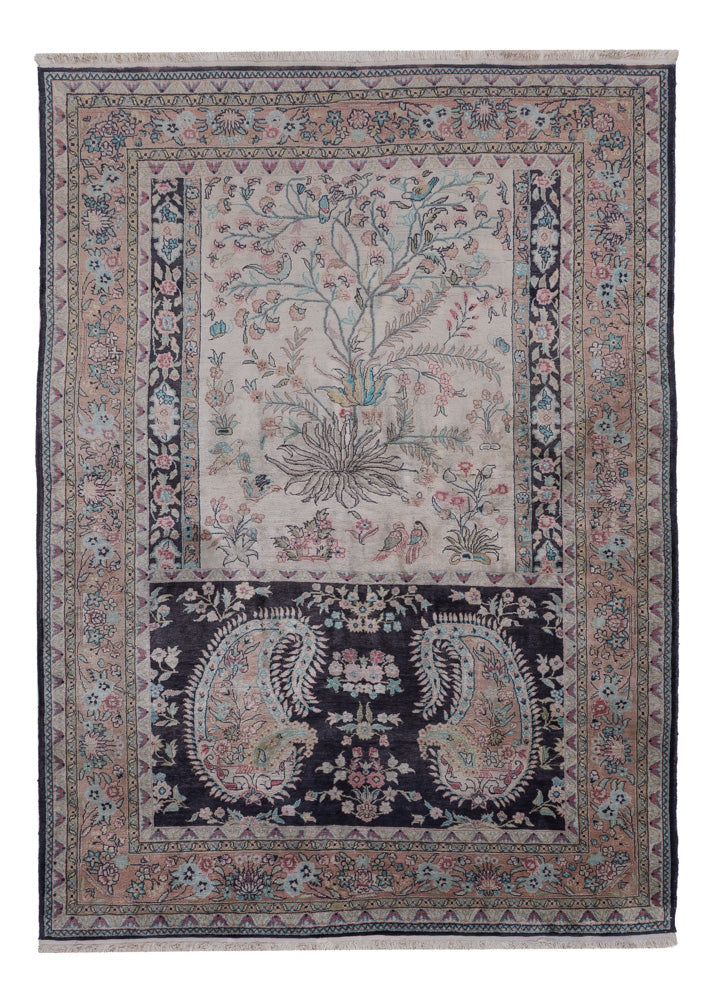
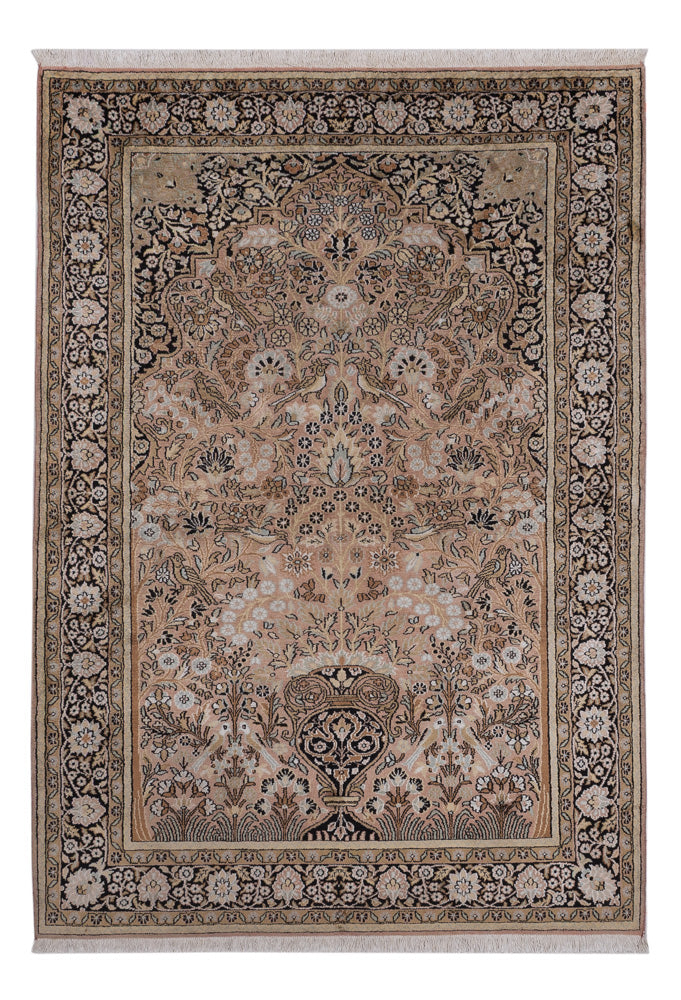
Photo: Morgenland Rugs
Kashmir silk rugs are fine silk rugs from Indian Kashmir and northern India. They draw on Persian models such as floral medallions, hunting scenes, and the tree-of-life pattern, and translate them into finely knotted silk. Caution is in order when buying: a large share of the ware sold as Kashmir silk is not made of natural silk but of art silk (viscose). This article explains origin, patterns, material, and knotting technique, places the value, and shows honestly how to tell genuine silk from art silk.
What is a Kashmir silk rug?
A Kashmir silk rug is a hand-knotted rug from India, traditionally from the Kashmir region around the city of Srinagar, whose pile is made of silk. Warp and weft are made of silk or cotton, depending on quality. Knotting uses the asymmetric knot, the Persian or Senneh knot, which renders the fine, curving lines of the floral patterns possible. Characteristic are a very short pile, a smooth surface, and a sheen that shifts with the angle of light.
The term covers an entire producing region and a style, not a single workshop. Important in this context is an honest distinction by material: there are pieces of pure natural silk, pieces with a silk pile on a cotton warp, and a large share of art silk. The latter are often marketed as art silk, bamboo silk, art silk, or mercerized cotton. They look similar at first glance but are worth considerably less. Anyone buying Kashmir silk should therefore always ask for the exact material.
Origin
Kashmir's silk and textile tradition is old and closely tied to the Mughal era. In the 15th and 16th centuries, craftsmen from Persia and Central Asia brought refined weaving and knotting techniques to the region, and under the Mughals Kashmir became a center for luxury textiles, including the famous Kashmir shawls. Hand-knotted rug production developed from there and oriented itself strongly on Persian models.
The center of Kashmiri knotting is Srinagar in the Kashmir Valley, in the Indian union territory of Jammu and Kashmir. The political situation in the region has at times hampered production, which is why genuine, locally knotted natural silk rugs are rare and accordingly in demand. A significant share of the ware traded today as Kashmir silk comes from other parts of northern India, such as the area around Amritsar, Agra, or Bhadohi, and merely follows the Kashmir style. The full tradition belongs to the family of Indian rugs. Related provenances knot Persian classics as Indian versions, such as the Indo-Qum.
Patterns and colors
Kashmir silk rugs reproduce predominantly Persian designs in particularly fine execution. Common are:
- Floral medallion patterns with a central medallion, corner spandrels, and an interior field of vines, palmettes, and blossoms.
- Tree of life patterns with rising branches, blossoms, and birds.
- Hunting scenes with riders and animals after classical Persian models.
- All-over patterns with continuous, fine floral drawing without a central medallion.
- Boteh motifs, the teardrop paisley shape historically tied closely to Kashmir.
The palette is mostly muted and elegant. Typical are cream, beige, soft rose, light blue, green, and subdued reds. The silk sheen makes the colors appear lighter or darker depending on the viewing angle, giving fine pieces depth. This shifting effect is also a test: with art silk, the sheen often looks more even and colder.
Material and knotting technique
In a genuine Kashmir silk rug, the pile is made of mulberry silk, in pure pieces warp and weft as well. Frequently a silk pile sits on a cotton warp, which is a stable and affordable construction. The properties and harvesting of the fiber are described in the article on silk, and the difference from wool and other fibers is covered in the overview of materials.
Here lies the most important honest note: a large share of the ware sold as Kashmir silk is art silk made of viscose. This is offered under names like bamboo silk, art silk, art silk, or mercerized cotton. Such rugs are not inherently poorly made, but they are not natural silk and cost only a fraction. When buying, the material should be clearly named and ideally confirmed in writing.
Knotting uses the asymmetric knot, the Persian or Senneh knot, which fully encloses only one of the two warp threads and thus allows for dense distribution and soft, curving lines. The knot types and their effects are explained in a dedicated overview, and the entire process from setting the warp to shearing is described in the article on rug production. The pile is sheared very short so that the fine drawing stands out sharply.
Knot density and quality
Fine Kashmir silk rugs reach high knot densities, with around 300,000 to 700,000 knots per square meter being typical, and very fine pieces ranging above that. These values apply to genuine natural silk; with art silk rugs the density varies widely and says less about value. What knot density means individually, and why it is not a sole quality seal, is explained in a dedicated article.
Alongside density, the type of material, the sheen and purity of the silk, the cleanness of the drawing, the harmony of the colors, and the evenness of the knotting decide quality. With Kashmir silk, the material question is even more important than the pure knot count: a cleanly worked natural silk rug of medium density is more valuable than a dense rug made of viscose.
| Variant | Material | Typical knot density | Classification |
|---|---|---|---|
| Kashmir silk (natural silk) | pure silk or silk on cotton | approx. 300,000 to over 700,000 / m² | fine Indian silk work, Persian patterns |
| Kashmir silk (art silk) | viscose, often as bamboo silk | varies widely | visually similar, considerably lower value |
| Qum silk | pure silk (Iran) | approx. 400,000 to over 1,000,000 / m² | finest Persian segment |
| Hereke silk | pure silk (Turkey) | up to over 1,000,000 / m² | Turkish top segment |
| China silk | pure silk or silk on cotton | approx. 300,000 to 900,000 / m² | Chinese motifs, carved outlines |
| Indo-Qum | silk or art silk (India) | varies widely | Indian reproduction of the Qum design |
What is a Kashmir silk rug worth?
The value depends above all on the material, then on size, knot density, pattern clarity, age, and condition. Genuine natural silk rugs from Kashmir belong to the finer Indian pieces and sit clearly above art silk rugs in price, though on average below the finest Persian silk pieces like the Qum silk rug. Rugs made of art silk move at the level of decorative trade ware and are not an investment.
Because of the wide spread and the risk of confusion with viscose, a careful assessment before purchase is worthwhile. Orientation is provided by the overview What is my rug worth? and the article identify valuable Persian rugs, which explains the general valuation logic. Practical notes on selection and the material question come from the buying guide.
How do you recognize a genuine Kashmir silk rug?
The decisive question here is the material question: natural silk or art silk. The risk of confusion is greatest with viscose, sold as bamboo silk, art silk, or mercerized cotton. Typical signs of a genuine natural silk piece include:
- Hand-knotted back: the pattern is sharply recognizable in mirror image, individual knots form a fine, slightly irregular grid.
- Genuine fringes: with pure silk the fringes are the extended warp threads of silk, not sewn on afterwards.
- Shifting sheen: natural silk changes brightness depending on the angle of light, art silk often shines more evenly and colder.
- Warm, dry handfeel: natural silk feels warm, viscose often cooler and smoother.
- Tear behavior: natural silk is tear-resistant and elastic, viscose becomes weak when wet and tears more easily.
- Clear material statement: reputable sellers name the material unambiguously and confirm natural silk in writing on request.
A reliable method for telling natural and art silk apart, including a burn test, is described in the article recognize silk. A general step-by-step inspection is offered by Is my rug genuine?, and the authenticity markers of hand-knotted pieces are summarized in recognize hand-knotted. For higher sums, a professional appraisal is advisable.
Care
Silk rugs are more delicate than wool rugs and need more care. Vacuum only carefully in the pile direction, without rotating brush and without strong suction. Long direct sunlight fades the colors. With art silk made of viscose, particular caution is needed, as the fiber rapidly loses strength when wet.
Stains and moisture belong in expert hands when it comes to silk. Self-treatment with water or cleaners can dull the sheen and leave lasting tide marks; with viscose, deformation is an added risk. In case of damage, specialized silk cleaning is the safe path. Detailed notes are in the care overview.
Frequently asked questions
Is Kashmir silk always genuine silk?
No. A large share of the ware offered as Kashmir silk is art silk (viscose), often labeled as bamboo silk, art silk, or mercerized cotton. These rugs are visually similar but considerably less valuable than pieces of genuine mulberry silk. Before buying, the material should be clearly named.
How do I tell natural silk from art silk in a Kashmir rug?
Natural silk shifts in light, feels warm and dry, is tear-resistant, and burns with the smell of singed hair to crumbly ash. Art silk feels cooler, shines more evenly, becomes weak when wet, and smells like paper when burning. The safe approach including burn test is described in recognize silk.
Where does a Kashmir silk rug come from?
Traditionally from the Kashmir region around the city of Srinagar in Indian Jammu and Kashmir. A significant share of the ware traded today comes from other parts of northern India and only follows the Kashmir style. Both belong to the tradition of Indian rugs.
Why are genuine Kashmir silk rugs expensive?
They combine precious natural silk with very fine, time-consuming knotting and a production base limited locally by the political situation. A single square meter of fine natural silk can require many weeks of work. Rugs made of art silk, by contrast, are inexpensive and not an investment.
Are all silk rugs from India Kashmir rugs?
No. Silk rugs are knotted in several regions of India, for example as Indo-Qum after Persian models. Only pieces from the Kashmir Valley or in the authentic Kashmir style count as Kashmir silk rugs.
Can you place a Kashmir silk rug on the floor?
Technically yes, but because of the delicate fiber and the short pile, fine pieces are often only used in lightly walked areas or as a wall hanging. Art silk rugs are cheaper but withstand stress worse than genuine silk or virgin wool.
How do I care for a Kashmir silk rug properly?
Carefully and without experiments. Vacuum only gently in the pile direction, do not use a rotating brush, protect from prolonged sunlight, and do not apply moisture or cleaners yourself. Stains and deep cleaning belong with specialized silk cleaning; with art silk, particular caution is needed because of the fiber's weakness when wet.
Impressions of the origin
Places, landscapes and landmarks around the home of Kashmir Silk rugs. Click any image for a larger view.
Related styles
Qom Silk
Qom silk rugs are knotted from pure silk in the holy city of Qom and rank among the world’s finest hand-knotted carpets.
Hereke Silk
Hereke silk rugs come from the Ottoman court manufactory and are among the world’s most prized silk carpets.
Indo Qom
Indo Qom rugs are produced in India in the style of the Persian Qom, fine craftsmanship at more accessible prices.


