Bakhtiari rugs: Kheshti garden pattern from the Zagros
Bakhtiari rugs are knotted by the Bakhtiari tribes in the Zagros mountains and are known for their characteristic garden compartments.
- Region
- Persia / Iran
- Category
- Persian rugs
- Manufacturing
- Hand-knotted
- Knot density
- 80,000 – 200,000 knots/m²
Profile
- Manufacturing
- Hand-knotted
- Origin
- Iran — Zagros mountains, Chaharmahal and Bakhtiari Province
- Pile material
- Wool on cotton
- Knot density
- 80,000 – 200,000 knots/m²
- Features
- Garden compartments, geometric, robust quality
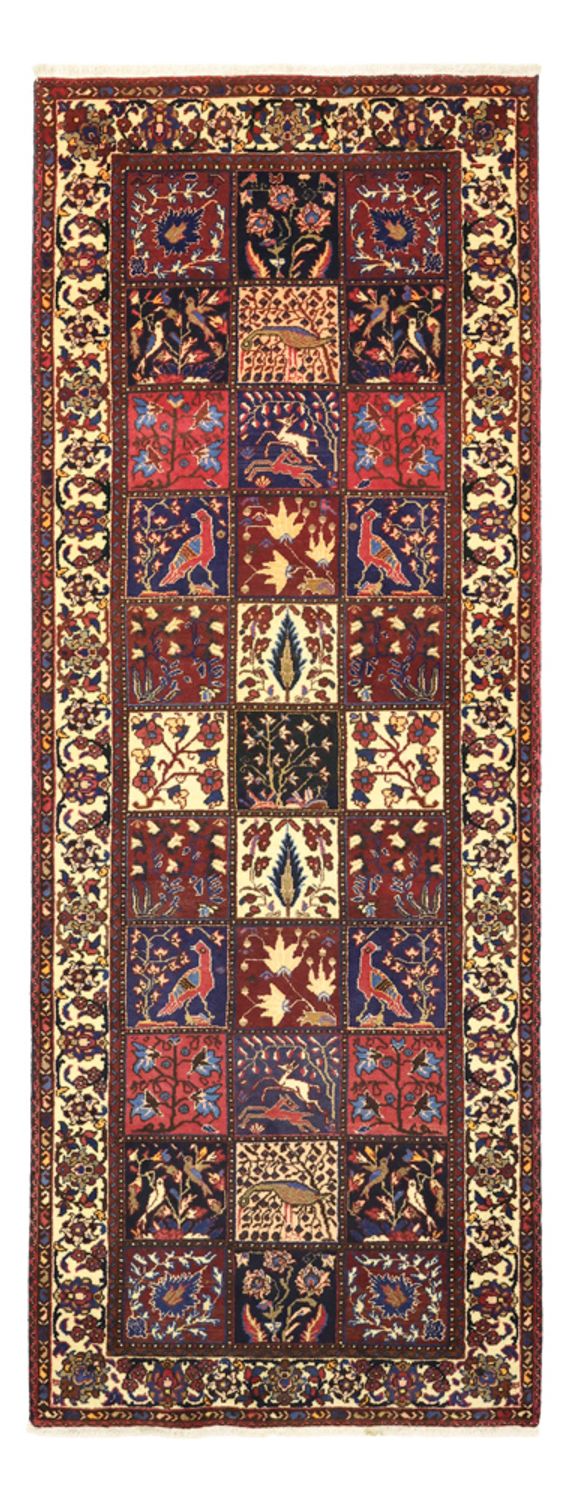
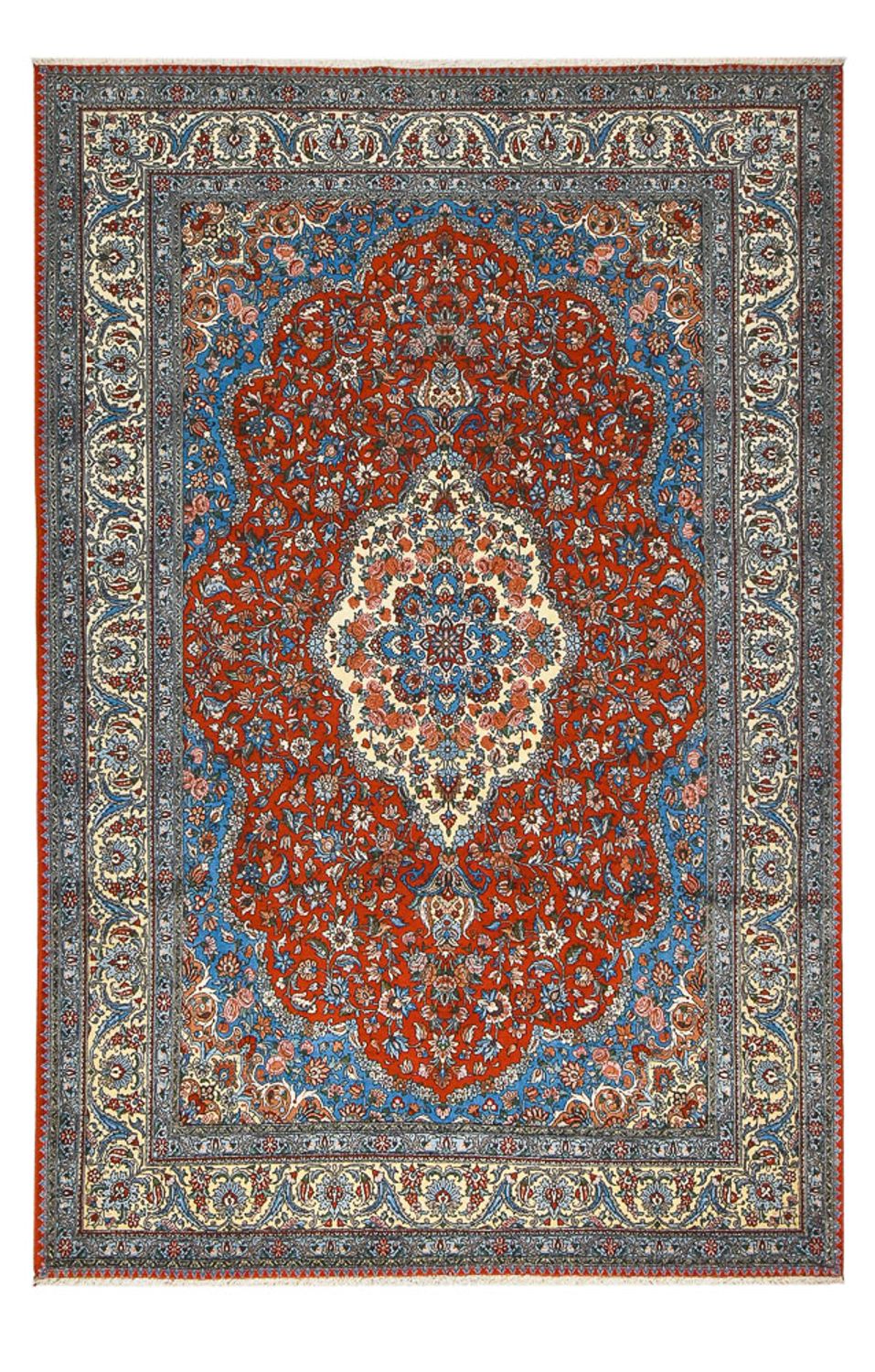
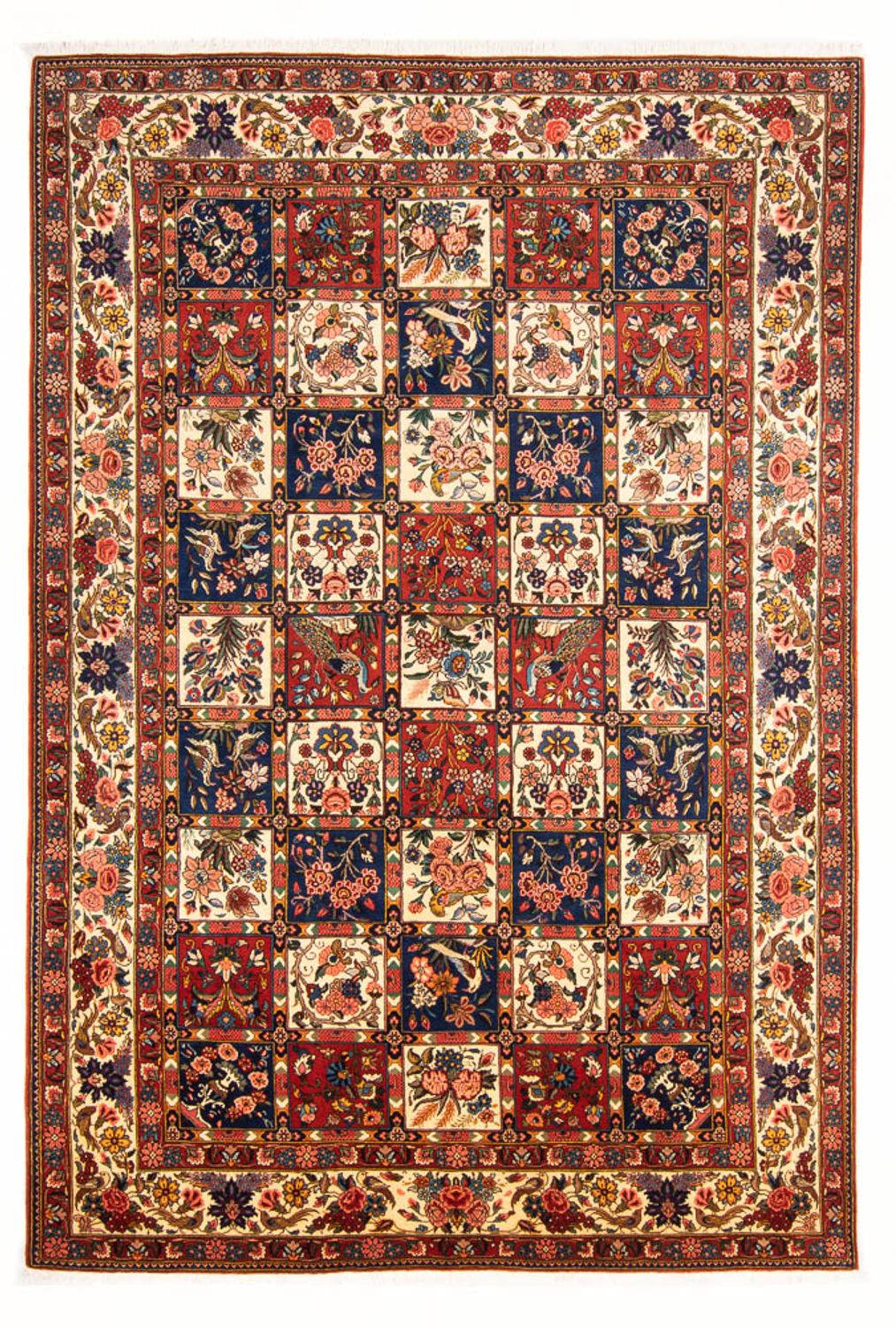
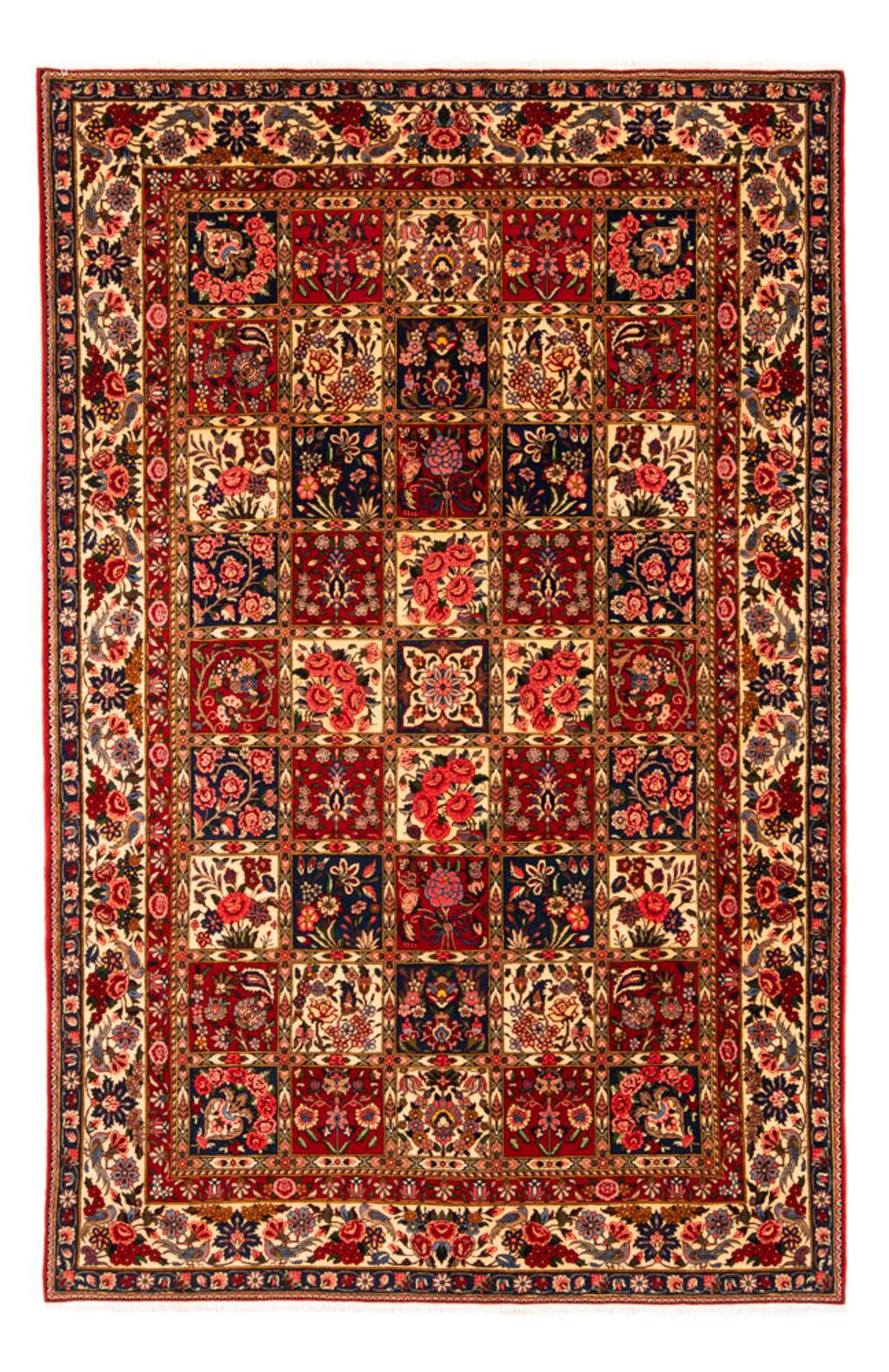
Photo: Morgenland Rugs
Bakhtiari rugs are robust hand-knotted Persian rugs from the Zagros mountains in western Iran. Their hallmark is the garden pattern, in which the surface is broken up into rectangular or diamond-shaped fields, each filled with its own flower, tree or animal motif. This compartment division is called Kheshti in Persian and makes the Bakhtiari recognisable at a glance. It was knotted both by settled villagers and by the semi-nomadic tribes of the region, which also places it close to the nomadic rugs and explains the wide range from coarser village goods to fine workshop pieces.
What is a Bakhtiari rug?
A Bakhtiari is a hand-knotted rug from the province of Chahar Mahal and Bakhtiari, south-west of Isfahan. Characteristic are the firm, heavy knotting, a wool pile on a cotton warp, the symmetric Turkish knot and, above all, the Kheshti garden design. The Bakhtiari tribes count, like the Qashqai, among the great tribal confederations of Iran, and their rugs combine village hard-wearingness with a clearly compartmented, almost architectural pictorial order. Anyone looking for a Persian rug for heavily used rooms quickly arrives at the Bakhtiari.
Origin
The home of the Bakhtiari rugs is today's province of Chahar Mahal and Bakhtiari in central Persia, a mountainous highland in the southern Zagros. The Bakhtiari are an old Lur tribal confederation that for centuries migrated between summer and winter pastures. Over time a large part of the tribes became sedentary and settled in villages such as Chal Shotor, Saman, Shahr-e Kord and Boldaji, which still count as knotting centres today.
Rug knotting developed here into a defining craft from the 17th century onwards. Its heyday came between roughly 1880 and 1930, when demand from Europe and America grew and the Kheshti garden design became a coveted export article. Many of the large-format pieces that are today traded as antiques arose in this period. After the Islamic Revolution of 1979 production declined markedly, so that older Bakhtiari rugs from the first half of the century are especially sought after.
Patterns and colours
The defining motif is the Kheshti pattern, a garden grid of rectangular or diamond-shaped fields, also known as a compartment or panel rug. Each field bears its own motif, often stylised roses, cypresses, palms, willows or bird motifs. The image recalls the Persian paradise garden, the chahar-bagh divided into squares, and belongs to the oldest pictorial ideas of oriental knotting art.
Alongside the Kheshti there are also Bakhtiari rugs with a central medallion surrounded by floral vines, as well as all-over patterned variants. The palette moves in warm, earthy tones: vivid brick-red and terracotta, deep indigo blue, ivory, golden yellow and brown tones, accented with green and occasionally pink. The bold tones traditionally come from plant dyes. The borders are usually multi-layered and pick up floral or geometric motifs. Overall the Bakhtiari feels more geometric and more vigorous than the curvilinear manufactory patterns from Isfahan or Nain.
Material and knotting technique
The pile consists of vigorous virgin wool from the robust mountain sheep of the Zagros, valued for its hard-wearingness and slight sheen. The warp is usually cotton; in older tribal pieces it is also wool. High-quality examples can include silk as an accent in individual fields; an overview of the yarns used is given in material studies.
The Bakhtiari is predominantly knotted with the symmetric Turkish knot, also called the Ghiordes knot. This knot type is widespread in the western Iranian highlands and gives the rug its firm, dense handle. The pile is sheared medium-high to high, which produces the typical, somewhat full feel. How a rug is made at all, from setting the warp to shearing, is explained in the production overview.
Knot density and quality
The knot density of a Bakhtiari usually lies between 80,000 and 200,000 knots per square metre, and above for fine workshop pieces. Village productions are often more coarsely knotted, while finer rugs arise in the workshops of the larger towns. A higher knot density allows for more detailed fields and cleaner contours, but does not on its own say everything about quality. Wool quality, natural dyeing, pattern clarity and clean execution of the Kheshti fields are just as important. How knot density bears on quality and price is treated in its own article.
A reliable quality marker on the Bakhtiari is the wool. Saturated, slightly glossy yarn with good spring suggests a high-quality piece, while dry, dull wool points to simpler commercial quality.
Bakhtiari variants in comparison
| Variant / type | Pattern | Typical quality |
|---|---|---|
| Kheshti (garden compartment) | grid of fields with single motifs | the classical Bakhtiari design, very widespread |
| Medallion Bakhtiari | central medallion with floral vines | village to workshop-fine |
| All-over Bakhtiari | continuous floral patterning without medallion | usually medium density, decorative |
| Bibibaff Bakhtiari | particularly finely knotted top quality | high knot density, often with silk accent |
| Tribal Bakhtiari | geometricised nomad motifs | coarser, vivid natural dyes |
| Mahal (comparison) | loose floral all-over, no Kheshti | neighbouring region near the Zagros, Persian knot |
| Heriz (comparison) | geometricised central medallion | robust north-west Persian village rug |
What is a Bakhtiari rug worth?
The value of a Bakhtiari depends above all on age, condition, size, knot density, wool quality, dyeing and fineness of the pattern. Newer village qualities begin in the affordable range, while antique pieces from before 1930 and especially fine Bibibaff qualities achieve significantly higher prices. Well-preserved large Kheshti rugs with natural dyes are sought after by collectors because they show the characteristic garden design in its purest form.
For an estimate of a particular piece, orientation is given by the value overview, by recognising valuable Persian rugs and by the general buying guide.
How do you recognise a genuine Bakhtiari rug?
Reliable indicators of a genuine Bakhtiari are:
- Kheshti garden pattern: the division into rectangular or diamond-shaped fields, each with its own motif, is the clearest sign of recognition.
- Symmetric Turkish knot: the Bakhtiari uses the Ghiordes knot; the back shows the pattern clearly mirrored.
- Heavy, firm structure: genuine pieces are noticeably heavier and firmer than machine-made imitations.
- Warm, earthy natural colours with brick-red, indigo, ivory and golden yellow.
- Vigorous virgin wool with a slight sheen and a medium-high to high pile.
- Fringes as part of the warp: the fringes are the extended warp threads, not sewn on afterwards.
A machine-made imitation has a glued-on or sewn-on back, uniform knots and usually a flat, lifeless yarn. A detailed step-by-step inspection is given in Is my rug genuine?; a general introduction in the recognising rugs guide.
Care
Regular vacuuming in the pile direction and the occasional professional cleaning preserve the quality of a Bakhtiari. Lift stains immediately with clear water, without rubbing. Because of the medium-high to high pile, occasional turning is advisable so that traffic marks are evenly distributed. Long direct sunlight bleaches the natural colours. Detailed notes are given in the care overview.
Frequently asked questions
What does the Kheshti pattern on a Bakhtiari mean?
Kheshti denotes the division of the rug surface into rectangular or diamond-shaped fields, each bearing its own flower, tree or animal motif. The garden grid goes back to the idea of the Persian paradise garden and is the characteristic design of the Bakhtiari.
What is the difference between a Bakhtiari and a Mahal?
The Bakhtiari comes from the southern Zagros and usually shows the Kheshti garden pattern with a symmetric Turkish knot. The Mahal comes from the Sultanabad region around Arak, is worked with the asymmetric Persian knot and shows a loose floral all-over without any compartment division.
How do I recognise a genuine Bakhtiari rug?
Look for the Kheshti compartment pattern, the symmetric Turkish knot, the heavy, firm structure and warm natural dyes. The back shows the pattern clearly, the fringes are part of the warp, and the wool is vigorous and slightly glossy.
Which sizes are common for Bakhtiari rugs?
Bakhtiari rugs range from smaller formats around 150 × 100 cm to large pieces of 400 × 300 cm and more. The Kheshti pattern comes into its own particularly well in square and broad rectangular formats, which is why runner formats are rarer.
What does a Bakhtiari rug cost?
Prices vary strongly with age, size and quality. Newer village qualities begin in the affordable range, while antique pieces from the first half of the 20th century and fine Bibibaff qualities are significantly more expensive.
Are Bakhtiari rugs suitable for heavily used rooms?
Yes. The firm knotting with the symmetric knot and the vigorous mountain-sheep wool make the Bakhtiari very hard-wearing. It is well suited to living, dining and through-rooms with heavy use.
How do I care for a Bakhtiari rug properly?
Vacuum regularly in the pile direction and have it professionally cleaned every few years. Lift stains immediately with clear water, without rubbing. Turn the rug occasionally and avoid long direct sunlight so that the natural colours are preserved.
Impressions of the origin
Places, landscapes and landmarks around the home of Bakhtiari rugs. Click any image for a larger view.