Mir rugs: boteh allover from the Saraband region
Mir rugs from the Malayer region show the classic boteh all-over pattern in fine quality and great size variety.
- Region
- Persia / Iran
- Category
- Persian rugs
- Manufacturing
- Hand-knotted
- Knot density
- 120,000 – 300,000 knots/m²
Profile
- Manufacturing
- Hand-knotted
- Origin
- Iran — Saraband, Markazi Province
- Pile material
- Wool on cotton
- Knot density
- 120,000 – 300,000 knots/m²
- Features
- Mir-e-boteh all-over pattern, many sizes, good value
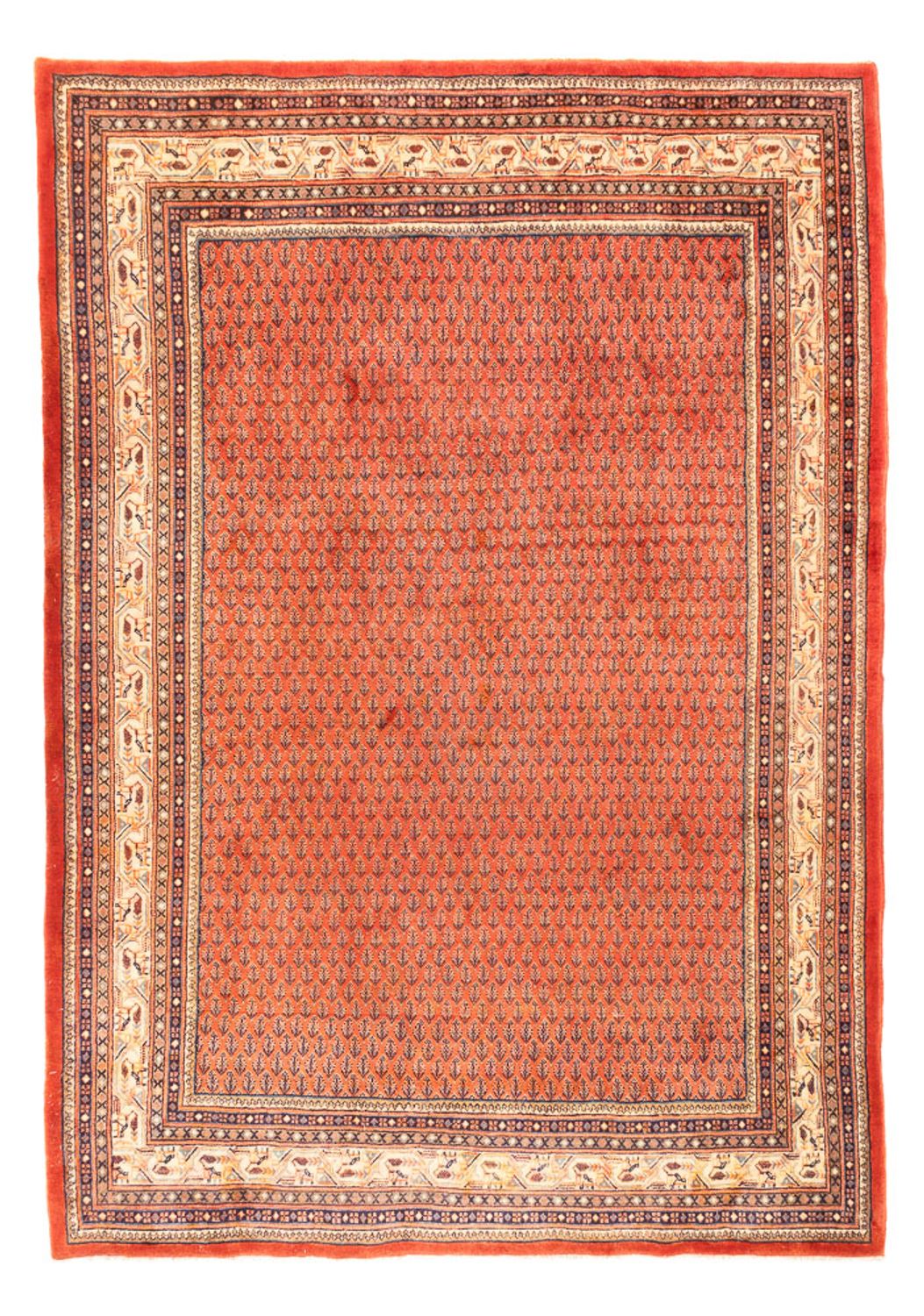
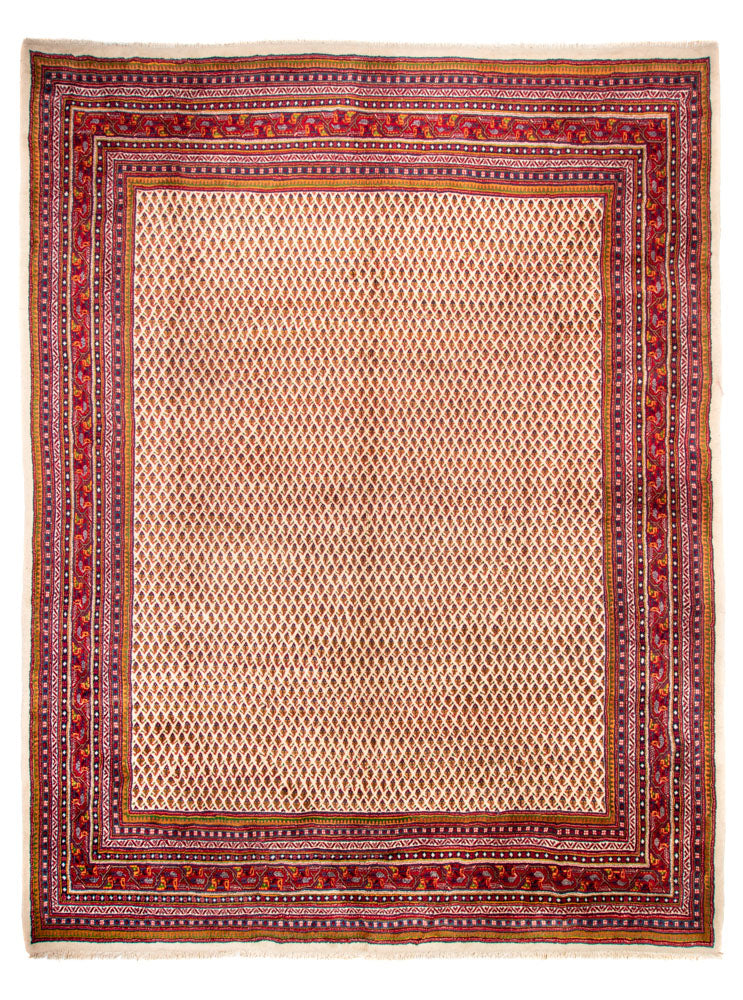
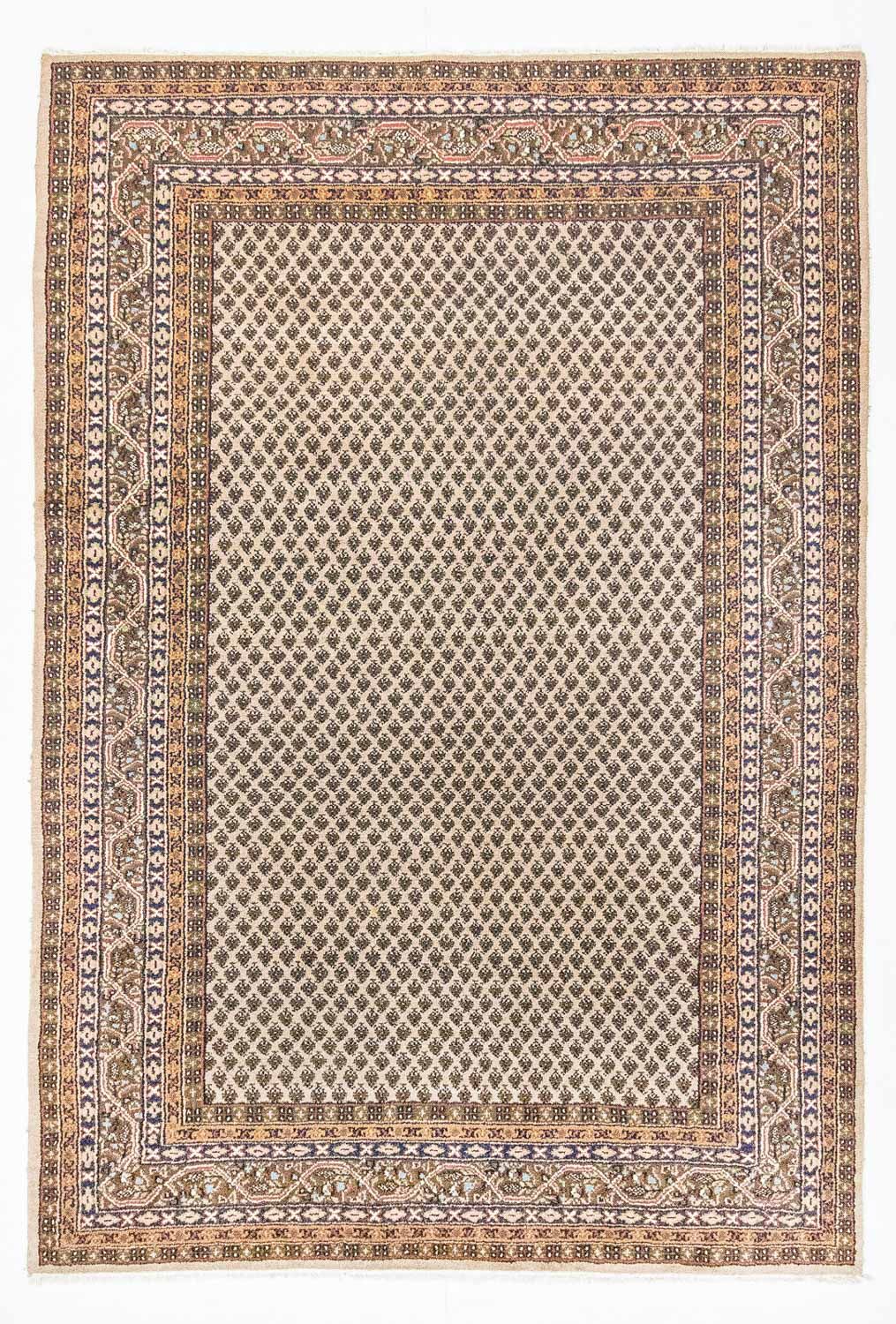
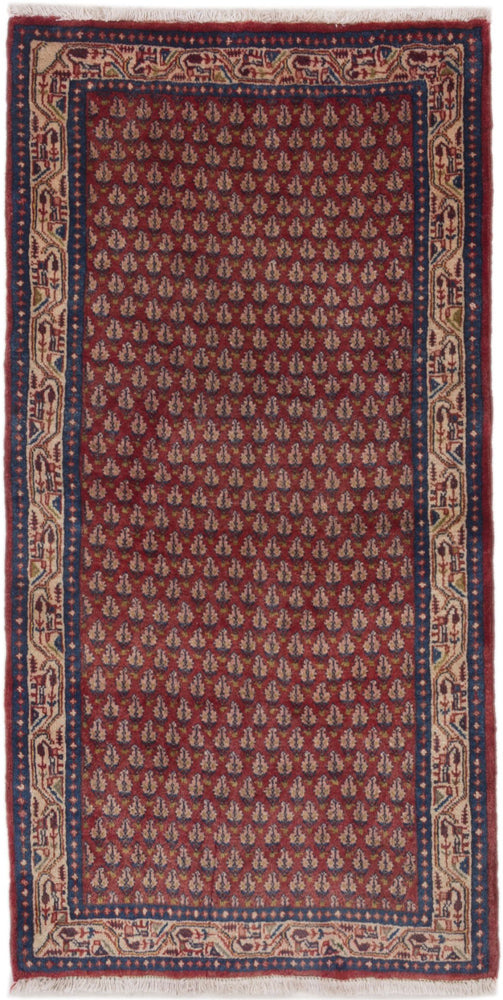
Photo: Morgenland Rugs
Mir rugs are classical Persian rugs from the Saraband region in western Iran, famous for a single, unmistakable pattern: the boteh repeated across the entire field. These teardrop paisley motifs, densely set and diagonally offset, make the Mir one of the most easily recognised Persian styles. This article explains the origin, the boteh pattern, materials and knotting technique, the value, and the marks of authenticity of a Mir rug, and sets it apart from related styles.
What is a Mir rug?
A Mir rug is a hand-knotted Persian rug whose field is completely covered by a small-scale, evenly repeated boteh pattern. The term Mir is closely linked to the Saraband region, which is why these pieces are often described in trade as Mir-Saraband. The name derives from the Persian word for prince or lord and points to the elevated reputation these fine village and workshop rugs have traditionally enjoyed.
Characteristic is the strict, almost textile order of the pattern: rows upon rows of small boteh in offset arrangement, usually on a red ground, framed by a striking, often ivory-ground border with a chain of boteh set end to end. This combination of all-over boteh in the field and a boteh border is regarded as the classical Mir scheme. Alongside the Persian originals there are reproductions from other countries, such as the Indo-Mir from India, which takes up the design outside Iran.
Origin
Mir rugs come from the Saraband region south of Arak (formerly Sultanabad) in western Persia. In the 19th century the region was a significant knotting area, supplying the European market through the trading centres of the province. Antique Mir-Sarabands of that period were already in demand in Europe as fine, finely patterned working rugs, and shaped the picture the West held of the boteh rug.
The label Mir has detached itself from the specific place of origin and today stands above all for the pattern. The term is therefore also applied to rugs that show the boteh all-over in the typical Mir manner without necessarily coming from the historical Saraband region. Well-known neighbouring provenances and relatives of the Mir also lie in western Iran, around Arak and in the wider Hamadan region. To place a piece accurately, look at pattern, knotting, and material together rather than at the name alone.
Patterns and colours
The defining element is the boteh, a teardrop or almond-shaped motif with a curved tip, known in the West as paisley. On the Mir this motif is kept small and repeated across the entire field, a so-called repeat or all-over pattern. The boteh stand in rows, each row slightly offset against the next. This produces a calm, even rhythm that gives the rug subtle visual movement and sets it apart from medallion rugs.
The palette is traditionally muted and harmonious. The field is usually held in a warm red or deep red, more rarely in blue or ivory. The individual boteh are drawn with dark contours in blue, blackish brown, or ivory and filled with fine inner patterns. The border often takes up the boteh again and lines it up on a light, frequently ivory ground to form a continuous band. This restrained, all-over patterning makes the Mir versatile to combine.
Material and knotting technique
Mir rugs are traditionally knotted from sheep's wool; the warp is usually cotton. The wool comes from regional flocks and is valued for its toughness. The pile is usually sheared low to medium, preserving the fine drawing of the many small boteh. An overview of the fibres in use can be found in the materials section.
Knotting uses the asymmetric Persian knot, the Senneh knot, which is widespread across the western Iranian Saraband area and allows the clean execution of the small-scale boteh. The differences between asymmetric and symmetric knots are explained in the overview of knot types; the whole production path is described in the article on rug production. Dyeing traditionally used natural dyes, above all madder for reds and indigo for blues. Modern production also uses high-quality synthetic dyes with good lightfastness.
Knot density and quality
The knot density of Mir rugs varies considerably with origin and quality, with around 100,000 to over 400,000 knots per square metre common. Fine antique Mir-Sarabands sit at the upper end of this range and show especially small, exactly drawn boteh, while plainer village qualities are more coarsely worked. What knot density really says, and why it is not the only measure of quality, is covered in its own article.
Beyond density, the merit of a Mir rests above all on the evenness of the boteh repeat, the clarity of the contours, the wool quality, and the harmony of the colours. A good piece holds the pattern across the whole surface in a calm, regular order, without the boteh drifting or becoming untidy.
| Style | Relation to Mir | Typical pattern |
|---|---|---|
| Mir (Saraband) | parent style, western Iran | small-scale boteh all-over, red ground |
| Indo-Mir | Indian reproduction | boteh all-over after the Persian model |
| Hamadan | neighbouring region | geometric medallion, coarser, single weft |
| Malayer | neighbouring provenance | often finer, floral and geometric motifs |
| Bidjar | west Iranian, Kurdish | very dense and heavy, often Herati pattern |
| Ghom | fine workshop centre | floral medallions, also boteh, very fine |
What is a Mir rug worth?
The value of a Mir rug depends on age, origin, knot density, fineness of the boteh repeat, wool quality, colour, size, and condition. Antique Mir-Sarabands from the 19th and early 20th centuries with fine knotting and natural dyes are sought after by collectors and accordingly fetch higher prices. Newer or coarser village qualities and the Indo-Mir sit considerably below them and offer good value for money.
For a grounded assessment, see the overview What is my rug worth? and the article Identifying valuable Persian rugs. Practical guidance on selection and purchase is in the buying guide.
How can you tell a genuine Mir rug?
Typical signs of a genuine, hand-knotted Mir include:
- All-over boteh: the whole field is filled with small, offset boteh, without a central medallion.
- Boteh border: the main border often lines up boteh again, frequently on a light, ivory ground.
- Hand-knotted back: the pattern is mirrored clearly, with individual knots visible as a fine grid.
- Real fringes: the fringes are the extended warp threads, not sewn on.
- Muted, harmonious colours with a red ground and dark boteh contours; older pieces show natural colour nuances.
- Slight irregularities in the repeat and colour (abrash) point to craft work that has matured.
A general step-by-step check of authenticity and hand-knotting is set out in Is my rug genuine?; an overview of the marks of hand-knotted rugs can be found under Identifying hand-knotted rugs.
Care
Mir rugs made of wool are robust and well suited to daily use. Regular vacuuming in the direction of the pile and occasional professional cleaning preserve colours and pile. Spills should be blotted at once with clear water, without rubbing, so they do not sink into the pile. Long, direct sunlight will fade the colours and should be avoided. Turning the rug occasionally spreads wear evenly. Detailed guidance is in the care overview.
Frequently asked questions
What is the boteh pattern on a Mir?
The boteh is a teardrop or almond-shaped motif with a curved tip, known in the West as paisley. On a Mir rug it is kept small and repeated across the whole field in offset rows. In the Persian tradition the boteh is read as a symbol of fertility and life force and is interpreted, among other things, as a stylised cypress, flame, or teardrop. It is one of the oldest ornaments in Persian art.
What does Mir-Saraband mean?
Saraband is the western Iranian region from which Mir rugs originate, which is why they are often called Mir-Saraband in trade. The suffix names the region of origin of the pattern. Over time the name Mir has detached itself from the place and today stands above all for the typical boteh all-over.
How does a Mir differ from a Bukhara rug?
Both show a pattern repeated across the field, but the motifs differ. The Bukhara lines up octagonal medallions, so-called guls, on a usually red-brown ground, a tribal pattern of Turkmen origin. The Mir by contrast repeats the teardrop boteh and is a west-Persian style. The colour world also differs; the Mir is often more varied in its contours.
What is the difference between a Persian Mir and an Indo-Mir?
The Persian Mir comes from the Saraband region in western Iran and is worked with the asymmetric Persian knot. The Indo-Mir is an Indian reproduction that takes over the boteh all-over but follows Indian production in its knotting, wool, and palette, and is usually less expensive.
Are Mir rugs suitable for heavily used rooms?
Yes. Through the robust wool and often high knot density, Mir rugs are hard-wearing and well suited to living rooms with normal to high traffic. The rather low pile and the all-over pattern also disguise wear marks.
How do I care for a Mir rug correctly?
Vacuum regularly in the direction of the pile, blot spills at once with clear water without rubbing, and have the rug professionally cleaned every few years. Avoid long, direct sunlight and turn the rug occasionally so that wear spreads evenly.
Impressions of the origin
Places, landscapes and landmarks around the home of Mir rugs. Click any image for a larger view.


