Indo Mir rugs: Mir boteh allover from northern India
Indo Mir rugs are produced in India and show the classic Mir-e-boteh all-over pattern in great size variety.
- Region
- India
- Category
- Persian rugs
- Manufacturing
- Hand-knotted in India
- Knot density
- 100,000 – 250,000 knots/m²
Profile
- Manufacturing
- Hand-knotted in India
- Origin
- India — produced after the Persian Mir model
- Pile material
- Wool on cotton
- Knot density
- 100,000 – 250,000 knots/m²
- Features
- Mir-e-boteh all-over pattern, many sizes, good value
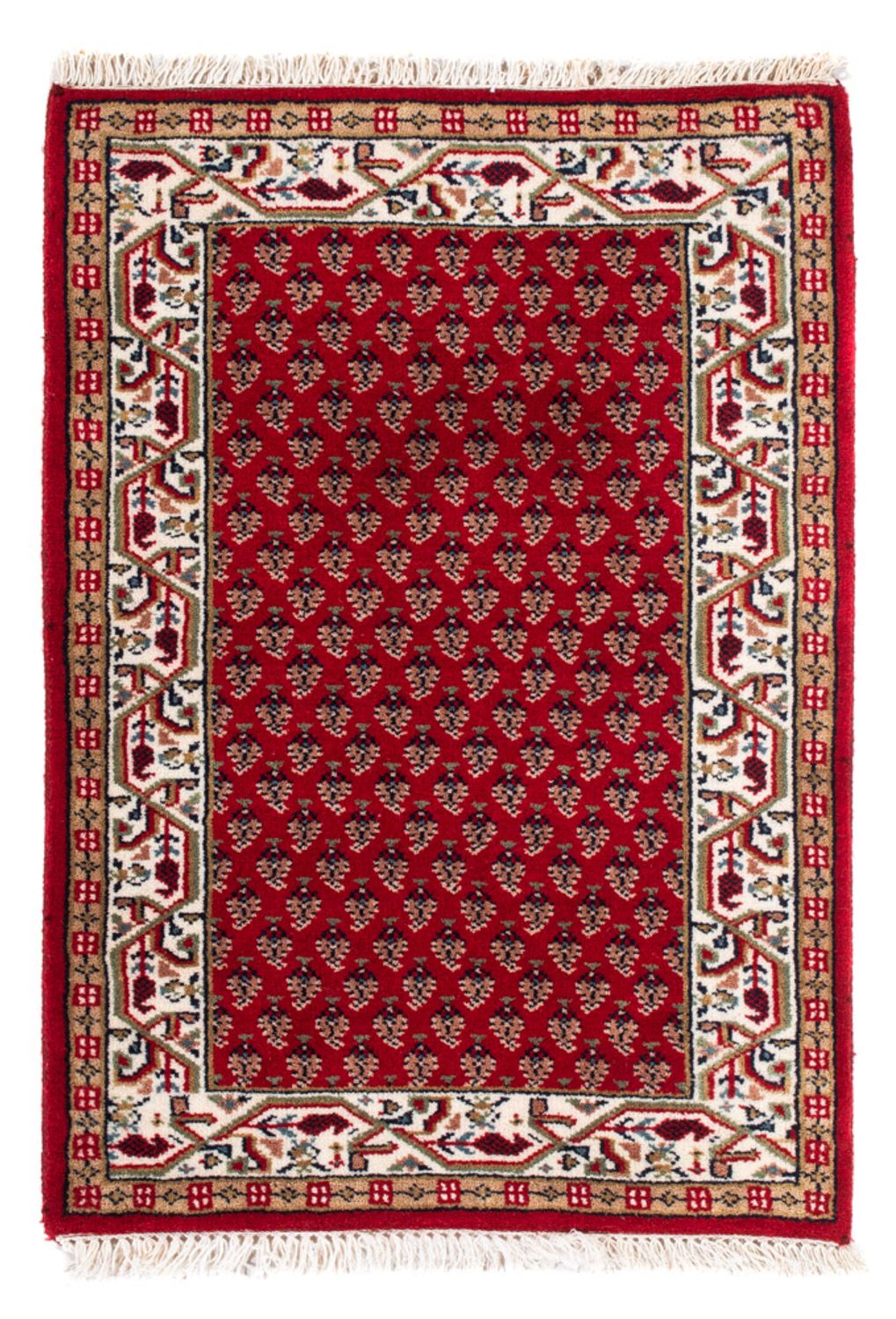
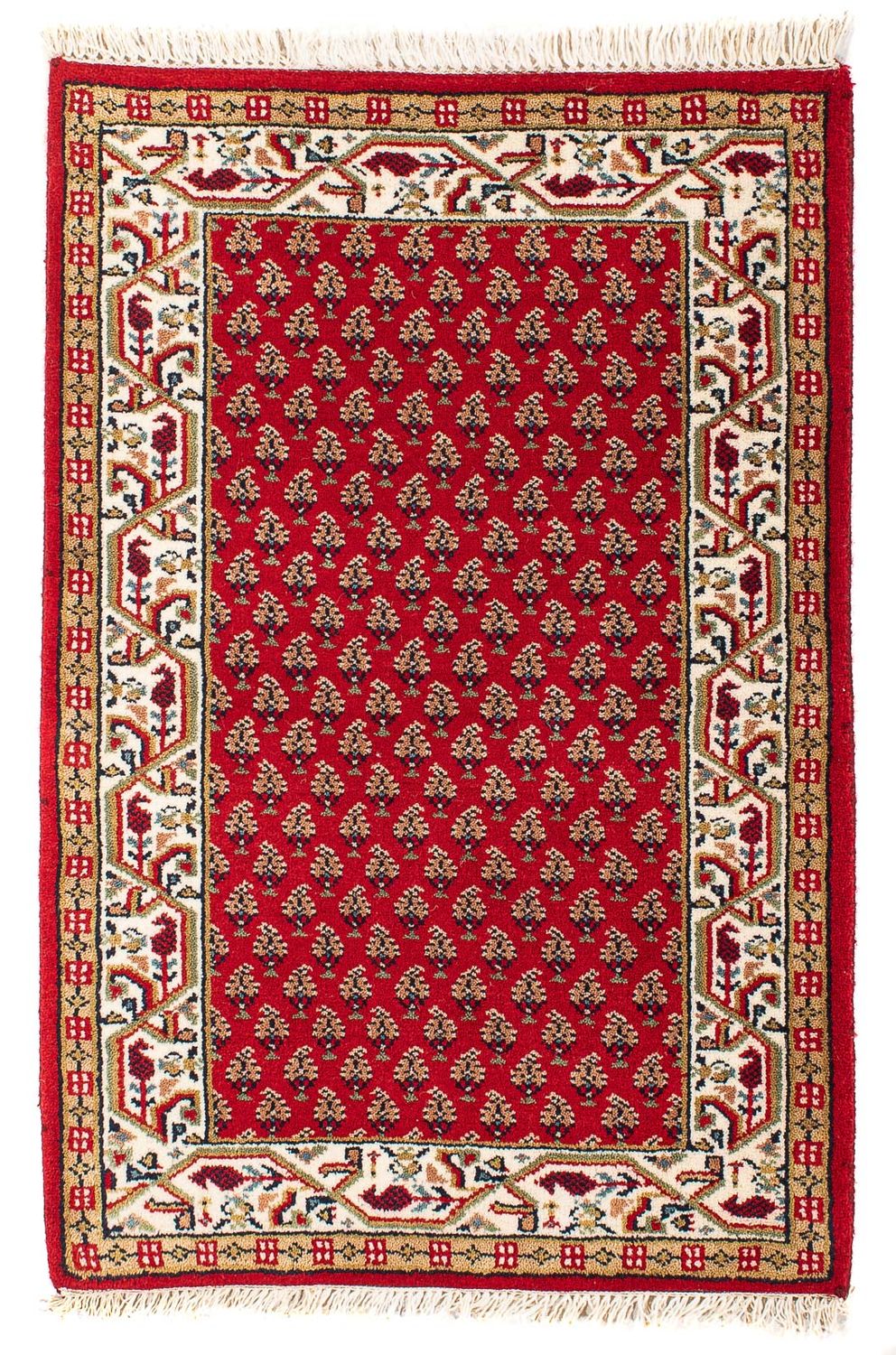
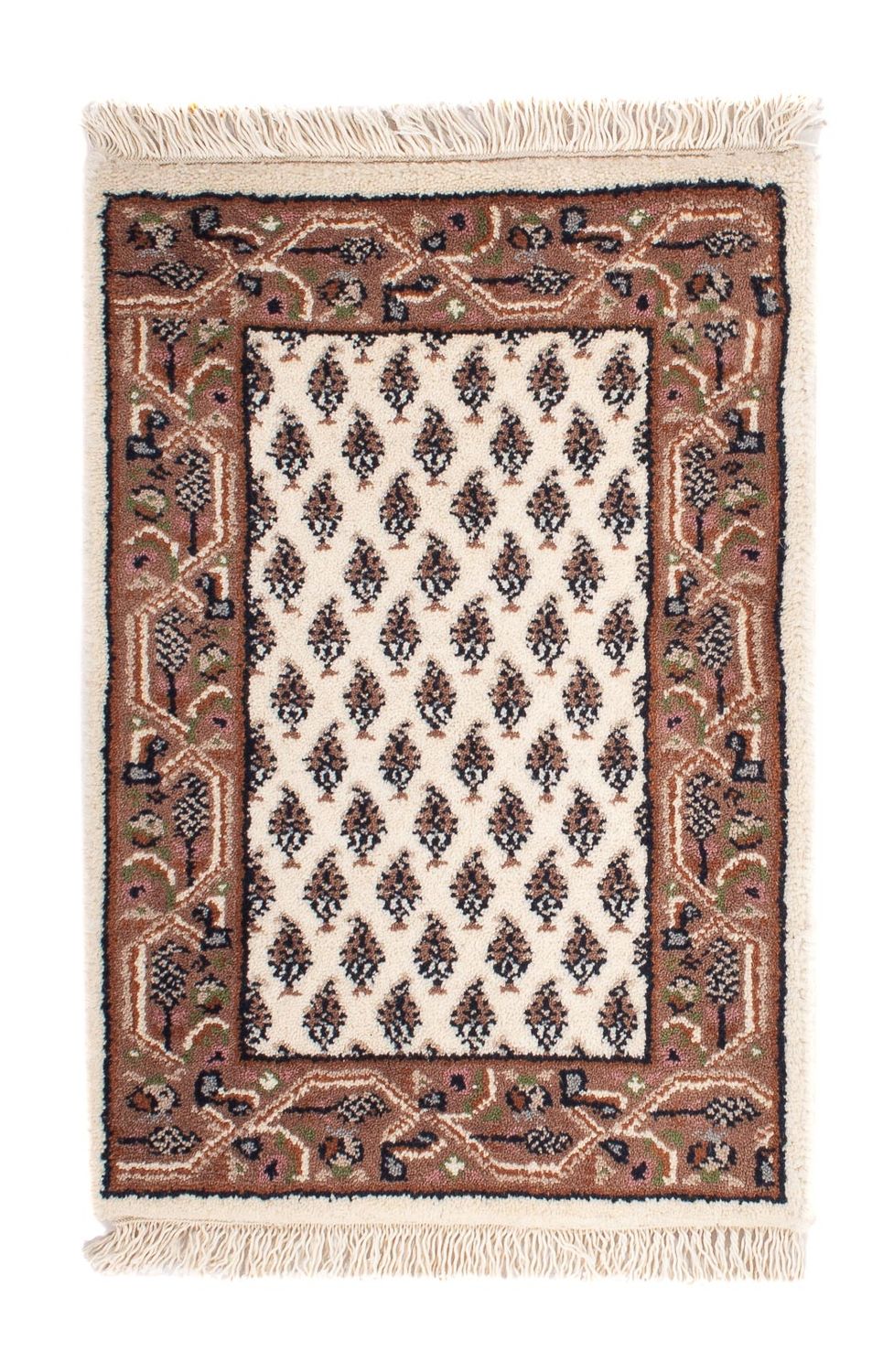
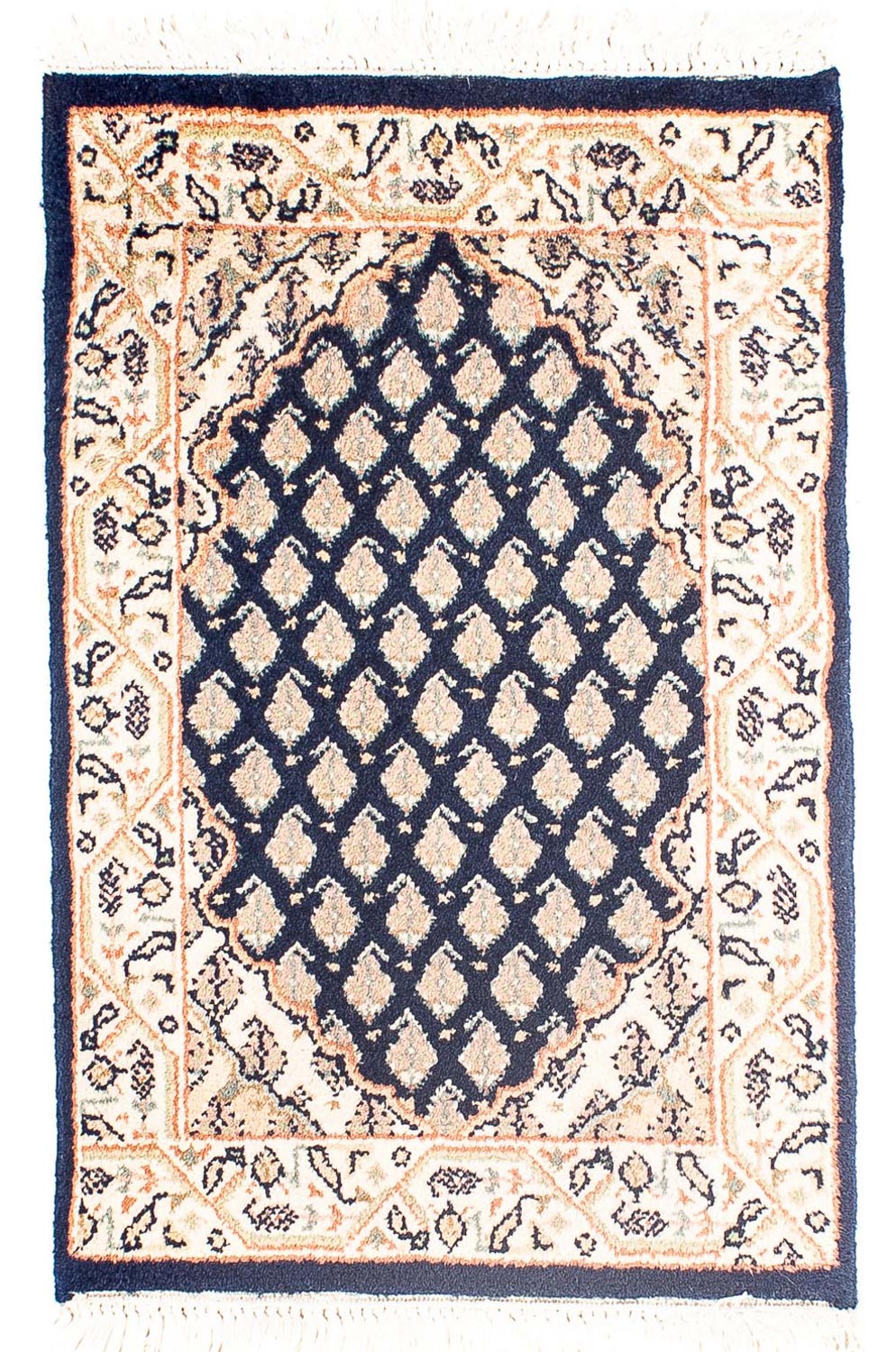
Photo: Morgenland Rugs
Indo-Mir rugs are hand-knotted Indian rugs that take up the model of the Persian Mir: the all-over boteh field, the clear ranks of small teardrop motifs, and the calm, classical color palette. They are knotted in the weaving centers of northern India, not in the western Iranian Saraband region from which the original comes. Buyers who know the differences get a well-made everyday rug in the style of a famous Persian rug at a significantly lower price. This guide explains what defines the Indo-Mir and how it differs from a genuine Mir.
What is an Indo-Mir rug?
An Indo-Mir is the Indian reproduction of a Persian Mir, that is, a rug from the Saraband region in the western Iranian province of Markazi. The genuine Mir counts as a classic among the Persian rugs. Its trademark is the small-scale boteh motif arranged in offset rows, also known as Mir-i-Boteh or, in the Western tradition, as paisley. Indian workshops have taken up this appearance and produce the style in large numbers for export.
The Indo-Mir thus reproduces the style, not the origin. It is an Indian rug after a Persian model, not a Persian from the Saraband. This distinction is decisive for value and classification.
Origin
Indo-Mir rugs are made in the weaving regions of northern India, primarily in the so-called rug belt around Bhadohi and Mirzapur in Uttar Pradesh state, as well as in Agra and partly in Kashmir. Bhadohi is considered the largest handcrafted rug-knotting center in Asia and specializes in hand-knotted goods for the world market. Workshops and home operations here mostly work from fixed knotting templates.
Indo-Persian rug production has a long history. Under the Mughals in the 16th century, court rugs after Persian models were already being made in Agra and Lahore. Today's export industry for Indo-Mirs, however, only took shape in the second half of the 20th century. After Indian independence in 1947, and especially from the 1970s onward, dealers systematically expanded the knotting centers to meet international demand for classical Persian designs such as Mir, Sarough, Bidjar, Keshan, Isfahan, Nain, and Ghom. The genuine Mir, by contrast, has its roots in the villages of the Saraband region in western Persia.
Typical features
The defining feature of an Indo-Mir is the Mir-i-Boteh all-over: small, almond- or teardrop-shaped motifs that fill the entire inner field in offset rows. The botehs are relatively small and evenly drawn, often with finely contoured tips and stylized floral fillings. The inner field thereby looks dense yet calm.
The boteh itself is one of the oldest Persian ornaments. Its symbolism is interpreted variously, from the cypress flame to the pomegranate, the blossom, or the hand of the knotter. In Europe it became popular as paisley via the shawls from Kashmir and France.
Pattern and color
Indo-Mir rugs reproduce the classical Mir repertoire closely following the Persian model. Three basic variants are common:
- Boteh all-over with small, densely arranged Mir-i-Boteh across the entire surface.
- Boteh with central medallion, in which a small, often diamond-shaped medallion interrupts the all-over.
- Boteh in rows of different colors, in which the tonality and size of the motifs shift slightly from row to row.
The palette follows the original: deep red, navy, and ivory as base tones, with beige, muted green, and occasionally mustard or salmon as accents. Borders are usually multi-tiered, with a main border of palmette or floral chains. Indian workshops realize the colors with lightfast chrome dyes, producing an even, saturated color picture. The patterns often look more regular than in an organically grown Saraband village rug, because they are worked from a fixed knotting template.
Material and knotting technique
The pile is virgin wool, warp and weft are cotton. In better qualities, New Zealand wool with high fiber length and good lanolin content is used; in simpler pieces, Indian highland wool. Knotting uses the asymmetric Persian knot, also called the Senneh knot, the same knot the Iranian original uses.
Knotting takes place on vertical looms in workshops and family businesses, usually from a colored knotting template. The article on Production and the guide on Knotting describe the individual work steps in more detail. After knotting, the rugs are sheared and washed, often with a luster wash that gives the wool a soft sheen. This wash is typically Indian and often makes the difference to the rather more matte appearance of the Persian Saraband original visible already at first sight.
Knot density and quality
The knot density of Indo-Mirs usually lies between 160,000 and 400,000 knots per square meter, with finer pieces above that. They thus cover a broad range, from sturdy standard quality to fine workshop rug. Density alone, however, tells little: wool quality, yarn spinning, cleanness of the knotting, and pattern clarity matter alongside. How knot density affects quality and price is covered in a dedicated guide.
| Feature | Indo-Mir | Genuine Mir (Persia) |
|---|---|---|
| Origin | India (Bhadohi, Mirzapur, Agra, partly Kashmir) | Saraband region, Markazi Province, Iran |
| Knot | asymmetric Persian knot | asymmetric Persian knot |
| Wool | Indian or New Zealand virgin wool, often luster-washed | sturdy wool of western Iranian highland sheep |
| Typical knot density | approx. 160,000 to 400,000 per m² | often 200,000 to 500,000 per m², finer pieces above |
| Pattern layout | very regular boteh all-over from template | organically grown boteh all-over, often with small deviations |
| Price | inexpensive to mid-range | clearly higher, older pieces with collector value |
What is an Indo-Mir rug worth?
Indo-Mirs are inexpensive to mid-priced everyday rugs. They typically cost a fraction of a comparable genuine Mir and offer good value in return: plenty of area in the classical boteh style at modest cost. Value is determined above all by size, knot density, wool quality, condition, and pattern clarity, with smaller factors such as fineness of the border and evenness of the boteh rows.
An increase in value as with old Persian pieces is not to be expected. Indo-Mirs are not an investment but durable rugs for everyday use. Anyone planning to invest in a genuine Persian will find guidance under Rug value and in the buying guide. For setting valuable originals apart, see Recognizing valuable Persian rugs.
How to recognize an authentic Indo-Mir
With a few checks an Indo-Mir can be classified and set apart from the Persian original:
- Check the back: Hand-knotted, the back shows the boteh pattern clearly in mirror image; individual knots are visible. Machine-made goods have an evened-out, often glued back.
- Regularity of rows: Very evenly arranged botehs point to Indian workshop production from a template. A genuine Saraband Mir often shows small deviations in the size and angle of the botehs.
- Wool and sheen: Luster-washed, uniformly dyed wool is typical of Indian production. Persian Mirs look more matte and drier in hand.
- Fringes: Genuine hand-knotted rugs carry the fringes as extended warp threads, not sewn on.
- Knot and beat-down: Both rugs use the Persian knot. Indian pieces are usually somewhat lighter and more flexible than a well-stuffed Persian original.
For those who want to set Indo goods apart from a genuine Persian, a systematic instruction is offered in Recognizing origin. Basics for authenticity checks are given in the overview Recognizing a rug and the article Is my rug authentic?.
Care
Indo-Mirs are low-maintenance and well-suited to everyday life thanks to their firm weave and sturdy wool. Regular vacuuming in the pile direction, immediate blotting of stains with clear water without rubbing, and occasional professional cleaning maintain quality. Long direct sun exposure fades the colors, especially reds and blues. On smooth floors, a non-slip underlay is recommended that protects the rug and prevents slipping. Detailed guidance is given in the care overview and in the article Cleaning a wool rug.
Frequently asked questions
What is the difference between an Indo-Mir and a genuine Mir?
The genuine Mir comes from the Saraband region in Markazi Province and belongs to the classical Persian rugs with a boteh all-over. The Indo-Mir is knotted in India after this model. Both use the Persian knot and the same boteh pattern. The Indian rug is usually more regular, glossier, and considerably less expensive.
Are Indo-Mir rugs genuine Persian rugs?
No. A Persian rug must be knotted in Iran. Indo-Mirs reproduce the Persian Mir style but are Indian rugs. They are hand-knotted and qualitatively solid but must not be sold as Persians.
What does the boteh motif mean?
The boteh is an old Persian ornament in the form of a curved teardrop or almond. Its symbolism is interpreted variously, often as a stylized cypress flame, pomegranate, or blossom, in folk belief also as a sign of luck and prosperity. In Europe it is known as paisley.
What does an Indo-Mir rug cost?
Indo-Mirs sit in the inexpensive to mid-range segment and usually cost only a fraction of a genuine Mir from the Saraband. The exact price depends on size, knot density, wool quality, and condition.
Are Indo-Mir rugs suitable for heavily used rooms?
Yes. The medium-dense weave and the hard-wearing wool make Indo-Mirs suitable for everyday use. They work well in living rooms, dining rooms, and representative areas with medium to high use.
What sizes are common for Indo-Mir?
Indo-Mirs are made mainly in common living-room formats, such as 170 x 240 cm, 200 x 300 cm, 250 x 350 cm, and 300 x 400 cm. Guidance on choosing the right size is given in the buying guide. Runners and smaller bridges also occur.
How do I assess the quality of an Indo-Mir?
Look for even, dense knotting, a saturated color picture without garish tones, clear boteh contours, a clean back, and firm edges. Higher knot density and handspun wool point to better quality.
How do I properly care for an Indo-Mir rug?
Vacuum regularly in the pile direction, blot stains immediately with clear water without rubbing, and have the rug professionally cleaned every few years. Long direct sun exposure should be avoided to prevent fading of the reds and blues.
Impressions of the origin
Places, landscapes and landmarks around the home of Indo Mir rugs. Click any image for a larger view.


