Shirvan rugs: finest Caucasian geometry
Shirvan rugs come from eastern Azerbaijan and stand out with their fine geometric medallions and clear color contrasts.
- Region
- Caucasus
- Category
- Nomad rugs
- Manufacturing
- Hand-knotted
- Knot density
- 80,000 – 180,000 knots/m²
Profile
- Manufacturing
- Hand-knotted
- Origin
- Azerbaijan — Shirvan region
- Pile material
- Wool on wool
- Knot density
- 80,000 – 180,000 knots/m²
- Features
- Fine geometric medallions, clear color contrasts, robust weave
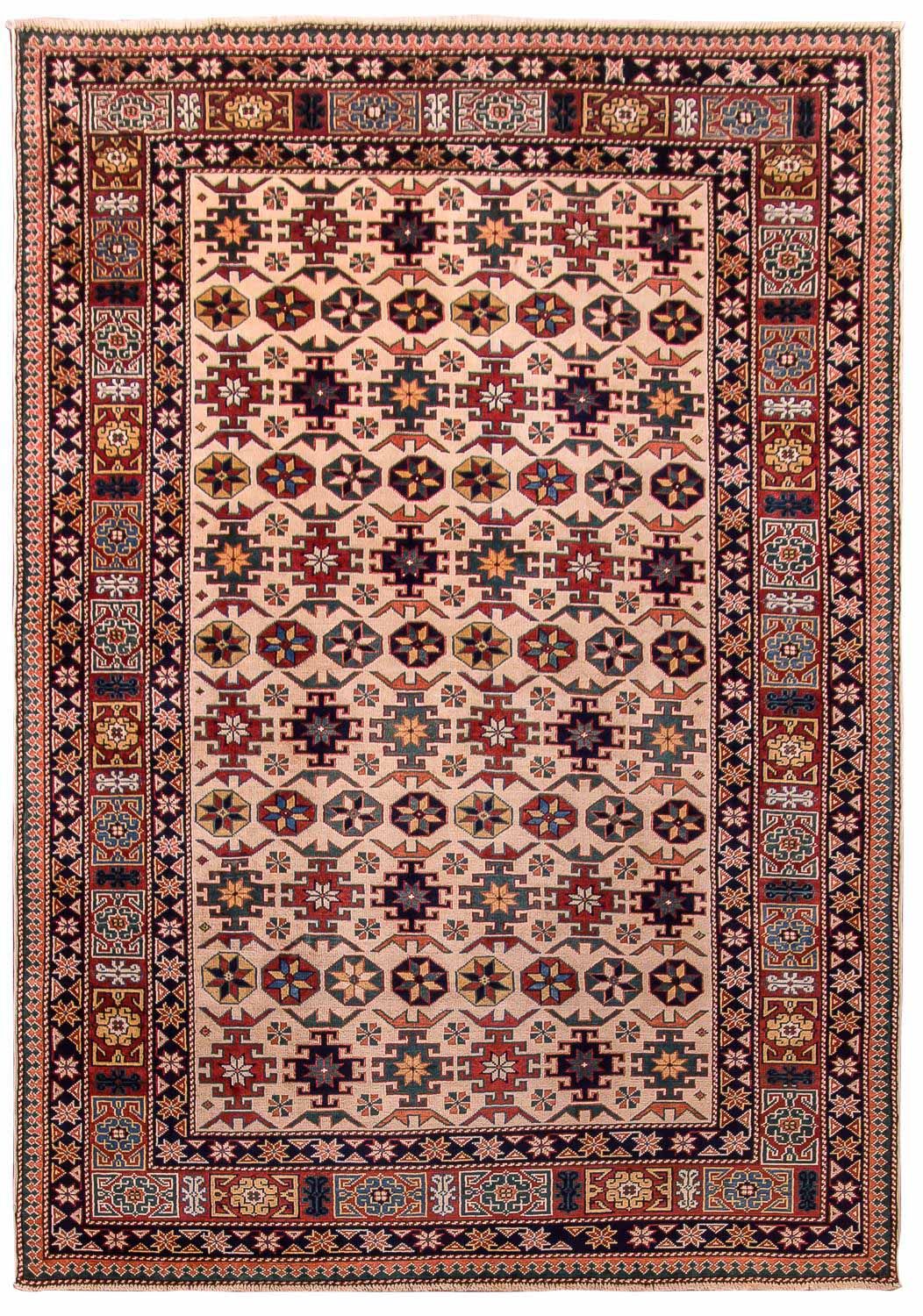
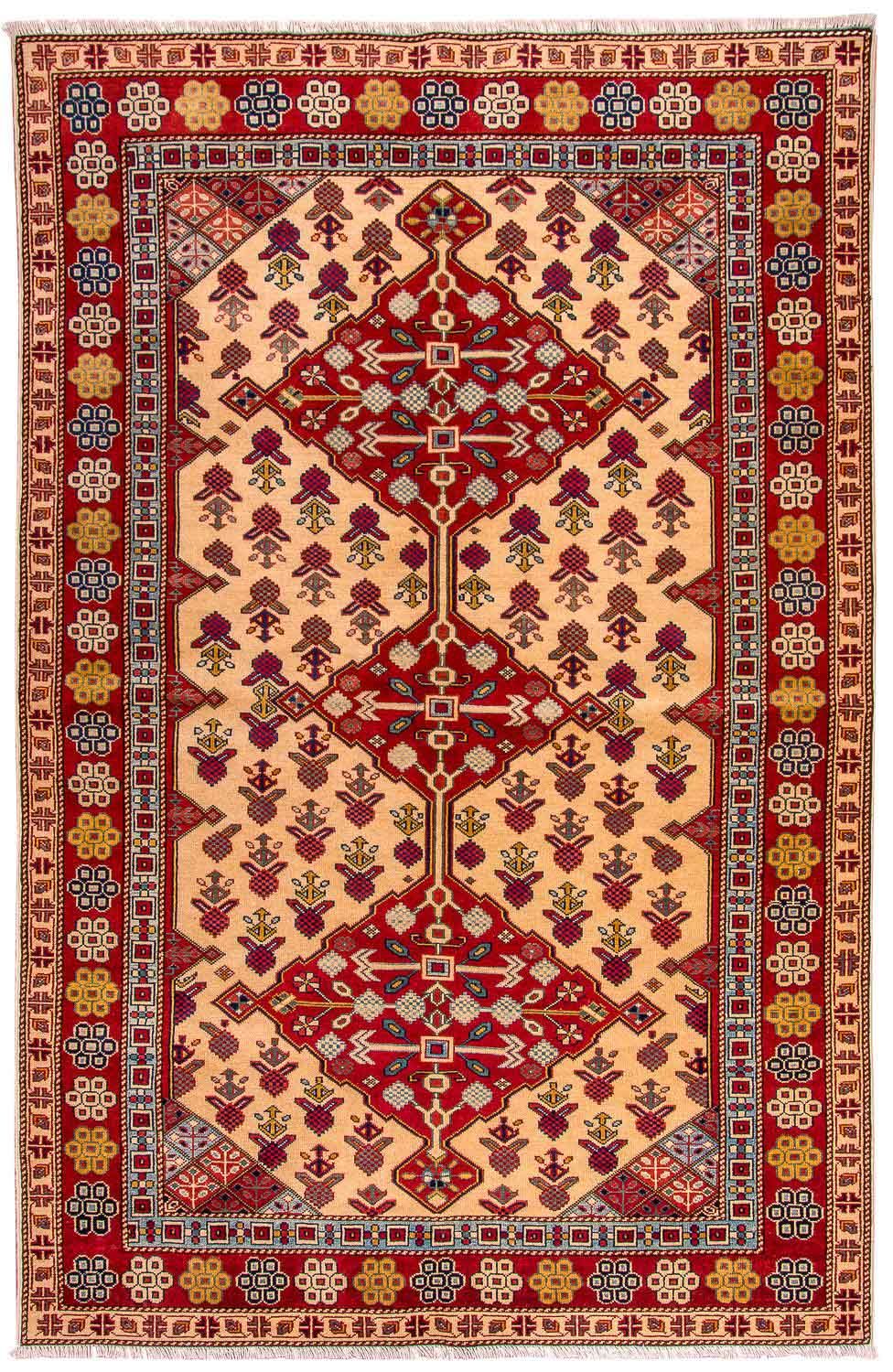
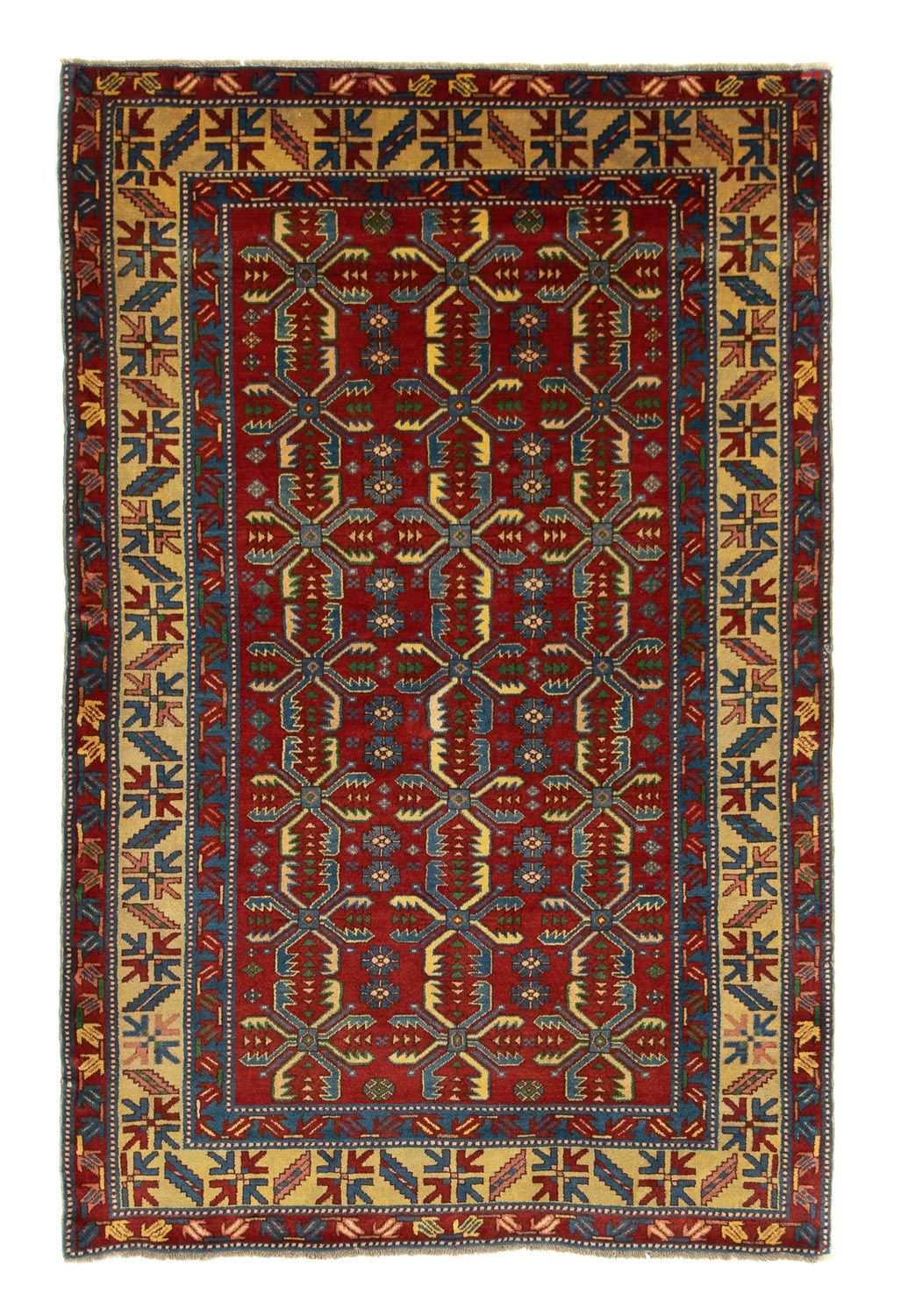
Photo: Morgenland Rugs
Shirvan rugs, also spelled Schirwan in trade, count among the finest geometric knotted work of the Caucasus. They come from the historical Shirvan region in the eastern Caucasus, today part of Azerbaijan. Characteristic are small-scale, precisely drawn star and diamond patterns, a luminous palette of indigo blue, red, and ivory, and a knot density that is high by Caucasian standards. They are knotted with the symmetric Turkish knot. Antique Shirvan rugs today count as sought-after collector pieces.
What is a Shirvan rug?
A Shirvan is a hand-knotted Caucasian rug from the eponymous region in eastern Azerbaijan. It belongs to the wider family of Caucasian village and nomad rugs but stands out through a particularly fine, dense knotting and a small-scale, disciplined patterning. Knotting uses the symmetric Turkish knot, the Ghiordes knot, which prevails across the entire Caucasus.
In contrast to the large-area, archaic Kazak rugs of the southern Caucasus, the Shirvan is more finely and richly drawn. With the curvilinear Persian rugs, despite shared motif roots, it has little in common: the Shirvan stays strictly geometric and flatly built. It is unmistakably a Caucasian rug, not a Persian one.
Origin
The historical Shirvan region stretched in the eastern Caucasus between the Greater Caucasus and the Caspian Sea, in the area of present-day Azerbaijan. From the 17th into the early 20th century it was one of the most important knotting centres of the Caucasus. The main place of production was Shemakha (Şamaxı), but numerous surrounding villages and settlements contributed, each cultivating its own pattern variations.
Knotting here was firmly embedded in village and semi-nomadic life. The wool of the villagers' own flocks was processed and dyed with local natural dyes. Production of authentic Shirvan rugs declined sharply in the 1920s as a result of the political upheavals in the region, when traditional structures broke down. Well-preserved pieces from the classical period before 1920 are therefore sought-after collector pieces today. The region belongs to the wider family of Caucasian rugs, which also includes Kazak, Kuba, Gendje, and Karabagh.
Patterns and colours
Shirvan rugs show a strictly geometric, small-scale repertoire. Typical are stars, diamonds, jagged medallions, and stylised animal figures such as birds, deer, and dogs lined up across the whole field. Often an all-over pattern of identically repeated motifs fills the field, sometimes also a vertical row of stacked medallions. Also well-known are Shirvan prayer rugs with a geometric mihrab niche and pieces with the characteristic boteh motif.
The palette is clear and luminous but, through the natural dyes, never garish. Deep indigo blue and saturated red dominate, complemented by ivory, yellow, brown, and green tones that articulate the pattern. The borders are usually narrow but laid out in several tiers and carry geometric bands, hook ornaments, or the typical vine with leaf motifs. From the hand-dyed yarns there often arises a fine abrash, a slight, lively variation of the colour tones across the surface.
Material and knotting technique
Shirvan rugs are traditionally made entirely of sheep's wool: warp, weft, and pile are usually wool; a cotton warp is rarer. The wool comes from the robust sheep of the region and is firm and tough. This wool-on-wool construction is typical of Caucasian rugs and gives the Shirvan its flat, supple character. Which fibres are processed in oriental rugs is covered in the overview of materials.
The Shirvan is knotted with the symmetric Turkish knot, also called the Ghiordes knot, as is customary across the entire Caucasus. The pile is sheared short to medium-long so that the fine, small-scale drawing stands out sharply. How the individual steps from spinning through dyeing to knotting work is described in the article on production. The natural dyes give the rugs their characteristic, slightly matte colour depth.
Knot density and quality
Compared with other Caucasian rugs, the Shirvan is strikingly finely knotted. Knot density typically lies between 80,000 and 180,000 knots per square metre, clearly exceeding the coarser Kazak rugs. This comparatively high density is the precondition for the small-scale stars, diamonds, and animal figures that distinguish the Shirvan. How knot density affects quality and price is covered in detail in its own article.
Quality marks of a Shirvan are an even, dense knotting, a clean geometric drawing, luminous natural colours, and a flat, supple hand. With antique pieces a fine patina is added that has developed over decades. Age is an important mark of authenticity and value, since most authentic Shirvan rugs arose before 1920.
| Feature | Expression on the Shirvan |
|---|---|
| Knot type | symmetric Turkish knot (Ghiordes) |
| Knot density | approx. 80,000 – 180,000 knots/m² |
| Material | wool on wool, rarely cotton warp |
| Pile height | short to medium-long sheared |
| Typical patterns | stacked stars, diamonds, animal figures, mihrab niches |
| Colour character | luminous indigo and red with ivory, natural dyes |
| Format | mostly small formats and gallery sizes |
What is a Shirvan rug worth?
The value of a Shirvan rug depends above all on age, condition, fineness, and rarity of patterning. Antique, well-preserved pieces from the classical period before 1920 are sought-after collector pieces and fetch accordingly high prices, especially rare prayer rugs or examples with rich animal decoration. Large-format Shirvans over three metres in length are rare and therefore particularly valuable, since the region mainly produced smaller formats.
Modern reproductions today are mostly made outside the original region and rarely reach the quality and authenticity of the historical models. For placing age and authenticity, see how old is my rug, the value overview, and the general buying guide.
How can you tell a genuine Shirvan rug?
Typical signs of a genuine Shirvan include:
- Hand-knotted back: the small-scale pattern is mirrored clearly; individual knots are visible.
- Symmetric Turkish knot: the Shirvan is worked with the Ghiordes knot, typical of the Caucasus.
- Wool on wool: warp, weft, and pile are usually wool; a cotton warp is the exception.
- Fine geometric drawing with stacked stars, diamonds, and stylised animal figures.
- Luminous natural colours with fine abrash, that is, lively colour variations from hand-dyed yarns.
- Age and patina: most authentic pieces date from before 1920 and show appropriate ageing.
Since Shirvan rugs are often confused with neighbouring Caucasian provenances such as Kuba, fineness, pattern guidance, material, and age should be considered together. A step-by-step guide is in Is my rug genuine?; for regional placement, see identifying provenance.
Care
Since most Shirvan rugs have already reached a great age, particular care is required. Regular gentle vacuuming without a rotary brush and professional cleaning when needed preserve pile and colours. Direct sunlight should be avoided to prevent further fading of the sensitive natural colours. Spills are blotted carefully with clear water without rubbing; for valuable antique pieces, any cleaning belongs in expert hands. Detailed guidance is in the care overview.
Frequently asked questions
Are Shirvan rugs Persian or Caucasian?
Shirvan rugs are Caucasian. They come from the Shirvan region in the eastern Caucasus, in present-day Azerbaijan, and are knotted with the symmetric Turkish knot. With the fine, curvilinear Persian rugs, they share only some motif roots, not construction and character.
What is the difference between Schirwan and Shirvan?
Schirwan and Shirvan denote the same rug; these are just two spellings of the region's name. In German-speaking trade Schirwan is widespread, in English-speaking trade Shirvan.
What distinguishes a Shirvan from a Kazak rug?
Both are Caucasian wool rugs with geometric patterning. The Shirvan is more finely knotted, more small-scale in drawing, and usually in a small format. The Kazak from the southern Caucasus is coarser, larger-area, and more archaic, with large stars and bold contrasts.
Why are Shirvan and Kuba rugs confused?
Both come from neighbouring regions of the eastern Caucasus and share many motifs. Shirvan rugs are usually more finely knotted, however, and show a greater variety of animal motifs, while Kuba rugs are often a touch thicker and accented differently in their drawing.
How old are genuine Shirvan rugs?
Most authentic Shirvan rugs date from the classical period between the 17th century and 1920, when production declined sharply due to political upheavals. Age is therefore an important mark of authenticity; a placement is given in the article how old is my rug.
What sizes are typical for Shirvan rugs?
Shirvan rugs were mostly knotted in smaller formats and as gallery sizes, roughly between 100 x 150 cm and 150 x 250 cm. Large-format examples over three metres in length are rare and accordingly valuable.
How do I care for a Shirvan rug correctly?
Owing to the great age of most pieces, caution is required. Gentle vacuuming without a rotary brush and professional cleaning when needed are enough. Direct sunlight is to be avoided, spills are blotted carefully with clear water, and valuable antique rugs belong exclusively in expert hands.
Impressions of the origin
Places, landscapes and landmarks around the home of Shirvan rugs. Click any image for a larger view.


