Hatchlu rugs: Turkmen door hanging with four-field cross
Hatchlu rugs are knotted by Turkmen tribes and show the typical four-field cross pattern of nomadic prayer rugs.
- Region
- Afghanistan
- Category
- Nomad rugs
- Manufacturing
- Hand-knotted
- Knot density
- 80,000 – 180,000 knots/m²
Profile
- Manufacturing
- Hand-knotted
- Origin
- Turkmenistan / northern Afghanistan
- Pile material
- Wool on wool
- Knot density
- 80,000 – 180,000 knots/m²
- Features
- Four-field cross pattern, prayer-rug format, deep red ground
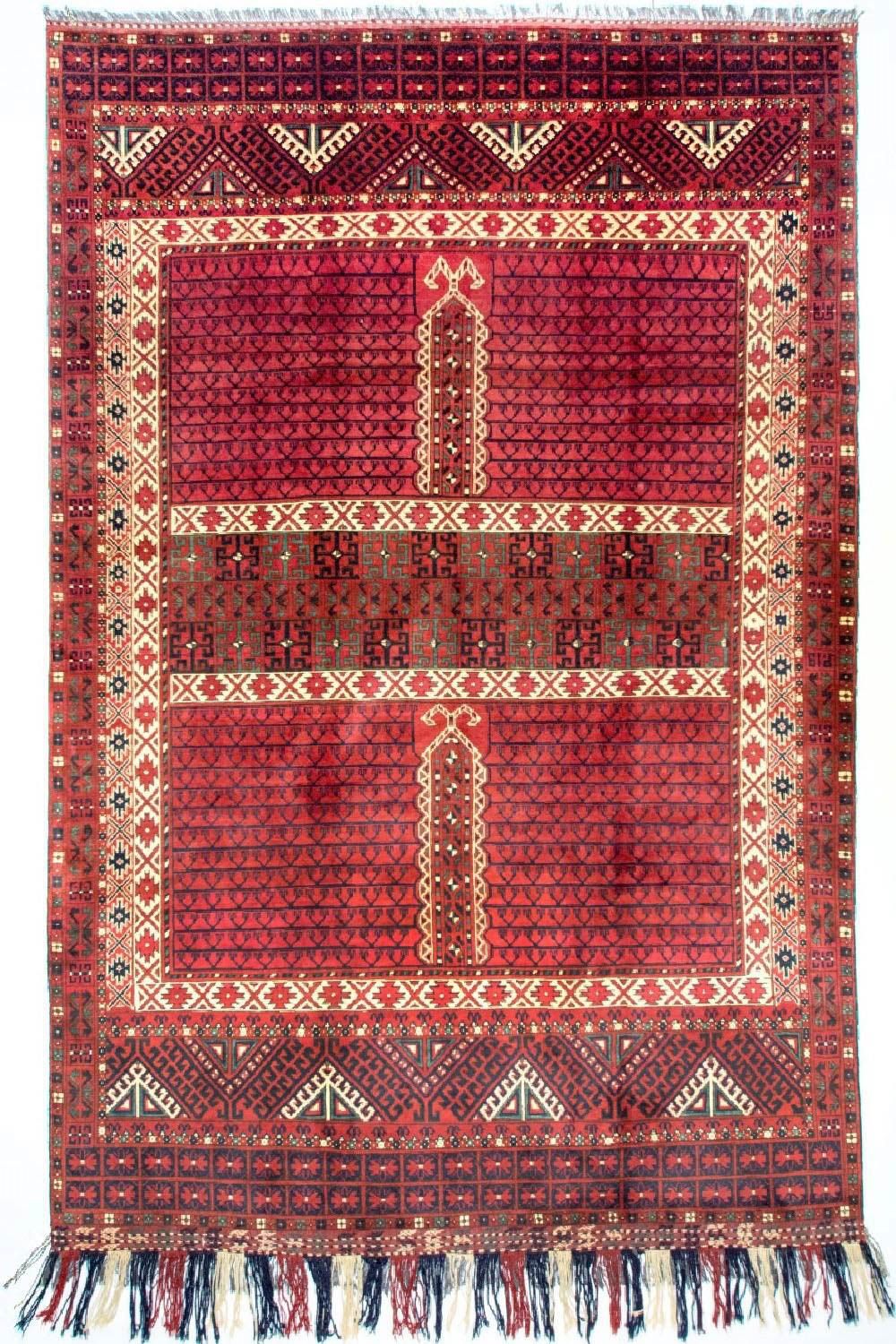
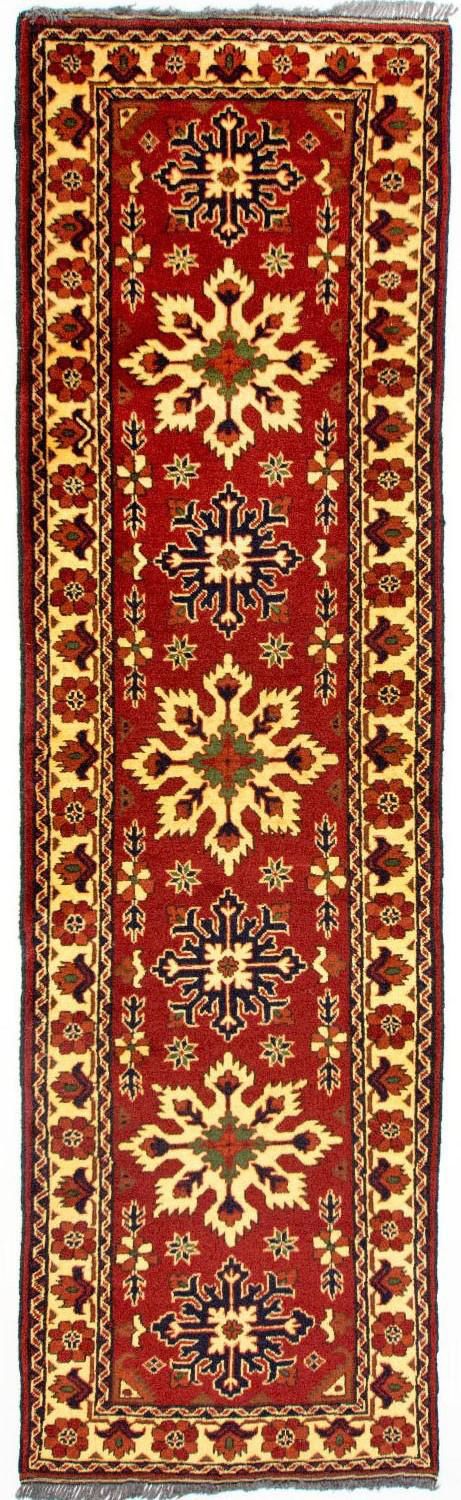
Photo: Morgenland Rugs
The Hatchlu is the most unmistakable special form among the Turkmen knottings: a rug whose field is divided by a large cross into four rectangular panels. Originally it served not as a floor rug but as a door hanging in front of the yurt entrance, which is why it is also called ensi in the trade. The Hatchlu was knotted by Turkmen tribes; today, above all by the Ersari in the north of Afghanistan. Within the nomadic rugs it forms its own, easily recognisable group.
What is a Hatchlu rug?
A Hatchlu is a hand-knotted Turkmen rug with a cross-divided field. The word derives from the Turkmen term for cross and so describes the defining design feature. The four panels are separated by wide bars that form the cross and are each filled with small-scale, often candle-shaped motifs. The Hatchlu belongs to the family of Turkmen knottings and is closely related to the Turkaman and to the Bukhara named after the trading place, but differs from these through the cross division in place of even gul rows.
Unlike the prayer rug, which shows a single mihrab niche, the Hatchlu divides the field into four parts. At the upper end there is often a transverse band with comb-like motifs, which is often interpreted as a stylised threshold or as an indication of the prayer function. Genuine door hangings are sometimes recognised by traces of fixing at the upper edge.
Origin
The home land of the Turkmen lies in Turkmenistan and the adjacent steppes and oases of Central Asia. There the Turkmen tribes lived for centuries as livestock keepers in yurts whose entrance was closed by a textile hanging. From this practical function the Hatchlu developed as its own rug form with a fixed pictorial order. Like the whole Turkmen body of work, it was at once utility goods and an expression of tribal belonging.
After the Russian conquest of Central Asia and the later Sovietisation, production shifted strongly. Many Turkmen families, above all Ersari, settled south of the Amu Darya in the north of Afghanistan. From this milieu come most of the Hatchlus traded today, often from the same region as the Akhche and the Khal Mohammadi. Because the door hanging has no practical function in the modern home, the pattern is today predominantly knotted as a decorative wall hanging or floor rug.
Patterns and colours
The defining element is the cross that divides the field into four roughly equally large rectangles. The individual panels are filled with rows of small candle- or tree-like motifs interpreted as stylised trees of life. In the dividing bars and borders appear geometric and stylised floral ornaments and occasionally small guls that attest the Turkmen origin. The upper transverse band with comb-shaped points forms a visual close. More on the meaning of these motifs is given in the symbols overview.
The handling of colour follows the Turkmen canon: a deep red-brown to aubergine-red as ground, with accents in dark blue, anthracite, black and ivory. This earthy, muted palette arises traditionally from natural dyes, above all madder for the red tones and indigo for the dark areas. More on the dyes is given under rug colours.
Material and knotting technique
Hatchlu rugs consist entirely of sheep's wool, both in the pile and in the warp and weft. The wool comes from the flocks of the tribes, is lanolin-rich, robust and suited to the harsh steppe climate. Dyeing was done historically with plant dyes, which explains the characteristic, slightly shifting colour tone. More on the fibres is given under materials and virgin wool.
The Hatchlu is predominantly knotted with the asymmetric knot, also called the Persian or open knot, which allows the fine drawing of the small-scale panels and corresponds to the construction of the classical Turkmen pieces. How the knot types differ is explained in the article on knot types; the whole sequence from spinning to shearing is set out under production. The pile is sheared short to medium-long. The selvedges are wrapped with coloured wool; at the ends the rug often closes with a narrow kilim strip.
Knot density and quality
Hatchlu rugs count among the medium to finely knotted nomadic rugs. The knot density typically lies between about 80,000 and 180,000 knots per square metre. A higher density allows the precise drawing of the candle-shaped panels and the dividing bars and distinguishes fine pieces from coarser commercial qualities. How knot density bears on quality and price is treated in its own guide.
A good piece is recognised by a clearly drawn, symmetrical cross, sharply set panels and a saturated, not garish red-brown. The following overview places the Hatchlu within the Turkmen family.
| Type | Tribe / region | Typical features |
|---|---|---|
| Ersari Hatchlu | Ersari, northern Afghanistan | vivid colours, large formats, most frequent type |
| Tekke Hatchlu | Tekke, historically Turkmenistan | finer, small-scale panels, rarer |
| Yomut Hatchlu | Yomut, Caspian surroundings | stepped motifs, independent border |
| Turkaman | Turkmen (collective term) | even gul rows instead of cross division |
| Bukhara | Turkmen, trade name | octagonal gul rows on a deep red ground |
| Khal Mohammadi | northern Afghanistan | dense gul rows, especially deep red-brown |
What is a Hatchlu rug worth?
The value of a Hatchlu depends on age, tribe, condition, size, knot density and dyeing. Antique Turkmen door hangings with natural dyeing are rare and especially sought after by collectors, since they document the original functional piece. Modern Afghan Hatchlus from the Ersari tradition are more affordable and are traded mainly as decorative pieces. Why genuine knottings have their price is explained in the article why real rugs are expensive.
Because the Hatchlu occurs more rarely than other Turkmen types, a close inspection pays off. For the classification, recognising valuable Persian rugs helps as methodical orientation, alongside the value overview and the buying guide.
How do you recognise a genuine Hatchlu rug?
Reliable indicators of a genuine Turkmen Hatchlu are:
- Cross-divided field: a large cross structures the field into four rectangles, the central sign of recognition.
- Wool on wool: warp, weft and pile consist of sheep's wool, often with shifting natural dyeing.
- Asymmetric knot: the Turkmen Hatchlu predominantly uses the Persian, open knot, readable in the dense back.
- Candle-shaped field motifs: rows of stylised trees of life fill the four panels.
- Deep red-brown to aubergine-red as ground colour, supported by anthracite, blue and ivory.
- Transverse band at the upper end with comb-like points; in genuine door hangings, sometimes traces of fixing.
Because the Hatchlu pattern is today predominantly re-knotted decoratively, field division, material, back and dyeing should be judged together. A step-by-step guide is given in Is my rug genuine?; for regional attribution see identifying origin.
Care
Thanks to the robust wool, the Hatchlu is easy to care for. If used as a floor rug, regular vacuuming in the pile direction and the occasional professional cleaning are enough. As a wall hanging it should be vacuumed occasionally and protected from permanent direct sun, since the deep red otherwise bleaches. Lift stains immediately with clear water, without rubbing, so that the natural colours do not bleed. Detailed notes are given in the care overview and under cleaning a wool rug.
Frequently asked questions
What does the name Hatchlu mean?
The name derives from the Turkmen term for cross and describes the cross-divided field that characterises this rug type. In the trade it is also called ensi, which refers to its original function as a door hanging of the yurt.
What was a Hatchlu originally used for?
The Hatchlu served as a door hanging in front of the entrance of the Turkmen yurt and protected against wind, cold and dust. In the modern home this function no longer has any meaning, which is why the pattern is today knotted as a decorative wall hanging or as a floor rug.
What distinguishes a Hatchlu from a Bukhara or Turkaman?
Is a Hatchlu a prayer rug?
The Hatchlu is in the first place a door hanging. The upper transverse band with comb-shaped points is sometimes interpreted as an indication of a prayer function, but unlike the classical prayer rug with a single mihrab niche, the Hatchlu shows a four-fold division of the field.
Which knot does a Hatchlu rug use?
The Turkmen Hatchlu is predominantly knotted with the asymmetric knot, also called the Persian or open knot. This fine knot type allows the precise drawing of the small-scale panels. More on this under knot types.
How do I care for a Hatchlu rug properly?
As a floor rug, regular vacuuming in the pile direction and professional cleaning every few years are enough. As a wall hanging, vacuum occasionally and protect from direct sun. Lift stains immediately with clear water, without rubbing.
Related styles
Khal Mohammadi
Khal Mohammadi rugs are produced in northern Afghanistan and stand out with their deep red tones and characteristic gül medallions.
Bukhara
Bukhara rugs are world-famous for their typical octagonal gül medallions on a deep red ground.
Turkmen
Turkmen rugs come from the Central Asian steppes and are world-famous for their characteristic gül medallions in deep red.


