Indo Ghom rugs: Qom interpretation from northern India
Indo Qom rugs are produced in India in the style of the Persian Qom, fine craftsmanship at more accessible prices.
- Region
- India
- Category
- Silk rugs
- Manufacturing
- Hand-knotted in India
- Knot density
- 300,000 – 800,000 knots/m²
Profile
- Manufacturing
- Hand-knotted in India
- Origin
- India — produced after the Persian Qom model
- Pile material
- Silk on silk or wool on cotton
- Knot density
- 300,000 – 800,000 knots/m²
- Features
- Fine knotting, classic Qom designs, accessible price
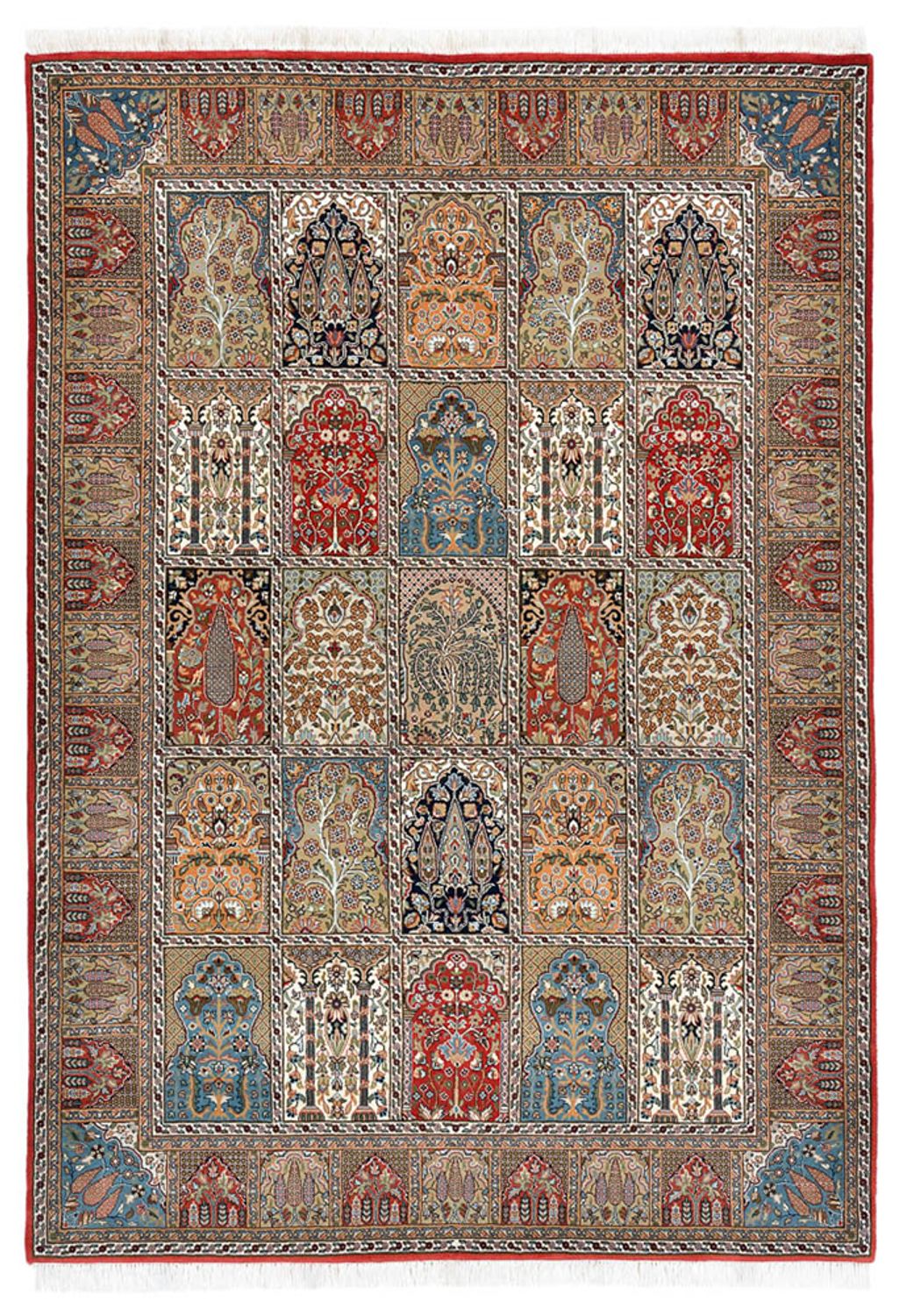
Photo: Morgenland Rugs
Indo-Ghom rugs are hand-knotted Indian rugs in the style of the famous Persian Ghom rugs: finely drawn floral medallions, dense knotting, and frequently a silk pile. They are knotted in northern India, not in the Iranian city of Ghom. They make the elegant Ghom look accessible to a much broader budget. This guide explains the Persian model, the Indian rendition, and how the two differ.
What is an Indo-Ghom rug?
An Indo-Ghom is the Indian reproduction of a Persian Ghom (also spelled Qom or Ghum). The original from the holy city of Ghom south of Tehran counts among the finest and most expensive Persian rugs. Ghom is not an old knotting region but a center that only emerged in the 20th century as a manufactory city for especially fine silk and kork-wool rugs.
Indian workshops have taken up this style: the floral medallions, the garden and hunting motifs, the fine drawing, partly silk on silk, partly in kork wool. The Indo-Ghom thus reproduces the look of the Persian model but comes from India. This distinction governs classification and value.
Origin
Indo-Ghom rugs are made in the northern Indian knotting centers. Fine silk rugs are produced above all in Kashmir, which maintains its own silk-knotting tradition, as well as in the workshops around Bhadohi and Mirzapur in Uttar Pradesh, where wool qualities are knotted.
Indo-Persian knotting art goes back to the 16th-century Mughal era, when fine rugs in the Persian manner were made at court. Today's export production of Indo-Ghoms is by contrast young: it developed in the second half of the 20th century alongside the rise of the Persian Ghom itself and meets the demand for fine, floral rugs that are very expensive as originals from Persia.
Pattern and color
The Indo-Ghom takes up the floral repertoire of the original. Typical are central medallions with dense vines, palmettes, and floral sprays, as well as all-over garden fields, vase motifs, and stylized hunting scenes. The drawing is curvilinear and detail-rich, not geometric.
The palette ranges from light, elegant arrangements with ivory, cream, light blue, and rose to bolder compositions in red and deep blue. Silk pieces play with the iridescence of the pile: depending on viewing angle, the color shifts from light to dark. Indian workshops realize this with great cleanness, which is why Indo-Ghoms often look very even and calm.
Material and knotting technique
Indo-Ghoms come in two main versions: silk on silk for the finest pieces and virgin wool on cotton for the wool qualities. Pure silk rugs count among the silk rugs and are particularly fine and lustrous. Knotting uses the asymmetric Persian knot, the Senneh knot, the same knot the Iranian original uses.
The fine, curvilinear drawing requires a high knot count and very exact work. After knotting, the rugs are sheared and washed; with silk, often a wash that brings out the luster. Background on the materials is given under Materials, on the process under Production.
Knot density and quality
Indo-Ghoms reach high knot densities depending on material, from about 300,000 to 800,000 knots per square meter in fine silk pieces. A high density allows the fine detail drawing but is not the only criterion: silk quality, yarn fineness, color purity, and the cleanness of the knotting matter alongside. How knot density shapes quality and price is the subject of a dedicated guide.
| Feature | Indo-Ghom | Genuine Ghom (Persia) |
|---|---|---|
| Origin | India (Kashmir, Bhadohi) | Ghom (Qom), Iran |
| Knot | asymmetric Persian knot | asymmetric Persian knot |
| Material | silk on silk or wool on cotton | fine kork wool or silk |
| Pattern | floral medallions, garden, hunting | floral medallions, garden, hunting |
| Knot density | approx. 300,000 to 800,000/m² | very high, top quality |
| Price | inexpensive to upper range | very high, collector pieces |
What is an Indo-Ghom rug worth?
Indo-Ghoms cover a broad price range: simple wool qualities are affordable, fine silk pieces from Kashmir sit in the upper range but mostly stay clearly below the price of a genuine Persian Ghom. Value is determined by material (silk or wool), knot density, fineness of drawing, size, and condition.
As an investment, Indo-Ghoms are hardly suitable; an increase in value as with fine Persian originals is not to be expected. They offer a very fine look at a fair price in return. Guidance on value is given by Rug value and the buying guide; for telling genuine originals apart, see Recognizing valuable Persian rugs.
How to recognize an authentic Indo-Ghom
These checks help classify an Indo-Ghom and set it apart from the Persian original and from machine-made goods:
- Verify silk: Real silk feels warm, has an iridescent sheen, and the fringes are silk. Artificial luster fibers (viscose, often "art silk") feel cool and shine flatly. Guidance is given in Recognizing silk.
- Read the back: Hand-knotted, the back shows the fine pattern sharply; individual knots are recognizable. Machine-made goods have an evened-out back.
- Assess fineness: Very fine, even knots point to good workshop production.
- Color picture: Very uniform, lightfast colors are typical of Indian production.
- Question origin: A piece offered as Ghom or Qom at a strikingly low price is often an Indo-Ghom.
A step-by-step method is given in Recognizing origin, basics in the overview Recognizing a rug and Is my rug authentic?.
Care
Wool Indo-Ghoms are low-maintenance; silk pieces require more care. Vacuum wool in the pile direction, silk only with reduced suction or a soft nozzle. Blot stains immediately with clear water, never rub. Silk rugs belong with a professional cleaner if soiled. Long direct sun exposure fades colors. Detailed guidance is given in the care overview.
Frequently asked questions
What is the difference between an Indo-Ghom and a genuine Ghom?
The genuine Ghom comes from the Iranian city of Ghom and counts among the finest Persian rugs, often in kork wool or silk. The Indo-Ghom is knotted in India after this model. Both use the Persian knot, but the Indian piece is considerably less expensive and rarely reaches the top quality of the original.
Are Indo-Ghom rugs made of real silk?
Both occur. Fine Indo-Ghoms from Kashmir are knotted from real silk, but many pieces are virgin wool. It is important to recognize offers labeled "art silk" or viscose, because that is not real silk.
Is an Indo-Ghom a genuine Persian rug?
No. A Persian rug must be knotted in Iran. The Indo-Ghom reproduces the Persian Ghom style but is a hand-knotted Indian rug and must not be sold as a Persian.
What does an Indo-Ghom rug cost?
The range is wide: wool Indo-Ghoms are affordable, fine silk pieces sit in the upper range but mostly stay below the price of a genuine Persian Ghom. Material, knot density, and size are the most important factors.
Is an Indo-Ghom suitable for heavily used rooms?
Wool Indo-Ghoms handle normal use well. Fine silk pieces are better suited to low-traffic rooms, as wall hangings, or as decorative accents, since silk is more delicate.
How do I properly care for an Indo-Ghom?
Vacuum wool in the pile direction, silk gently only. Blot stains immediately with clear water, do not rub. Have silk pieces professionally cleaned if soiled, and avoid long direct sun to protect the colors.
Impressions of the origin
Places, landscapes and landmarks around the home of Indo Qom rugs. Click any image for a larger view.
Related styles
Qom
Qom rugs from the holy city are among the finest Persian rugs and are particularly prized in pure-silk versions.
Indo Isfahan
Indo Isfahan rugs are produced in India in the style of the famous Persian Isfahan, fine floral compositions at moderate prices.
Indo Nain
Indo Nain rugs are produced in India in the style of the Persian Nain, the typical ivory-and-blue palette at more accessible prices.

