Baluch rugs: tribal weave from Baluchistan
Baluchi rugs come from the borderlands of Iran, Afghanistan, and Pakistan, dark earth tones and prayer-rug formats define their nomadic style.
- Region
- Balochistan
- Category
- Nomad rugs
- Manufacturing
- Hand-knotted
- Knot density
- 60,000 – 140,000 knots/m²
Profile
- Manufacturing
- Hand-knotted
- Origin
- Iran / Afghanistan / Pakistan — Balochistan
- Pile material
- Wool on wool
- Knot density
- 60,000 – 140,000 knots/m²
- Features
- Dark earth tones, prayer-rug formats, nomadic character
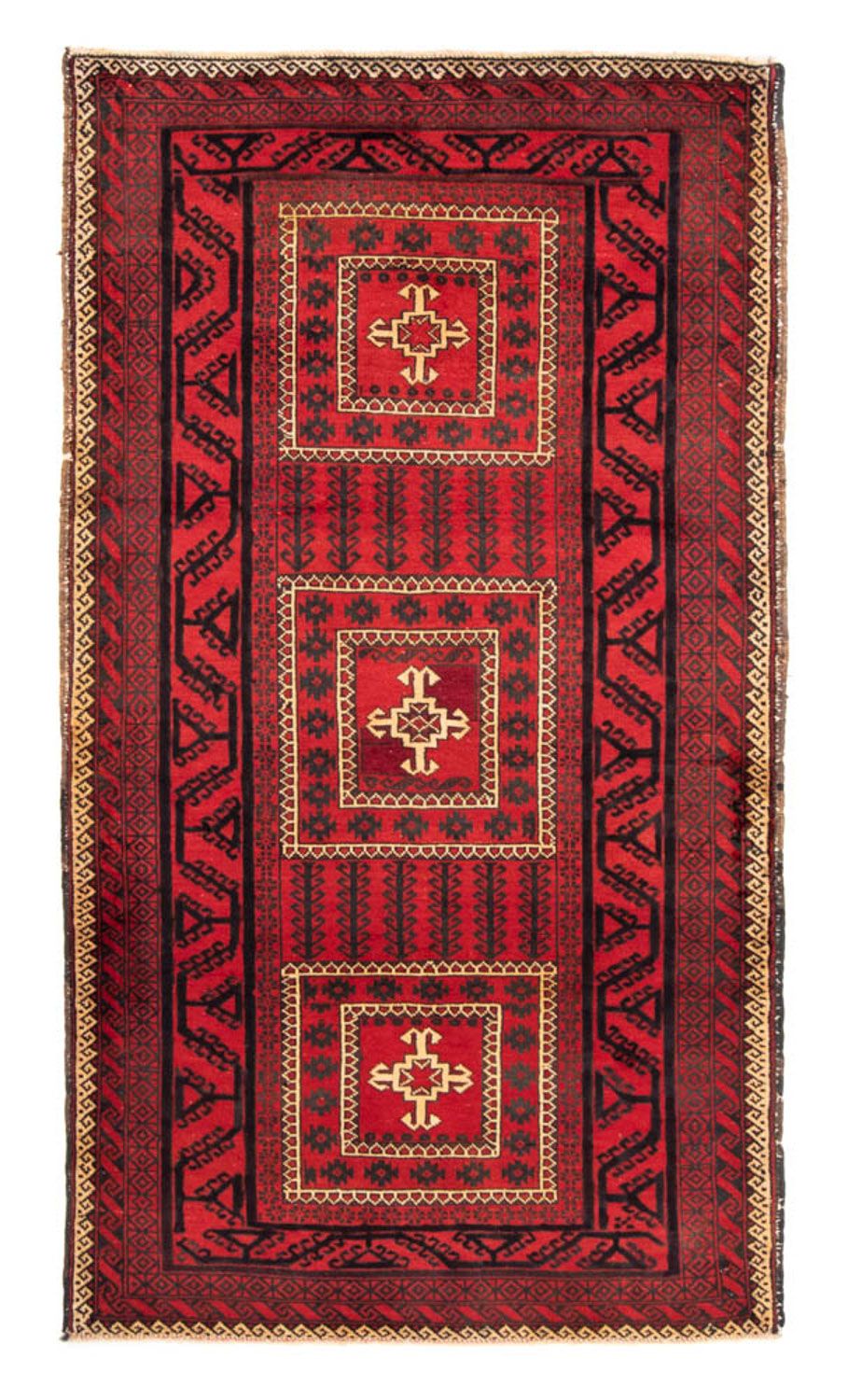
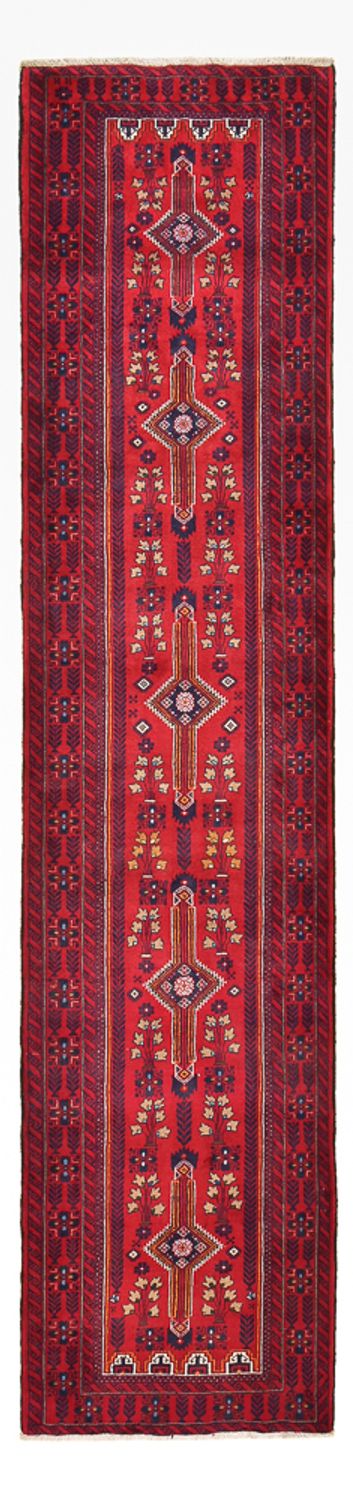
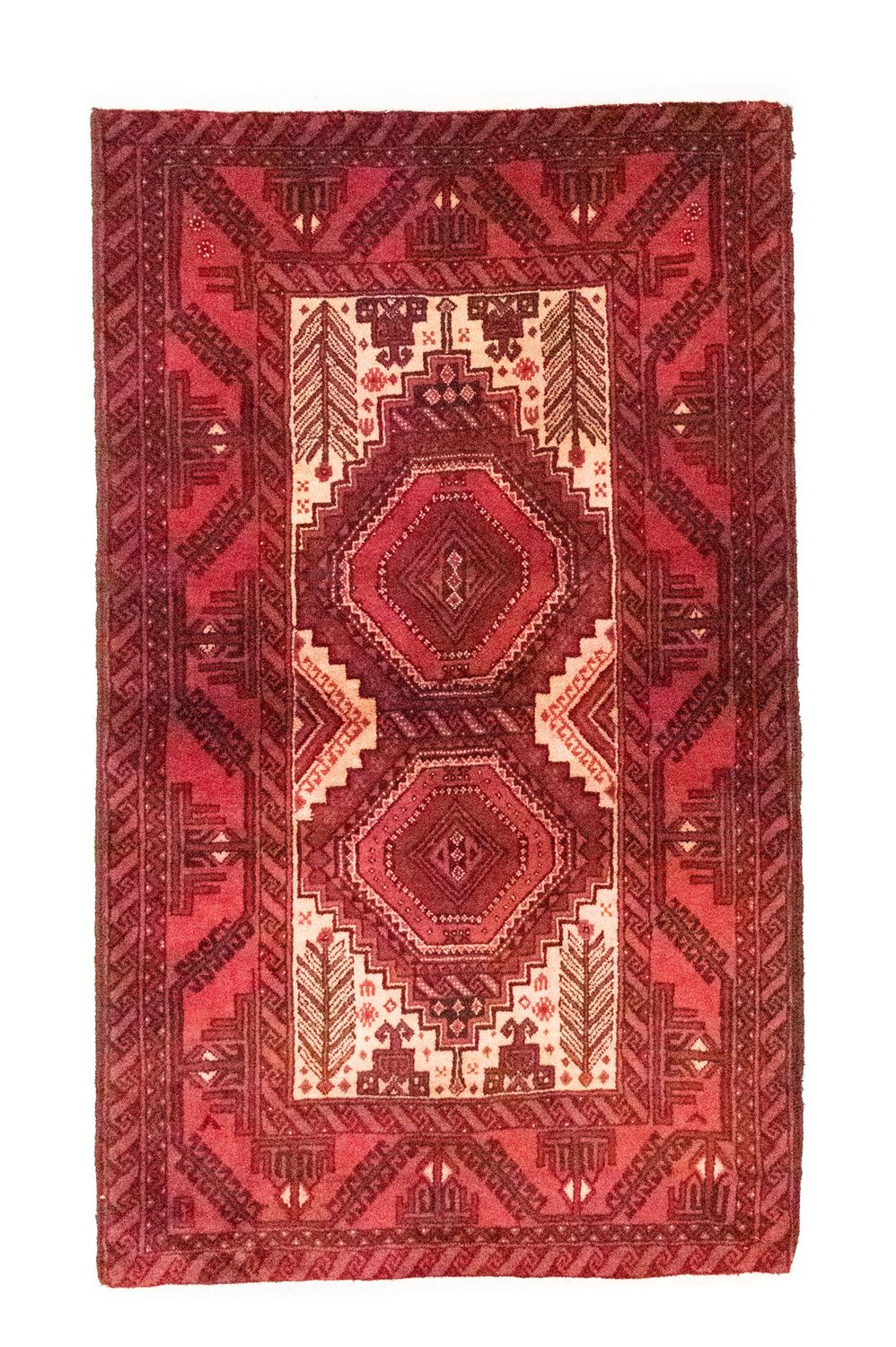
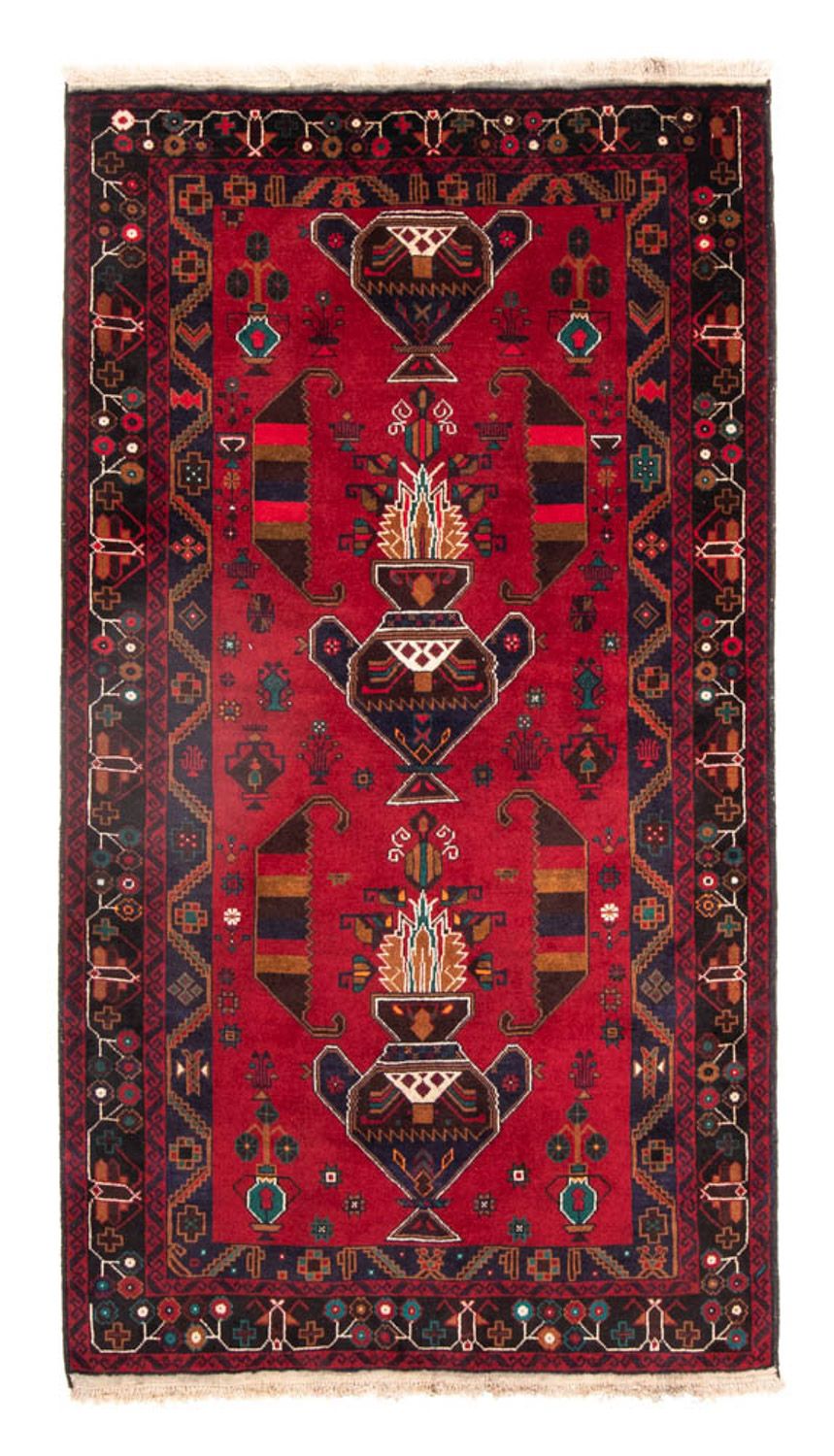
Photo: Morgenland Rugs
Baluch rugs, also written Belutsch or Balouch in the trade, are hand-knotted tribal rugs from the border region of Iran, Afghanistan and Pakistan. They count among the most strongly characterful nomadic rugs of the Orient: small format, dark in tone with madder red, indigo and walnut, geometrically patterned, with a high proportion of prayer rugs carrying a mihrab niche. The weavers work with the asymmetric Persian knot, fully in the tradition of Iranian-influenced tribal workshops.
What is a Baluch rug?
A Baluch rug is a hand-knotted tribal piece by the Baluch, a people who have lived for centuries in the bleak high desert at the borders between eastern Iran, western Afghanistan and western Pakistan. The weavers work at horizontal ground looms that can be quickly assembled and dismantled during migrations. This sets the typical small to medium formats, since a ground loom dictates a limited knotting width.
The pieces arise for personal use in the tent, as prayer rugs with a mihrab niche, as saddlebags (khorjin), or as small tagh strips. Only since the late 19th century have Baluch rugs systematically entered European trade. The provenance has retained its tribal character to this day: not manufactory goods, not repetition down to the last detail, but individual pieces shaped by the weaver, with small deviations that betray authenticity.
Origin: Baluchistan in the three-country corner
The region of Baluchistan extends across three states. In the east it reaches deep into Pakistan, in the north as far as Afghanistan, and in the west it comprises the Iranian province of Sistan and Baluchistan and parts of South Khorasan. It is high-desert country with extreme temperature swings, thinly populated, without developed crop farming, shaped by livestock keeping and caravan trade. These conditions shape the rugs: small, transportable formats, dark colours that show dust and soot less, and a dense wool that warms and insulates.
Most of the Baluch pieces traded today come from eastern Iran, above all from the area around Torbat-e Heydariyeh and Torbat-e Jam in South Khorasan, as well as from the Afghan provinces of Herat and Farah. Pakistani Baluch goods appear more rarely, but they are present. Within the tribal group there are subgroups with their own pattern traditions, among them the Salar Khani, the Mushwani, the Yaqub Khani and the Dokhtar-e-Ghazi. Anyone who wants to place the northern Afghan knotting tradition in context will find it in Afghanistan, and the Iranian context in Persia.
Typical features
The format is the first calling card of a Baluch. Standard are small to medium sizes between 80 × 120 cm and 200 × 130 cm, alongside runners and prayer formats. Larger rugs occur but are rare and usually go back to special orders.
The patterning is consistently geometric. The main field carries small-scale all-over patterns: stylised boteh teardrops, jagged stars, octagons, candle motifs and hooked meanders. A central medallion is rather the exception; more often the field is organised into rows or small repeat-like compartments. The border consists of several narrow bands with continuous meander or hook patterns, rarely broadly laid out. At the beginning and end of a Baluch sit narrow kilim strips, the so-called elem, with additional rows of geometric motifs.
The palette is deep and muted: madder red in several shades, dark indigo blue, walnut brown, rust, aubergine. Accents in ivory, mustard yellow and occasionally light green set contrasts without disrupting the calm overall picture.
Patterns and colours
A particular role is played by the prayer rug. With the mihrab, the pointed-arched niche turned upwards, it marks the direction of prayer. In the niche there often appear the tree of life, a stylised mosque lamp, or hands as a symbol of ritual purification. More on the tree-of-life motif is given in tree of life, on the boteh teardrop in boteh, an overview of the most important symbols in symbols, and on protective signs in protective symbols.
The colours arise traditionally from plant sources. Madder yields the red palette, indigo the blue, walnut husks brown, pomegranate skins and weld yellow and green tones. The typical dark effect arises not from dark dyes alone, but also from the choice of natural brown and black wool for contour and weft. Characteristic is a slight abrash, horizontal colour shifts that go back to changing batches of wool and count as an authenticity marker. How to test natural dyes is described in identifying natural dyes; the comparison with synthetic dyes is treated in natural versus chemical dyes.
Material and knotting technique
Baluch rugs are traditionally made entirely of wool: virgin wool in the pile, wool in warp and weft. The wool comes from local sheep keeping, is hand-spun and lanolin-rich, which produces the characteristic soft, slightly oily handle. In some pieces goat hair appears in the side edges for reinforcement, as well as camel hair or cotton in smaller portions of the field. More on the fibres is given in the materials overview.
Knotting is done with the asymmetric Persian knot, the open or Senneh knot. This choice distinguishes Baluch from many Turkmen tribes, who historically preferred the symmetric knot. A survey of the bindings is given in knot types; the knotting process is described in knotting, the whole process in production.
The construction is predominantly double-wefted, with two weft threads between the rows of knots, which stabilises the small formats. The pile height is medium, neither especially short like manufactory goods nor high-pile like a Berber. The lateral edges are usually wrapped several times with dark wool, often in black or anthracite, which produces the typical dark framing. At the ends sit narrow kilim borders with dense cross threads that close off the pile field.
Knot density and quality
The knot density of a Baluch typically lies between 60,000 and 140,000 knots per square metre, in individual top pieces also above. The style thus belongs to the medium density zone of hand-knotted tribal rugs. How knot density and wool quality interact is described in knot density explained.
Quality with the Baluch is decided less by density than by the wool, by the clarity of the pattern geometry and by the cleanness of the end borders. High-quality pieces show a fine, even wool sheen, sharply drawn small motifs and intact mihrab contours on prayer rugs. The table places Baluch in its closer tribal context.
| Provenance | Relation to Baluch | Knot density | Typical features |
|---|---|---|---|
| Baluch | tribal rug from eastern Iran and western Afghanistan | 60,000 – 140,000 / m² | dark earth tones, mihrab format, small formats, boteh-rich patterning |
| Bukhara | classical Turkmen predecessor | 100,000 – 250,000 / m² | deep red-brown, symmetric gul rows, more densely knotted |
| Hatchlu | Turkmen counterpart to the prayer rug | 120,000 – 250,000 / m² | cross field, short mihrab, Tekke lineage |
| Khal Mohammadi | Afghan neighbouring provenance | 80,000 – 160,000 / m² | dark red, Turkmen gul patterns, double weft |
| Qashqai | southern Persian tribal rug | 80,000 – 180,000 / m² | more colourful, south-west Persian style, varied patterning |
| Gabbeh | southern Persian shepherd's piece | 30,000 – 80,000 / m² | high pile, few large colour fields, different tradition |
What is a Baluch rug worth?
The value depends on age, condition, wool quality, clarity of the geometry and format. Small to medium everyday pieces of younger production are affordable and often lie in the mid three- to low four-figure range. Older tribal pieces from the late 19th or early 20th century with plant-dyed wool and well-preserved mihrab fields reach significantly higher prices and are sought after by collectors.
Anyone wanting to judge the value of a piece should consider wool, natural dyes, end borders and age together. Orientation is given by recognising valuable Persian rugs, the value overview, old rugs gain in value and why real rugs are expensive. Before buying, the buying guide offers decision aids.
How do you recognise a genuine Baluch rug?
Reliable indicators of a genuine Baluch:
- Hand-knotted back: the pattern is clearly mirrored on the reverse, and individual knots show as fine points.
- Fringes as part of the warp: the fringes are the extended warp threads, not sewn on afterwards.
- Asymmetric Persian knot: the knot face is slightly offset, typical of Iranian-influenced tribal goods.
- Small format and mihrab: standard formats between 80 × 120 cm and 200 × 130 cm, often with a prayer niche and tree of life.
- Dark wool construction: wool in warp, weft and pile, dark end borders, often black-wrapped lateral edges.
- Deep madder-red and indigo tones with small-scale geometric all-over patterns.
- Narrow elem strips: kilim borders at the ends with their own geometric rows.
The general step-by-step inspection is given in Is my rug genuine?. How to place the provenance via construction and pattern is treated in identifying origin. Further notes on age dating are given in how old is my rug? and the recognising overview.
Care
Baluch rugs are robust and everyday-suitable. The compact wool construction tolerates regular vacuuming in the pile direction with reduced brush action. Every three to five years a professional wash is advisable that brings dust out of the dense binding. Dab fresh stains immediately from the outside inwards with clear water and a light cloth, never rub. Direct sun over a long time bleaches above all the red tones, which is why turning the rug regularly is advisable. Detailed notes are given in the care overview and in cleaning a wool rug, generally in cleaning a rug.
Frequently asked questions
What exactly does Baluch or Belutsch mean?
Both spellings refer to the same provenance: hand-knotted tribal rugs of the Baluch, a people in the border area of Iran, Afghanistan and Pakistan. In English the name is written Baluch; in German Balutsch and Belutsch occur equally. The provenance itself is identical under all spellings.
How does a Baluch differ from a Bukhara?
Bukhara rugs come from the Turkmen tradition with symmetric gul rows, higher knot density and a deep red-brown that carries the entire surface. Baluch pieces are smaller, darker overall, often worked as prayer rugs with a mihrab, and follow an Iranian-influenced tribal tradition with the asymmetric knot.
Which knot is used in Baluch rugs?
The weavers work with the asymmetric Persian knot, also called the open or Senneh knot. With this, Baluch differs from many Turkmen tribes that historically preferred the symmetric knot.
Why are Baluch rugs so dark?
The dark effect arises from a combination of deep madder and indigo dyeing with natural brown and black wool in the contour and weft. Practically this was an advantage: dust and soot in the tent showed less on dark surfaces. Aesthetically it corresponds to the tribal culture's preference for muted, dignified palettes.
Are Baluch rugs suitable for daily use?
Yes. The dense wool construction and the robust double-weft build make Baluch pieces classic everyday rugs. They are particularly well suited to smaller rooms, hallways, living rooms and as a bedside rug. The small formats often fit better into modern apartments than large pieces.
What does a Baluch rug cost?
Small to medium everyday pieces of younger production lie in the mid three- to low four-figure range. Older tribal pieces with plant-dyed wool and a well-preserved mihrab can be significantly more expensive and belong to a preferred collecting area.
How do I care for a Baluch rug properly?
Vacuum regularly in the pile direction, dab fresh stains immediately with clear water, and have a professional wash carried out every few years. Avoid direct sun over a long time and turn the rug occasionally to achieve even wear. More in the care overview.
Impressions of the origin
Places, landscapes and landmarks around the home of Baluchi rugs. Click any image for a larger view.


