Maimana Kelim: diamond and octagon patterns from NW Afghanistan
Maimana kilims are flat-woven in northern Afghanistan and are known for their bold red, blue, and ivory stripes.
- Region
- Afghanistan
- Category
- Kilim
- Manufacturing
- Hand-woven
- Knot density
- Flat weave (no knots)
Profile
- Manufacturing
- Hand-woven
- Origin
- Afghanistan — Maimana, Faryab Province
- Pile material
- Wool
- Knot density
- Flat weave (no knots)
- Features
- Bold stripes, deep reds and blues, robust flat weave
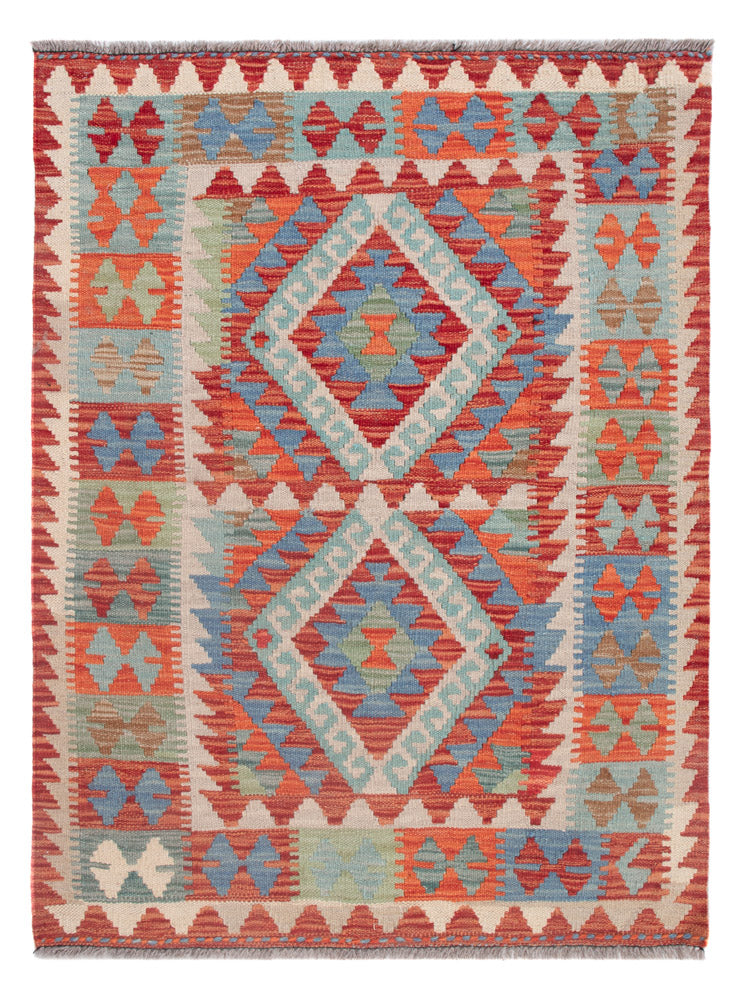
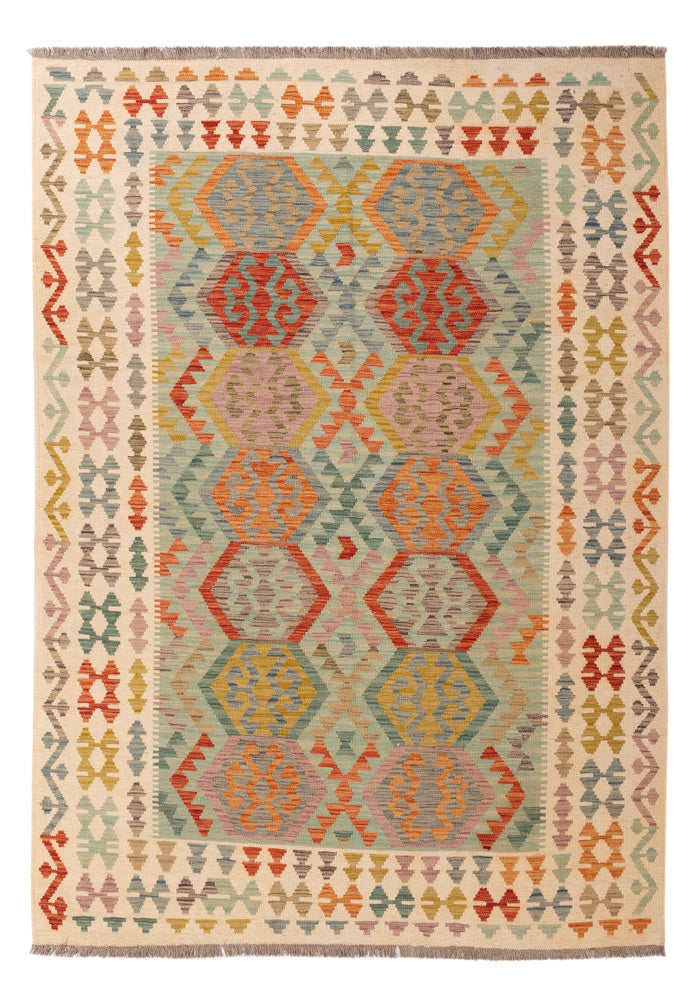
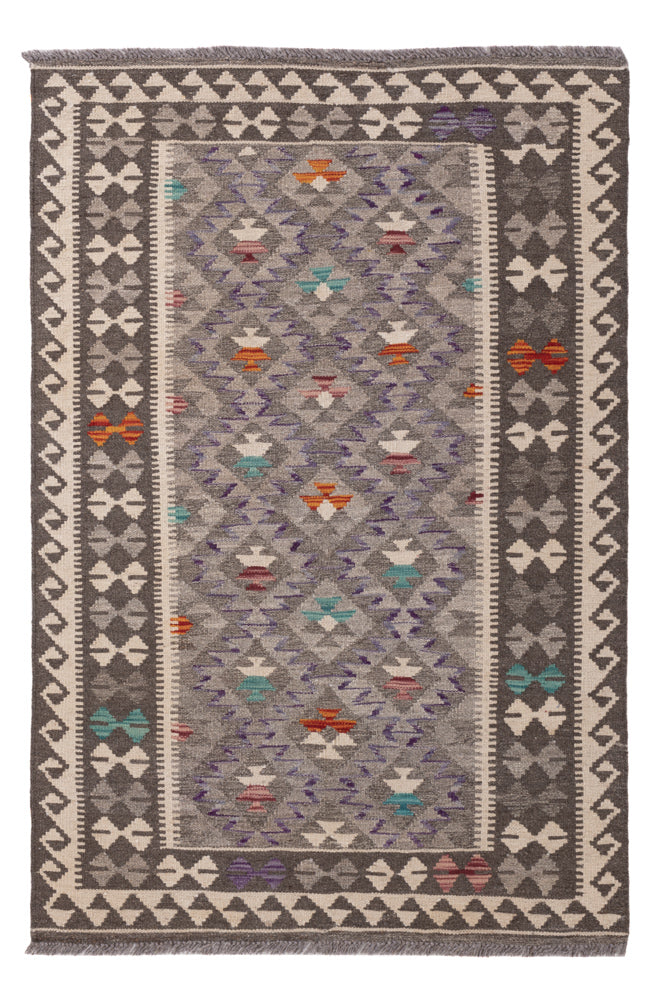
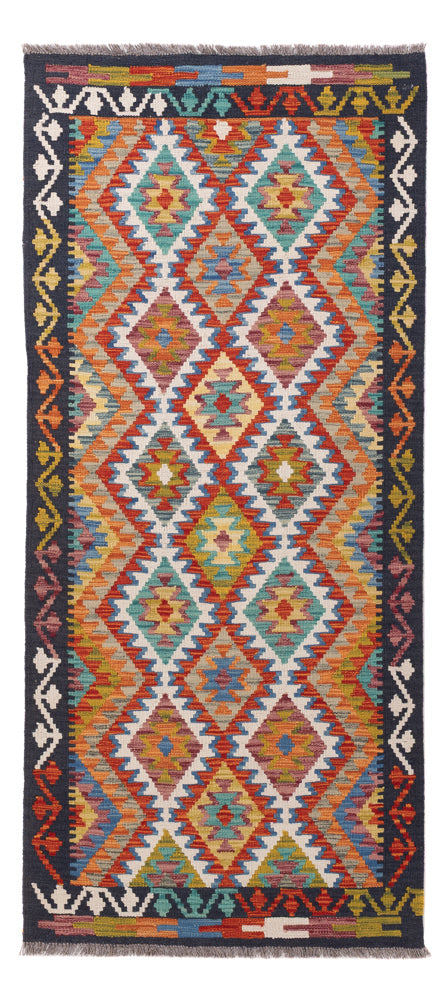
Photo: Morgenland Rugs
The Maimana kelim is a flat-woven, pile-free rug from northwest Afghanistan and one of the best-known Afghan flatweaves. Characteristic are the strong tribal palette of deep reds, browns, and indigos, clear geometric diamond and octagon patterns, and the robust sheep's wool of the northern Afghan highland flocks. Anyone looking for a kelim with lively tribal looks and an everyday-capable weave lands quickly at the Maimana bazaar.
What is a Maimana kelim?
A Maimana kelim is a hand-woven flat rug without pile and without knots. The pattern is formed exclusively by colored weft threads laid in dense plain weave between the warp threads, fully covering them. Where two color fields meet vertically, the characteristic small slit of slit-weave remains. This makes the Maimana almost identical on both sides and fully reversible, like all genuine kelims.
The term Maimana is a collective name for a family of Afghan tribal kelims traded at the market of the town of Maimana (also Maymana, Mimana). They are shaped by the nomadic way of life of Turkmen and Uzbek women weavers, who originally made the flatweave for their own household: as a sleeping and seating pad, storage bag, saddle bag, and wall hanging.
Origin: Faryab and the Maimana bazaar
Maimana is the capital of the northern Afghan province of Faryab and lies about 100 kilometers south of the Turkmen border, at the edge of the Hindu Kush. The province was a node of the northern Silk Road and a center of Karakul sheep breeding. Turkmen, Uzbek, and Tajik weaving traditions meet here and combine with the patterns of the neighboring regions of Turkmenistan and Pakistan.
Kelim production in Faryab is documented at least since the 19th century, when the town became a gathering point for nomadic tribal ware. After the war years of the late 20th century it temporarily came almost to a halt. Since the early 2000s it has been revived via cooperatives in Mazar-i-Sharif and Maimana and now stands in the broader tradition of the nomadic rugs of Central Asia.
Typical patterns and colors
Maimana kelims show a strictly geometric repertoire. The center is dominated by diamond and octagon grids, often in staggered rows, framed by narrow borders with arrowhead, S, or hook motifs. Horizontal stripe bands with small diamonds and stylized animal or plant forms are also common. Floral curves are almost completely absent, since slit-weave only allows straight and diagonal edges.
The palette is tribal and earthy: deep madder red often dominates the center, complemented by indigo blue, oak-gall brown, natural white, and accents in saffron yellow or pomegranate green. Older pieces are mostly dyed with natural colors from madder, indigo, and local plants; newer market qualities partly with chrome dyes. The article recognize natural dyes describes the difference.
Material and weaving technique
Maimana kelims are traditionally made entirely of virgin wool. Warp and pattern-forming weft are made of the robust highland wool of the Karakul and Ghilzai sheep, fat-rich, long-fibered, and resilient. The strands are spun with a hand spindle and dyed before weaving. Simpler qualities use cotton for the warp, which makes the kelim lighter.
Weaving is done in classic slit-weave: on a horizontal loom, the colored weft thread is passed back and forth in its color field without binding the neighboring fields. Unlike with a knotted rug, no pile and no knot density emerge. The Maimana has neither Senneh nor Ghiordes knots; this is not a defect but the defining feature of a flatweave. The overall process is described on the page weaving in the production area. Slits at the color boundaries that grow too long are avoided by interlocking the wefts (dovetailing) or stitched with a needle. The fringes are the extended warp threads, often knotted into small bundles.
Weave density and quality
The weft density of a Maimana kelim is medium to coarse and reflects the tribal and utility character. Typical values lie between 6 and 12 weft threads per centimeter; finer workshop qualities of recent decades come out denser too. More important than the pure number are evenness of the weave, straight edges, and firmness of the fabric. High-quality pieces feel compact and heavy but can be folded easily.
Wool and dyeing are equally decisive. A top wool from the highland flocks is fat-rich and long-fibered, keeps its springiness for decades, and develops over time the lively shimmer that collectors value in older pieces. Naturally dyed wool shows the typical abrash, the fine horizontal color shift within the same tone. A perfectly even color picture rather points to a later, industrially dyed production.
Maimana compared with other tribal kelims
The Maimana is only one member of a large kelim family. The following overview places it alongside the most important other types with which it is compared in the trade.
| Kelim type | Region | Typical features |
|---|---|---|
| Maimene Kelim | Faryab, northern Afghanistan | diamond and octagon grids, strong red and indigo, robust |
| Afghan Kelim | western and northern Afghanistan | earthy large patterns, stripe fields, often darker in tone |
| Kelim Fars | southern Persia, Qashqai tribes | lively color blocks, tribal motifs, often lighter |
| Senneh Kelim | western Iran, Kurdish | finest weave, curving boteh and Herati patterns |
| Silk Kelim | Iran, Turkey (workshop) | silk warp and weft, high sheen, very fine details |
| Anatolian kelim (Turkey) | Anatolia | mihrab and star motifs, clear fields, contrasting borders |
Anyone expecting the fine, curving character of a Senneh kelim will be disappointed with the Maimana: it deliberately belongs to the tribal school, and its charm lies in archaic clarity. From the related Afghan kelim it differs through livelier coloring with luminous red and indigo surfaces instead of the dark earth tones of the more southerly Afghan kelim.
What is a Maimana kelim worth?
The price of a Maimana kelim is determined by age, size, wool quality, dyeing, and condition. Current workshop ware from the past 20 years usually sits in the low to medium price segment, comparable with other Afghan tribal kelims. Older pieces from the pre-war period with hand-spun wool and pure natural dyes can cost a multiple of that, especially with rich madder red and rare pattern combinations.
Value factors are the even weave without ripples, the purity of the colors, the condition of the fringes, and the completeness of the borders. Repaired slits, shortened ends, or garishly redyed areas push the value down. Placement in the overall market is offered by What is a rug worth?, and for dealer selection and contract handling the buying guide.
How do you recognize a genuine Maimana kelim?
A genuine hand-woven Maimana shows several connected features. Individual points can be imitated, the overall picture rarely.
- No knots and no pile: the surface is flat. Unlike a Persian rug, there is no velvety pole.
- Vertical slits at color boundaries: the surest sign of authenticity for slit-weave.
- Almost identical pattern on both sides: the kelim is fully reversible.
- Fringes as extended warp threads: not sewn on, but part of the fabric.
- Geometric tribal motifs: diamonds, octagons, hook motifs, and stripe fields in deep red, indigo, and natural white. Floral curves are atypical.
- Hand-spun wool: uneven yarn thicknesses, visible abrash, and lively wool sheen.
- Slight irregularities of the edges: signs of handcrafted work on the simple loom, not a defect.
Machine-made kelims, by contrast, look unnaturally even, often have an adhesive layer on the back, and show no genuine slits. A step-by-step guide is offered by recognize oriental rug and Is my rug genuine?.
Care
Maimana kelims are robust but thinner than knotted rugs and react more sensitively to moisture. In daily life, vacuuming with reduced suction power and the brush roll switched off is enough, ideally in the direction of the weave. Blot small stains with a damp cloth and a mild pH-neutral cleaner, never rub. Heavier soiling or water damage belongs in professional cleaning, otherwise the thin flatweave gets soaked through and warps.
Since the kelim is reversible, turn and rotate it once or twice a year to spread wear and light exposure evenly. On smooth floors, use a non-slip underlay. Detailed routines are in the care overview.
Frequently asked questions
What is the difference between a Maimana kelim and a knotted rug?
A Maimana kelim is a flatweave without pile and without knots, with the pattern formed in slit-weave. A knotted rug, by contrast, has a pole of wool knots, is thicker, and usable on one side only. The Maimana is thinner, lighter, and fully reversible.
Does a Maimana kelim have a knot density?
No. A kelim has no knots, so there is no knot density either. The weave density is given as weft threads per centimeter, with the Maimana between 6 and 12. More important than the number are evenness, firmness, and wool quality.
How do I recognize a genuine Maimana kelim?
Genuine pieces show a flat, pile-free surface, vertical slits at color boundaries, an identical pattern on both sides, geometric tribal motifs, and hand-spun wool with slight abrash. The fringes are extended warp threads. Machine ware looks unnaturally even and often has a back coating.
Are Maimana kelims suitable for heavily used rooms?
Yes. The robust highland wool and dense slit-weave make them suitable for living rooms, dining rooms, and hallways. Since they are reversible, wear and light can be spread evenly through regular turning.
What does a Maimana kelim cost?
Newer workshop qualities usually sit in the low to medium price segment, markedly cheaper than finer city kelims such as the Senneh. Older pieces with natural dyes and hand-spun wool can fetch a multiple.
How do I care for a Maimana kelim properly?
Vacuum in the direction of the weave, with reduced suction and without brush roll. Blot stains with clear water or mild cleaner, do not rub. Water damage in professional cleaning. Turn the kelim once or twice a year, use a non-slip underlay on smooth floors.
Are Maimana kelims made of pure wool?
Traditionally yes: warp and weft of virgin wool from the highland flocks. Some simpler market qualities use cotton for the warp, which makes the kelim lighter and smoother. Pure wool qualities are more robust.
Impressions of the origin
Places, landscapes and landmarks around the home of Maimana Kilim rugs. Click any image for a larger view.