//
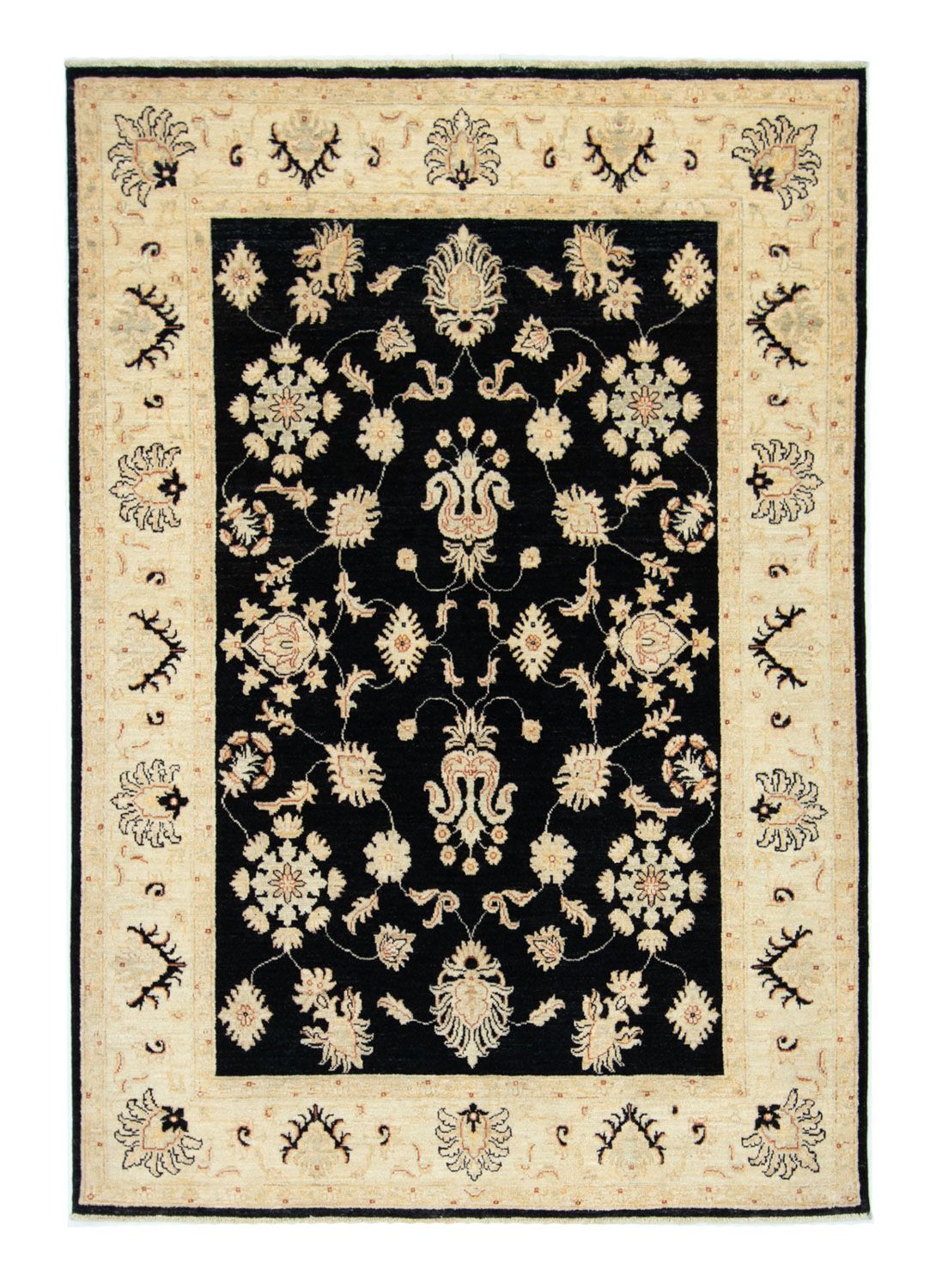
Named after the Swiss trading house, Ziegler rugs combine oriental patterns with a Western sense of color.
Photo: Morgenland Rugs
A Ziegler is a hand-knotted oriental rug with a generous, simplified pattern and a muted color palette, named after the Swiss-British trading firm Ziegler & Co. The company set up workshops around Sultanabad, today's Arak in central Persia, in the late 19th century and developed rugs specifically for Western tastes. Instead of the dense, small-scale ornamentation of classical city rugs, the Ziegler puts calm surfaces, soft earth tones and large-scale floral vines in the foreground.
Today the term Ziegler covers two things: the rare antique originals from around 1880 to 1920 and the modern goods in the Ziegler style that continue this design and are knotted mainly in Pakistan and Afghanistan. This page explains what Ziegler means in rugs, how the Ziegler differs from the classical Persian, how to recognize authentic hand knotting and what to look for when buying.
Both are hand-knotted oriental rugs, but they pursue different design ideals. A classical Persian rug from Tabriz, Kashan or Sarouk shows dense, small-scale patterns, a central medallion and strong colors, often in deep red and blue. The Ziegler, by contrast, takes up these Persian models, enlarges and simplifies them and reduces the colors to muted tones such as beige, cream, soft rust and pale blue-green.
This deliberate simplification, in the trade called the loosening or reworking of classical patterns, was a design choice for the European market. In the trade, Ziegler therefore refers less to an origin than to a style: the generous, flat, color-restrained pattern. The link to Persian tradition is covered on the page Persian rugs, the comparison with the flat Gabbeh in the article Gabbeh vs. Ziegler.
In the rug trade, Ziegler denotes a style, not a city or region. The name goes back to the firm Ziegler & Co., which from the 1880s designed Persian knotted goods for export to Europe and America. Hallmarks are large-scale, simplified floral patterns, all-over vines or reduced medallions and a restrained, harmonious palette. A rug is called a Ziegler today when it follows this design, regardless of the place of knotting.
Ziegler rugs can be ordered by pattern, origin and age. The overview below shows the most important versions.
| Type / pattern | Known for | Typical features |
|---|---|---|
| Antique Ziegler (Sultanabad) | historical originals | soft colors, loose all-over pattern, patina |
| Ziegler style from Pakistan | modern workshop goods | fine wool, muted palette, large formats |
| Ziegler style from Afghanistan | robust hand knotting | earthy tones, stronger wool |
| Herati Ziegler | herringbone all-over | fine vine grid, calm ground color |
| Palmette Ziegler | large-scale vines | widely spaced palmettes, much open space |
| Mahal / Mahal | coarser Sultanabad goods | generous patterns, strong structure |
The antique Sultanabad originals count as the benchmark, their soft coloring and loose all-over pattern still shape the style today. Modern Zieglers from Pakistan often reach very fine qualities, while Afghan pieces turn out stronger and earthier. Related is the coarser Mahal from the same region. All recorded styles can be found in the styles overview.
The firm Ziegler & Co., descended from a Manchester trading house with Swiss roots, built up a large putting-out system in the Sultanabad region from around 1883. Hundreds of weavers worked from designs that combined European living ideas with Persian ornament. The result was large-format rugs with soft colors and calm patterns that established themselves in the salons of the late 19th century.
With the decline of the putting-out system in the early 20th century, original production ended. The antique pieces from this phase, roughly dated 1880 to 1920, are sought-after collector rugs today. The style lived on, however: since the late 20th century, workshops in Pakistan and Afghanistan have been knotting rugs in the Ziegler style that carry the original design idea forward in modern production. More on the Persian root is in Persia and Origin of the knotting art.
Ziegler rugs are exclusively hand-knotted. The pile material is high-grade virgin wool, supplemented on finer pieces by silk for glossy accents. The foundation is usually cotton. Characteristic is the muted palette with predominantly plant-based dyes, whose identification is covered in the article Recognize natural dyes.
Knotting is often done with the asymmetric Persian knot (Senneh), which allows a clean pattern resolution. The knot density moves between around 150,000 and 400,000 knots per square meter depending on quality, producing a fine, stable structure without reaching the top densities of city rugs. The process is in the Production area, the technique on the page Knotting, the knot systematics on the page Knot types, the meaning of density in the article Knot density explained.
An authentic, hand-knotted Ziegler shows several clear features:
Antique originals can additionally be recognized by patina, slight pile abrasion and historical dyeings. The age check is covered in How old is my rug?. The complete guide is in Recognize an oriental rug and Is my rug authentic?.
The value of a Ziegler is determined by age, material, knot density, format and condition. Antique Sultanabad originals fetch the highest prices as collector pieces, modern Zieglers from Pakistan sit, depending on fineness, in the mid to upper range and are significantly more affordable. Why handwork has its price is explained in Why authentic rugs are expensive, the appeal of old work in Old rugs gain in value.
Before buying, the buying guide and the comparison Gabbeh vs. Ziegler are worth a look when a calm, flat rug is the goal. Anyone torn between several styles uses the style comparison. Look for high-grade wool and an even, clean knotting.
Ziegler rugs are long-lived with the right care. Regular vacuuming in the pile direction with the brush roll switched off is enough in everyday use. Dab stains at once with clean water, never rub. A professional cleaning every three to five years preserves color and substance. The muted colors should be protected from intense, direct sun, which can fade them over the years. The complete routines are in the care overview.
Ziegler denotes a rug style, not a city. The name goes back to the trading firm Ziegler & Co., which from the 1880s designed Persian rugs for the Western market. Hallmarks are large-scale, simplified floral patterns and a muted, harmonious palette.
A classical Persian rug shows dense, small-scale patterns with a central medallion and strong colors. The Ziegler takes up these models, enlarges and simplifies them and reduces the colors to muted earth tones. Ziegler therefore refers to a style, not to a particular origin.
The antique originals were made around 1880 to 1920 in the Sultanabad region, today's Arak in central Persia. Modern rugs in the Ziegler style are knotted today mainly in Pakistan and Afghanistan and carry the original design idea forward.
Antique Zieglers were produced from around 1880 to 1920 by the firm Ziegler & Co. and are sought-after collector pieces with patina and historical dyeings. Modern Zieglers take their cue from the design of the originals but are made with contemporary methods and are significantly more affordable.
Authentic Zieglers show a clear, mirror-image knot picture on the reverse and knotted-in fringes from the extended warp threads. The muted palette, the generous pattern and the natural color shift Abrash confirm the hand-knotted Ziegler design.
Zieglers made of pure virgin wool count as allergy-friendly, since wool repels dust and regulates moisture. With a house dust mite allergy, regular vacuuming and occasional professional cleaning help. Pieces with a silk content are particularly fine.
Regular vacuuming in the pile direction with the brush roll switched off is enough. Dab stains at once with clean water, never rub. A professional cleaning every three to five years preserves the substance, and the muted colors should be protected from intense direct sun.