Chinese silk rugs: dragons and lotus blossoms in fine silk
Chinese silk rugs are knotted in pure silk and stand out with their distinctive motifs, dragons, medallions, and Buddhist symbols.
Profile
- Manufacturing
- Hand-knotted
- Origin
- China — silk-producing provinces
- Pile material
- Silk on silk or cotton
- Knot density
- 300,000 – 900,000 knots/m²
- Features
- Pure silk, dragons and medallions, Buddhist symbols
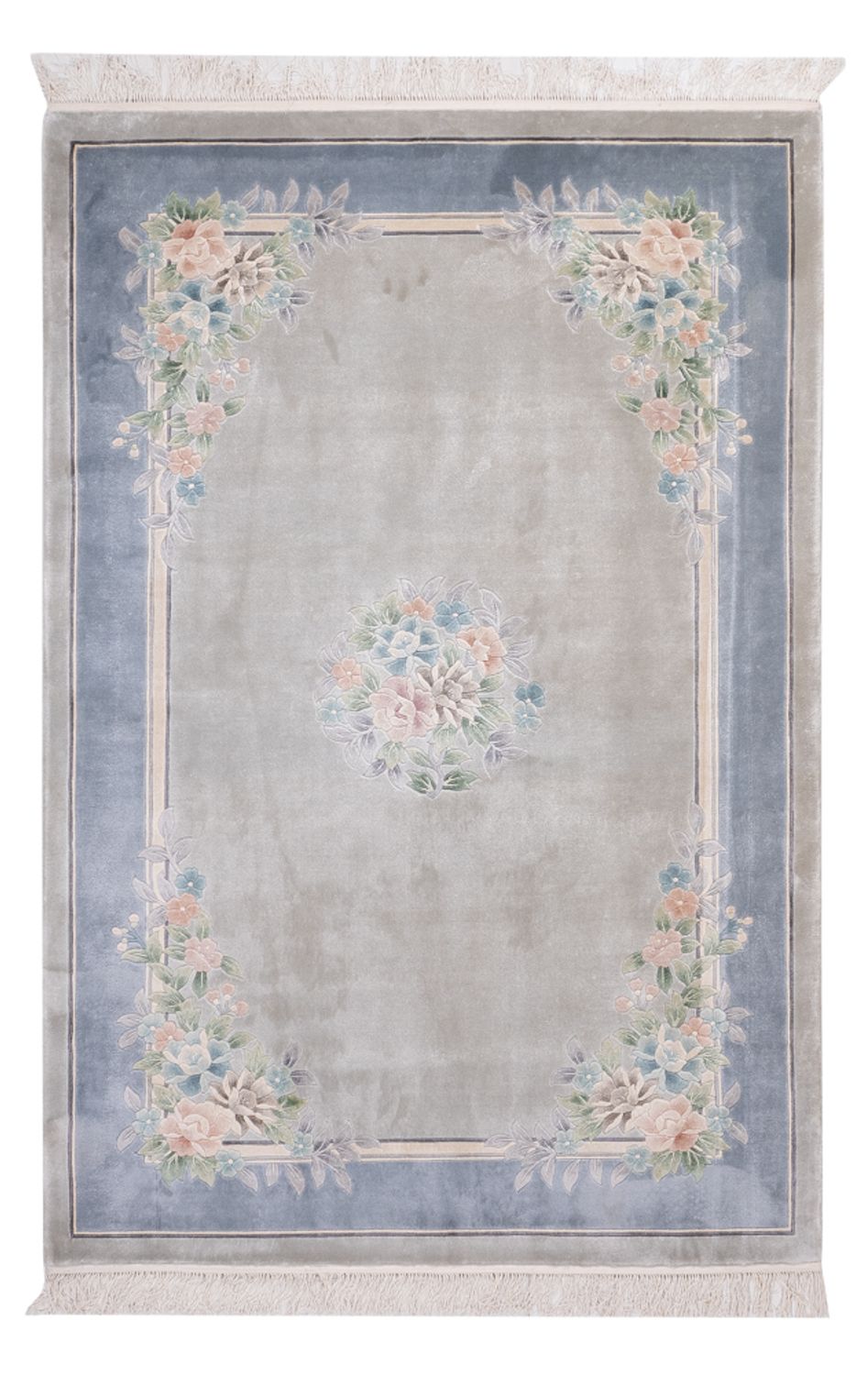
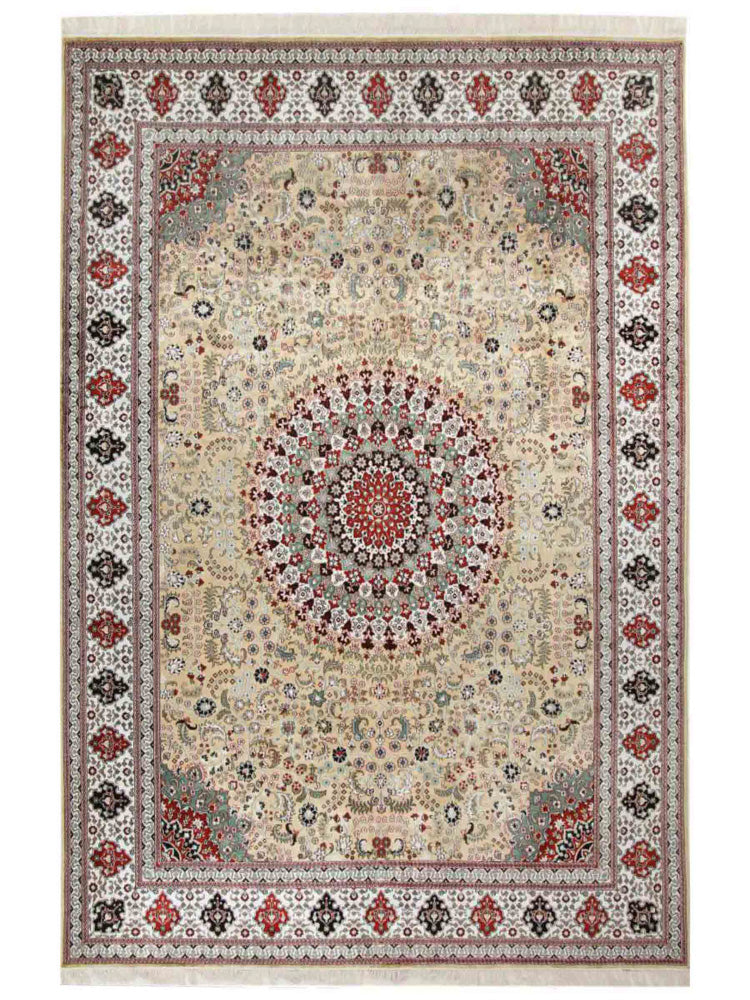
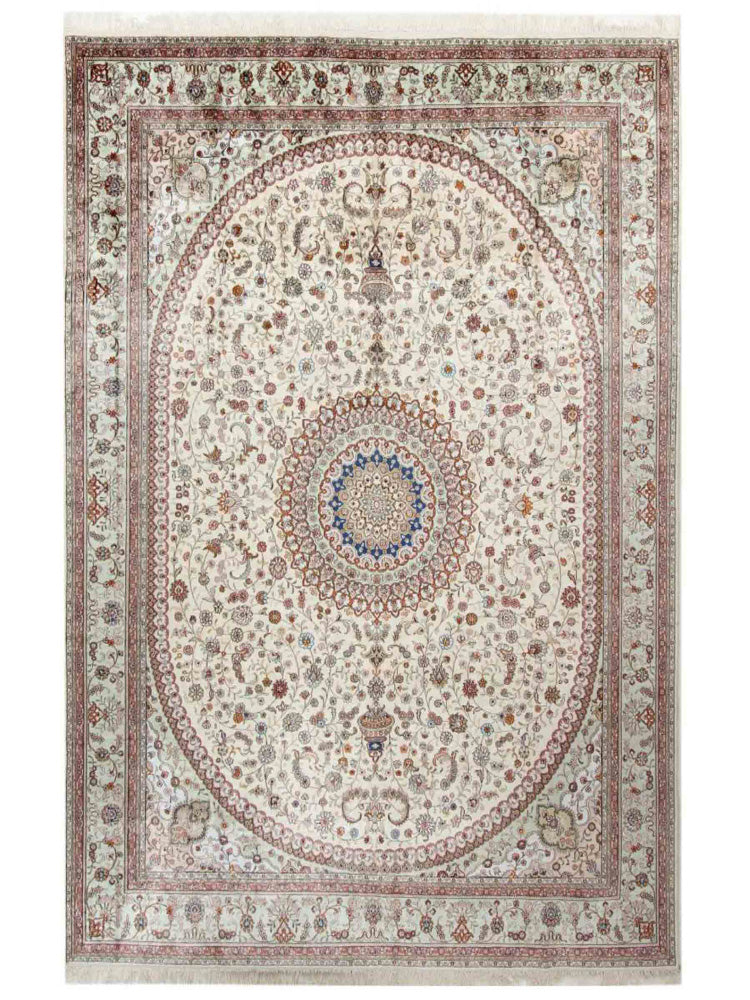
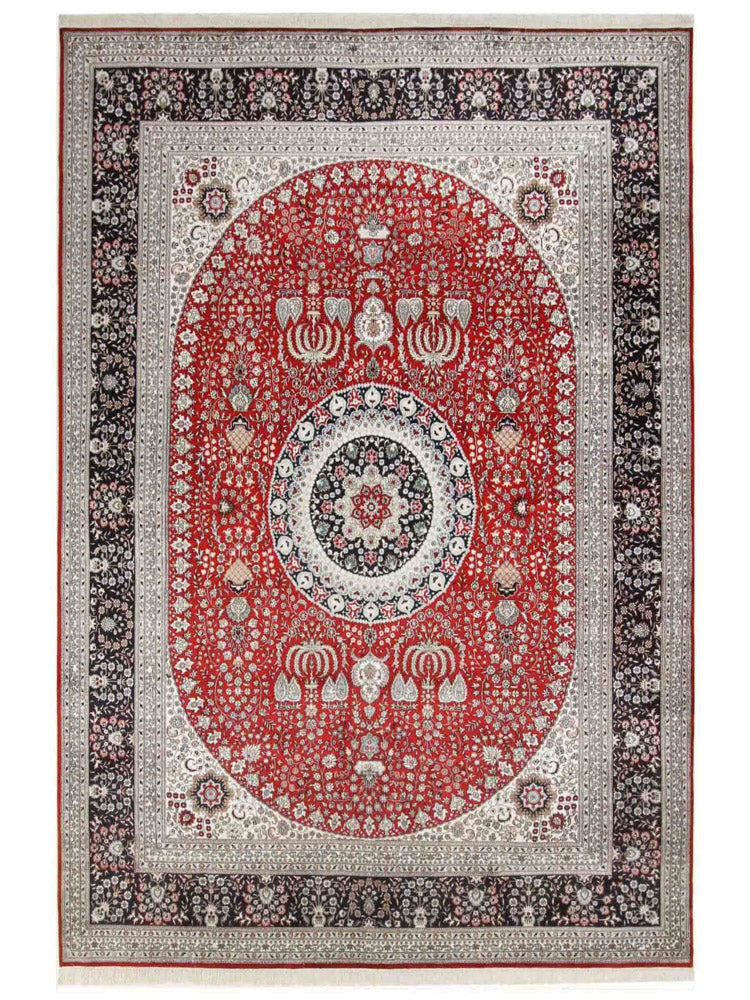
Photo: Morgenland Rugs
Chinese silk rugs are hand-knotted silk rugs from China whose pictorial language differs markedly from the Persian tradition. Instead of floral vines and palmettes they show dragons, cloud bands, lotus blossoms and Buddhist symbols, often on a light, calm ground. Characteristic too are carved contours that let individual motifs stand out in relief. This article explains the origin, patterns, material, knotting technique, value and authentication features of a Chinese silk rug, and sets it apart from the Persian silk work.
What is a Chinese silk rug?
A Chinese silk rug is a rug hand-knotted in China whose pile consists of mulberry silk. Warp and weft, depending on the quality, are likewise silk or cotton. Knotting is predominantly done with the asymmetric knot, which is called the Persian or open knot in the trade and also referred to as the Senneh knot. Despite this affinity with the Persian knotting technique, the Chinese silk rug remains an independent tradition: its motifs come from the Chinese art and symbol world, not from the Persian canon.
The term does not stand for a single workshop, but for the whole Chinese silk production, from solid export goods to finely worked masterpieces. From the woollen Chinese rug, the silk variant is distinguished by the sheen of the fibre, the short pile and the finer drawing. Compared with the Persian Qom silk rug, the knot density of Chinese pieces usually lies lower, but the motifs are clearly Chinese in character.
Origin
China looks back on a long history of rug knotting, even if written and surviving testimonies are younger than in Persia. Early knotted rugs are attributed to the Xinjiang region in the north-west and to the northern Chinese area. Under the Ming dynasty (1368 to 1644) and especially in the Qing dynasty (1644 to 1911), representative rugs arose for temples, palaces and well-to-do households. The classical Chinese wool rugs of these epochs, for example from the Ningxia region, shaped the motif world that was later also translated into silk.
Silk rugs in today's sense are above all a phenomenon of the 20th century. Important production centres lie in the provinces of Henan and Hebei as well as in the Tianjin and Beijing area. During the Cultural Revolution (1966 to 1976) traditional production came largely to a standstill. From the 1980s onwards an export-oriented industry developed from this, which knots fine pure silk rugs for the world market. The whole tradition belongs to the large family of Chinese rugs and stands independently alongside the Persian provenances.
Patterns and colours
The motif world of the Chinese silk rug is its clearest sign of recognition. Widespread are:
- Dragons as an old symbol of imperial power and protection, often shown with a pearl.
- Phoenix and Fo dogs (temple guardian lions) as further protective and lucky motifs.
- Lotus blossom and peony as emblems of purity and prosperity.
- Cloud bands and meanders that rhythmically structure surfaces.
- Buddhist and Daoist lucky symbols, for instance the eight precious things or the shou sign for long life.
Many pieces arrange these motifs around a central medallion, framed by a rather plain, wide border. Characteristic is the restrained, often asymmetrical division of the surface with much calm ground, which differs from the dense all-over drawing of Persian rugs. The palette ranges from the deep blue, red and gold of the classical pieces to the light cream tones, ivory, delicate rosé and pastel nuances of modern export goods. The silk sheen lets every colour appear lighter or darker depending on the angle of view.
Material and knotting technique
Chinese silk rugs are knotted from mulberry silk. In pure silk rugs, pile, warp and weft are made of silk; in a more frequent quality, a silk pile lies on a cotton warp. The fibre is valued for its sheen, its tensile strength and its fineness, and can be spun so thinly that many knots find room in a small space. Background on the production and properties of silk is given in the article on silk; the difference to wool is treated in the overview of materials.
Knotting is predominantly done with the asymmetric knot (Persian or open knot), more rarely with the symmetric Turkish knot. The asymmetric knot wraps only one of the two warp threads completely and allows for a denser distribution and softer lines. The knot types and their effect are explained in their own overview; the whole sequence from setting the warp to shearing is described in the article on rug production.
A typically Chinese feature is the carving: along the pattern contours the pile is cut at an angle, so that the motifs appear lifted from the ground as if in relief. These cut contours are not found in Persian silk rugs. The pile is otherwise sheared short so that the drawing stands out sharply.
Knot density and quality
Chinese silk rugs reach fine but usually not the extreme values of the Persian top pieces. Common qualities lie at around 300,000 to 600,000 knots per square metre; very fine work reaches 900,000 and more. In the trade, the fineness of Chinese silk rugs is often given in lines, for example 90, 120 or 150 lines, which corresponds to the knot count per unit length and can be converted into knots per square metre. What knot density means in detail, and why it is not a sole mark of quality, is explained in its own article.
Density alone does not decide quality. Just as important are the purity and sheen of the silk, the cleanness of the drawing, the harmony of the colours and the even knotting across the entire surface. A cleanly worked piece of medium density stands above a denser but dully dyed rug.
| Variant | Material | Typical knot density | Classification |
|---|---|---|---|
| China silk | pure silk or silk on cotton | approx. 300,000 to 900,000 / m² | Chinese motifs, carved contours |
| Qom silk | pure silk (Iran) | approx. 400,000 to more than 1,000,000 / m² | finest Persian segment |
| Hereke silk | pure silk (Turkey) | up to over 1,000,000 / m² | Turkish top segment |
| Kashmir silk | silk or art silk (India) | strongly variable | Persian-inspired patterns from India |
| Chinese wool rug | wool on cotton | approx. 120,000 to 360,000 / m² | coarser, more robust, significantly cheaper |
What is a Chinese silk rug worth?
The value of a Chinese silk rug depends on size, knot density, silk quality, pattern clarity, age, state of preservation and the fineness of the workmanship. Fine pure silk rugs lie significantly above Chinese wool rugs, but on average remain below the top prices of the finest Persian pieces such as the Qom silk rug. Antique Chinese rugs, especially well-preserved pieces of the Qing period or from the Ningxia region, are by contrast highly traded by collectors and follow their own price logic.
Because of the span from export goods to collector's items and because of the many imitations, a careful classification before buying pays off. Orientation is given by the overview what is my rug worth? and the article recognising valuable Persian rugs, which explains the valuation logic in general. Practical notes on selection are given in the buying guide.
How do you recognise a genuine Chinese silk rug?
The most important question is whether it is genuine, hand-knotted natural silk. Confusion is possible above all with art silk made of viscose, which is often offered as bamboo silk or mercerised cotton, and with machine-made imitations. Reliable indicators of a genuine piece are:
- Hand-knotted back: the pattern is sharply mirrored on the reverse; individual knots form a fine, slightly irregular grid.
- Real fringes: in pure silk, the fringes are the extended silk warp threads, not sewn on afterwards.
- Shifting sheen: natural silk changes brightness with the angle of light; art silk often shines more uniformly and more coldly.
- Warm, dry handle: natural silk feels warm; art silk often cooler and smoother.
- Carved contours: the Chinese carving along the motifs is a good sign of handcraft work from China.
- Chinese motif world: dragons, cloud bands, lotus and Buddhist symbols clearly point to the Chinese tradition.
A reliable method for distinguishing natural from art silk, including the burn test, is described in the article identifying silk. A general step-by-step inspection is given in Is my rug genuine?; the authentication features of hand-knotted pieces are gathered in recognising hand-knotted rugs. For high values a professional appraisal is advisable.
Care
Silk rugs are more delicate than wool rugs and need more care. Vacuum only carefully in the pile direction, without a rotating brush and without strong suction. Permanent direct sunlight bleaches the colours and should be avoided. Heavy furniture on the short pile leaves pressure marks.
Stains and moisture on silk belong in expert hands. Self-experiments with water or cleaning agents can permanently reduce the sheen and leave rings. In case of damage, a specialised silk cleaning is the safe route. Detailed notes are given in the care overview.
Frequently asked questions
What distinguishes a Chinese silk rug from a Persian silk rug?
Both are usually worked with the asymmetric knot, but the pictorial language clearly separates them. The Chinese silk rug shows dragons, cloud bands, lotus and Buddhist symbols, often on a calm ground and with carved contours. Persian silk rugs such as the Qom silk rug show floral vines and medallions and on average reach a higher knot density.
Which symbols does a Chinese silk rug show?
Frequent are dragons as a sign of power, phoenix and Fo dogs as protective motifs, lotus and peony as emblems of purity and prosperity, and cloud bands and Buddhist lucky symbols such as the shou sign for long life. This motif world clearly points to the Chinese tradition.
How do I recognise genuine natural silk in a Chinese rug?
Natural silk shifts in light, feels warm and dry, and burns with the smell of singed hair to crumbly ash, while art silk feels cooler, shines more uniformly and on burning smells like paper. In pure silk the fringes are also made of silk. The safe procedure including the burn test is described in identifying silk.
What is the carving on Chinese silk rugs?
Carving denotes the angled cutting of the pile along the pattern contours. Through this the motifs stand out from the ground as if in relief and look sculptural. This technique is typically Chinese and does not occur in Persian silk rugs.
How much does a Chinese silk rug cost?
The price depends on size, knot density, silk quality, age and condition. Fine pure silk rugs lie significantly above Chinese wool rugs, but on average below the most expensive Persian silk pieces. Antique Chinese rugs of the Qing period follow their own collector logic. Orientation is given by what is my rug worth? and the buying guide.
How do I care for a Chinese silk rug properly?
Carefully and without experiments. Only vacuum gently in the pile direction, do not use a rotating brush, protect from permanent sun and do not apply moisture or cleaning agents yourself. Stains and thorough cleaning belong with a specialised silk cleaner.
Is a Chinese silk rug a good investment?
High-quality and especially antique Chinese rugs can be a stable store of value, above all rare pieces of renowned origin. Modern export goods behave like ordinary commercial goods. Value arises from age, condition, rarity, fineness and material. For a realistic estimate, a professional appraisal and a look at what is my rug worth? are sensible.
Impressions of the origin
Places, landscapes and landmarks around the home of Chinese Silk rugs. Click any image for a larger view.
Related styles
Qom Silk
Qom silk rugs are knotted from pure silk in the holy city of Qom and rank among the world’s finest hand-knotted carpets.
Kashmir Silk
Kashmir silk rugs are knotted in northern India and combine classic Persian designs with the lustrous quality of Kashmir silk.
Hereke Silk
Hereke silk rugs come from the Ottoman court manufactory and are among the world’s most prized silk carpets.


