//
Caucasian rugs captivate with their luminous colors and bold geometric patterns from the mountain regions.
The Caucasus is among the most independent rug regions in the world. Between the Black Sea and the Caspian, on the territory of today's Georgia, Armenia, and Azerbaijan and parts of southern Russia and eastern Anatolia, a knotting tradition emerged that cannot be confused with any other: strictly geometric, high in contrast, often archaic. Caucasian rugs show no finely curved vines but stars, diamonds, hooks, and stylized dragons in luminous, clear colors. This visual language has made them the most coveted collector pieces among oriental rugs.
Unlike Persia or Turkey, the Caucasus is shaped less by large manufactory cities than by villages, tribes, and khanates. Every valley, every community developed its own repertoire, handed down through generations. This page sets the region in geographic order and describes its most important knotting groups from the Kazak highlands in the west to the Kuba villages on the Caspian Sea.
The Caucasian rug region stretches across the entire Caucasus mountains and the adjoining lowlands. It can be divided roughly into three spaces: the southern Caucasus with Georgia, Armenia, and Azerbaijan, where the bulk of the well-known types arose, the northern Caucasus on Russian soil around Derbent, and the eastern foothills of Anatolia. The elevation gradient from high-mountain pastures to fertile coastal plains is mirrored in the rugs: the rough highlands produced coarsely knotted, wool-thick pieces; the warmer plains finer, more densely knotted goods.
The Caucasian knotting tradition works with the symmetric knot, also called the Turkish or Gördes knot, which loops the pile yarn around both warp threads. This binding fits the geometric visual language of the region and produces a firm, very durable pile. Knot density usually lies between 100,000 and 300,000 knots per square meter depending on origin and use. The difference between knot types is covered on Knot types, the full production path on Production.
The pile material is mostly high-quality virgin wool, more rarely goat hair in the warp and weft. Dyeing was traditionally done exclusively with plant colors from the regional flora: madder for the strong reds, indigo for deep blue, weld and reseda for yellow. From this comes the characteristic, luminous and yet harmonious color chord of Caucasian rugs, often with an additional accent in pure white that gives the geometric patterns their crispness. How to recognize natural dyes is explained in Recognizing natural dyes; the natural color shift is covered on Abrash.
The type names of the Caucasus mostly point to a region, a khanate, or a village group rather than to a single city. The overview below sorts the best-known groups.
| Group / region | Known for | Typical traits |
|---|---|---|
| Kazak | western Caucasus, highlands | large medallion-like patterns, luminous red and blue, coarse, dense wool |
| Shirvan | eastern Azerbaijan | finer knotting, small-scale fields, floral alongside geometric elements |
| Kuba | northeastern Azerbaijan | very fine village goods, dragon and medallion patterns, cool palette |
| Karabagh | Armenian-Azerbaijani highlands | large-format rugs, rose patterns, deep red and green |
| Ganja | central Azerbaijan | diagonal stripe fields, strong geometry, warm tones |
| Gendje | western Azerbaijan | long-format runners, oblique bands, luminous contrasts |
| Derbent | northern Caucasus, Dagestan | robust mountain goods, stars and diamonds, muted colors |
| Tiflis | Georgian trading center | collection and distribution point for various village types |
The greatest reputation belongs to the Kazak style from the western highlands with its large, luminous medallions on a red ground. Finer and more small-scale are the Shirvan rugs from the east, which bind floral elements into the geometric framework. The Kuba villages in the northeast of Azerbaijan are regarded as the home of the finest Caucasian village goods, including the famous dragon rugs. Karabagh in the highlands stands for large-format pieces with rose motifs. All registered types sit in the Style overview.
The Caucasus lies at an old crossroads between the Persian, Ottoman, and Russian spheres of influence, and its rugs carry traces of all three. The famous Caucasian dragon rugs of the sixteenth and seventeenth centuries were made under Persian suzerainty and translated Safavid court motifs into the strict geometry of the region. With the decline of the central power, the southern Caucasus in the eighteenth century organized itself into a series of khanates whose names, such as Kuba, Shirvan, or Karabagh, live on to this day as type names.
In the nineteenth century the Caucasus came under Russian rule, and with the expansion of trade routes village production saw a heyday. This period, roughly from 1860 to 1910, is regarded as the classical age of Caucasian knotting: most of today's traded collector pieces come from it. The political upheavals of the twentieth century, revolution, Sovietization, and the collectivization of the villages, then largely broke the old workshop ties. The longer development of the technique is traced on Origin of knotting.
Caucasian rugs are the geometric counterpart to the floral Persian city goods. Their repertoire consists of large medallions, eight-pointed stars, hooked diamonds, stylized dragons and animals, and lachak fields with offset motifs. The borders are almost always multi-stepped and show meanders, vine work in abstracted form, or the characteristic chalice border. Color is dominated by deep red and indigo blue, supplemented by ivory, yellow, green, and brown, with pure white visually breaking up the patterns and giving them their crispness.
The work uses the symmetric Turkish knot, which technically allows the angular geometry in the first place. The wool is usually long and lustrous, the pile correspondingly dense and hardwearing. Alongside the knotted rug, the Caucasus has a rich flatweave tradition: kilim, sumakh, and verneh in slit-tapestry and wrapping technique are among the most striking pieces of the region. How Caucasian geometry sets itself off from Persian and Turkish pattern language can be traced in the Style comparison.
The Caucasian types listed in Rug Wiki are Kazak and Shirvan, the two best-known representatives of the region. They stand for the two poles of Caucasian knotting: the coarse, luminous highland piece and the finer, small-scale village goods. In the wider frame these rugs sit as geometric relatives of Nomadic rugs, while they set themselves off clearly from the floral Persian rugs. The full overview sits in the Style overview.
Genuine old Caucasian rugs are today almost only available as vintage or antique pieces, since traditional village production largely broke off in the twentieth century. Well-preserved examples from the classical period are correspondingly valuable. Value is set by age, condition, fineness of knotting, rarity of the pattern, and purity of the natural dyes. Before buying, the Buying guide and the article Old rugs gain value help. How to check origin and authenticity sits under Recognizing oriental rugs and Recognizing origin. Care is described in the Care overview.
A Caucasian rug is a hand-knotted rug from the region between the Black Sea and the Caspian, that is from Georgia, Armenia, Azerbaijan, and southern Russia. It is worked with the symmetric knot and recognized by its strictly geometric, high-contrast visual language of stars, diamonds, and hooks.
Caucasian rugs are defined by geometric, often archaic patterns, strong, clearly separated natural colors, and a robust, dense wool quality. Characteristic are large medallions, eight-pointed stars, and multi-stepped borders on a deep red or blue ground.
In the Caucasus the symmetric knot dominates, also called the Turkish or Gördes knot. It loops the pile yarn around both warp threads and fits the angular, geometric visual language of the region. The comparison with the Persian knot is shown on Knot types.
Caucasian rugs are strictly geometric and high in contrast, while Persian rugs often show floral, curving patterns. The Caucasus knots with the symmetric knot, Persia mostly with the asymmetric. The palette is also stronger and more crisply offset in the Caucasus.
An authentic Caucasian rug shows the symmetric knot, geometric patterns in clear natural colors, and a firm wool structure. The back reflects the pattern crisply, and the edges are usually wrapped with the same wool as the pile. The authenticity check is described in Is my rug genuine?.
Caucasian rugs were predominantly knotted in smaller to medium formats, typically between roughly 100 x 150 cm and 200 x 300 cm, plus long narrow runners. Very large formats are rarer, since village and partly nomadic production favored manageable measurements.
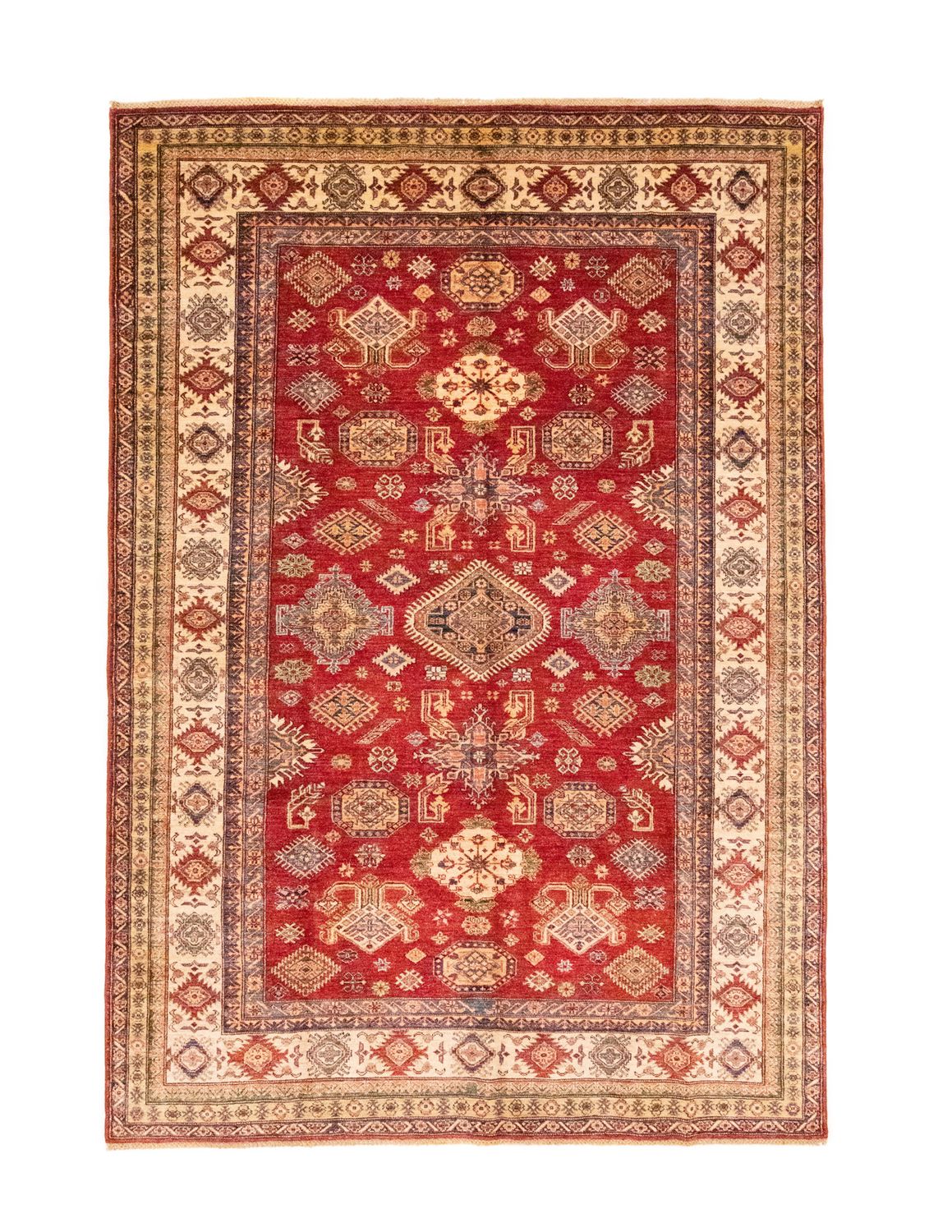
Kazak rugs from the southern Caucasus impress with bold geometric patterns and luminous colors.
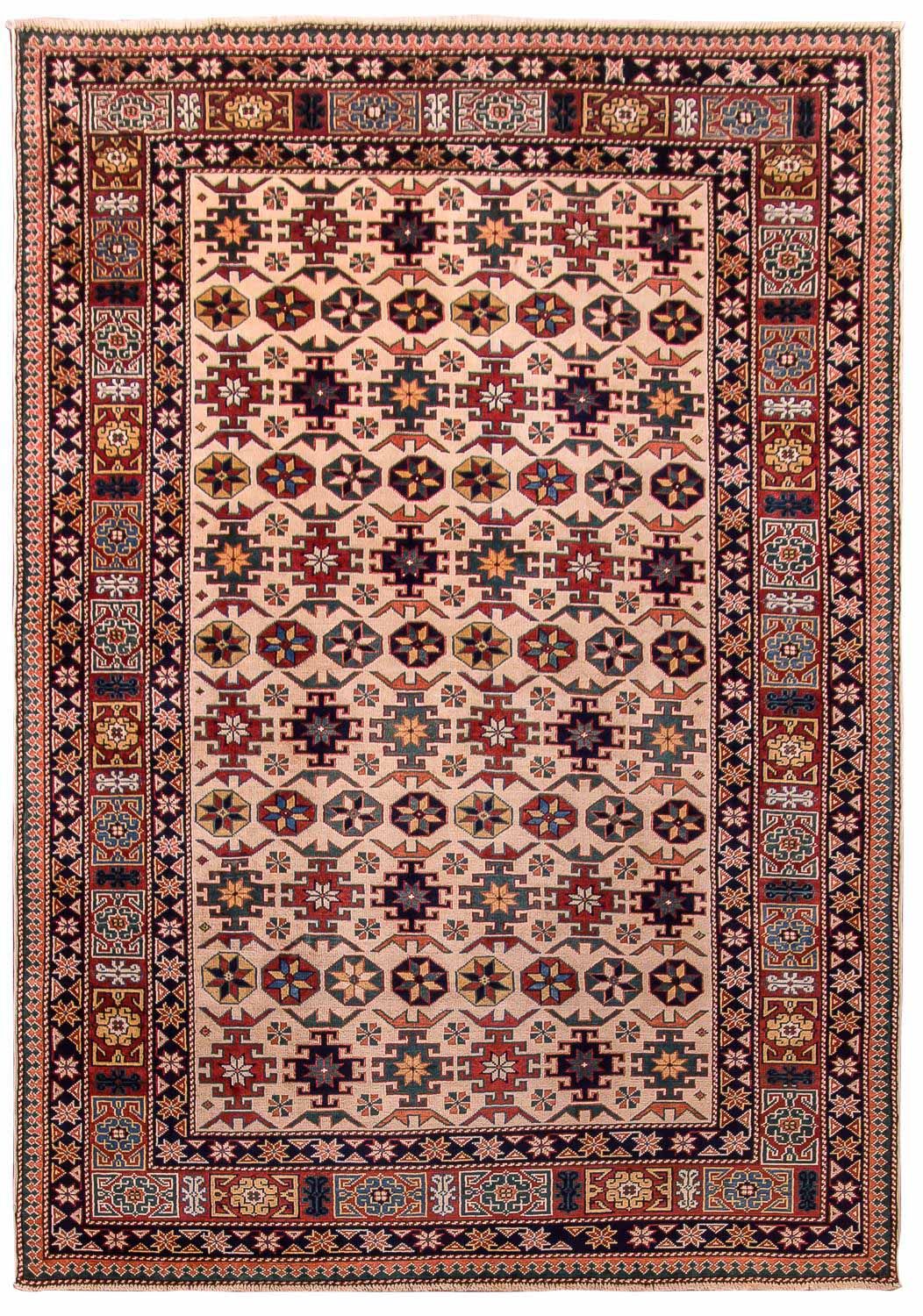
Shirvan rugs come from eastern Azerbaijan and stand out with their fine geometric medallions and clear color contrasts.