//
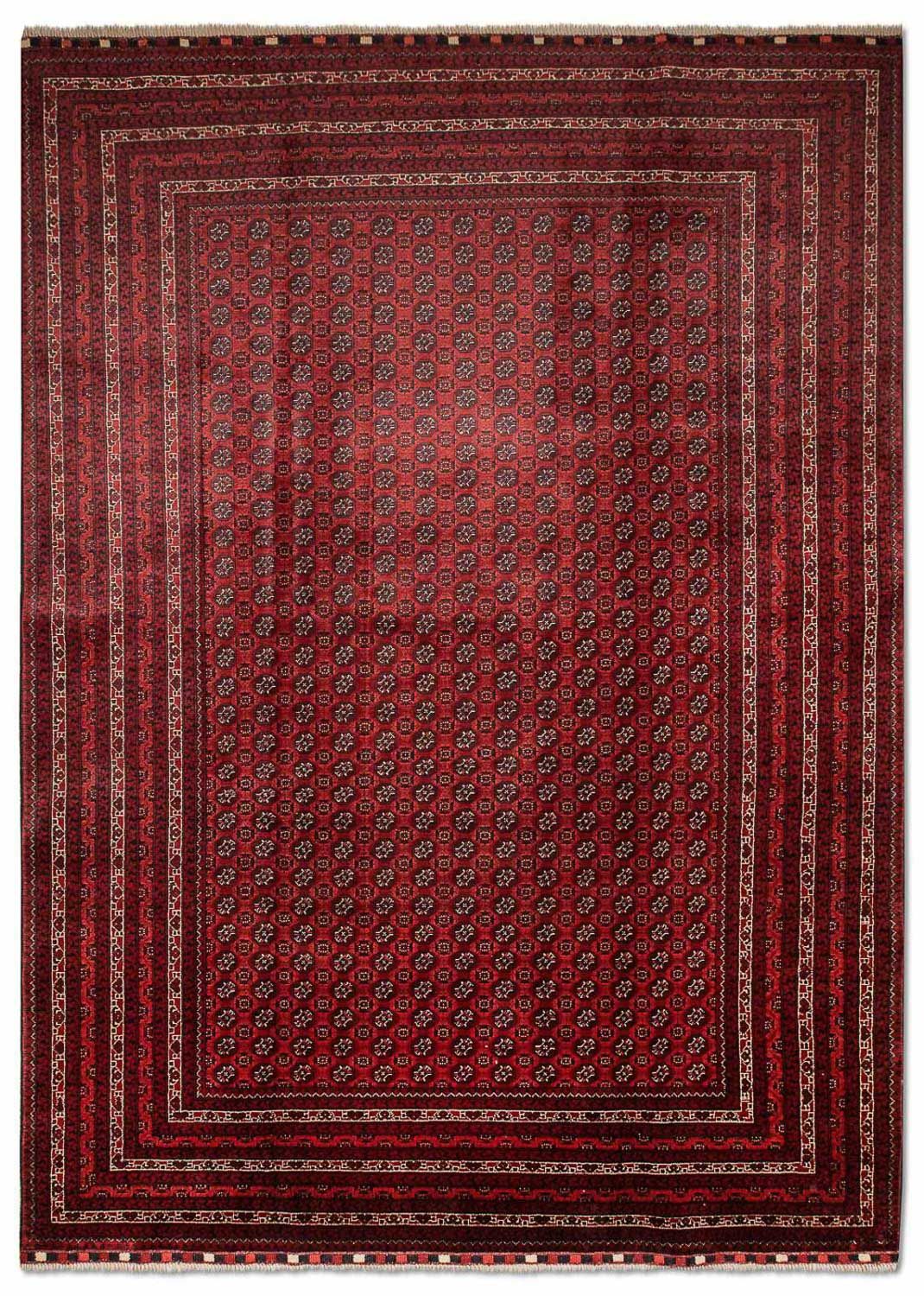
Turkmen rugs are world-famous for their deep red tones and the characteristic gül medallions of the tribes.
Turkmenistan, lying in Central Asia between the Caspian Sea and the Afghan border, is the home of one of the oldest and stylistically most coherent knotting traditions in the world. Turkmen rugs are immediately recognized by their deep red ground color and by the gul, an octagonal tribal medallion that runs in strict rows across the entire field. Every tribe had its own gul, which functioned like a coat of arms and signaled the origin and identity of the knotters.
These rugs are not a courtly but a nomadic art. They were made in the tents of the tribes, knotted by women, and served as floor and door hangings as well as saddlebags, tent bands, or dowry pieces. Via the trading center of Bukhara they reached Europe, which is why the classical Turkmen rug was long simply called Bukhara in the West. This page sets the region in geographic order and describes its most important tribes and pattern traditions.
Turkmenistan stretches from the Caspian Sea in the west to the border with Afghanistan and Iran in the southeast. The greater part of the country lies under the Karakum desert, so life and rug production concentrate in the oases and the few river courses, above all along the Amu Darya and around the Merv oasis. The continental desert climate with extreme temperature swings and the sheep husbandry of the steppe regions yield a particularly lustrous, firm wool that gives Turkmen rugs their velvety hand.
Characteristic of Turkmen knotting is the asymmetric knot, looped open to the left by many tribes, above all the Tekke. It allows a very dense, even knotting. Knot density runs by tribe and piece from about 100,000 to over 400,000 knots per square meter, and higher still in the finest Salor work. The difference between knot types is covered on Knot types, the full production path on Production.
The pile is exclusively virgin wool from local sheep, occasionally with silk inlays in the most precious pieces. Dyeing was traditionally done with plant colors, above all madder for the dominant red, plus indigo for the dark contours and cochineal for the deep red Salor pieces. Antique Turkmen rugs develop a silky patina over the years that is prized. How to recognize natural dyes is explained in Recognizing natural dyes; the natural color shift is covered on Abrash.
Turkmen rugs are named after the tribe whose gul they carry, more rarely after a market town. The overview below sorts the most significant.
| Tribe / center | Known for | Typical traits |
|---|---|---|
| Tekke | finest standard goods | small Tekke gul in dense rows, deep red-brown, velvety pile |
| Yomud | lively colors | diamond gul, kepse and dyrnak patterns, lighter, warmer tones |
| Salor | most precious pieces | large turreh gul, cochineal red, highest fineness, silk inlays |
| Saryk | deep color chord | dark brown-red, angular guls, very dense knotting |
| Ersari | large-format goods | wide guls, warmer palette, link to the Afghan tradition |
| Bukhara | Western trade name | collective term for Tekke guls, octagonal medallions in rows |
| Turkaman | modern continuation | classical tribal patterns for the international market |
| Hatschlu | door-hanging format | cross-shaped field division, ensi of the yurt |
The Tekke are regarded as the knotters of the finest Turkmen standard goods, whose small gul set in dense rows became the embodiment of the Bukhara rug. The Yomud stand out by livelier colors and diamond guls, the Salor, historically called the princes among the Turkmen, created with their cochineal red and the large turreh gul the most precious pieces of all. The Hatschlu format denotes the ensi, the knotted door hanging of the yurt with its cross-shaped field division. All registered types sit in the Style overview.
Turkmen knotting reaches far back and is inseparably tied to the nomadic life of the Central Asian steppe. Over centuries the great tribal confederations, Tekke, Yomud, Salor, Saryk, and Ersari, shared the area of today's Turkmenistan and the adjoining regions. Each carried its own gul as a recognition sign that appeared unchanged on the main rugs but could also be taken over or shrunk after defeats or mergers. From the gul one can therefore often read the history of the balance of power between the tribes.
Via the caravan city of Bukhara, the great trading center in neighboring Uzbekistan, these rugs reached the Western trade, which is why the name Bukhara took hold there even though almost no knotting was done in the city itself. With the Russian conquest of Central Asia in the late nineteenth century and Sovietization in the twentieth century the tribes lost their independence, and classical knotting with natural dyes largely receded. Antique pieces from the time before Soviet rule are therefore considered especially coveted. The longer line of the technique is traced on Origin of knotting.
The all-determining motif is the gul: an octagonal or diamond-shaped medallion that fills the entire main field in regular vertical and horizontal rows, separated by a smaller secondary motif. The borders repeat tribe-typical ornaments in several narrow stripes. The palette is organized almost monochromatically around red, from the wine red of the Tekke to the cochineal red of the Salor, lightened only by ivory, dark blue, and a little brown.
The work is done predominantly with the asymmetric knot in very high density, which explains the fine, velvety pile. Alongside the main rug (khali) a whole family of functional formats emerged: the door hanging Hatschlu or ensi, the saddlebag chuval, the narrow tent bands, and the prayer rugs. These pieces belong to the great category of Nomadic rugs and stand opposite the floral Persian rug as a geometric, tribe-bound art.
The Turkmen types listed in Rug Wiki are Bukhara, the classical gul goods under their Western trade name, Turkaman as a modern continuation of the tribal patterns, and Hatschlu for the door-hanging format. They stand in for the Tekke, Yomud, Salor, Saryk, and Ersari tradition. Closely related is the Turkmen-influenced work from neighboring Afghanistan, where many guls wandered across the border. The full overview sits in the Style overview.
Antique Turkmen rugs, especially Salor and fine Tekke pieces from the time before Soviet rule, are among the most coveted collector items among oriental rugs. Value is set by tribe, age, fineness of knotting, purity of the natural dyes, and condition. Before buying, the Buying guide and the article Old rugs gain value help. How to check origin and authenticity sits under Recognizing oriental rugs and Recognizing origin. Care is described in the Care overview.
Turkmen rugs come from Central Asia, from the area of today's Turkmenistan between the Caspian Sea and the Afghan border, and from adjoining Turkmen settlement areas. They were knotted by nomadic tribes such as the Tekke, Yomud, and Salor. Closely related goods come from neighboring Afghanistan.
Turkmen rugs are defined by a deep red ground color and the gul, an octagonal tribal medallion that fills the field in strict rows. They are very densely knotted with the asymmetric knot and have a fine, velvety pile.
A Bukhara rug is a Turkmen rug with gul pattern, named after the Central Asian trading city of Bukhara through which it entered Western trade. It was knotted not in the city itself but by the Turkmen tribes, above all the Tekke. In the West the name stands for the classical red-ground gul rug.
A gul is an octagonal or diamond-shaped medallion that served as the tribal sign of individual Turkmen groups and is arranged in regular rows across the field of the rug. Every tribe had its own gul, which like a coat of arms signaled origin and identity.
In Turkmenistan the asymmetric knot dominates, looped open to the left by many tribes, such as the Tekke. It allows a very dense, even knotting and the fine pile of Turkmen rugs. The comparison of knot types is shown on Knot types.
The most valuable Turkmen rugs are antique Salor pieces with their cochineal red and the large turreh gul, as well as fine Tekke work from the time before Soviet rule. The decisive factors are tribe, age, fineness, and the preservation of the original natural dyes.
A genuine Turkmen rug shows the red ground color, guls arranged in rows, and a dense, even knotting with a fine, firm pile. The back reflects the pattern clearly; antique pieces have a natural, silky patina. The authenticity check is described in Is my rug genuine?.
Hatschlu denotes the ensi, the knotted door hanging of a Turkmen yurt. It is marked by a cross-shaped field division that closed the tent off to the outside, and belongs to the characteristic functional formats of Turkmen knotting.