//
Baluchi rugs come from the borderlands of Iran, Afghanistan, and Pakistan and carry an unmistakable nomadic style.
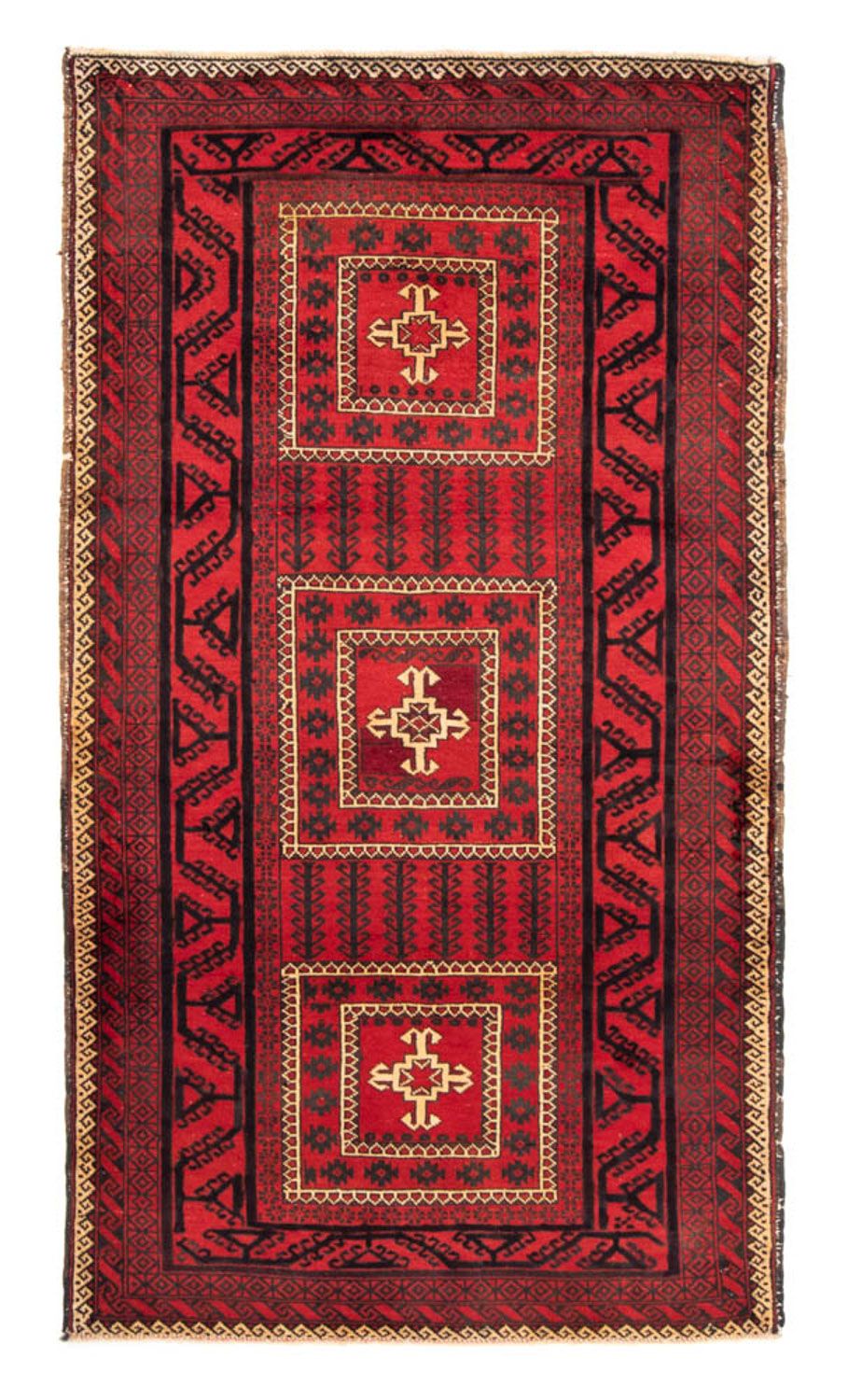
Balochistan is not a nation but a cultural area: a wide, harsh territory that stretches across the borders of Iran, Afghanistan, and Pakistan, inhabited by the Baluchi, an Iranian-speaking people with a nomadic tradition. From this region comes one of the most singular rug types in the Orient, the Baluchi rug: dark, archaic, densely knotted, in deep reds, blues, and browns, often on a camel-hair or natural-wool ground. Where the city rugs of Persia rely on floral splendor, the Baluchi pieces speak the restrained, almost severe language of the nomadic tent.
The region's best-known contribution to rug art is the Baluchi prayer rug with its mihrab, the prayer niche, and its small-scale geometric fill patterns. These pieces are among the finest tribal prayer rugs anywhere. This page sets the region in geographic order and describes its tribes, its pattern traditions, and what sets the Baluchi work apart from the rest of nomadic production.
Balochistan covers a wide area of southwestern Asia politically divided between three states: the Iranian province of Sistan and Baluchestan, the Pakistani province of Balochistan, and the south and west of Afghanistan. The landscape consists of harsh high plains, desert regions, and sparsely vegetated mountain regions at elevations between roughly 500 and 3,000 meters. The extreme temperature swings and the nomadic life call for robust materials and a dense knotting. An important collection and trading point for Baluchi goods, however, lies outside the core area: the western Afghan city of Herat, through which a large part of the rugs comes to market.
Baluchi knotting works predominantly with the asymmetric knot, some groups also with the symmetric, each in medium to high density. Knot density usually lies between roughly 80,000 and 200,000 knots per square meter. The work is done on the portable horizontal loom, traditionally by women, who pass the craft on through generations. The difference between knot types is covered on Knot types, the full production path on Production.
The pile is the resilient wool of local sheep, often supplemented by goat hair and the characteristic, naturally camel-brown yarn that gives many Baluchi rugs their earthy ground tone. Dyeing was traditionally done with plant colors: madder for red, indigo for blue, plus walnut and various plants for browns and yellows. From the interplay of dark indigo, deep madder red, and natural brown areas comes the muted, almost melancholy color chord of the region. How to recognize natural dyes is explained in Recognizing natural dyes.
Baluchi rugs are named after tribe, subgroup, or format, more rarely after a market town. The overview below sorts the best-known.
| Tribe / type | Known for | Typical traits |
|---|---|---|
| Timuri | finest Baluchi goods | dense knotting, dark palette, octagonal medallions |
| Sarhaddi | fine borders | small-scale geometric edge patterns, balanced fields |
| Brahui | Pakistani Baluchi | strong geometry, robust wool, warm reds |
| Rakhshani | Iranian-Pakistani | strict diamond fields, muted colors |
| Sistani | Iranian-Afghan border area | archaic patterns, tree motifs, dark ground |
| Baluchi prayer rug | sajjadeh format | mihrab with small-scale fill, often camel-hair ground |
| Mushwani | crossover to Afghanistan | strong fields, blend of Baluchi and Afghan motifs |
| Baluchi | collective trade name | dark red-blue-brown, geometric, elongated formats |
The finest Baluchi goods are the rugs of the Timuri group with their dense knotting and dark palette. The Sarhaddi are known for their finely drawn geometric borders, the Brahui in the Pakistani part for stronger, more robust pieces. In the trade the name Baluchi gathers all these subgroups. All registered types sit in the Style overview.
The Baluchi are an Iranian-speaking people whose tribes spread over centuries across the tri-border area of Iran, Afghanistan, and Pakistan. The region knows no courtly manufactory tradition; its rug art is through and through nomadic and geared to its own needs. Floor and sleeping rugs, prayer rugs, saddlebags, and tent equipment were knotted, whose patterns arose from memory and without a drawn template.
In the nineteenth and early twentieth century Baluchi goods reached the trade mainly via the western Afghan city of Herat and the Persian markets of Mashhad, which is why many a type is also listed as Herat-Baluchi or Mashhad-Baluchi. The antique prayer rugs of this time, with their fine knotting and pure natural dyes, are today regarded as the most coveted pieces of the region. Placed in the larger history of nomadic knotting, the Baluchi tradition is closely related to the Persian nomadic rug culture; the longer line of the technique is traced on Origin of knotting.
Baluchi rugs are the dark, restrained counterpart to the luminous tribal goods of the Turkmen or Caucasians. The field usually carries small octagonal or diamond-shaped medallions evenly scattered, or tree and branch motifs, plus stylized animal symbols. The defining format is the prayer rug with its pointed or rectangular mihrab and a small-scale geometric fill, often on a light camel-hair ground that sets a warm contrast against the dark field. The borders show zigzag bands, abstracted flowers, and geometric stripes.
The work is done in medium to high density, often with the asymmetric knot, on a firm wool or goat-hair foundation, which makes the pieces very durable despite their modest size. Alongside the knotted rug, the Baluchi keep a kilim tradition and combine knot and flatweave technique in saddlebags and pouches. The elongated, rather small formats betray the nomadic origin: they had to stay portable on the move.
The central Baluchi style in Rug Wiki is the Baluchi rug, which gathers the Timuri, Sarhaddi, Brahui, and Sistani traditions under one trade name. Closely related are the Baluchi pieces from neighboring Afghanistan, where Herat is an important collection center, and the rest of the Persian nomadic rug family. As knotted prayer rugs the Baluchi sajjadeh sits in a line with other prayer formats of the Orient. The full overview sits in the Style overview.
Baluchi rugs are robust, characterful collector and everyday goods at mostly moderate prices, with antique prayer rugs and fine Timuri work at the upper end. Value is set by tribe, age, fineness, purity of the natural dyes, and condition. Before buying, the Buying guide and the article Why genuine rugs are expensive help. How to check origin and authenticity sits under Recognizing oriental rugs and Recognizing origin. Care is described in the Care overview.
Baluchi rugs come from the cultural area of Balochistan, which stretches across the Iranian province of Sistan and Baluchestan, Pakistani Balochistan, and the south and west of Afghanistan. An important trading point is the western Afghan city of Herat. Related goods are covered in the region Afghanistan.
Baluchi rugs are defined by a dark palette of deep red, indigo blue, and natural brown, often on a camel-hair ground, plus geometric patterns and the widespread prayer rug format. They are densely knotted, robust, and usually kept in elongated, smaller formats, which betrays their nomadic origin.
The Baluchi knot mainly with the asymmetric knot, some groups also with the symmetric. Both yield a firm, durable pile. The comparison of knot types is shown on Knot types.
A Baluchi prayer rug, also called sajjadeh, carries a mihrab, a stylized prayer niche aligned toward Mecca during prayer, filled with small-scale geometric patterns. The field often sits on a light camel-hair ground. These pieces are among the finest tribal prayer rugs of the Orient.
Baluchi rugs are nomadic, dark, and geometric, while Persian city rugs like Isfahan show floral, light, and finely drawn patterns. The Baluchi goods use muted natural colors and a more rustic aesthetic; the Persian Persian rugs tradition relies on courtly splendor and higher knot counts.
Yes. Baluchi rugs are considered especially robust and long-lasting. The resilient local wool, the frequent share of goat hair, and the dense knotting make them very abrasion-resistant, so that with good care they last across generations.
An authentic Baluchi rug shows the typical dark red-blue-brown palette, often on a camel-hair ground, geometric patterns, and a dense wool structure with small irregularities typical of handwork. The back reflects the pattern clearly. The authenticity check is described in Is my rug genuine?.
Baluchi rugs are predominantly small to medium and often elongated in proportion, with common measurements such as 100 x 150 cm or 120 x 200 cm, plus runners and small prayer formats. Very large pieces are rare, since the nomadic tradition favored portable measurements.