Persian rug vs. oriental rug
In everyday speech the terms are often used interchangeably. In the trade they are not. A Persian rug is a sub-group of oriental rugs, defined by geographical origin. This page clarifies what counts, what does not, and why the distinction matters when buying.
The terms at a glance
A compact definition, followed by the detailed explanations further down.
| Criterion | Persian rug | Oriental rug |
|---|---|---|
| Definition | hand-knotted in Iran (formerly Persia) | hand-knotted across the wider Orient (Iran, Turkey, the Caucasus, Central Asia, Afghanistan, India, Pakistan, Nepal, China) |
| Best-known styles | Bidjar, Isfahan, Nain, Tabriz, Heriz, Hamadan, Qum | all Persian styles plus Hereke, Kayseri, Yagcibedir, Baluch, Kazak, Yomud, Tibetan |
| Knotting tradition | asymmetric Senneh knot dominates | various traditions: Turkish Ghiordes, Persian Senneh, Tibetan loop knot |
| Material | wool, occasional silk, cotton warp | as Persian, plus yak wool (Tibet), goat hair (Baluch), pure silk (Hereke) |
| Design language | curving floral patterns, medallions, boteh, Persian gardens | geometric (Caucasus, Baluch), floral (Persia, India), abstract (Berber-related) |
| Political situation | sanctions since 1979, fluctuating availability | diverse supplying countries, overall stable availability |
#What exactly is a Persian rug?
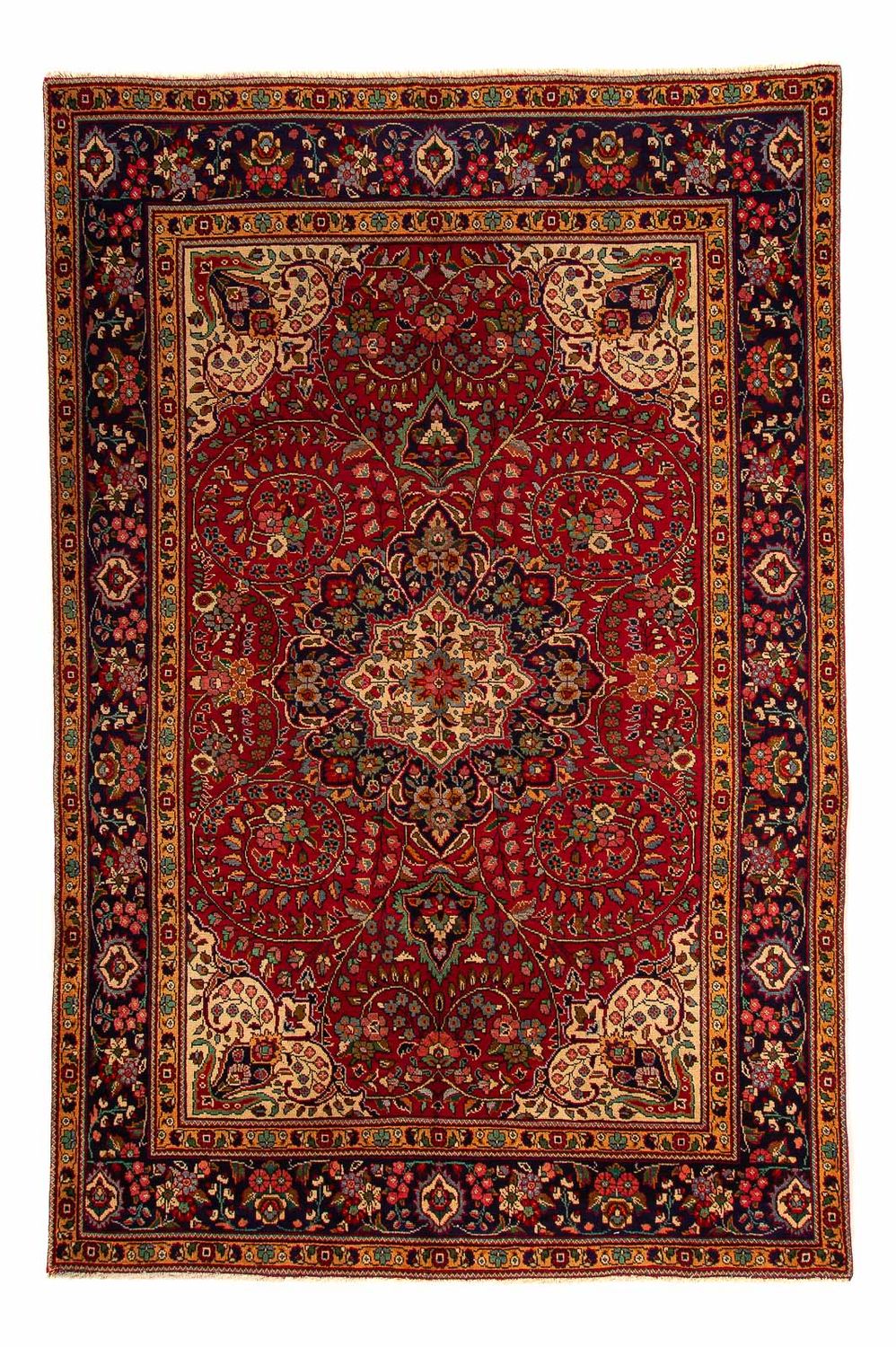
A Persian rug is a rug hand-knotted within the present-day borders of Iran. Iran was called Persia until 1935, and the term Persian rug has held since the European imports of the 19th century. The geographical definition is unambiguous: if the rug comes from Tabriz, Isfahan, Qum, Kashan, or any other Iranian knotting center, it is a Persian rug.
Important: machine-made rugs from Iran do not count. In everyday language and in the trade, Persian rug always means a hand-knotted rug from Persia. Machine-made pieces from Iran, if exported at all, are simply traded as Persian machine-made rugs.
Within Persian rugs there are hundreds of regional styles, often named after the city or region. Each style has its own knotting traditions, color preferences, and design language.
#What does the term oriental rug cover?
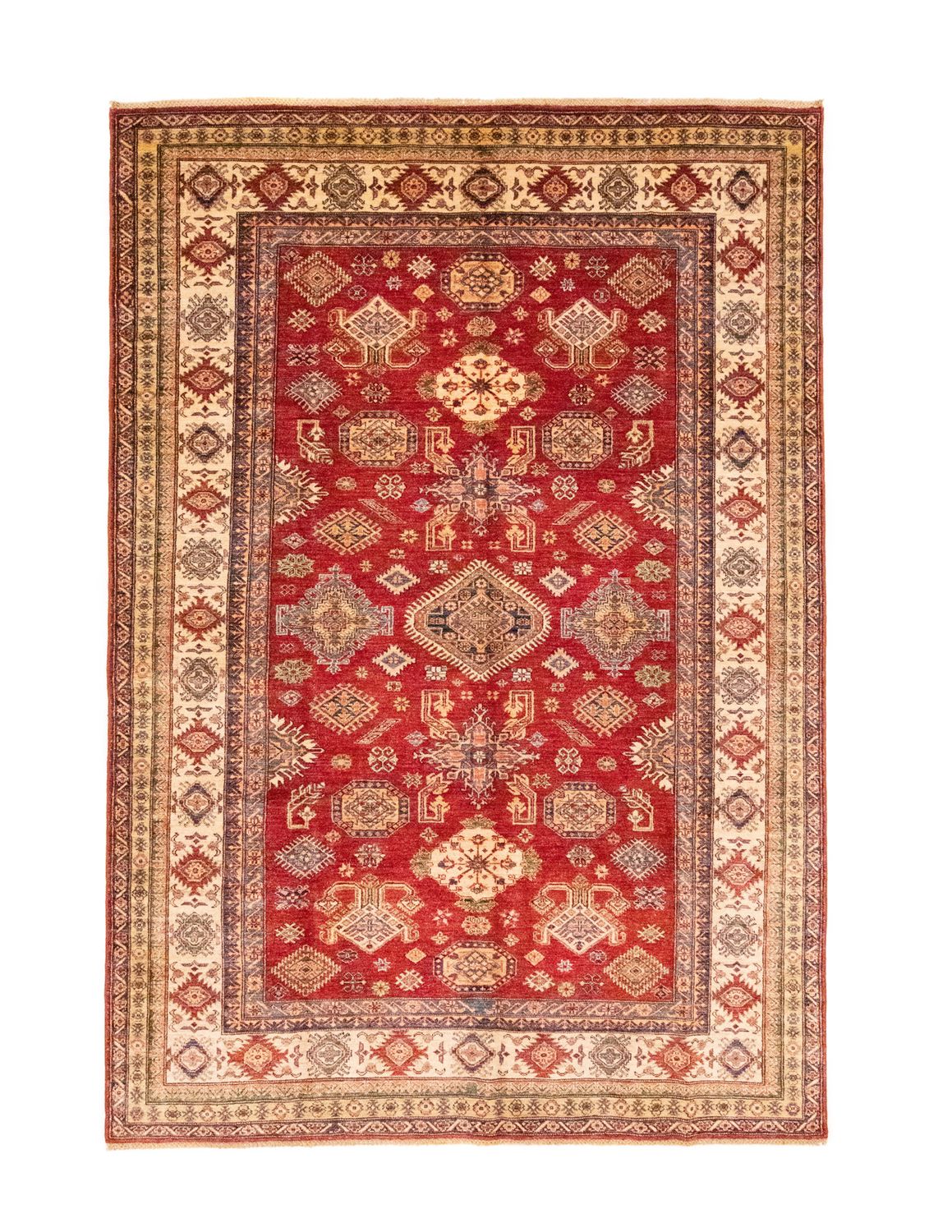
The term oriental rug is markedly broader. It refers to any hand-knotted rug from the wider Orient. In a rug context, the wider Orient covers: Iran, Turkey, the Caucasus, Central Asia (Turkmenistan, Uzbekistan, Kyrgyzstan), Afghanistan, India, Pakistan, Nepal, Tibet, and China.
So every Persian rug is also an oriental rug, but an oriental rug can have many other origins. A Hereke from Turkey, a Yomud from Turkmenistan, a Baluch from Afghanistan, or a Tibetan rug from Nepal are all oriental rugs, but not Persian rugs.
In the European trade, the umbrella term oriental rug was long more common than Persian rug, because it served the market better. Only after the Iranian share of the market shrank after 1979 did the distinction become commercially relevant again.
#Why does the distinction matter when buying?
First: price. Genuine Persian rugs from Iranian production have grown scarcer since the US sanctions, and prices for high-quality pieces have risen significantly over the last decade. Anyone looking for an investment that holds its value should ask specifically for Persian rugs.
Second: character. Persian designs are clearly different from Turkish, Caucasian, or Indian. Anyone seeking the floral and curving language of the Persian school does not want a geometric Baluch. Anyone fond of geometric strictness is better served by a Kazak than by an Isfahan.
Third: provenance. In the collector segment, a rug with clearly documented origin, for example a signed manufactory in Qum or Nain, carries a measurable premium over a stylistically similar but unattributable piece.
#Which confusions are most common?
Indo-Persian. India has been knotting rugs in the Persian style for decades. An Indo-Bidjar or Indo-Isfahan can look almost identical to the Iranian original, but it is not a Persian rug. In the trade these pieces are usually called Indo-Persian. They are cheaper and often dyed synthetically.
Pakistani pieces in Persian style. Similar to Indian knotting, Persian-style designs are produced in Pakistan. The label Persian rug is misleading here, the correct phrasing would be Persian-inspired Pakistani rug.
Machine-made imitations. Machine-made rugs from Belgium, Turkey, or China are produced with Persian patterns. These pieces are neither Persian nor oriental in the traditional sense, because they are not hand-knotted. The proper label is Persian-look or machine-made oriental rug.