Nain vs. Isfahan
Nain and [Isfahan](/isfahan) rank among the finest Persian knotting traditions. Both come from central Iran, both work with high knot density, both have been at home in Central European living rooms for generations. This page shows where the difference lies and which suits which living situation.
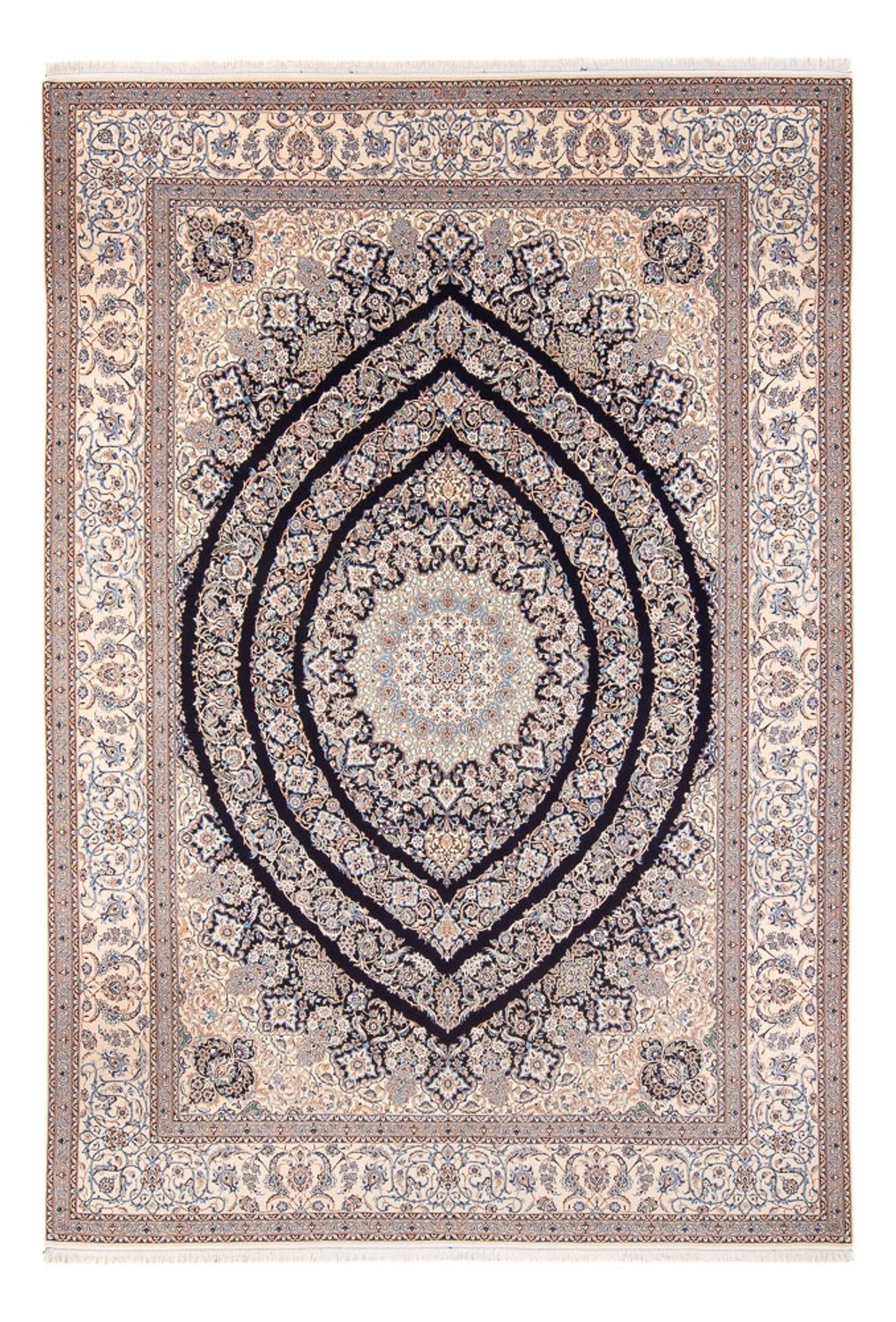
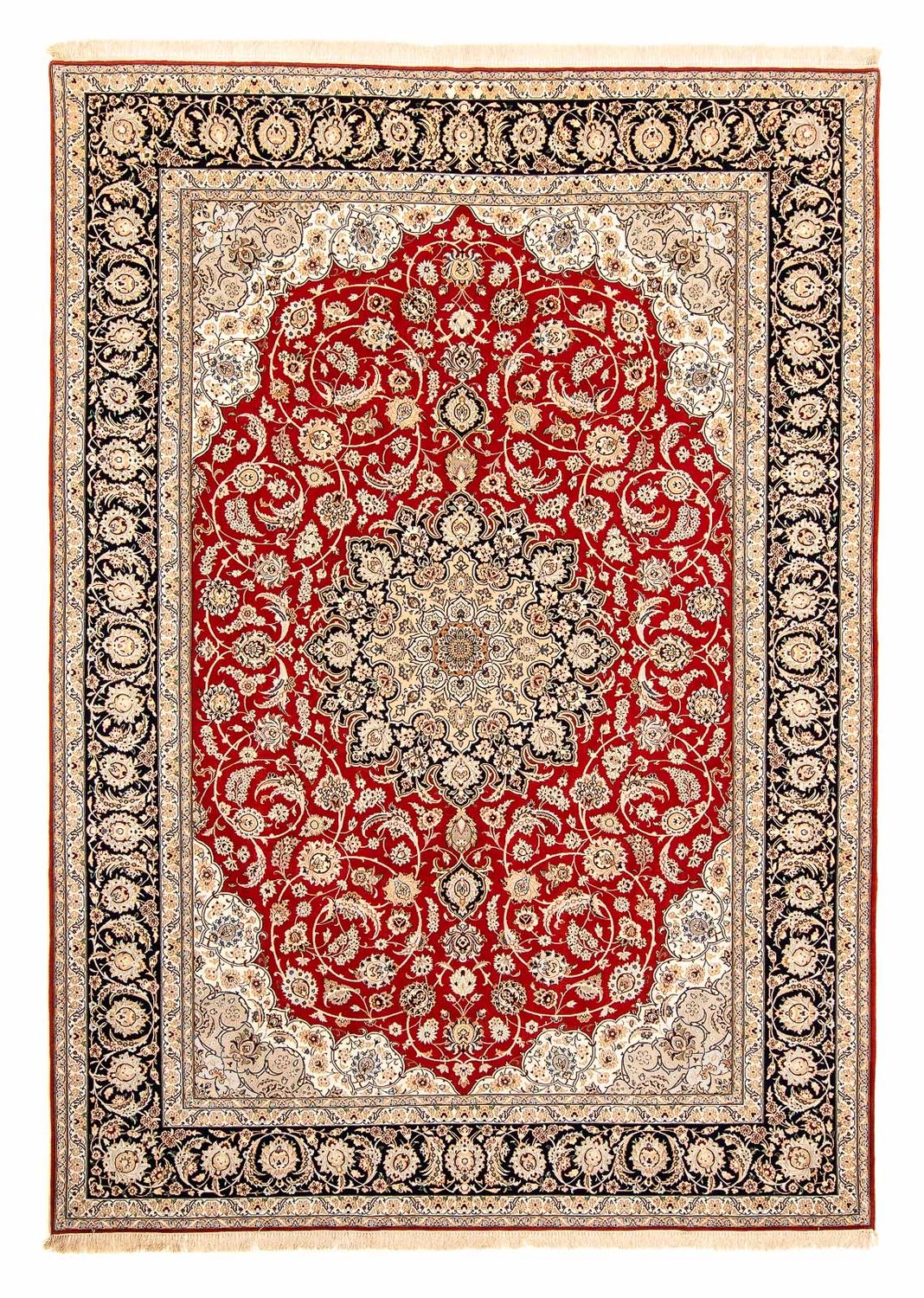
Six criteria compared directly
A quick overview. The sections under the table go deeper into each point with background.
| Criterion | Nain | Isfahan |
|---|---|---|
| Origin | Nain, central Iran (Isfahan province) | Isfahan, central Iran |
| Knot density | 200,000–1,000,000+ knots/m², La grades 12 down to 4 (4 is the finest) | 400,000–1,000,000+ knots/m² |
| Dyeing | ivory dominant, light pale blue, sparing contrasts | classically warm, bordeaux red, indigo, occasional ivory |
| Material | wool, often with silk contours | wool and silk, kurk wool as premium |
| Design language | calm, medallion usually small, much ivory ground | powerful, lush medallions, dense border framing |
| Price level | 1,500–5,000 €/m² depending on La grade | 2,500–8,000 €/m² depending on workshop |
#How do you tell a Nain from an Isfahan?
The fastest test is the base color. A Nain is mostly light, often with a creamy ivory ground into which fine pale blue and beige tones are set. An Isfahan, by contrast, looks warm and saturated, with bordeaux red, deep indigo, and ivory only as an accent.
The second test is the contour line around the patterns. In Nain, contours are often executed in silk, giving them a slight sheen. In Isfahan, contours are usually drawn in the wool itself, with darker dyeing. Anyone looking with a magnifier can see the difference clearly.
The third test is knot density. Both are very fine, but Isfahan top pieces go beyond the density an average Nain reaches. Nain is classified in La grades (4 La, 6 La, 9 La), where lower numbers are finer. A 4-La Nain is exceptional, a 9-La Nain standard.
#Which style reads calmer, and which more powerful?
Nain is the calmer choice. A parlor rug of 250 × 350 cm does not feel like a statement, but like a restrained foundation that lets furniture and accessories shine. Anyone with a bright flat, minimalist furnishing, and a need for a rug that does not dominate the design is in the right place with Nain.
Isfahan is the counterpart. An Isfahan fills a room, is the main element, draws the eye. It suits rooms with classic furnishing, dark wood accents, and a representative character. In a bright modern living room it quickly looks too heavy, in a traditional parlor it is the natural choice.
For uncertain buyers the question helps: should the rug be background or lead actor? Background speaks for Nain, lead actor for Isfahan.
#Which workshops stand behind Nain and Isfahan?
Both styles are produced in many workshops, with large quality differences. In Nain, the most important workshops are Habibian, Habibi, and Issabaff, with Habibian pieces from the 1960s to 1980s regularly fetching four-figure sums per square meter on the collector market.
In Isfahan, the workshops Seirafian, Davari, Hekmat-nezhad, and Salahi have traditionally led. A signed Seirafian Isfahan is a category of its own, with prices well above the market average for Isfahan pieces.
Anyone wanting to invest in these top workshops should buy with a specialist, because imitations and restorations can heavily affect value. A signed workshop without documented origin is, in case of doubt, no workshop at all.
#Which one suits which room?
Bright living room with white walls, light wood floor, modern furniture: Nain. The light base color matches the lighting, and the calm character supports a restrained design. Size mostly 200 × 300 or 250 × 350 cm.
Classic dining room or library with solid wood, bookshelves, muted wall colors: Isfahan. The warm tones suit the atmosphere, the powerful pattern carries a large room. Size from 250 × 350 cm upwards.
Bedroom or smaller room: both work. A small Nain (170 × 240 cm) at the foot or beside the bed feels light. An Isfahan in the same size is a deliberate accent decision.
Keep reading
Persian rug or oriental rug?
Every Persian rug is an oriental rug, but not the other way around. What both terms really mean and where they overlap.
ReadMaster weavers
The women and men behind the best-known rugs, historical and contemporary workshops.
ReadKnot types in oriental rugs
Ghiordes, Senneh, Jufti, and the Tibetan loop knot. What sets the four knots apart and how knot density shapes value.
Read