Medallion
The central medallion is probably the best-known compositional principle in the classical Persian rug. It organises the entire piece around a central figure that acts as an anchor for both eye and composition. This page shows what a medallion is, where it comes from, and which knotting traditions give it particular character.
#What is a medallion in an oriental rug?
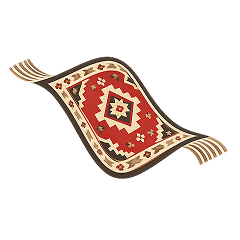
The medallion is a central, often elliptical or octagonal figure in the main field of a rug. It can have several layers, such as an inner core, a middle ring, and an outer contour, each carrying its own ornamentation.
Complementing the medallion are the four corner pieces. These fill the corners of the main field with mirrored quarters of the medallion design or with independent ornamental motifs. Together, medallion and corner pieces form a composition that is symmetrical along both axes.
Around this central interplay run the borders, usually three to five, framing the piece. The main border is wider and carries the most defining motif, often boteh, herati, or a floral band. Secondary borders are narrower and bridge the transitions between main border and main field.
#Where does the medallion design come from?
The medallion as a design principle emerged in the Persian manufactories of the Safavid era (16th to 17th century). The famous Ardabil rugs of the 1530s, today in the Victoria & Albert Museum London and the Los Angeles County Museum, are early examples of this principle.
The inspiration came from Persian book illumination. Iranian manuscripts of the 14th and 15th centuries had book covers with a central cartouche and corner ornamentation, and this design language was transferred directly to the rug. This connection between book and rug design explains why the finest manufactories often employed designers from the royal book workshops.
In the 19th century the medallion became the standard for export rugs, because European buyers valued the clear central design principle. It suits European interiors with a central coffee table or dining table, because the medallion remains visible there.
#How do medallions differ by region?
Tabriz medallions are large, often layered, with clear geometric contours. The corner pieces mirror exactly one quarter of the medallion. Tabriz pieces often appear with an ivory background.
Kashan medallions are smaller and more elegant, often with floral inner fields. The characteristic Kashan ground is deep bordeaux red or indigo blue, against which the lighter medallion stands out powerfully.
Isfahan medallions are the finest, with high knot density and richly detailed inner patterns. Some signed Isfahan pieces from the major manufactories (Seirafian, Davari) show medallions with dozens of nested inner layers.
Caucasian medallions are strictly geometric, without floral elements. Here the medallion is often repeated several times below one another, in two or three rows, rather than as a single central element.
Kurdish and tribal medallions are often angular and powerful, with clear symbolic functions rather than purely decorative ones.