//
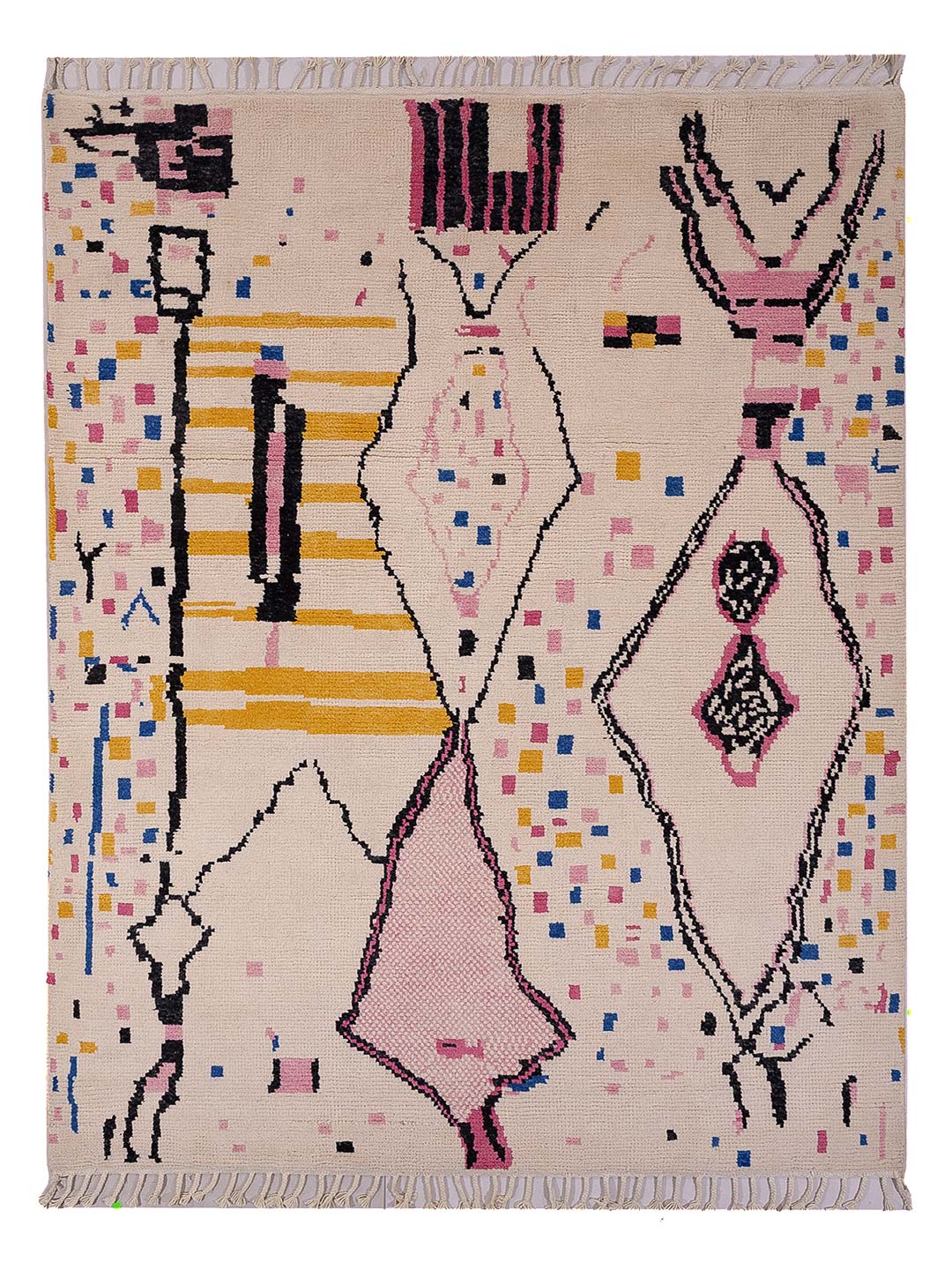
Berber rugs from North Africa stand out through minimalist patterns and thick, heavy wool.
Photo: Morgenland Rugs
A Berber rug is a hand-knotted wool rug of the Amazigh (Berber) tribes of North Africa, above all from the Atlas in Morocco. Characteristic are unbleached or plant-dyed wool, clear geometric patterns of diamonds, zigzag lines and triangles, and an often long, soft pile. The name comes from the Amazigh, the peoples who have lived in the Atlas mountains and the North African highlands for thousands of years and who still maintain this weaving tradition today.
Berber rugs arose as warm sleeping and seating mats for the harsh mountain climate and carry a rich symbolic language: diamonds stand for femininity and fertility, zigzag lines for water, triangles for protection. In recent decades, the cream-colored Beni Ourain rugs in particular have become icons of modern interior design. This page explains the difference between a Berber rug and a classical oriental rug, the most important tribes and regions, the knotting and what to look for when buying.
Both are hand-knotted rugs, but they come from different cultural circles. The classical oriental rug in the narrower sense comes from Western and Central Asia, from Persia, Turkey, the Caucasus or Afghanistan, and often shows dense floral or fine-lined patterns. The Berber rug comes from North Africa and follows an independent, archaically geometric formal language with much open space and reduced coloring.
In the broader sense the Berber is counted among the oriental knotted rugs because it is hand-knotted and shares the same wool tradition. In the trade, however, it is clearly set apart: Berber refers to the North African, Amazigh knotting goods. There is also a risk of confusion with industrial wall-to-wall Berber rugs, which are also called Berber but have nothing to do with the authentic hand-knotted Berber. The difference between the manufacturing methods is explained in the comparison hand-knotted vs. machine-made.
Berber rugs come from North Africa, above all from Morocco. The most important knotting regions lie in the Middle and High Atlas as well as in the adjoining highlands. They are knotted by various Amazigh tribes, each cultivating its own patterns, colors and pile heights. The rug name usually points to the tribe or the region, such as Beni Ourain, Azilal or Boujaad.
Berber rugs carry the name of their tribe or their region. The overview below places the best-known types.
| Tribe / style | Region | Typical features |
|---|---|---|
| Beni Ourain | Middle Atlas | cream-colored ground, black diamond and line lattices, long pile |
| Azilal | High Atlas | natural white with colored accents, free, abstract patterns |
| Boujaad | Khouribga region | strong red and pink, dense geometric fields |
| Beni Mguild | Middle Atlas | darker tones, purple and brown fields, dense pile |
| Boucherouite | nationwide | recycled fabrics, colorful patchwork look, textile remnants |
| Zanafi / kilim | High Atlas | flat-woven, geometric stripes, reversible |
The cream-colored Beni Ourain rugs are the best-known and shape the Western image of the Berber. Azilal pieces are freer and more colorful, Boujaad rugs strongly red. The Boucherouite made from fabric remnants are a younger, ecologically minded special form. Related is the Berber entry in the styles overview.
The Amazigh, traditionally referred to as Berbers, are the indigenous peoples of North Africa. Their weaving tradition reaches far back and first served their own needs: blankets, sleeping mats and tent hangings for the cold climate of the Atlas mountains. The patterns were passed down over generations by women and carry a symbolic visual language that expresses protection, fertility and natural forces.
In the 20th century the simple Beni Ourain rugs in particular caught the eye of Western modernist architects and designers, who appreciated their clear geometry and neutral coloring. Since then Berber rugs have been a firm part of contemporary interior design. More on the region of origin is in Morocco, on the development of the knotting art in Origin of the knotting art.
Berber rugs are made of pure virgin wool from local highland sheep. The wool is often left in its natural color, from cream-white through beige to dark brown, or dyed with plant-based dyes. These natural colors are covered in the article Recognize natural dyes. The wool is hand-spun and worked on simple looms.
Knotting is done with the symmetric Berber knot, a variant of the Turkish knot, which gives the pile its characteristic structure. Many Berbers, especially the Beni Ourain, have a long, loose pile created through a special shearing technique. The knot density, at around 40,000 to 160,000 knots per square meter, sits in the range of coarse tribal goods, which contributes to the archaic effect. The process is in the Production area, the technique on the page Knotting, the knot systematics on the page Knot types.
An authentic, hand-knotted Berber shows several clear features:
Industrial Berber wall-to-wall goods, by contrast, are perfectly uniform, machine-made and have a smooth, glued back. The complete guide is in Recognize an oriental rug and Is my rug authentic?.
The value of a Berber rug is determined by wool quality, age, size, fineness of the knotting and the graphic power of the pattern. Old Beni Ourain pieces knotted before the mid-20th century with fine natural wool fetch the highest prices, simple new market goods sit in the affordable range. Why authentic handwork has its price is explained in Why authentic rugs are expensive, the appeal of old work in Old rugs gain in value.
Before buying, the buying guide and the style comparison are worth a look. Look for pure, richly glossy wool, an even pile cut and clean natural colors instead of garish chemical ones, whose difference is explained in the article Natural dyes vs. chemical dyes.
Berber rugs in wool are robust and low-maintenance. Regular vacuuming with the brush roll switched off spares the long pile. Dab stains at once with clean water, never rub. The high, loose pile tends to shed at first, which subsides over time. A professional cleaning every two to three years preserves quality and lifespan. The complete routines are in the care overview.
Berber rugs come from North Africa, above all from Morocco. The most important knotting regions lie in the Middle and High Atlas as well as in the adjoining highlands. They are knotted by Amazigh (Berber) tribes such as the Beni Ourain, Azilal or Boujaad.
The classical oriental rug comes from Western Asia (Persia, Turkey, Caucasus, Afghanistan) and often shows dense floral patterns. The Berber comes from North Africa and follows an archaically geometric formal language with diamonds, lines and much open space. In the broader sense it is counted among the oriental knotted rugs.
Authentic Berbers show unbleached or plant-dyed natural wool, geometric patterns of diamonds and lines, a clear knot picture on the reverse and knotted-in fringes. Slight irregularities and a long, loose pile document the handwork. Industrial Berber wall-to-wall goods, by contrast, are perfectly uniform.
The geometric motifs carry a symbolic visual language: diamonds stand for femininity and fertility, zigzag lines for water, triangles for protection against evil influences. These signs are passed from generation to generation and are often freely distributed across the surface.
A Beni Ourain is the best-known Berber type, knotted by a tribal federation in the Middle Atlas. Hallmarks are a cream-colored ground, black or dark brown diamond and line lattices and a long, soft pile. These rugs became icons of modern interior design.
Berbers made of pure virgin wool count as allergy-friendly, since wool repels dust and regulates moisture. Regular vacuuming is important to prevent dust from gathering in the long pile. With a house dust mite allergy, occasional professional cleaning helps in addition.
Vacuum regularly with the brush roll switched off to spare the long pile. Dab stains at once with clean water, do not rub. A professional cleaning every two to three years preserves quality. Initial shedding of the high pile is normal and subsides over time.